
In Berlin at the turn of the century, a black horse answered maths questions by tapping his hoof. On 12 September 1904, a commission of thirteen people, convened at the request of the board of education, delivered its verdict: no trickery, no prearranged signal, nothing resembling a fairground act. Three years later, a 30-year-old laboratory assistant, Oskar Pfungst, showed what the thirteen experts had had in front of their eyes without seeing it: the horse was not reading numbers, he was reading people. A barely perceptible lift of the head from whoever asked the question, and Hans knew it was time to stop tapping. The flaw was not in the horse: it was in the examiner’s body. This is the story of Clever Hans, and what it still says today about what your horse perceives of you.
The short answer. Clever Hans was a real horse, owned by the Berlin schoolmaster Wilhelm von Osten, who appeared to solve arithmetic by tapping his hoof between 1900 and 1904. In 1907 the psychologist Oskar Pfungst showed that Hans was responding to tiny, involuntary movements of the questioner’s head and body. The Clever Hans effect now names any case where a subject, animal or human, gives the expected answer because it reads unconscious cues from the person who knows that answer.
Clever Hans, the Berlin horse who tapped out the right answers with his hoof
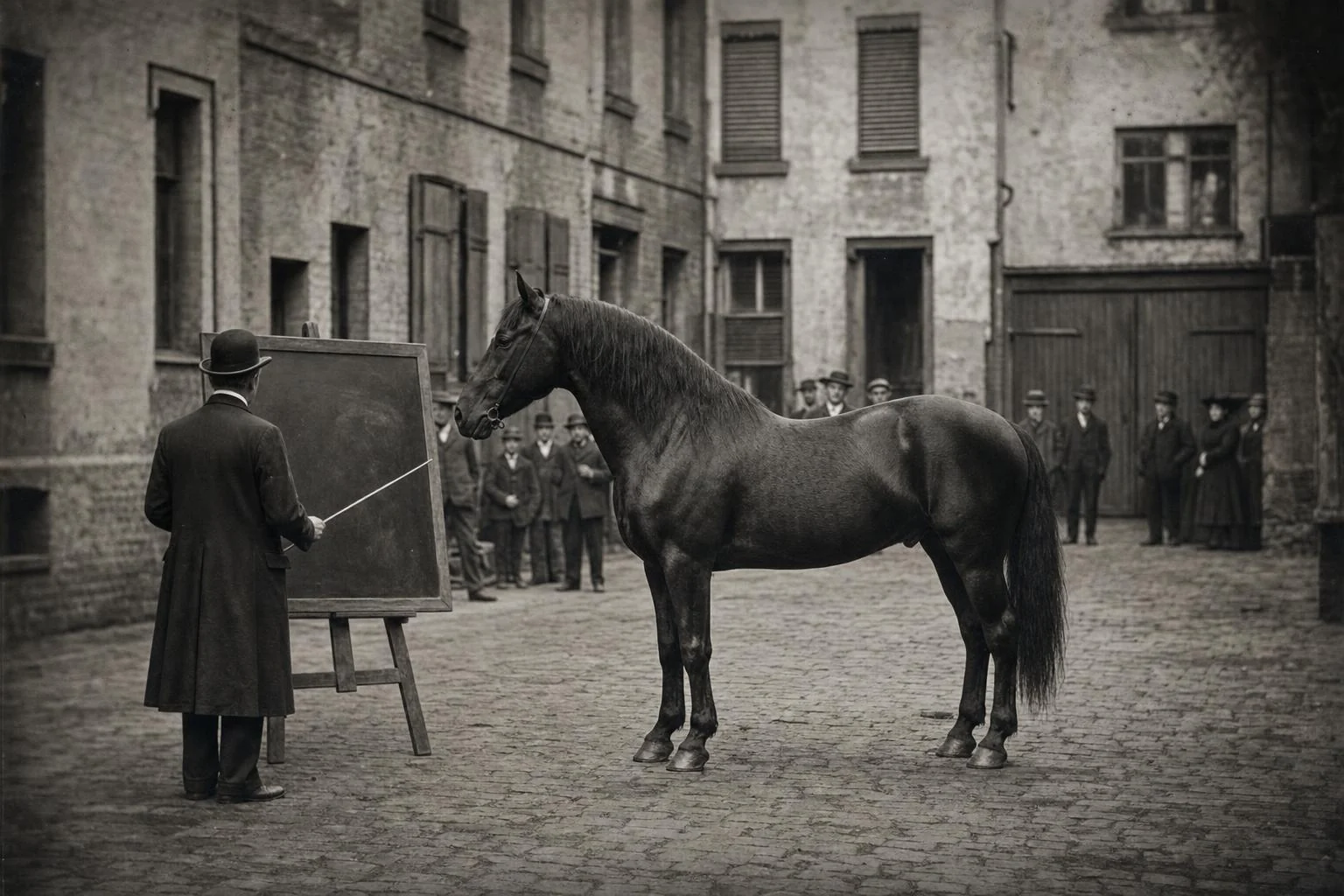
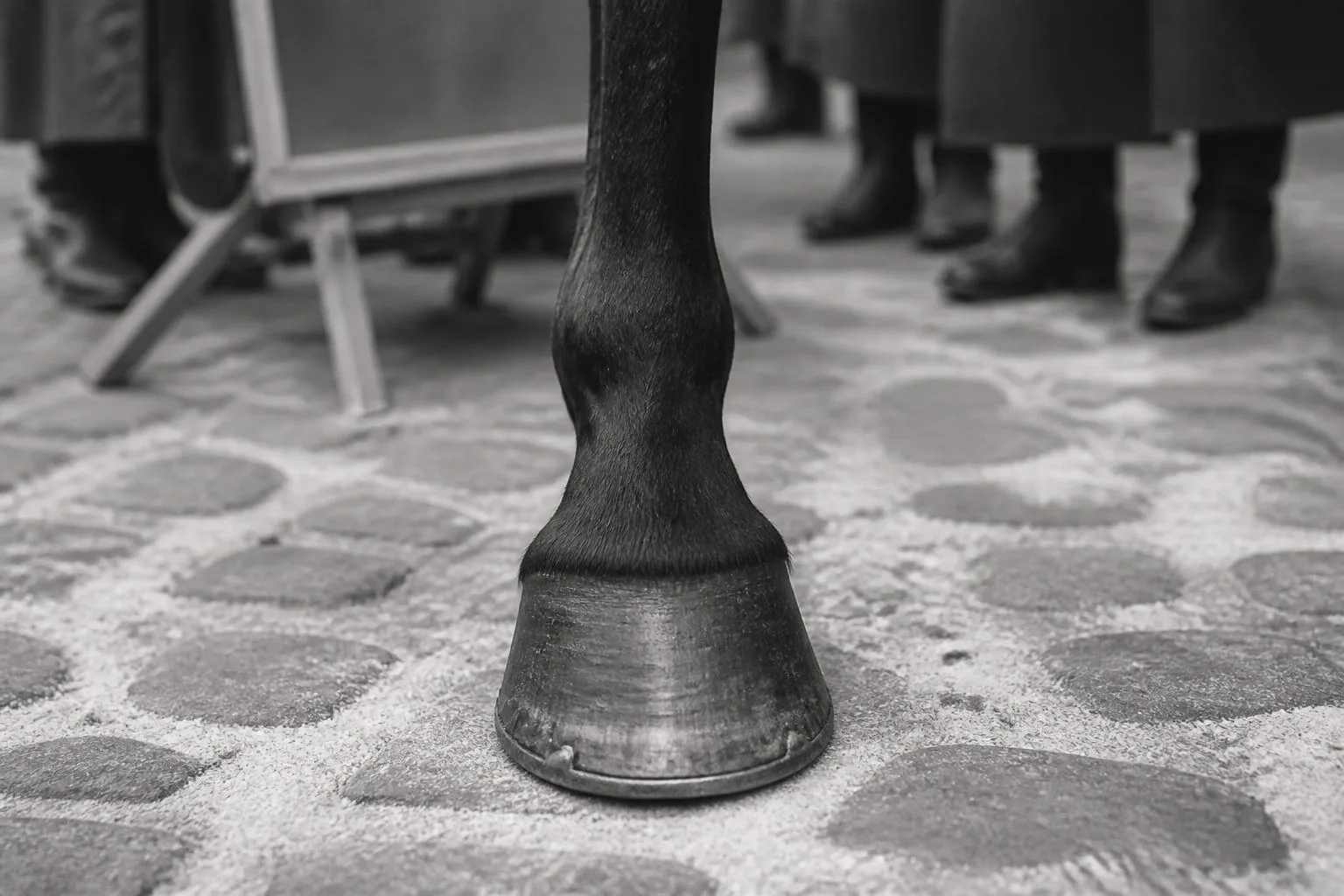
The setting is only a few square yards: a cobbled courtyard in the north of Berlin, ringed by tenement blocks. A blackboard on an easel. An elderly man in a frock coat and bowler hat. And a dark horse, foaled around 1895, most often described in the sources as an Orlov trotter, sometimes as an Arabian. His name is Hans. Berliners call him der Kluge Hans, Clever Hans.
The man chalks up a sum. The horse looks, then lifts a foreleg and strikes the cobbles. One tap. Two. Three. He stops. It is the right answer. The same works for subtraction, multiplication, division, fractions. Hans tells the time. He follows a calendar and says which day of the week a given date will fall on. He tells musical notes apart. He recognises colours. He answers yes or no with a nod of the head. With an alphabet coded as numbers of taps, he spells German words.
Between 1900 and 1904, thousands of people come to watch, free of charge, in the courtyard. The German press seizes on it, then the international press: the New York Times devotes an article to him in 1904. For many visitors the demonstration is overwhelming, because it seems to prove at a stroke what every rider vaguely suspects when working with a horse: that the animal understands more than we admit.
On video · 104 seconds
Clever Hans: 13 experts found no fraud, the flaw lay elsewhere
On 12 September 1904, a commission of thirteen experts concluded that there was no trick and no cheating. Three years later, Oskar Pfungst, a laboratory assistant, found the flaw: Hans was not reading the numbers, he was reading a barely perceptible lift of the head from whoever questioned him. He gave 89% correct answers when he could see the questioner, and 6% when he could not.

Wilhelm von Osten, the schoolmaster who wanted to prove the horse could think
Hans’s master was called Wilhelm von Osten. A former maths teacher at a Berlin secondary school, retired from the classroom, he was an amateur horse trainer, a phrenologist in his spare time, and something of a mystic. He was not after money: he never charged admission, and he staged no show. He wanted to demonstrate a thesis, one defended at the time by several German authors in the wake of Darwin: that animals possess an intelligence of the same nature as ours, only less developed.
His method was that of a nineteenth-century schoolteacher transposed to the stable. He set skittles in front of the horse, taught him to tap their number, then removed the skittles and kept only the written figures. He rewarded with carrots and pieces of bread. He repeated the lessons for years, with a fanatic’s patience. Hans was not even his first pupil: von Osten had already tried the experiment on an earlier horse, without convincing results.
It is only fair to say that von Osten was sincere. This is the point that the rest of the story often obscures. He rigged nothing, hid no wire, no whistle, no accomplice. He believed, until his death in 1909, that his horse was calculating. That is precisely what makes the case interesting, and it is what the 1904 commission was about to establish before anyone else.
12 September 1904: 13 experts conclude that Clever Hans is not cheating
The affair grew so large that the German board of education appointed a commission to examine von Osten’s claims. It came to be known as the Hans Commission. It was convened under Carl Stumpf, philosopher and psychologist, director of the Berlin institute of psychology, and had thirteen members. The list is worth reading, because it explains what followed: a veterinary surgeon, a circus director, a cavalry officer, teachers, and the director of the Berlin zoological garden.
In other words, they summoned the people best placed to detect a stage trick, signal training, or a horse dealer’s swindle. These were professionals of horses and training, not methodologists. They observed, they tested, they looked for the wire and the accomplice.
The report came down on 11 and 12 September 1904, and it was categorical: no trick, no fraud, no deliberate signal. It is worth weighing how honest that sentence is. The commission did not declare that Hans could count; it declared that it had found no cheating and that the case deserved further investigation. On that precise point, the thirteen were right, and history has vindicated them. What they did not see was that the answer did not lie on the horse’s side.
Stumpf then handed the next stage to one of his collaborators. That is where the affair turned.
Oskar Pfungst: the experiment that cracked the secret of Clever Hans
Oskar Pfungst, born in 1874, was 30 in 1904. He was neither a teacher nor a vet: he was a volunteer assistant in Stumpf’s laboratory. He did what nobody had done, which was to stop watching the horse and start watching the humans around the horse, and above all to vary one thing at a time.
His set-ups were strikingly simple. He changed the questioner, to see whether the effect held without von Osten: it did. He had the questions put by someone who did not know the answer himself. He positioned the horse so that he could not see the person questioning him, using blinkers or by moving the examiner away. He had one number whispered into one ear and another number into the other, so that nobody in the room knew the total.
The figures he obtained were unambiguous. When Hans could see a questioner who knew the answer, he was right 89% of the time, 50 times out of 56. When he could not see the person questioning him, he fell to 6%, two times out of thirty-five. The horse was no worse at arithmetic with blinkers on: he had never done arithmetic.
It remained to find which signal he was using. Pfungst finally isolated it: at the moment the hoof reached the right number, the questioner, until then leaning forward and tense, straightened up. A slight lift of the head, a return to the starting posture, a relaxing of the face. Nobody did it on purpose. Nobody noticed. The horse did.
Pfungst then pushed the experiment to its tipping point: he took the horse’s place. He began tapping with his hand in front of visitors who were asked to think of a number. Of twenty-five questioners, twenty-three involuntarily signalled to him when to stop. And once he had understood the mechanism perfectly, he found that he himself produced the signal whether he wanted to or not: knowing was not enough to stop it. In 1907 he published Clever Hans (the Horse of Mr. von Osten), a contribution to experimental animal and human psychology.
- Whoever asks the question must not know the answer. This is the central lesson of 1907. As long as the examiner knows the result, his body gives it away. Today we call this double-blinding, and Hans is its birth certificate in the behavioural sciences.
- Cut the visual channel, then compare. 89% with a view of the questioner, 6% without: it is the gap between the two conditions that proves something, not the raw performance. A filmed demonstration in which the horse can see his owner proves nothing at all.
- Change the human, keep the horse. If the effect vanishes with another questioner, it belonged to the relationship, not to the animal. If the effect holds, you have isolated something.
- Count the trials and publish every one. 50 out of 56 and 2 out of 35 are denominators. A video of three successes has no denominator, and therefore no value.
- Tell error from imposture. Von Osten never cheated, and the commission established as much. Being mistaken in good faith is the commonest situation of all, for a scientist as for a rider.
The Clever Hans effect: when the horse reads its rider’s body language
From this affair came a term still taught in undergraduate psychology: the Clever Hans effect, or experimenter expectancy effect. It describes how a subject, human or animal, produces the expected response because it picks up involuntary cues from whoever is observing it. The remedy is blind, double-blind and triple-blind protocols, and automated data-collection set-ups in which no informed human is in contact with the subject at the moment of measurement.
Its reach extends far beyond the stable. The Hans case is cited in the evaluation of therapies, in work on great apes and language, in debates over detection dogs, and whenever an animal seems to answer a question in the presence of its handler. The rule fits in one sentence: as long as someone who knows the answer is visible to the subject, you are not measuring the subject, you are measuring the relationship.
It is worth noting what von Osten himself would not accept. After Pfungst’s publication, he rejected the demonstration, broke with Stumpf, and went on presenting his horse until his death in 1909. Hans was then bought by Karl Krall, a jeweller from Elberfeld who pursued the experiments with other horses. The horse was requisitioned by the army in 1914; his trail goes cold in 1916.

What Clever Hans really proves for equine ethology and groundwork
The story is often told as an execution: the learned horse was only an illusion, move along. That misses the result. Pfungst did not show that Hans was stupid. He showed that a horse can detect, from several yards (metres) away and in a stranger, a movement of the head so slight that thirteen human experts, forewarned, attentive and looking precisely for an anomaly, failed to spot it over several weeks. That performance is not an illusion. It was measured, repeated and published.
This is exactly the foundation on which equine ethology and all groundwork rest. The horse is a herd prey animal whose survival long depended on instantly reading the posture of others: a companion that freezes, a neck that rises, a weight that shifts. That skill does not stop at the species boundary. It applies to us, constantly, whether we like it or not.
The rider who works in ethological riding exploits exactly this channel: the position of the shoulders, the orientation of the pelvis, the gaze, the speed of approach, the precise moment at which pressure is released. It is also the mainspring of what Monty Roberts demonstrated, and we have told how he saddled a never-ridden horse in thirty-five minutes in front of the Queen, who had come to check for herself. Liberty work and backing rest on the same truth.
And the lesson cuts both ways, even when it is uncomfortable. Your horse does not refuse the fence because he is stubborn: he may have sensed that you no longer believed in that stride. The riding-school pony that becomes perfect with an experienced rider and impossible with a beginner has not changed his mind about riding, he is reading two different bodies. If you want to know where you stand, our quiz on horse body language gives you an answer in a few minutes, and the one on ethology and natural horsemanship takes the thinking further. To go beyond self-teaching, there are fundable equine ethology courses.
The Clever Hans effect beyond horses: dogs, apes and artificial intelligence
The term travelled far from the Berlin courtyard. Researchers who test detection dogs, great apes or parrots now design their trials so that nobody who knows the answer can be seen by the animal. The same name turned up in computer science, and with a horse again. In 2019, a team led by Sebastian Lapuschkin published a study in Nature Communications, “Unmasking Clever Hans predictors and assessing what machines really learn”. One of the image classifiers they examined recognised the category “horse” with high accuracy, but not by looking at horses: many horse photographs in its training set carried a copyright tag in one corner, and the model had learned to spot the tag. The logic is the one Pfungst used in 1907: when a result looks too good, remove the hidden cue and measure again.
Clever Hans: your questions answered
Was Clever Hans real?
Yes. Hans was a real horse, examined by a commission in 1904 and by Oskar Pfungst, whose report was published in 1907. What was not real was the arithmetic: the horse was reading people, not numbers.
What breed was Clever Hans?
Most sources describe him as an Orlov trotter; a few call him an Arabian. No pedigree document has reached us that settles it.
What happened to Clever Hans?
After von Osten died in 1909, Hans passed to Karl Krall, a jeweller from Elberfeld who continued the experiments. The horse was requisitioned by the army in 1914, and his trail is lost in 1916.
Did von Osten cheat?
No. The 1904 commission found no trickery, and Pfungst agreed that von Osten believed in his horse. He was sending the signals without knowing it.
What we still do not know about horse intelligence after Clever Hans
A century and a quarter on, the Hans affair still sets a limit rather than lifting one. We know the horse does not count as we count. We know he perceives tiny postural variations. Between the two, a whole territory remains open, and caution is still in order.
What recent work documents: the horse’s long-term memory, its ability to recognise human faces and expressions, discrimination of shapes and symbols, and trial-and-error learning. What remains debated: the understanding of abstract quantities, the representation of the future, and what we should mean by emotion in an equid.
One more fact is easily forgotten: the horse does not see the world as we do. His dichromatic vision makes him confuse certain colours, to the point that the orange of the fences escapes him. A horse that fails a task may be failing to perceive it, not to understand it, and that is yet another lesson from Pfungst: before drawing conclusions about intelligence, check the sensory channel.
One last thing remains that Clever Hans gave to the history of science. It took a horse in a Berlin courtyard for psychology to invent the double-blind. Twenty-six years earlier, a different apparatus, Muybridge’s photographs of 1878, had proved that the human eye had been wrong about the gallop for centuries. The horse has a real gift for showing us what we could not see. He had already moved a philosopher to tears in Turin in 1889. And if we want a defensible conclusion on horse intelligence, perhaps it lies here: he is cleverer than you think, but not in the way you think.
Clever Hans, the Berlin horse, in five dates
- Around 1895: birth of the horse who would be nicknamed Clever Hans, most often described as an Orlov trotter, acquired by Wilhelm von Osten, a former maths teacher in Berlin.
- 1900 to 1904: free public demonstrations in a Berlin courtyard; Hans adds, subtracts, tells the time, spells, and answers by tapping his hoof; the international press picks up the story.
- 11 and 12 September 1904: the Hans Commission, thirteen members convened under the psychologist Carl Stumpf, concludes that there is neither trick nor fraud and calls for further investigation.
- 1904 to 1907: Oskar Pfungst establishes that the horse reads an involuntary lift of the questioner’s head. 89% success when Hans sees an informed questioner, 6% when he does not. Published in 1907.
- 1909: death of von Osten, who never accepted the demonstration. Hans passes to Karl Krall, is requisitioned by the army in 1914, and his trail goes cold in 1916. His name remains attached to the Clever Hans effect.
Sources: Hans le Malin and the Clever Hans effect (French Wikipedia), Clever Hans and Oskar Pfungst (English Wikipedia), and Pfungst’s full text, Clever Hans (the horse of Mr. von Osten), 1911, on the Internet Archive.