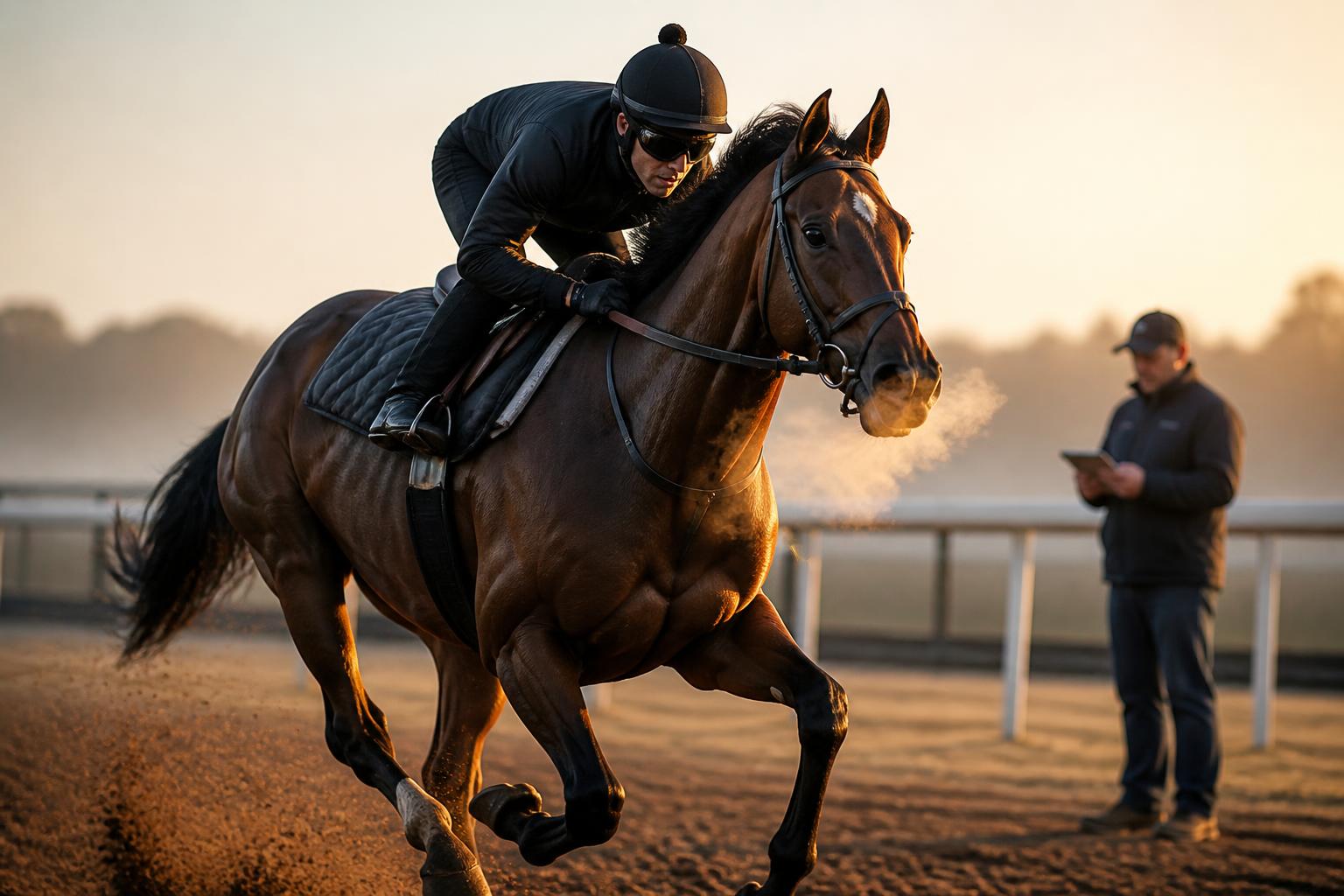

For decades, training racehorses rested on the trainer’s eye, the stopwatch and pure intuition. Today, sports data has walked into the gallop and trotting yards. At the heart of this shift sits a small French device: the Equimetre, built by the company Arioneo. Heart-rate sensor, GPS and locomotion analysis rolled into one, it turns every training gallop into hard numbers. The goal is simple: understand a horse’s speed more precisely, protect its health and, in the end, win races. Here is a closer look at the tool that is quietly reshaping daily life in the racing stable.
Arioneo and the Equimetre: data for the équine athlete
Arioneo is a French start-up founded in 2014 by Valentin Rapin, Thomas Buisson and Erwan Mellerio, specialised in connected devices for horses. Its flagship product, the Equimetre, is a new-generation équine heart-rate monitor: a sensor that slips under the girth or into a dedicated pad and fits in about thirty seconds. Where a leisure rider might picture a simple GPS watch, the Equimetre goes much further by combining three families of measurement.
- Heart: heart rate at work and at rest, and the quality of recovery.
- GPS: speed, distance, accelerations and split times, with live 4G tracking.
- Locomotion: stride frequency and length, symmetry and regularity.
These readings feed an analytics platform that processes more than 300 parameters. For a yard’s communication as much as for the trainer’s daily work, it is a small revolution: you move from a subjective impression to an objective figure. The English-speaking market often talks about horse fitness analytics, a phrase that captures the spirit of the tool rather well.
Measuring a horse’s speed: from walk to full gallop
The first figure every trainer looks at is speed. Knowing a horse’s speed at each gait is the key to dosing effort and reading a youngster’s potential. The Equimetre measures speed continuously, gait by gait, returning both the average speed across a session and the peak speed reached over the final metres. For a racehorse, speed is sélection: it is often the top speed that makes the difference on the line.
As a benchmark, here are rough orders of magnitude for équine speed by gait (a sport horse, indicative values):
| Gait | Indicative speed | Context |
|---|---|---|
| Walk | 6 to 7 km/h (4 mph) | Recovery, warm-down |
| Trot | 13 to 19 km/h (8 to 12 mph) | Stamina work, the trotter |
| Working canter | 20 to 40 km/h (12 to 25 mph) | Training sessions |
| Full gallop | up to 60 to 70 km/h (37 to 43 mph) | Race effort, peak |
These numbers explain why a horse’s speed fascinates so many enthusiasts. A Thoroughbred at full stretch can outrun a car in town, while a compétition trotter holds an impressive pace over distance. Whether you are chasing the racing speed of a champion or simply the cruising speed of a riding horse, the Equimetre puts a figure on all of it. A horse’s speed is no longer an estimate; it is a measurement.
Heart rate, the true engine of monitoring
If speed is the most spectacular figure, heart rate is probably the most precious. The horse’s heart is an extraordinary organ: a racehorse’s heart can weigh more than 4 kilos (around 9 lb) and beat at over 220 beats per minute under effort. Tracking heart rate during and after work measures the animal’s real fitness. In practice, how fast the heart rate drops back down after a gallop is an excellent indicator of form: the quicker the heart recovers, the better the horse is doing.
Trainers also pay close attention to heart-rate variability, or HRV. HRV measures the tiny variations in time between two beats. It is a fine marker of stress and nervous fatigue that compléments raw heart rate. Just as a human athlete is screened for a possible heart murmur, équine heart monitoring helps catch an anomaly early. The data lets you act before the incident, not after.
VO2max and aerobic capacity: the horse as an athlete
Another indicator borrowed from sports physiology is VO2max: the maximum amount of oxygen the body can consume under effort, the best mirror of aerobic capacity. Transposed to the horse, the value dwarfs our own. For scale, a fit human sits around 40 ml/kg/min, while a Thoroughbred can exceed 150. VO2max matters because it shapes performance over distance. By cross-referencing heart rate, speed and an estimated VO2max, the Equimetre draws a stamina profile unique to each athlete.
Preventing injury: spotting fatigue before breakdown
The real power of data is prévention. A tiring horse changes its stride, its sweating pattern and its heart rate well before it goes lame. By tracking these signals, the Equimetre helps anticipate the setbacks that haunt every yard.
- Muscles: an asymmetry or a drop in output can betray tying-up (exertional rhabdomyolysis). Watching the muscles closely limits the risk: poorly dosed effort and muscle injury often go hand in hand.
- Bones and tendons: repeated intense effort exposes the horse to stress fractures, a micro-fissure in the bone linked to overload that can turn into a full fracture. Early stiffness or a developing lameness is far easier to spot with regular locomotion monitoring.
- Breathing: a nosebleed after intense effort is a common sign of exercise-induced pulmonary haemorrhage. Heart and sweat tracking help to put a figure on respiratory strain.
- Digestion: training stress encourages gastric ulcers, whose effect on locomotion (a shortened stride) is real and often underestimated.
The ultimate stake stays dramatic: avoiding the worst. Sudden death under effort haunts the sport, and every horse lost on a track reopens the debate. Spotting an early warning sign is exactly what continuous heart monitoring promises. Behind the sweat and heart-rate curves lies the safety of the animal. An early alert is always better than a tragedy.
Recovery, hydrotherapy and managing effort
Data is not only there to push; it is there to recover. After a hard gallop, many yards turn to hydrotherapy: the use of cold water and salt to relieve tendons and joints. An équine pool or a marine spa speeds muscle recovery, and a water-walker compléments the Equimetre perfectly by quantifying the effect of recovery on the next day’s heart rate.
The data also supports the big career calls: should a horse race barefoot, lighten its work, or move from the track to the breeding shed? Measuring rather than guessing is the whole point.
What trainers say
The Equimetre has won over a new generation of trainers, on the flat and over the trot. The pre-trainer who breaks in and prepares youngsters before the racing yard finds in it a way to build a solid base without overloading. Among established professionals, the testimonials keep coming.
“What I value is knowing the speed at which my horses cover the sections, in kilometres per hour. We collect the data right after the gallop, and we can point a horse towards a race or adjust the work.” Xavier Blanchet, a flat trainer based in Chantilly who uses the Equimetre alongside Louis Blanchet.
In the south-west of France, trainer Antoine de Watrigant, based in Mont-de-Marsan, has also adopted the sensor to manage his strings. Whether you train on the flat, train trotters or feature on the roster of a major centre, the logic is the same: data helps you decide. For anyone keen to get started, there is now no shortage of resources to learn this approach.
And for the bettor? Data changes the game too
This rise of data interests the punter as well. Understanding training means reading a racecard better and spotting the horses to watch. A horse whose yard is communicating excellent work data deserves attention: the day’s horses to watch are not always the market favourites. Before locking in a bet, a glance at recent form is a habit that pays.
From the yard to the track, Arioneo’s Equimetre illustrates an obvious truth: the racehorse is a top-level athlete, and data has become its best ally. Measure the speed, listen to the heart, anticipate the injury: that is the whole meaning of this new era of race training.