
Before the engine, before steam, barges advanced by the sheer strength of horses. Along canals and rivers, teams of draught horses hauled entire convoys from the bank. This trade, known as halage (towpath haulage), shaped France’s waterways for centuries before vanishing almost imperceptibly in the mid-twentieth century.
Today, little remains but the name: the chemin de halage, now a cycling track or greenway. Yet behind this term lies an essential chapter in the history of the draught horse and its working roles, past and present.
Towpath haulage, a trade born on the riverbanks
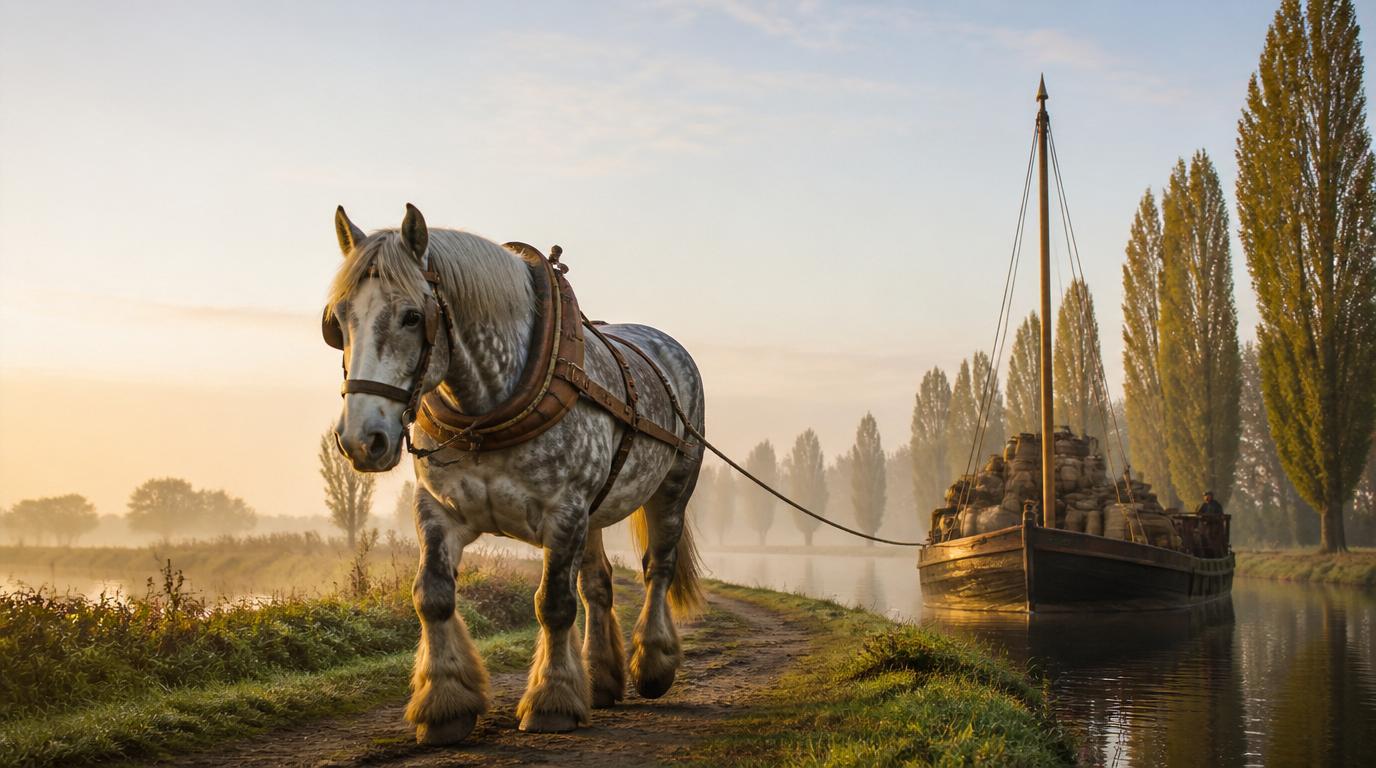
Halage consisted of moving a boat forward by pulling it from the shore with a long rope. This required a clear, raised passage running alongside the navigable waterway: the towpath. On the opposite bank, one often found a counter-towpath, used depending on the direction of current and wind.
The practice is very ancient. Documented from the Middle Ages, it intensified from the 15th century onward, when abundant, inexpensive rural labour could be hired along watercourses. On the Rhône and its tributaries, this activity mobilised several thousand men. Fluvial transport was then the most efficient means of moving heavy goods: salt, grain, stone, coal, timber.
Why horses rather than men?
For a long time, halage relied on human muscle. Into the 1920s, human traction, provided by teams of haulers, often remained more economical than animal traction. But man has his limits, and the draught horse eventually proved indispensable on major commercial routes.
The secret lies in the physics of water. On land, a horse can only displace a load limited by friction. On a canal, resistance is minimal: once the barge is moving, only gentle effort is needed to sustain it. This allows just a few horses to set hundreds of tons in motion, a feat impossible on a dirt road.
On water, a team could effortlessly move what ten horses could never budge on a country lane. All the power of the draught horse channelled into an almost silent glide.
Boulonnais and Ardennais, kings of the towpath
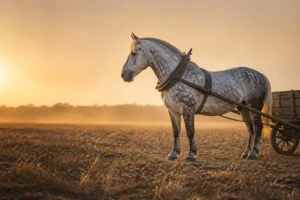
Not all draught breeds served in halage, but two excelled at it: the Boulonnais and the Ardennais. They were chosen for three inseparable qualities: strength, endurance and above all, temperament. A nervous horse could never have sustained hours of steady pulling along a narrow, sometimes slippery riverbank at the water’s edge.
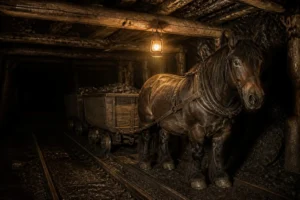
Depending on région and waterway, other breeds lent their strength: the Trait du Nord in Flanders, the Comtois in the east, the Percheron or Breton elsewhere. The horse either belonged to the bargeman, who housed it in a floating stable aboard, or to specialised carters who maintained relay stations spaced along the canals.
Images from this era have survived. In Amiens, Somme, the municipal archives hold a photograph from 1890 (Maurice Duvanel collection) showing a barge pulled by draught horses on the towpath, in prime Boulonnais country. A precious record of a scene once commonplace on every waterway in northern France.
The team and its hazards
Pulling a barge was no casual affair. The horse or horses were connected by a long rope to a haulage mast planted on the boat, also called a foncet. This mast served two purposes: raising the cable so the pull didn’t force the horse toward the water, and the ability to fold down to allow the barge passage under bridges.
The rope was long enough that if the animal stumbled, it wouldn’t tumble into the canal. The carter stood constantly ready to cut the rope in case of accident: a horse dragged along by the weight of a moving barge spelt certain disaster. Teams were harnessed according to load, in pairs or fours, and large convoys of several boats could deploy teams of eight horses or more, advancing at roughly 6 miles (10 kilometres) per day.
Impressive tonnages
The power of a haulage team is measured less by speed than by tonnage displaced. Here, as a guide, is what différent configurations could manage, bearing in mind that everything varied according to the waterway, current and cargo:
| Team | Typical use | Indicative load |
|---|---|---|
| 1 horse | Small craft, light tonnage | Several dozen tonnes |
| 2 horses (pair) | Loaded barge on canal | Around 100 tonnes |
| 4 horses | Heavy loads, strong current | Several hundred tonnes |
| Team of 8 and above | Convoy of multiple boats | Up to 400 tonnes and beyond |
On certain routes, teams could muster up to thirty horses to haul a convoy of five or six boats representing roughly 400 tonnes of cargo. A spectacle of quiet power, orchestrated like clockwork, that set the rhythm of life along the banks.
Boulonnais, Ardennais, Percheron, Comtois: discover draught horses to adopt or sell near you.
The decline: from steam to motor
Horse-drawn towpath haulage didn’t vanish overnight. It retreated slowly, displaced by steam and then by motorised barges. By 1935, nearly 1,500 barge-stables remained in France, boats capable of housing the horse aboard. Human traction had faded earlier, by the 1920s.
Horses, more enduring and versatile, held on longer: until around 1960, barges were still being hauled by rope. Then the system disappeared entirely from French waterways in the mid-1960s. Within a few decades, a trade millennia old had vanished, taking with it all the craft and knowledge of the riverbanks.
Towpaths today
The banks were not abandoned. Freed from their original function, the towpaths found a second life: converted into greenways and cycling paths, they rank among the most popular walking and cycling routes, from the Canal du Midi to the Canal de Bourgogne.
The horse has not entirely left the scene. The modern animal traction movement, championed by associations and local authorities, occasionally puts draught horses back to work: heritage haulage demonstrations, old-fashioned river tourism, bargeman festivals. A way of keeping alive the memory of these teams, whilst reminding us that the draught horse remains a credible working partner, as his contemporary uses demonstrate.
The draught horse, living heritage
Towpath haulage recalls a truth too quickly forgotten: draught horse power built part of our economy before machines. The very breeds that pulled barges, today often threatened, still carry this legacy. Rediscovering them means understanding what a giant of the draught represents, grasping the true weight of these horses and acknowledging the quiet solidity of a Percheron or a Boulonnais.
The towpath is now merely a path beside the water. But close your eyes, and you can still hear the heavy, steady tread of the teams that, for centuries, moved France forward along its canals.
Frequently asked questions about towpath haulage
What is a towpath?
It is the path laid out beside a navigable canal or river, along which horses or men pulled boats by rope. Most are now converted into greenways and cycling paths.
Which horse breeds worked on the towpath?
Chiefly the Boulonnais and Ardennais, renowned for strength, endurance and calm. Depending on région, the Trait du Nord, Comtois, Percheron or Breton were also employed.
When did horse-drawn towpath haulage disappear?
Human traction faded by the 1920s. Horses continued pulling barges until around 1960, then towpath haulage disappeared entirely from French waterways in the mid-1960s, replaced by motorisation.