
The sun is hammering down, the air has stopped moving, and your horse stands rooted in the shade of the field’s only tree, flanks heaving a little too fast. A heatwave is not a simple seasonal discomfort: for a five-hundred-kilo animal that is a poor heat dissipater by nature, it can tip into a life-threatening emergency within hours. The good news is that the essentials come down to simple, low-cost actions any rider can master. Here is the complète guide to protecting your horse when the thermometer runs wild.
A horse copes badly with heat because it generates a huge amount of thermal energy but sheds it slowly. Its mass is large and its skin surface relatively small: a powerful radiator that is also slow. Under effort its core temperature rises by around one degree per minute, and it sweats up to three times more than a human. When the air turns heavy and humid, its sweat no longer evaporates, its built-in cooler seizes up, and the danger begins. Everything that follows flows from this mechanism.
Recognising heat stroke: signs that demand fast action
Before prévention comes the emergency, because it does not forgive hesitation. A horse’s normal temperature sits between 37.5 and 38.5 C (99.5 to 101.3 F). Above 41 C (106 F) you are facing a life-threatening emergency that justifies calling the vet at once, while you begin cooling the animal. Watch for these signals:
- a rapid or panting breath, flared nostrils that do not settle at rest;
- a jerky spasm of the flank, the well-known thumps, a hiccup of the diaphragm that betrays a mineral imbalance;
- marked lethargy, a staggering gait, a horse that seems absent;
- more serious still, a horse that stops sweating while it is hot, with darkening urine.
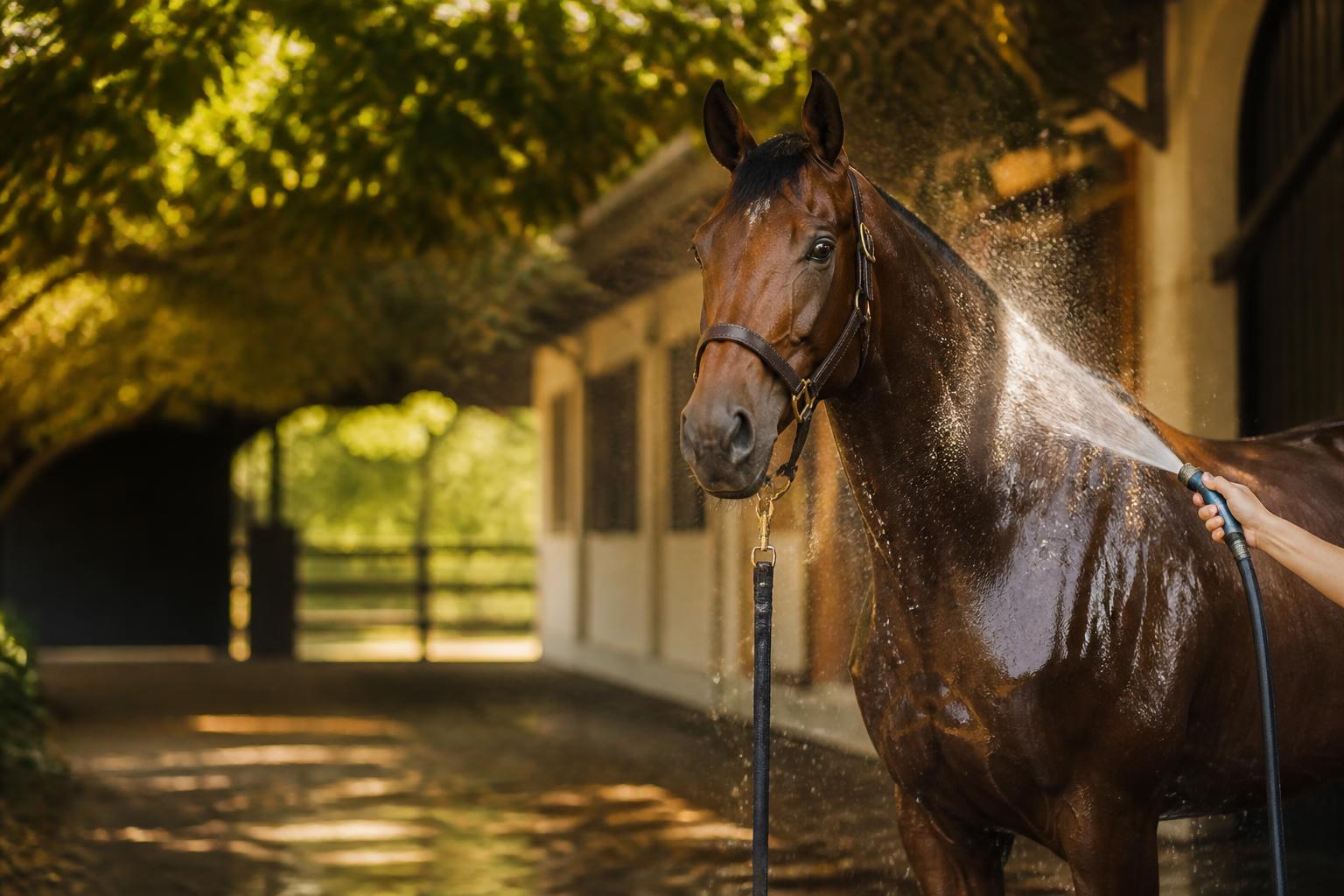
The reflex is simple: hose thoroughly with cold water, move into the shade, ventilate, and offer water. Contrary to a stubborn belief, cold water on a hot horse is not dangerous; it is in fact the move that saves. The high-level veterinary consensus, forged at the Olympic Games, is unambiguous on this point.
Misting and cooling the stable
Cooling a horse is not just about hosing it down: it is also about making its surroundings livable. A box or a shelter that turns into an oven cancels all your efforts. The first weapon stays shade, dense and cool, doubled with a draught of air. A simple fan moving the air through a stable already changes things as a preventive measure.
Then comes misting. The misting unit throws a fine rain of droplets that evaporate on contact with the air and the skin, and that evaporation pumps away heat. The most effective pairing is misting combined with a cold hose-down, especially when the air is saturated with humidity and the horse’s sweat no longer evaporates on its own. A stable misting system, fixed or mobile, run during the hottest hours, noticeably lowers the felt temperature under the shelter. When installing one, aim the mist towards an airflow zone, never into a confined corner where humidity would stagnate.
A few principles for equipping a stable against the heat:
- Open and ventilate early in the morning, close up when the outside air turns scorching;
- Create shade over living areas and water points, with shade sails or planting;
- Install a misting unit in a ventilated zone, and couple it with the fans to multiply the effect.
Electrolytes: hydrate and remineralise without mistakes
A horse drinks on average twenty-five litres of water a day (around 6.5 gallons); in a full heatwave that need can double. But water alone is not enough, because a horse’s sweat does not only carry water: it is more concentrated in mineral salts than its own blood. Sodium, potassium, chloride, magnesium and calcium leak away with every sweating effort. Letting them go without replacing them opens the door to fatigue, cramp and the dreaded thumps.
The baseline, all year round, is the free-access salt block, which the horse licks as it needs. After intense effort in high heat, or for a horse that sweats heavily, you move to electrolytes. Here are the markers that count:
- Never give electrolytes without clean water available right beside them: a concentrated intake without water worsens dehydration;
- the groom’s trick, two buckets side by side, one of plain water, the other with added electrolytes, and the horse chooses, often drinking more;
- réservé the reinforced intakes for periods of real sweating, not as a routine on a horse at rest;
- for sport or endurance horses, plan before, during and after effort, and never improvise the doses.
If in doubt about the amount or the timing, the vet’s advice comes first: remineralisation is reasoned, not improvised.
Cooling rugs and sheets
The word rug evokes winter, but summer has its wardrobe too. Cooling sheets and rugs are not there to insulate against cold: they exploit evaporation to lower the surface temperature. There are two main families. Lightweight mesh sheets, breathable and pale, protect from the sun while letting air circulate, ideal on a dark-coated or sensitive-skinned horse. So-called cooling rugs, which you wet before fitting, prolong the effect of a cold hose-down by keeping the coat damp for longer.
A few safeguards so you do not get the opposite effect:
- a rug that is too thick or poorly breathable traps the heat instead of releasing it;
- favour light shades, which reflect solar radiation;
- re-wet the evaporative models regularly, because once dry they no longer cool;
- remove the rug if the horse seems to tolerate it poorly; comfort comes before the accessory.
Fly protection: comfort that becomes health
Heat brings its train of insects, and flies are not merely a nuisance. They attack the eyes, carry disease and feed the irritation that exhausts a horse already strained by the heatwave. Protection plays out on three complementary fronts. The fly mask protects the eyes and nostrils, the most vulnerable zones, without hindering vision when well fitted. The fly sheet or rug covers the body with a fine veil that keeps insects at bay while letting the skin breathe. Finally, repellent sprays and lotions target the exposed areas, to be renewed according to effort and sweating.
The ideal combines all three according to your horse’s exposure.
Adapting work and outings to the heat
The best equipment will never replace good calendar sense. In periods of high heat, you shift the work to the cool hours: early morning, at dusk, never in the full blaze of midday. A reliable benchmark for deciding exists, the heat index, which adds together air temperature and humidity. Above a certain threshold the horse can no longer cool itself, and any effort becomes risky. When in doubt, skip the session: no training is worth a horse.
For outings and daily life, a few rules serve as a compass:
- Cool water at all times, clean, refreshed, in troughs placed in the shade;
- Accessible shade in the field, natural or created, that the horse can retreat to freely;
- reduce the intensity and length of sessions, multiply the breaks, watch the recovery;
- after effort, hose and ventilate until the breathing settles down.
Mind the field itself, too: heat stresses plant life, and certain toxic species thrive along the fence line. A regular glance is a must.
Special cases: the older horse, the retiree, the dark coat
Not all horses are equal before a heatwave. Some profiles call for heightened vigilance.
The older or retired horse regulates its temperature less well, tires faster and sometimes drinks less than it should. Keep a close eye on its drinking, guarantee cool and accessible shade, and watch for the first signs of lethargy. A horse with a metabolic disorder, such as an endocrine imbalance, deserves veterinary follow-up suited to the season.
The dark-coated horse, dark bay or black, absorbs more solar radiation and heats up faster both in the field and at work. For it, shade and pale sheets are not a luxury. Conversely, horses with pale skin or pink zones around the nostrils risk sunburn, and a suitable sun repellent usefully rounds out the kit.
Finally, the thick-coated horse that struggles to shed often benefits from a summer clip, though never clipped too close so as not to expose the skin directly to the sun. Every horse has its threshold: knowing your horse’s is already protecting it.
Frequently asked questions
Is cold water dangerous for a hot horse?
No. The consensus among top-level vets, forged in particular at the Olympic Games, is unambiguous: cold water on a hot horse is both the safest and the most effective way to cool it. No study has shown any danger.
When should I give my horse electrolytes?
After intense effort in high heat, or for a horse that sweats heavily, always with clean water available right beside it. For a horse at rest, a free-access salt block is usually enough.
At what temperature should I start to worry?
A horse’s normal temperature is 37.5 to 38.5 C (99.5 to 101.3 F). Above 41 C (106 F) it is a life-threatening emergency: cool the horse immediately and call the vet.
Does a cooling rug really work?
Yes, provided you choose a breathable, light-coloured model and dampen the evaporative types. A rug that is too thick has the opposite effect by trapping heat.
Can I ride my horse in a heatwave?
It is better to work in the cool hours, early morning or evening. When the horse heat index, which combines temperature and humidity, climbs above a high threshold, it is wiser to skip the session.
Sources: International Equestrian Fédération (FEI), veterinary recommendations drawn from the cooling protocols of international compétitions and the Olympic Games. Informational article; it does not replace your veterinarian’s advice.
{“@context”: “https://schema.org”, “@type”: “FAQPage”, “mainEntity”: [{“@type”: “Question”, “name”: “Is cold water dangerous for a hot horse?”, “acceptedAnswer”: {“@type”: “Answer”, “text”: “No. The consensus among top-level vets, forged in particular at the Olympic Games, is unambiguous: cold water on a hot horse is both the safest and the most effective way to cool it. No study has shown any danger.”}}, {“@type”: “Question”, “name”: “When should I give my horse electrolytes?”, “acceptedAnswer”: {“@type”: “Answer”, “text”: “After intense effort in high heat, or for a horse that sweats heavily, always with clean water available right beside it. For a horse at rest, a free-access salt block is usually enough.”}}, {“@type”: “Question”, “name”: “At what temperature should I start to worry?”, “acceptedAnswer”: {“@type”: “Answer”, “text”: “A horse’s normal temperature is 37.5 to 38.5 C (99.5 to 101.3 F). Above 41 C (106 F) it is a life-threatening emergency: cool the horse immediately and call the vet.”}}, {“@type”: “Question”, “name”: “Does a cooling rug really work?”, “acceptedAnswer”: {“@type”: “Answer”, “text”: “Yes, provided you choose a breathable, light-coloured model and dampen the evaporative types. A rug that is too thick has the opposite effect by trapping heat.”}}, {“@type”: “Question”, “name”: “Can I ride my horse in a heatwave?”, “acceptedAnswer”: {“@type”: “Answer”, “text”: “It is better to work in the cool hours, early morning or evening. When the horse heat index, which combines temperature and humidity, climbs above a high threshold, it is wiser to skip the session.”}}]}