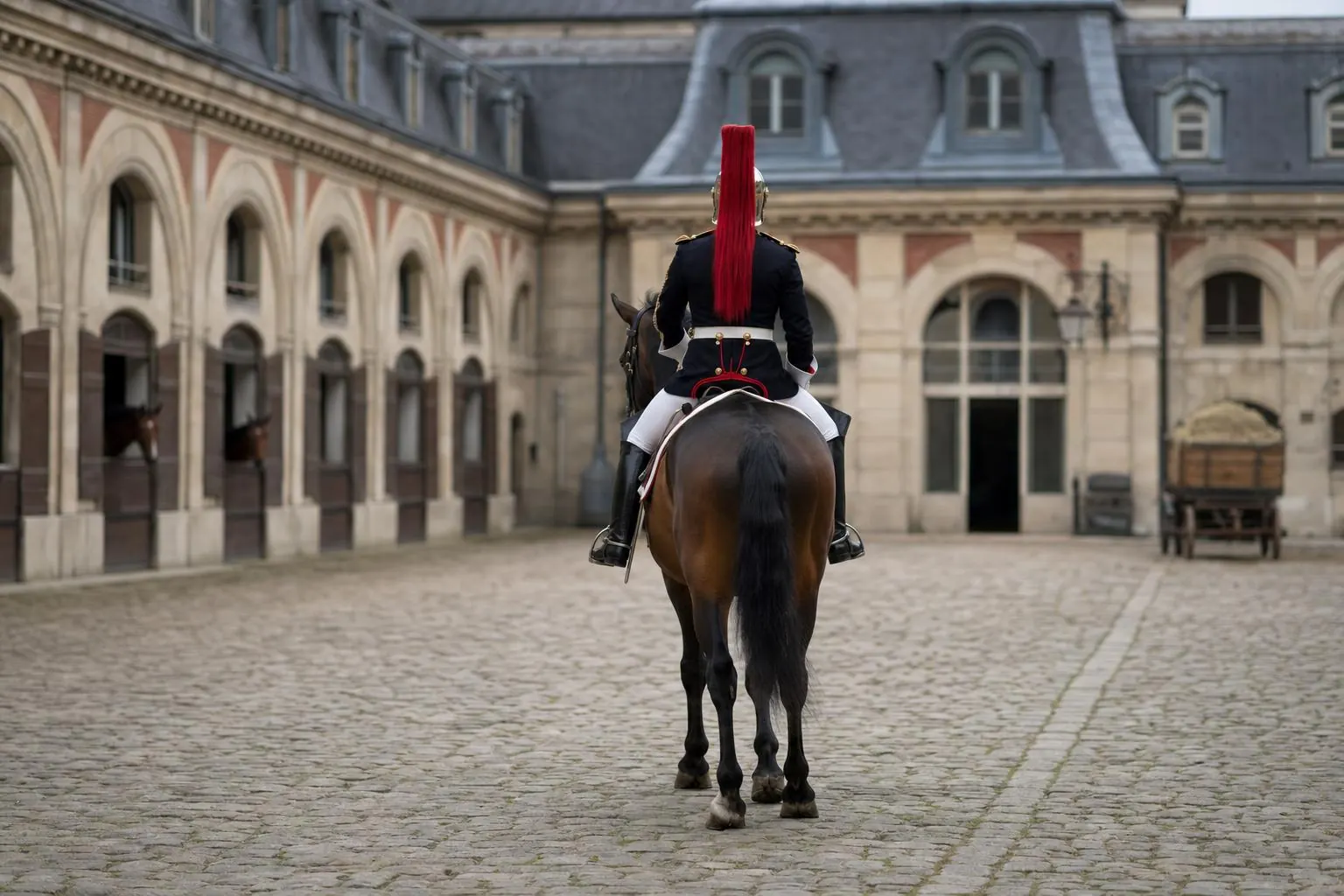

On Saturday 19 and Sunday 20 September 2026, the Republican Guard opens the Celestins district, its cavalry barracks in Paris’s 4th arrondissement, for the European Heritage Days. Entry via 18 Boulevard Henri IV, 9 am to noon and 2 pm to 5 pm, free but by named reservation only, with security screening before entry. Beyond the gates: four hectares built between 1893 and 1905 to house nearly 500 horses, a metal-framed riding hall, a circular 820 ft (250 m) track, and the horses of France’s last mounted cavalry regiment. Here’s what you’ll see, how to book, and what you need to know about the Guard’s 460 horses before you arrive.
Republican Guard at Heritage Days 2026: dates, times and booking for the Celestins
The visit runs Saturday 19 and Sunday 20 September 2026, across two time slots each day: 9 am to noon, last entry at 11:30 am, and 2 pm to 5 pm, last entry at 4 pm. Access is only via 18 Boulevard Henri IV, Paris 4th, between the Seine and Place de la Bastille. The official Republican Guard ticketing office notes that registration is valid for a single half-day session only.
The visit is free, but it is not open access. The Celestins barracks is a military compound: at the time of booking, each visitor provides their full name, date of birth, city and country of birth, as security screening is carried out before the day. Tickets are issued in your name, visual bag checks await visitors at entry, and no parking is permitted within the barracks.
The site is announced as accessible to people with reduced mobility, with an honest caveat from the organisers: the pathways are cobbled, and cobbles make movement challenging. Capacity is not made public, and there is no guarantee spaces remain available by the time you read this. For riders, this is one of the rare weekends each year when you can enter an active cavalry barracks without a personal invitation.
The Celestins district: a barracks built for 500 horses in the heart of Paris
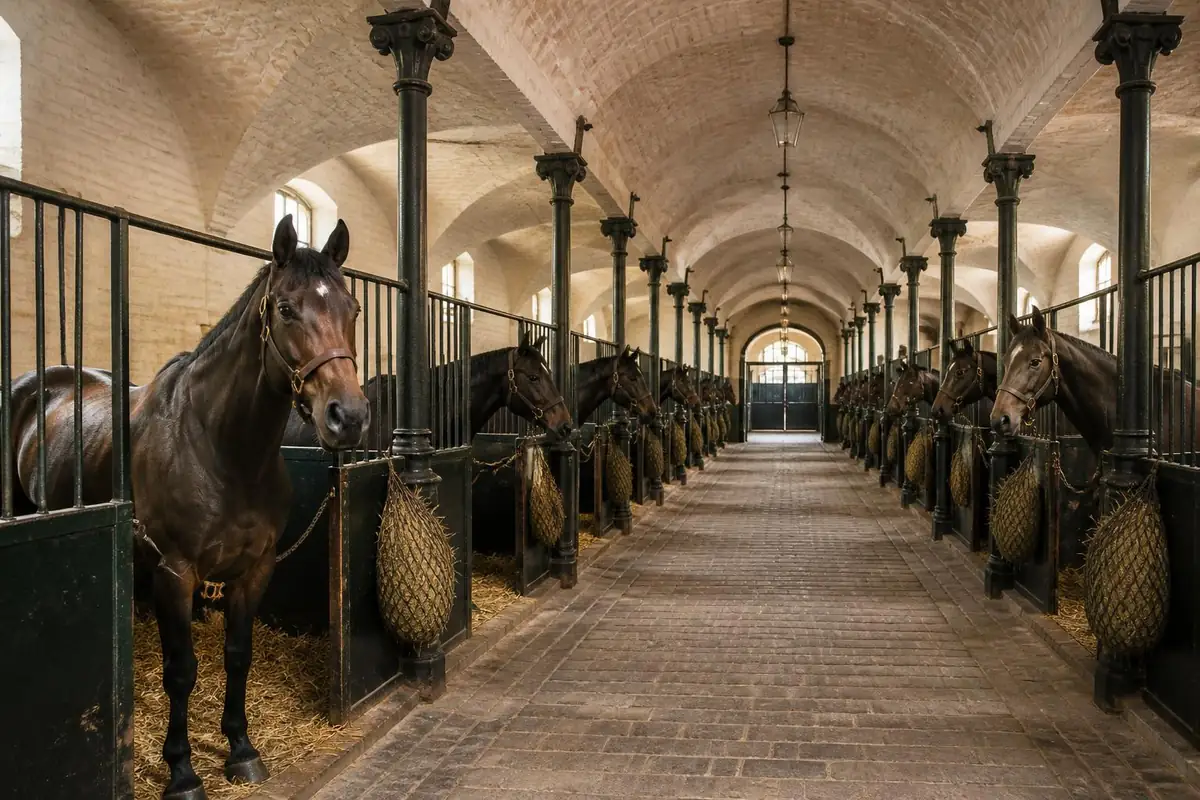
The name comes from a convent. The site at 18 Boulevard Henri IV was once occupied by the Celestins and Cordeliers convents; in 1875 the City of Paris decided to build new facilities there for the soldiers and horses of what was then called the Republican Guard of Paris. Construction ran from 1893 to 1905 across four hectares, overseen by architect Jacques Hermant, who also designed the Gaveau concert hall.
Hermant devised a master plan in the shape of a spearhead, pointing towards Notre-Dame. The facades feature rusticated stonework from the Haute-Marne, rough-hewn with hammers, giving them the raw appearance you notice from the Pont de Sully. At the entrance, a bas-relief by sculptor Allard depicts a man controlling free horses: it draws inspiration from the Horses of the Sun, sculpted by Robert Le Lorrain in 1736 for the Hôtel de Rohan in the neighbouring Marais district.
The interior is planned for horse before man. The stables could accommodate nearly 500 horses when completed. A circular 820 ft (250 m) track allows them to be worked without leaving the barracks, which remains unique in central Paris. The rectangular riding hall measures 174 ft by 72 ft (53 m by 22 m) inside, beneath an Eiffel-type metal frame: it is the Battesti riding hall, named after a Guard officer killed in combat in 1914, where the regiment stages its equestrian displays, including the twelve-horse reprise or carousel of lances. The barracks also houses the Republican Guard museum, the saddle room, the blacksmith’s forge and the cavalry fanfare. It is a living place: horses are groomed, shod, trained and sent out on patrol every day, including during open weekends.
460 horses, four squadrons: how the Republican Guard’s cavalry operates
The Republican Guard cavalry regiment numbers 460 horses, according to the unit itself. It is organised into four squadrons and a fanfare, spread across three sites: the Celestins and the Carnot district in Paris, and the Goupil district in Saint-Germain-en-Laye in the Yvelines, which serves as the training centre. Not all 460 horses are at the Celestins: what the visitor sees this weekend are the stables of the Paris squadrons and the fanfare.
The Guard presents itself as the largest mounted formation currently active and the last cavalry unit of the French armed forces. It descends from the Paris Municipal Guard, created on 4 October 1802, and its cavalry regiment has retained pre-war uniforms, crested helmets and traditions. This is no mere parade unit: horses go out every day, and the regiment claims more than 12,000 patrols annually.
Selle Français horses purchased at three years old and trained for two years at Saint-Germain-en-Laye
More than nine in ten Guard horses are Selle Français, geldings or mares. The regiment buys them at three or four years old, at approximately 6,000 euros each according to a 2020 monograph, and recruits thirty to forty annually to replace retirements. A minimum height of 16 hands 2 in (1.66 m) at the withers is required: the rider in full dress, helmet included, must dominate a crowd or an official car door.
Young horses do not arrive directly in Paris. They first pass through the equestrian training centre at Saint-Germain-en-Laye, where they are prepared for two years: classical dressage, then gradual accustoming to brass instruments, flags, motor vehicles and crowds. This explains the calm of Guard horses in the middle of a parade, and why their retraining is highly sought: at 16 or 18 years old, when they leave service, these are horses that have seen everything. In 2020, ninety retired Guard horses enjoyed retirement to pasture in Normandy, at an estate reserved for them.
Chestnuts, bays, greys: why each Guard squadron rides a single coat colour
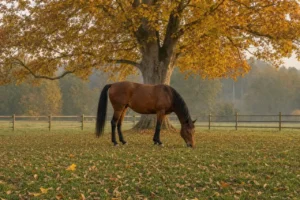
The detail you notice in the Celestins stables is the uniformity of coat colours. The first squadron rides chestnut horses, the second bays, the third dark bays. The three standard-bearer horses and those of the kettledrummers are grey, and since 2014 the kettledrummers, who carry a pair of kettledrums on each side of the withers, have been heavy Percheron horses. This rule is not mere aesthetics: in an escort of several dozen cavaliers set to a trot through Paris, visual cohesion is part of protocol, as much as horse height or lance position.
The cavalry fanfare, established in 1848 with twelve trumpets, now fields approximately thirty, plus two kettledrummers and a trumpet major. It presents itself as Europe’s only mounted musical formation to parade at the trot, which demands horses capable of maintaining pace with a musician whose hands are occupied by the instrument.
Escorts, patrols, 14 July: what the Guard’s horses do
Three missions occupy the regiment’s horses. First is ceremonial duty: approximately 500 services annually, from escorting the President of the Republic to receiving a foreign head of state, through to the 14 July parade on the Champs-Élysées, which the Guard cavalry closes every year. Second is protection of institutions, with the Élysée Palace, Senate and National Assembly chief among them. Third, the least known, is public safety: mounted patrols in the woods and parks of the capital, and in summer on beaches and dunes, as we reported in our investigation into horses patrolling the coastline.
For a rider, a visit to the Celestins is also a lesson in large-scale stable management: a saddle room where each full-dress bridle is maintained by hand, a forge that shoes continuously, a horse-by-horse veterinary record that few private yards maintain with such rigour. Those managing their own horse will find ideas for record-keeping to adapt to their scale in maintaining an up-to-date health record.
What to judge on a Republican Guard stable visit
- The horses, first: condition of their feet, shine of their coats, calm in their stalls despite hundreds of visitors passing. A Guard horse dozing amid the noise is the result of those two years at Saint-Germain.
- The stables: ventilation, cleanliness of the cobbled aisles, bedding, ceiling height. The Celestins were designed in the nineteenth century for the horse, before the motor car; compare with what you know from your local riding centre.
- The Battesti riding hall: 174 ft by 72 ft (53 m by 22 m) beneath a metal frame, wider than a standard 196 x 66 ft (60 x 20 m) dressage arena. Look at the floor and the light.
- The saddle room and forge: this is where you understand, in hours, what a full-dress escort costs. The craft of the farrier is visible here as nowhere else.
- What the visit does not show: real patrols, the training of young horses at Saint-Germain and the horses at the Carnot district. The official programme speaks of discovering the site, its history and architecture, without announcing a guaranteed riding hall display; do not come expecting a carousel show.
Heritage Days 2026: other stables and horses to visit this weekend
Should the Celestins be fully booked, the weekend of 19 and 20 September remains one of the richest of the year for those who love historic stables. At Chantilly, the Grand Stables of the Prince of Condé have hosted since 12 September an exhibition devoted to Rosa Bonheur and the horse, in the living Horse Museum. In Corrèze, the Pompadour national stud opens its château and stables whilst the Grand Week of young horse three-day events concludes, with free entry. At Versailles, the Grand Stables of Louis XIV, of which we recounted the king’s final carriage outing, remain the other monumental equestrian complex in the Île-de-France region.
And for those who prefer to ride rather than visit, September is when clubs open their registrations: our directory of riding centres in Paris and the find a centre near me tool let you compare facilities, and the calendar of equestrian events lists other open days throughout September.
Republican Guard at the Celestins, 19-20 September: key facts
- When: Saturday 19 and Sunday 20 September 2026, 9 am to noon (last entry 11:30 am) and 2 pm to 5 pm (last entry 4 pm), registration valid for one half-day session.
- Where: Celestins district, 18 Boulevard Henri IV, Paris 4th. No parking within the barracks.
- How: free, named reservation compulsory via the Republican Guard ticketing office, full identification required for screening, bag checks at entry.
- What you see: a four-hectare barracks built 1893 to 1905 for nearly 500 horses, its stables, the circular 820 ft (250 m) track, the 174 x 72 ft (53 x 22 m) Battesti riding hall, the Guard museum.
- The horses: 460 across the regiment at three sites, over 90 per cent Selle Français, purchased at 3 to 4 years old, trained two years at Saint-Germain-en-Laye, retired at 16 to 18 years old, one coat colour per squadron.
The key point for riders: the Republican Guard opens its Paris stables to the general public only two days a year, and these are those two days. Should tickets sell out, Chantilly, Pompadour and Versailles remain open the same weekend, and riding centre open days continue throughout September.