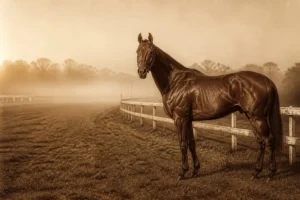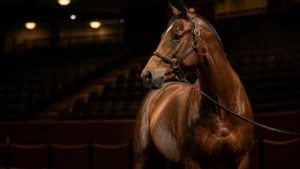

On Friday, 9 August 1715, a man of nearly seventy-seven took to the chase in the park at Marly. He had not ridden for years. Instead, he drove himself, holding the reins and whip of a light carriage drawn by four horses. It would be his last outing. Twenty-three days later, on 1 September, Louis XIV died in his bedchamber at Versailles. Tuesday, 1 September 2026, will mark three hundred and eleven years.
History remembers him for his wigs, his gardens, his Hall of Mirrors. We forget that the longest reign in French history was conducted largely from horseback, and that he left behind the greatest equestrian complex ever built by a European state: twin buildings facing his château, a school, a national administration for breeding, and a riding school where horses still work today.
His Final Outing, Reins in Hand
The story comes from the duc de Saint-Simon, a court memoirist and direct witness to those weeks. On 9 August 1715, after dinner, the king set out to hunt stag. For years, gout and age had forbidden him the saddle, so he hunted by carriage: a small light conveyance with a red hood, drawn by four horses, which he drove himself. He returned exhausted.
The following day, 10 August, on the return from Marly, acute pain seized his left leg. His chief physician, Guy-Crescent Fagon, diagnosed sciatica. Black marks appeared shortly after: gangrene. The king maintained his station to the last, continuing his audiences and public meals, but on 25 August, the feast of Saint Louis, he did not rise. He would not leave his chamber again.
He died on 1 September 1715, shortly after half-past eight in the morning, four days before his seventy-seventh birthday, after seventy-two years of reign. Modern medical interpretation speaks of acute lower-limb ischaemia, linked to a cardiac arrhythmia, complicated by gangrene. This is a retrospective reconstruction, made from descriptions by seventeenth-century courtiers and physicians: it explains, but does not prove.
A King Who Lived in the Saddle
The contrast with his youth was stark. For decades, Louis XIV hunted almost daily, travelled on horseback between his residences, had himself painted as a cavalier, and made horsemanship a compulsory exercise for princes. At court, the ability to handle a horse before witnesses was not a leisure pursuit: it was political skill, ranking alongside dance and swordplay.
The pinnacle of this pageantry came in two days. On 5 and 6 June 1662, in the courtyard of the Tuileries Palace, the young king held an equestrian fête to celebrate the birth of the Dauphin. One thousand two hundred and ninety-nine participants were divided into five quadrilles, each led by a great nobleman: the Romans by the king, the Persians by his brother, the Turks by the Prince de Condé, the Indians by the duc d’Enghien, the Americans by the duc de Guise. They ran at the ring, a lance through a suspended loop, and at the head, a wooden figure plucked by lance-point.
The fête left a trace that millions of tourists cross each year without knowing it: the place du Carrousel in Paris takes its name from this 1662 spectacle. A street name in the heart of the capital comes from a riding-school exercise.
Facing the Château, He Built a Palace for His Horses
When the court settled at Versailles, the horses needed lodging. The king did not house them behind the château, out of sight: he placed them before it. From 1679 to 1682, under Jules Hardouin-Mansart, two identical buildings rose in scarcely three years on the far side of the place d’Armes, the Grande Écurie to the north, the Petite Écurie to the south. Some sources date their complete finish to 1683.
The two stables frame the patte-d’oie laid out by Le Nôtre, those three avenues converging towards the château. Each is organised around a court ending in a hemicycle, with a covered riding school at its centre. The façade of the Grande Écurie bears a sculptural group of three rearing horses, by Pierre Granier and Jean Raon. In the late eighteenth century, the architect Jacques-François Blondel would call them masterpieces of their kind, praising their comfort as much as their design.
The meaning of this bears weight. The first building a visitor from Paris sees, before even the château itself, is the royal stable. In a monarchy where everything speaks in signs, this was no mere convenience.
Seven Hundred Horses at Opening, More Than Two Thousand by the Next Century
Available figures do not all tell the same story, and rightly so: they do not count the same things. The Ministry of Culture’s heritage database on the horse records just over seven hundred horses housed when the buildings were complete, some thirty coach houses, and staffing levels close to one thousand five hundred people in the king’s stable service. Versailles itself states that the royal stables sheltered more than two thousand horses in the eighteenth century, and similarly accepts the order of magnitude of one thousand five hundred employees under Louis XIV.
The two figures complement rather than contradict each other: seven hundred is what the new walls could hold; two thousand is what the service came to manage a generation later, including stables at other residences. What both sources say in common is essential: about one thousand five hundred people lived from the king’s horses, on a single site.
The range of professions is striking. There were equestrians, pages, coachmen, postillions, footmen, but also surgeons and apothecaries for the horses, musicians for the carousels, riding-school workers. It was a town. Three centuries on, the equestrian sector still employs tens of thousands in France, and some of these horse trades still seek hands year-round.
Two Stables, Two Households, Two Chiefs Who Did Not Care for Each Other
The separation between the two buildings was not decorative, but administrative. The Grande Écurie fell under the Grand Écuyer of France, whom the court called simply Monsieur le Grand. It housed saddle horses, those for hunting and war, the riding academies and the oversight of royal breeding.
The Petite Écurie answered to the Premier Écuyer, called Monsieur le Premier. It managed carriage horses, coaches, state vehicles and everything that rolled. Two parallel hierarchies, two budgets, two prides, and a rivalry for precedence that memoirists much enjoyed. The draught and carriage horses of that era indeed shaped entire breeds, beginning with the Percheron, the stage-coach horse become national colossus.
The School That Invented French Horsemanship
In the Grande Écurie, they did not merely keep horses: they trained men. The school of pages admitted some fifty young nobles for four years of instruction. Works on this school describe about a dozen masters charged with teaching them mathematics, drawing, fencing, vaulting, dance, military exercises, German, writing and horse knowledge. One emerged as an officer, or one did not emerge at all.
Between 1680 and 1830, this same building housed the École de Versailles, regarded as the cradle of French classical horsemanship. Here was established a manner of working the horse that favoured lightness of hand and calm in the animal, principles that still run through all that is called dressage today. The connection to the Cadre Noir, founded at Saumur in 1815, is intellectual rather than administrative: the same principles, passed down by riding masters, not the same institution.
The mounts in this school were not the sport horses we know. They worked with Iberian and Neapolitan horses, compact and reactive, capable of gathering and turning short. Today’s Andalusian is their direct descendant, and its shape alone explains why haute école figures look as they do. The equipment followed the same logic: the history of the saddle shows how the riding-school seat lightened as the war saddle disappeared.
1665: The Year the State Began to Make Horses
Yet the most lasting legacy of this reign is not a building. By a royal Council decree of 17 October 1665, supplemented by a second decree of 29 September 1668, Louis XIV charged Jean-Baptiste Colbert with organising the studs of the realm. The thinking was military before it was zootechnical: the cavalry lacked horses, France bought too many abroad, production must be domestic.
The mechanism adopted would structure French breeding for three centuries. The state bought stallions, placed them with approved private owners, oversaw their use, and directed production towards defined purposes. Thus were born the royal studs, which became the Haras Nationaux, absorbed in 2010 into the Institut Français du Cheval et de l’Équitation. When one visits today France’s largest stud, one walks through an administration invented under Louis XIV.
From this policy also sprang, step by step, the modern French breeds and the registries that define them. The present map of horse breeds in France owes more to a royal Council decree of 1665 than to geography.
How to Judge a Figure from the Old Régime
- What the source counts: the capacity of a new building and the strength of a royal service sixty years later are not the same measure.
- When the figure dates from: seven hundred horses in 1682 and two thousand in the eighteenth century describe two moments, not a contradiction.
- The geographical scope: Marly, Fontainebleau, Compiègne and Saint-Germain had their own stables, often added to those of Versailles.
- The nature of the source: a court memoirist writes to avenge or to please, a royal household account obeys administration.
- The gap between fact and medical interpretation: gangrene was described at the time, cardiac arrhythmia is a diagnosis made three centuries after.
- The tendency of figures to swell from edition to edition: an order of magnitude cited without source is worth less than a dated, attributed figure.
- What sources do not say: the exact number of horses personally ridden by the king is established nowhere, and no one should invent it.
Three Centuries On, There Are Still Horses Under the Timbers
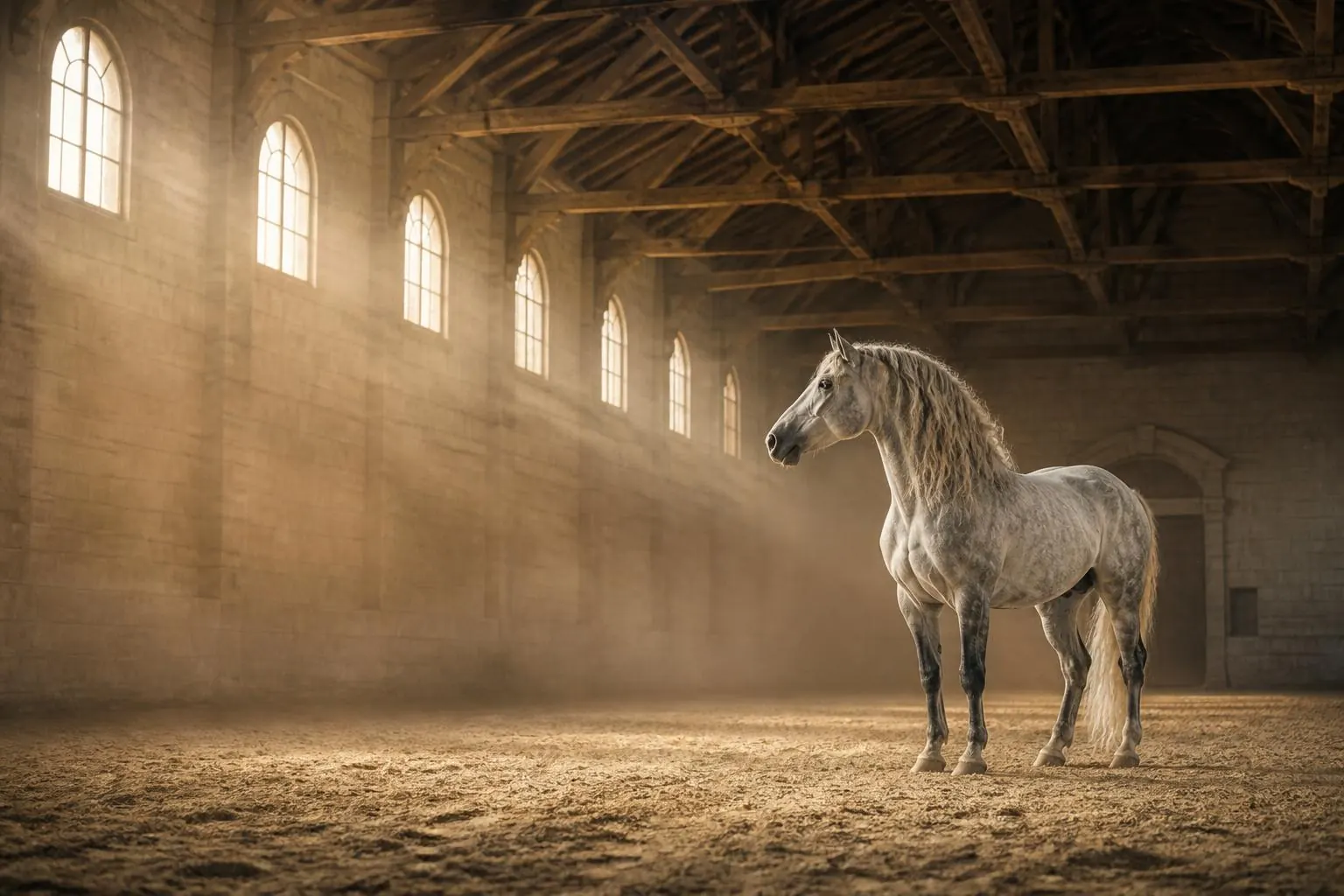
What followed might have been just another museum. It proved more interesting than that. In 2003, the Versailles estate entrusted the riding school of the Grande Écurie to Bartabas, who founded an equestrian academy there. About forty horses live and work in a deliberate blend of classical horsemanship, fencing, dance, song and Japanese archery. The spectacle that results, La Voie de l’Écuyer, stages the daily work of this school.
The rest of the building houses the Carriage Gallery, the École Nationale Supérieure d’Architecture de Versailles, and a research and conservation centre for France’s museums. In other words, the stable built for a king who died in 1715 has never ceased to serve, and still serves what it was built for.
A century later, another queen of France would take refuge in these same stables to ride away from prying eyes, and that is another story: the horse Marie-Antoinette hid at Versailles. French power’s relationship with the horse has never wavered, from the medieval charge told in the true end of Richard III to Napoleon’s devotion to Marengo.
What a King’s Horse Is Worth Today
There remains the question this all ultimately poses. A sovereign who devotes to his horses two buildings planted before his own palace, a school, a national administration and one thousand five hundred employees puts a price on the animal. In the seventeenth century, that price read in prestige. Today it reads in euros, and the sums can surprise.
Louis XIV housed his horses facing his own château. Today, some cost the price of a building.
Sale records, stud fees, gaps between disciplines: what the world’s priciest horses really cost.
Key Points
- Louis XIV died on 1 September 1715 at Versailles, shortly after half-past eight, after seventy-two years of reign.
- His final outing dates to 9 August 1715: a stag hunt conducted from a light carriage he drove himself.
- Pain in the leg appeared on 10 August, first taken for sciatica, before gangrene was recognised.
- On 5 and 6 June 1662, the Grand Carrousel of the Tuileries brought together one thousand two hundred and ninety-nine participants in five quadrilles, giving its name to the place du Carrousel.
- The Grande Écurie and Petite Écurie were built from 1679 to 1682 by Jules Hardouin-Mansart, facing the château, across the place d’Armes.
- Just over seven hundred horses lodged there at completion, more than two thousand in the eighteenth century, for roughly one thousand five hundred employees.
- The Grande Écurie answered to the Grand Écuyer, the Petite Écurie to the Premier Écuyer: saddle horses on one side, carriages and coaches on the other.
- The École de Versailles, housed in the Grande Écurie from 1680 to 1830, is regarded as the cradle of French classical horsemanship.
- The royal Council decree of 17 October 1665 created the administration of the royal studs, ancestor to the Haras Nationaux and later the IFCE.
- Since 2003, the equestrian academy founded by Bartabas has worked about forty horses in the riding school of the Grande Écurie.
Equirider is affiliated with none of the institutions mentioned. Facts reported here come from public institutional sources and scholarly works, whose references appear below.
Sources
- Château de Versailles, pages on the Royal Stables and Grande Écurie (construction 1679 to 1682 by Jules Hardouin-Mansart, staffing levels, more than two thousand horses in the eighteenth century, current uses of the building)
- Château de Versailles, key dates, The Death of Louis XIV, 1 September 1715
- Ministry of Culture, database Le cheval et ses patrimoines, entry on Versailles stables (just over seven hundred horses, some thirty coach houses, nearly one thousand five hundred people, Blondel’s assessment)
- Louis de Rouvroy, duc de Saint-Simon, Memoirs, account of the final hunt of 9 August 1715 and the king’s final weeks
- Bibliothèque Nationale de France and Musée Carnavalet, entries on the Grand Carrousel of 5 and 6 June 1662 in the Tuileries courtyard
- Institut Français du Cheval et de l’Équitation, history of the Haras Nationaux, royal Council decrees of 17 October 1665 and 29 September 1668
- Scholarly works on the Versailles Equestrian School from the Old Régime to the Restoration, for the school of pages and the École de Versailles
- Académie Équestre de Versailles, presentation of the school founded by Bartabas in 2003 in the riding school of the Grande Écurie