
On Friday 25 and Saturday 26 September 2026, the Pôle hippique de Saint-Lô (Manche) hosts the Selle Français stud-book foal championship: 103 foals born this year, all still at their dams’ sides, compete for the title of supreme champion. The official show catalogue is public, and it says something you will never read in a federation press release: 53 of these 103 foals, more than one in two, are listed for sale, with their breeder’s telephone number. Here is what is at stake, how a four-month-old horse is scored, and what a mark at Saint-Lô is really worth.
Selle Français foal championship: the programme for 25 and 26 September at Saint-Lô
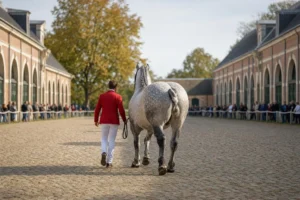
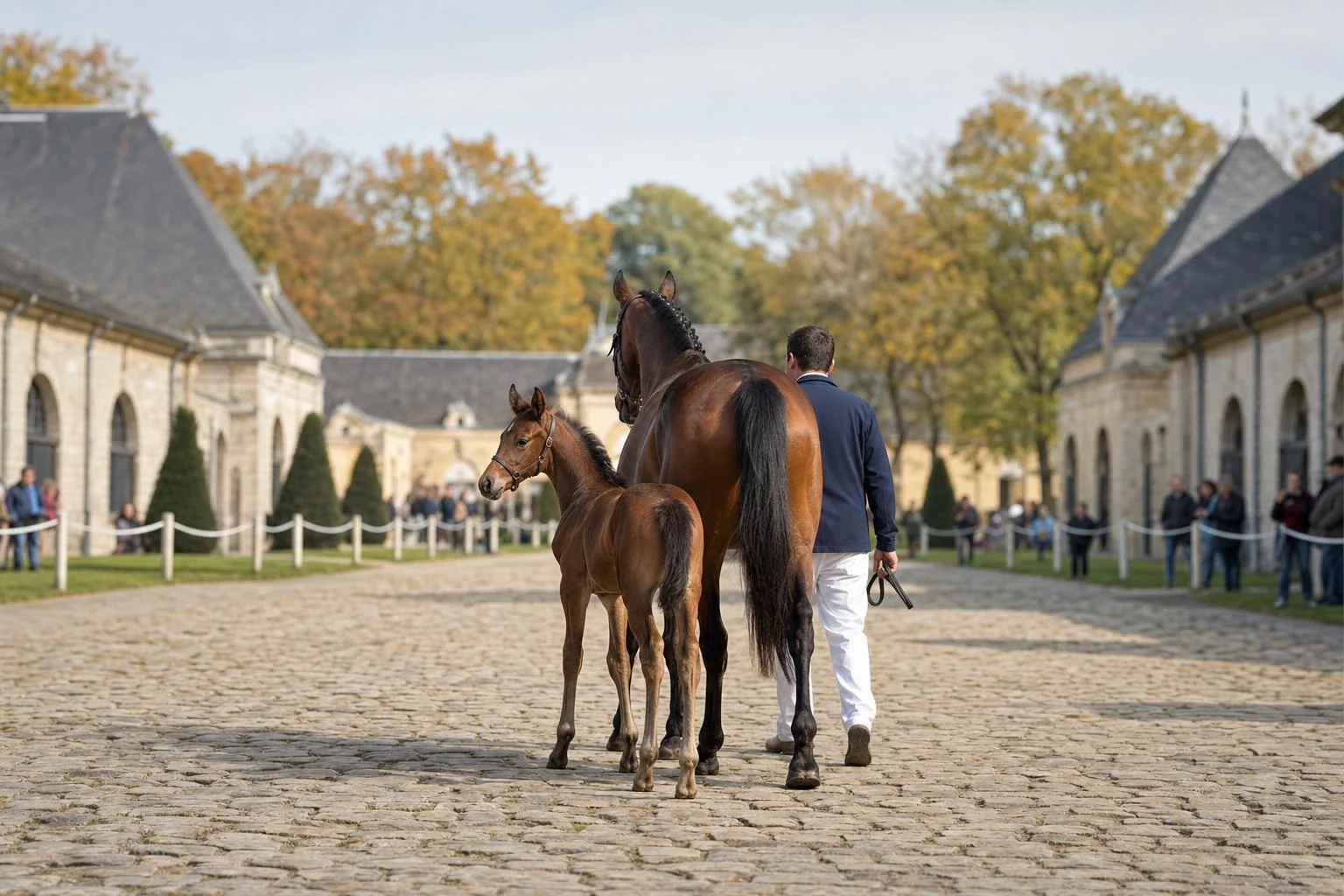
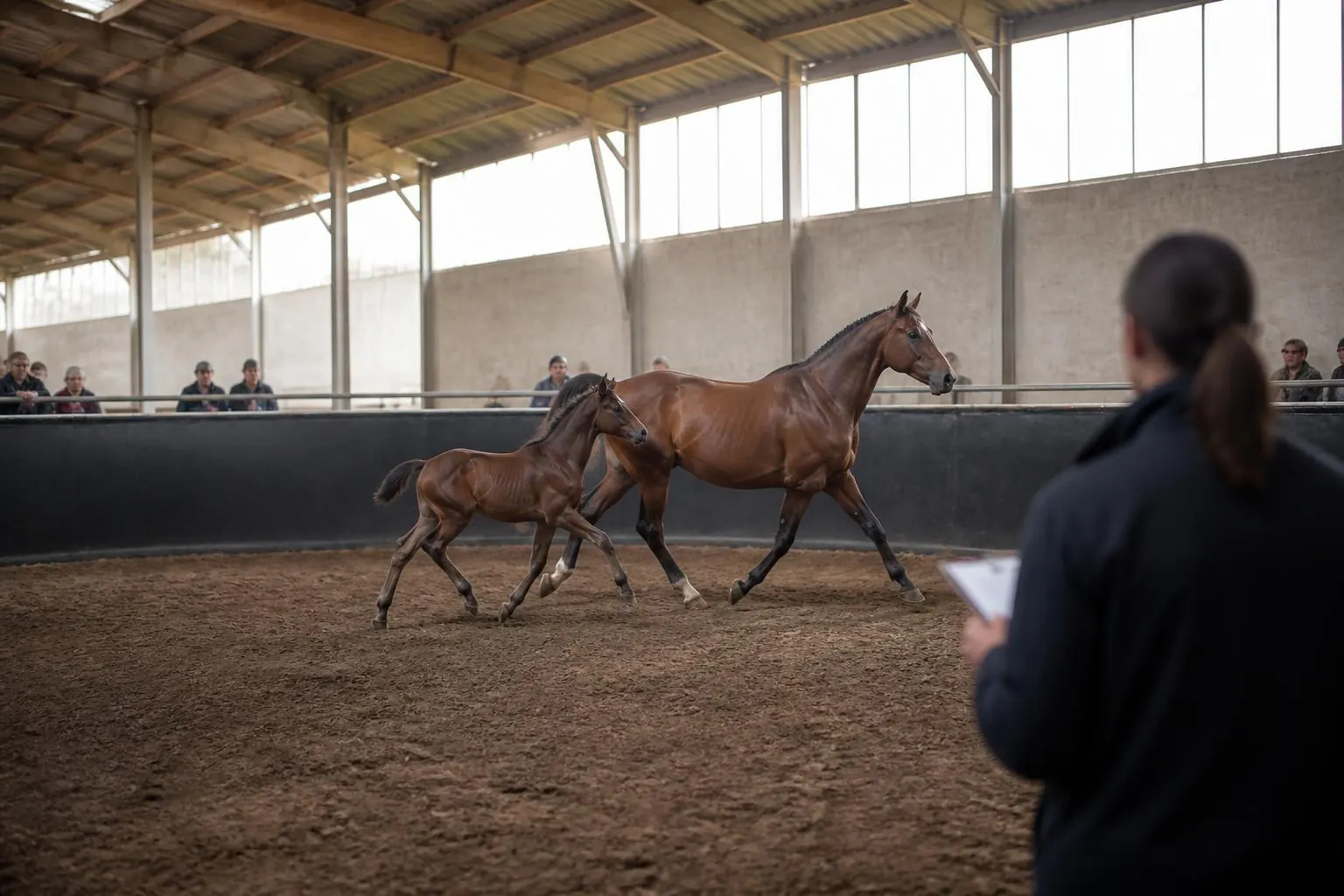
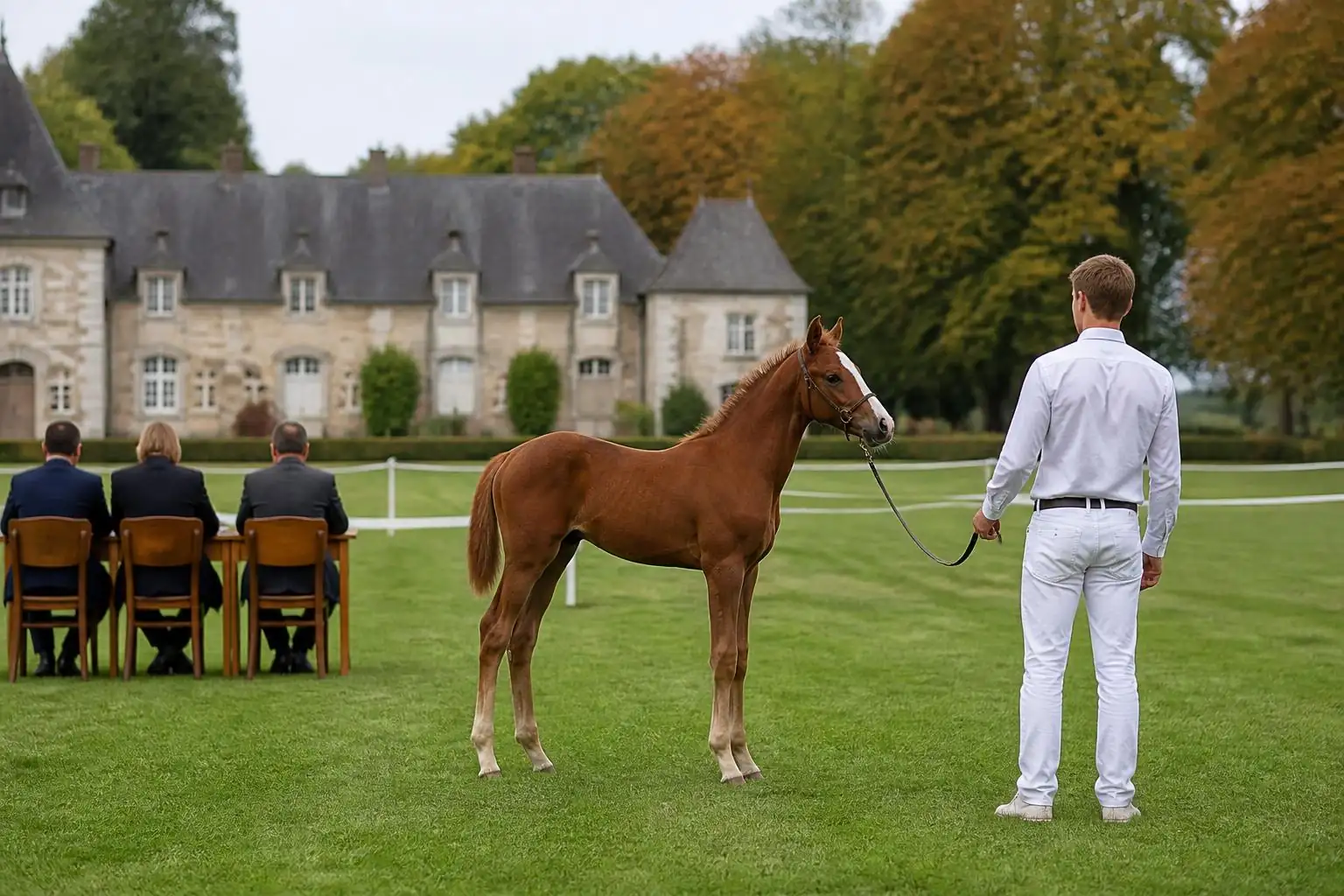
The championship runs over two full days, from 9 a.m. to 5 p.m. each day, within the grounds of the former national stud of Saint-Lô, now the Pôle hippique. The first round, on Friday, takes place in the main indoor arena: mare and foal are released together into the Selle Français ring, and the foal is presented by the Young Breeders, a team of young riders and breeders trained in showing horses at breeding competitions. The second round, on Saturday, is held in the stud’s courtyard: the foal is first shown in hand, then loose beside its dam, who is herself led in hand, this time presented by the breeder or by a Young Breeder. The prize-giving follows straight after Saturday’s classes.
The final ranking is the average of the marks from the two rounds. Three titles come out of it: supreme champion among the colts, supreme champion among the fillies, and supreme foal champion, chosen between the two by the judges. The stud-book’s official prize fund is 12,000 euros, up to 3,000 euros per section, and only the top half of each section receives prize money, topped up by the bonuses from the Génétique Avenir and Selle Français Originel programmes. Entry cost 100 euros and closed on 3 September. To place this event among the others, our calendar of equestrian competitions lists the autumn fixtures across every discipline.
Video · 117 seconds
Selle Français Foal Championship 2026 at Saint-Lô: 103 Foals Judged, More Than Half for Sale
The official catalogue lists 53 for sale. The scoring grid, the four sections, the prize fund and what a supreme champion title is worth.

103 Selle Français foals, four sections and six minutes per horse
The 103 qualified foals are divided into four sections: 29 older fillies, 27 older colts, 23 younger fillies and 24 younger colts. Each French region has a quota of places in proportion to the number of births registered there, and the stud-book contacts the highest-scoring foals from the regional selection rounds to tell them they have qualified. The rules provide for 60 places for colts and 60 for fillies: with 103 entries, the 2026 field is not quite full, which is a constant at breeding shows, where an injured foal or a mare that travels badly can wipe out an entry within hours.
The running order is timed to the minute: one foal every six minutes, from the first at 9 a.m. to the last in late afternoon, with a break in the middle of each half-day. Six minutes is the total time a horse of a few months has to show what it has, in front of a jury that will see a hundred of them in the same day.
Younger or older foals: why the 1 May cut-off matters so much
The split between “younger” and “older” sections rests on a single date, 1 May. It is far from a purely administrative matter. The eldest of the field, Qalgary Gravelotte, was born on 14 February 2026; the youngest, Qui Voilà l’Évidence, was born on 3 July. On show day the first is seven and a half months old, the second less than three. In a growing animal, that gap changes size, muscling, the balance of the back and the way of moving: judging the two in the same section would make no sense. All 2026 foals also carry a name beginning with the letter Q, the French rule that assigns one initial per birth year, which lets you date a horse at a glance from its name. The basics of gestation, foaling and the first months are covered in our guide to mare gestation.
Blind scoring: the foal championship jury does not know whose foal it is
This is the most interesting rule of the foal championship, and it is set out in black and white in the stud-book’s information note: in the first round, the presentation is handled by the Young Breeders and the scoring is done blind. In other words, the breeder does not hold their own foal in front of the jury, and the judges mark without the usual thread of the breeding show, where you recognise a breeder by their cap and a bloodline by the mare at the foal’s side. In a world of a few hundred breeders who have been bumping into one another for twenty years, this procedural detail is worth more than any number of speeches about fairness.
The mark itself is not a general impression: it is a weighted grid, published by the stud-book, and the weight given to each item tells you exactly what the Selle Français is trying to produce.
What a Selle Français foal is judged on: the grid and its weightings
- Paces, 30 per cent. The first criterion, level with overall impression. The foal’s walk, trot and canter loose around its dam: stride length, spring, natural balance, freedom of the shoulder.
- Overall impression, 30 per cent. General harmony, style, presence, the way the animal fills the ring. This is the most subjective part of the grid, and it carries as much weight as the paces.
- Forehand, 10 per cent. Head, neck, shoulder, withers: the slope of the shoulder governs the scope of the movement and, later on, where the saddle sits.
- Body, 10 per cent. Back, loin, ribs, topline: this is the frame that will carry the rider and absorb the landings over fences.
- Hindquarters, 10 per cent. Hip, quarters, stifle, hock: the engine of the jump, the part that pushes.
- Limbs, 10 per cent. Legs and feet, seen from the front, side and rear. In a foal the conformation can still change, but a marked fault will cost you in training.
- The walk-through in hand. Entry, halt, walk away and back over 30 metres (about 33 yards), then halt while the horse is shown from the other side: every foal is seen from both flanks, in both directions.
- The average of the two rounds. A foal that shows well one day and shuts down the next does not win: the title rewards consistency across two presentations on two different surfaces.
53 Selle Français foals for sale: what the Saint-Lô catalogue says about the market
The stud-book publishes a separate document, titled “Foals for sale”, giving the foal’s name, its sire, its dam, its damsire, then the breeder’s name, village and telephone number. It lists 53 entries out of the 103 competing: 13 older fillies, 16 older colts, 10 younger fillies and 14 younger colts. More than one foal in two shown at Saint-Lô is therefore for sale during the show, and the proportion is higher among colts (30 of 51) than fillies (23 of 52), which is the very logic of breeding: a good filly can stay at home to become a broodmare, whereas a colt not destined for stallion duty has no such way out.
The championship thus works as a shop window as much as a competition. Each foal has its own page in the official programme, with its maternal line over five generations and the show-jumping indices of related horses: the show is not presenting just a four-month-old foal, but a family and its competition record. This is exactly what the Deauville yearling sale does on another scale and with an auctioneer’s gavel, where one-year-olds that have never raced change hands for a million. The difference is in the price and the noise: at Saint-Lô, the deal is done by telephone, between two classes, and nobody announces the figures.
To grasp the economic weight of this sector, our article on horse breeding in France and its 2024 figures gives the order of magnitude for annual births and the number of breeders, the vast majority of them small operations with one or two mares.
Palme d’Or de la Noue: what a supreme foal champion title changes for a horse
The previous edition crowned Palme d’Or de la Noue, a filly by Mylord Carthago out of Angie de la Vallée by L’Arc de Triomphe, scoring 17.90 out of 20 and bred by Frédéric Mottier in Indre-et-Loire: she won the younger fillies’ section, then the supreme title. Among the older colts, Popstar du Galet, by Halifax, had received the same mark of 17.90. These two figures show the real scale of the competition: at this level everything is decided in the last two points, and a tenth of a point often separates the podium from the rest of the section.
A title at Saint-Lô does not make a show-jumping champion, and nobody in the business claims it does. It does three concrete things. It sets an immediate market value on the foal and its dam, whose standing as a breeder’s mare rises overnight. It draws stallion owners’ attention to a bloodline, which raises the odds that a future colt will be put forward for approval. And it often decides whether a mare is sent back to the same stallion the following year. The Selle Français breed, France’s leading sport-horse breed, was built on this chain of decisions, made show after show, since the merger of the regional half-bred types in 1958.
Visiting the foal championship at the Pôle hippique de Saint-Lô
Saint-Lô is one of the cradles of French sport-horse breeding: the former national stud, founded in the early nineteenth century, now houses a full equestrian centre with arenas, schooling rings and stables, and the town remains the meeting point of Normandy’s breeding community. Normandy alone accounts for a major share of saddle-horse births in France, and our guide to Normandy on horseback explains how the region came to hold that role.
In practical terms, a spectator who walks in on Friday sees mares and foals loose in a covered arena, with marks posted as the classes go on; on Saturday they watch the in-hand presentation in the stud’s courtyard, then the prize-giving. One health requirement frames the whole event: since 1 January 2022, vaccination against equine herpesvirus (rhinopneumonia) has been compulsory for all equines entered in a Selle Français stud-book event. Broodmares are covered, but not foals shown at foot. To find a breeder or a riding club near the venue, our Normandy equestrian directory lists the businesses in the Manche and the four other Normandy departments. And if you prefer draught horses, the French Percheron championship takes place on exactly the same dates at the Haras du Pin, in neighbouring Orne.
Foal championship 2026: the key facts
- When: Friday 25 and Saturday 26 September 2026, 9 a.m. to 5 p.m. on both days.
- Where: Pôle hippique de Saint-Lô (Manche), main indoor arena on Friday, stud courtyard on Saturday.
- How many horses: 103 foals born in 2026, in four sections, with 60 places provided for colts and 60 for fillies.
- The figure: 53 of the 103 foals are listed for sale in the show’s official catalogue.
- The mark: paces 30 per cent, overall impression 30 per cent, forehand, body, hindquarters and limbs 10 per cent each, averaged over the two rounds.
- The prize fund: 12,000 euros, up to 3,000 euros per section, with the top half of each section paid.
- The title-holder: Palme d’Or de la Noue, supreme champion with 17.90.
Sources: information note, official programme and list of foals for sale for the 2026 foal championship published by the Selle Français stud-book (PDF documents dated 15 September 2026), running times for the four sections published by the same stud-book, the Selle Français stud-book’s 2026 championship calendar, and results of the previous edition relayed by regional breeders’ associations. The 2026 titles will be known on Saturday 26 September in late afternoon.