
From 12 September 2026 through 3 January 2027, Château de Chantilly presents an exhibition devoted to Rosa Bonheur and the horse across two venues: the prints and drawings cabinet of the Musée Condé and the Musée Vivant du Cheval, housed in the Grand Stables. The show gathers drawings, paintings, photographs, engravings, and archives, including previously unseen materials lent by the Château de Rosa Bonheur at By. Behind the headline lies a story less often told than the painting itself: to prepare The Horse Fair, the nineteenth century’s most celebrated equestrian scene, the artist spent eighteen months frequenting the market on Boulevard de l’Hôpital dressed as a man, armed with a permit from the police prefecture that required renewal every six months.
Twice weekly at the Boulevard de l’Hôpital horse market
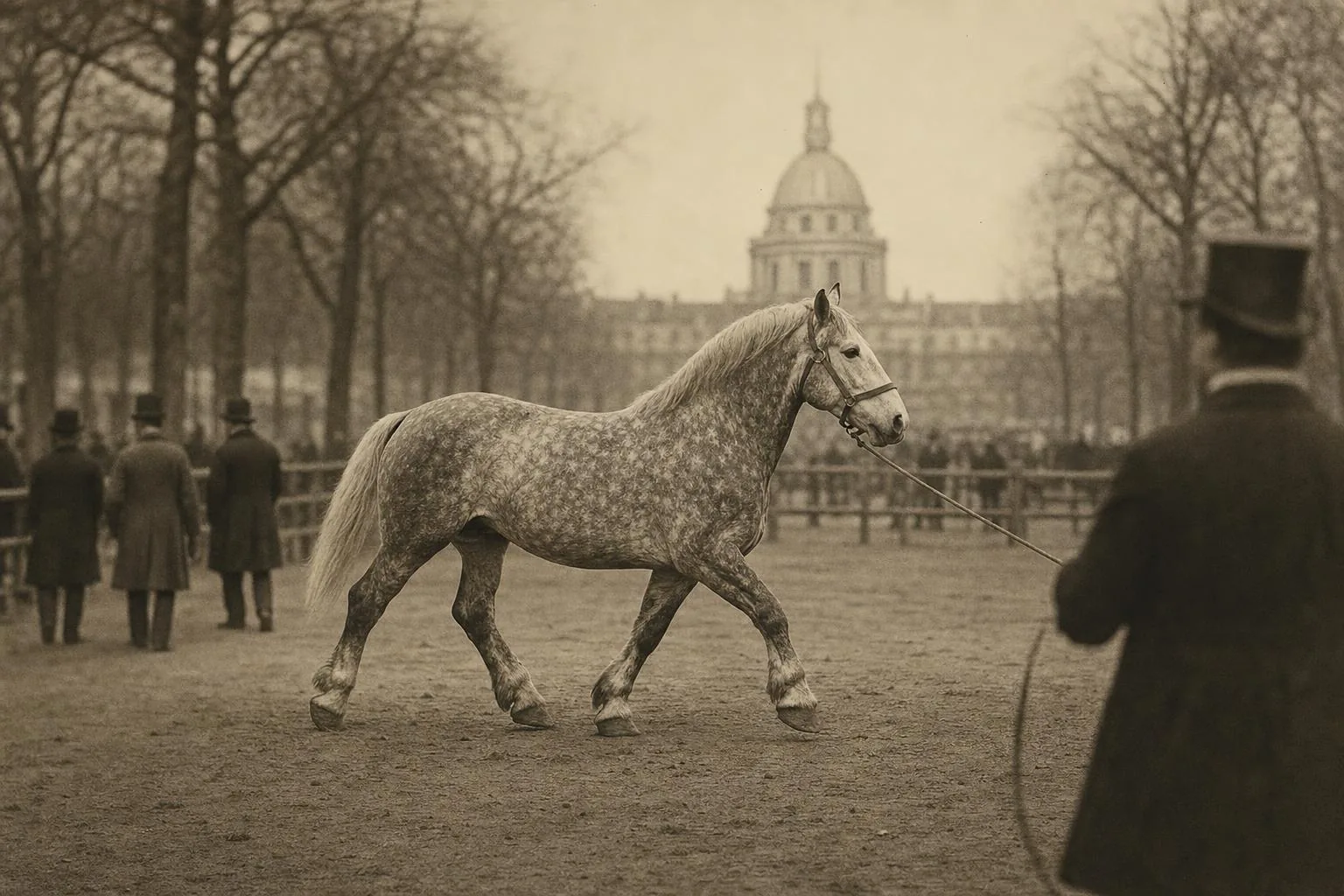
Paris’s horse market convened at the foot of La Salpêtrière, whose dome anchors the painting’s background, on Wednesday and Saturday afternoons. From summer 1850 through the end of 1851, Rosa Bonheur went there twice a week to draw the draught horses, Percherons foremost, which dealers trotted before buyers. She completed her studies with the horses of the omnibus company, observed at work in the streets.
A twenty-eight-year-old woman alone, sketchbook in hand, standing amongst horse traders, did not pass unnoticed. She chose the smock and trousers of a stable lad so that no one would mind her, and she could simply watch. The Percheron, a plough and cart horse, held little interest for painters of her time, who preferred the thoroughbreds of the racecourse and the hunt. She would make it the subject of a canvas exceeding 130 square feet (12 square metres).
In video, 107 seconds
What the video shows
To prepare The Horse Fair, the 1853 canvas that made her famous, the artist frequented the Paris market dressed as a man, with a police prefecture permit renewed every six months. What the exhibition reveals, and what it owed to her own horses.

The cross-dressing permit: an 1800 ordinance to paint horses in trousers
The trousers were not mere audacity. In Paris, since the ordinance of 16 Brumaire Year IX, 7 November 1800, signed by police prefect Louis Nicolas Dubois, any woman wishing to “dress as a man” had to obtain authorisation from the prefecture, upon presentation of a medical certificate. The text declared itself “persuaded that none of them would abandon their sex’s attire except for reasons of health,” and stipulated that “any woman found cross-dressed” without authorisation “shall be arrested and brought to the police prefecture.” Permission was valid for six months.
Rosa Bonheur therefore applied, and reapplied, for her cross-dressing permit. Only one has survived, issued 12 May 1857 and now held at the Château de By, alongside that of her companion Nathalie Micas. Period press clippings suggest the document was uncommon: some dozen women benefited from it across Paris between 1850 and 1860, another ten or so by around 1890. She adhered strictly to its terms: in the city, in official photographs, she wore skirts. At By, on horseback, in her studio, she wore trousers. The 1800 ordinance was never formally repealed: on 31 January 2013, answering a senator, the Ministry for Women’s Rights noted only its “implicit repeal,” lacking compatibility with the principle of equality enshrined in the Constitution.
The riding breeches have their own history, traced to India: that of the jodhpur’s origins.
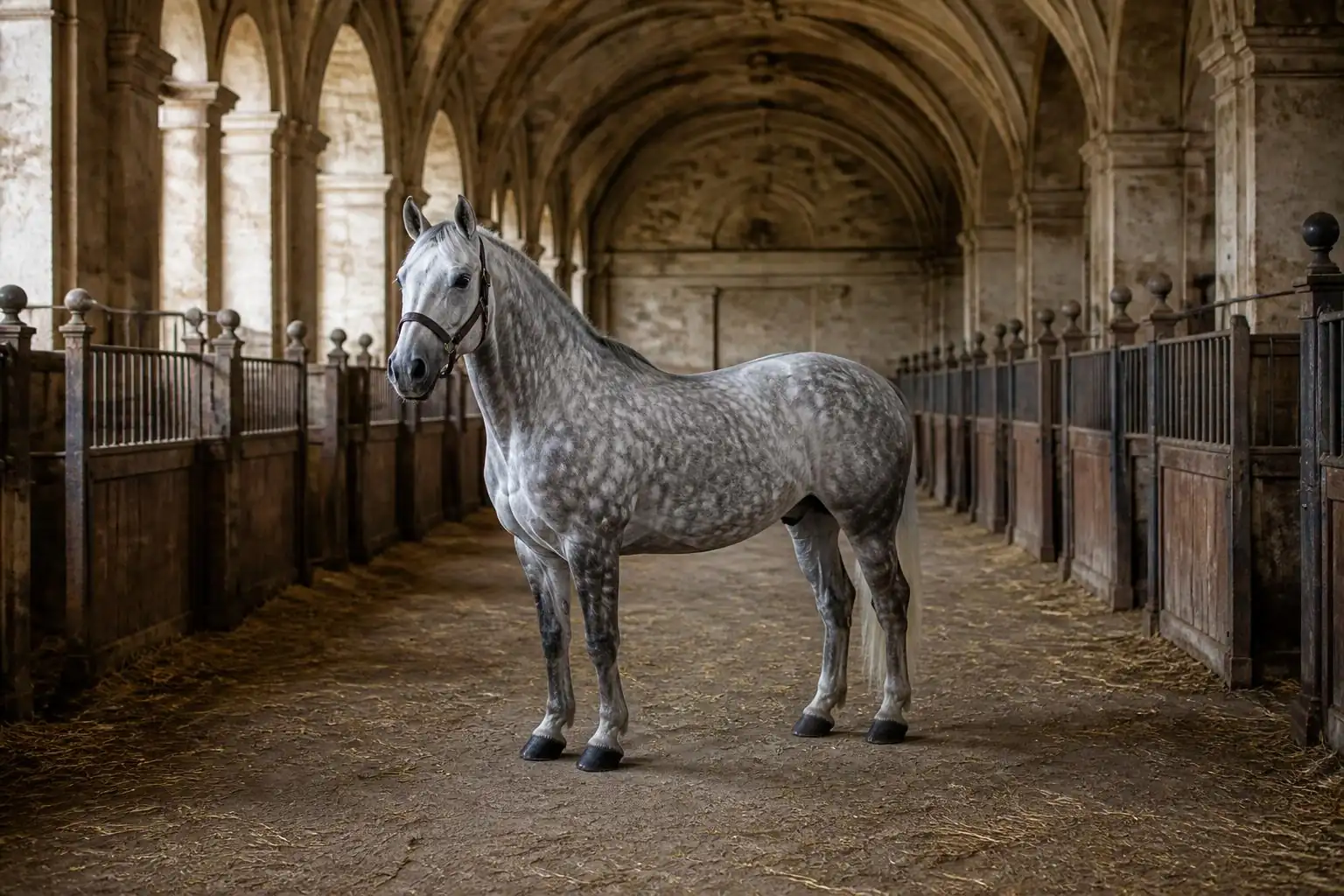
The Horse Fair, 8 feet by 16 feet: the Percheron painting that bought a château
The Horse Fair was presented at the Salon of May 1853. The canvas measures 8 feet by 16 feet 7 inches (2.445 m × 5.067 m). Critical reception was unanimous, to the extent that the jury decided that Rosa Bonheur, having already won every medal available, would henceforth exhibit without jury review. In L’Éclair, Henry de La Madelène wrote that the painting “possesses the rare and singular privilege of raising nothing but praise from every quarter” and saw in it “a masculine painting, nervous, solid, full of frankness.” Bordeaux, her native city, nonetheless refused to purchase it for 15,000 francs.
Dealer Ernest Gambart acquired it for 40,000 francs in 1854 and had it travel through England and Scotland; Queen Victoria requested a private viewing at Buckingham Palace. After passing through two American collections, the canvas was purchased for 53,000 dollars in March 1887 by Cornelius Vanderbilt II, who immediately donated it to the Metropolitan Museum of Art in New York, where it remains. A half-size replica, painted with Nathalie Micas, entered the National Gallery in London in 1859; it was from this that Thomas Landseer produced the engraving that circled the world, and a lithograph after Landseer, dated 1857, is held by the Musée Vivant du Cheval at Chantilly. To place these sums in context, our feature on the world’s most expensive horse sets the scale of prices paid for a living horse, then and now.
With the proceeds from The Horse Fair, she purchased the property at By, on the hillside of Thomery, on the edge of the Fontainebleau forest. She settled there in 1860 with Nathalie Micas, had a very large studio built, and died there on 25 May 1899.
Astride, not sidesaddle: Rosa Bonheur the horsewoman, and her horses at By
Rosa Bonheur rode every day. As early as 1845, she bought a mare named Margot, whom she rode astride around Paris and then through the Seine-et-Marne countryside. At a time when the female norm was the sidesaddle, with both legs on one side, she rode like a man, in trousers. Her saddle, preserved at the Musée Départemental des Peintres de Barbizon, is among the pieces the château is highlighting for the exhibition.
At By, horses were not merely mounts: they were models. She observed them at length, had them posed with the help of her servants, and noted that some, too wild, allowed approach only in fleeting moments. She was given a wild horse by the American John Arbuckle. She photographed her animals and reworked the prints in pencil and gouache; an enhanced cyanotype showing one of her horses viewed from the side is among the announced pieces. Care was managed with rigour, the horses fed several times a day. What estate owners once kept in their heads, a proprietor today records in a horse health record.
Her equestrian palette was broad for her century: Shetland ponies, Percherons, Camargue horses, American mustangs, and even the legendary Godolphin Arabian, one of the three foundation sires of the thoroughbred. In 1889, she received Buffalo Bill at By, who had come to Paris with his Wild West Show for the Universal Exposition, and painted his portrait on horseback, now at the Buffalo Bill Center of the West in Wyoming. Our guide to horse breeds brings together their files, from the Shetland to the mustang, not forgetting the Camargue, which is never born white.
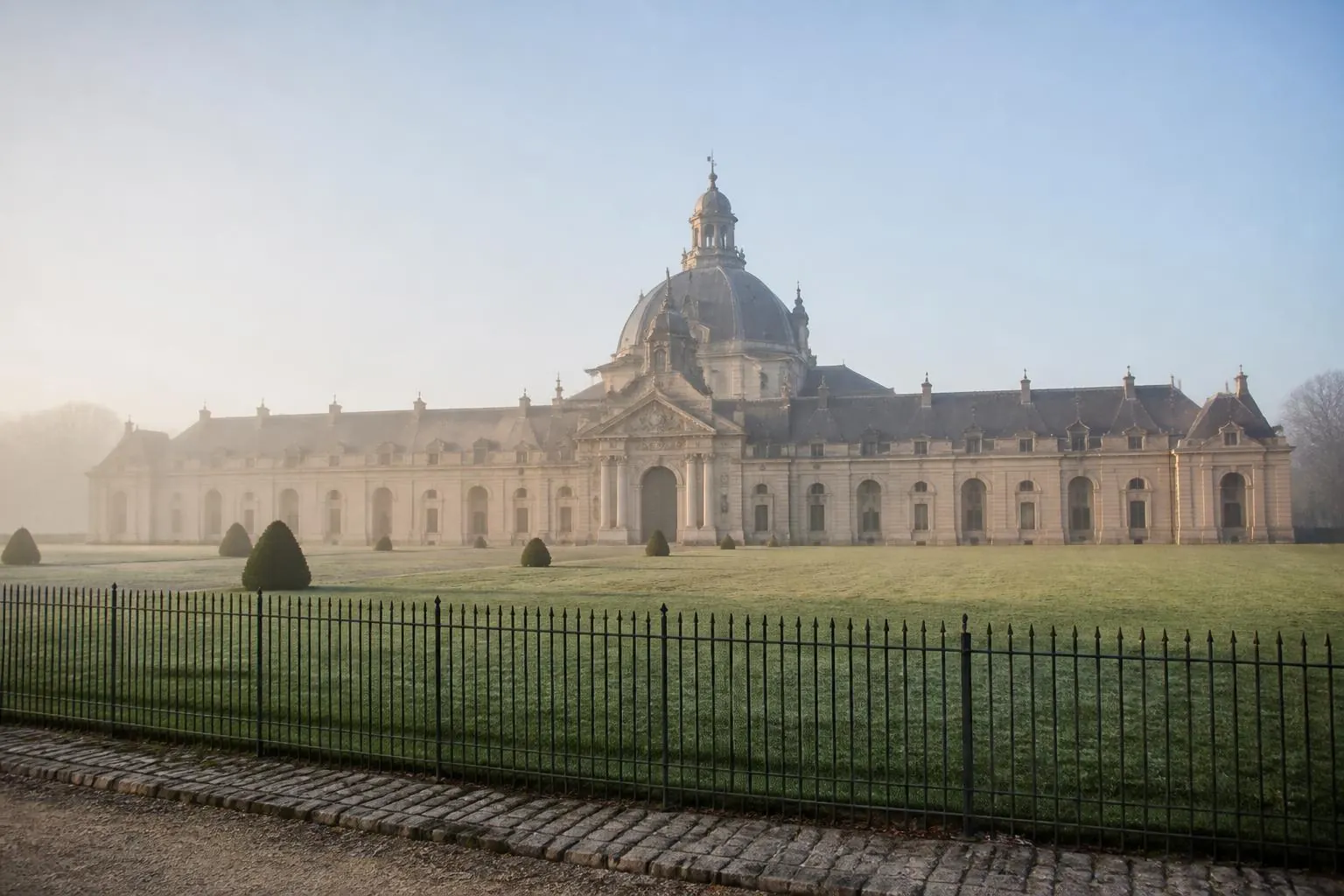
Rosa Bonheur at Chantilly: what the exhibition shows, and where
The link between Rosa Bonheur and Chantilly runs through a painting and a man. Henri d’Orléans, Duke of Aumale, was born in 1822, the same year as she was. A collector of Old Masters, exiled to England under the Second Empire, he discovered her when Gambart made her known to the British public. His wife, Marie-Caroline of Bourbon-Sicily, commissioned him to paint The Shepherd of the Pyrenees Giving Salt to His Sheep; on delivery in 1864, the duke doubled the asking price. The two met only in 1894, at Chantilly. The painting is at the Musée Condé, and the exhibition details the studies that prepared it.
The second venue occupies the Musée Vivant du Cheval, installed since 2013 in fifteen rooms of the Grand Stables, built 1719 to 1735 by Jean Aubert for Louis-Henri de Bourbon, seventh Prince de Condé: a palace for horses, as the château itself puts it. One will also see bronzes by Isidore Bonheur, her younger brother, an animal sculptor awarded the gold medal at the 1889 Universal Exposition and eclipsed by his sister’s fame. Curated by Charlène Totin, keeper of the Musée Vivant du Cheval, in partnership with the Château de Rosa Bonheur. European Heritage Days, 19 and 20 September, with 2026’s national theme being the heritage of photography, fall conveniently: it was through photography that Rosa Bonheur fixed her horses before painting them. Our practical information for the Chantilly event sets out the dates, and our page on the Chantilly racecourse, neighbour to the Grand Stables, completes the visit for those who wish to make a day of it.
What makes a horse painter, and why The Horse Fair still stands
Anatomy first: trained by copying Carle Vernet and Géricault, claiming George Stubbs’s plates as her reference, she verified everything from life, at the market, in the stable, from veterinarians and breeders. Movement next: trot, rear, sudden halt, every horse in the painting is caught in a different phase of gait, a quarter-century before photography would break down the gallop. The eye: she painted the horse’s eye as it is, without lending it human expression. The subject finally: draught horses, when only thoroughbreds were painted. It is this combination, not the trousers, that built the painting’s reputation. The trousers were merely the means to it.
“Genius has no sex”: the Legion of Honour in 1865, Chantilly and the Duke of Aumale in 1894
On 14 June 1864, the Empress Eugénie appeared at By unannounced and invited the painter to lunch at Fontainebleau. She returned on 10 June 1865 to present her with the cross of the Legion of Honour, the first awarded to a woman artist, with words reported by Anna Klumpke: “I wished the final act of my regency to show that in my eyes, genius has no sex.” In 1894, Rosa Bonheur became an Officer, the first woman to hold that rank. That same year, at seventy-two, she was received at Chantilly by the Duke of Aumale.
The horse runs through all painting, from Lascaux, where it is the most represented animal, to the avant-gardes of Cubist horses. Between the two, a woman in trousers, sketchbook in hand, on Boulevard de l’Hôpital, on a Wednesday in 1850.
What remains unknown about Rosa Bonheur’s horses
The cross-dressing permit preserved at By dates from 1857, which is after the market sessions (1850,1851); the earlier authorisations, renewed every six months, have not been found, and it is biographer Anna Klumpke, followed by the Metropolitan Museum’s catalogue, who reports that she attended the market in masculine dress under such a permit. The figure of some dozen beneficiaries between 1850 and 1860 comes from press clippings, the prefecture’s file being incomplete. The exhibition closing date is given as 3 January 2027 by the press release and 4 January by the château’s English-language page: we go by the press release. The number of works, the exhibition’s hours and tariffs, were not published at time of writing. Finally, the legend that the Prince de Condé built the Grand Stables because he believed he would be reborn as a horse rests on no period document, and the château does not repeat it.
Sources: Château de Chantilly press release and official page “Rosa Bonheur and the Horse” (2026); château page “Grand Stables, Horse Museum”; Metropolitan Museum of Art, notice of The Horse Fair (gift of Cornelius Vanderbilt, 1887); Anna Klumpke, Rosa Bonheur, Her Life, Her Work (1908), excerpt published by the Fondation Napoléon; Christine Bard, “The Right to Trousers” (La Vie des idées, 2013) and the “cross-dressing” file from the police prefecture archives (Clio, 1999); Journal officiel du Sénat, 31 January 2013; Journal d’agriculture pratique, 1854; Henry de La Madelène, L’Éclair, 1853; Château de Rosa Bonheur, By-Thomery; French Ministry of Culture, European Heritage Days 2026.