
If you were planning to buy your horse’s hay in November this year, you will arrive after everyone else. By 10 August 2026, cumulative grass growth across French permanent pastures had reached only 51.4 per cent of its expected annual value, against 76.2 per cent over the reference period 1989-2018. This is not the impression of a worried owner: it is the figure published by the Isop system of the agricultural ministry’s statistics service, built with Inrae and Météo-France. Roughly one third of the year’s grass is missing, and winter forage is being reserved now, not at the first frost.
Here is what the figures actually say, what the support plan announced on 4 September changes or does not change for a horse, how much hay you really need to plan for, and what to judge a batch on before reaching for your card.
One Third Less Grass, and It’s the Second and Third Cuttings That Are Missing
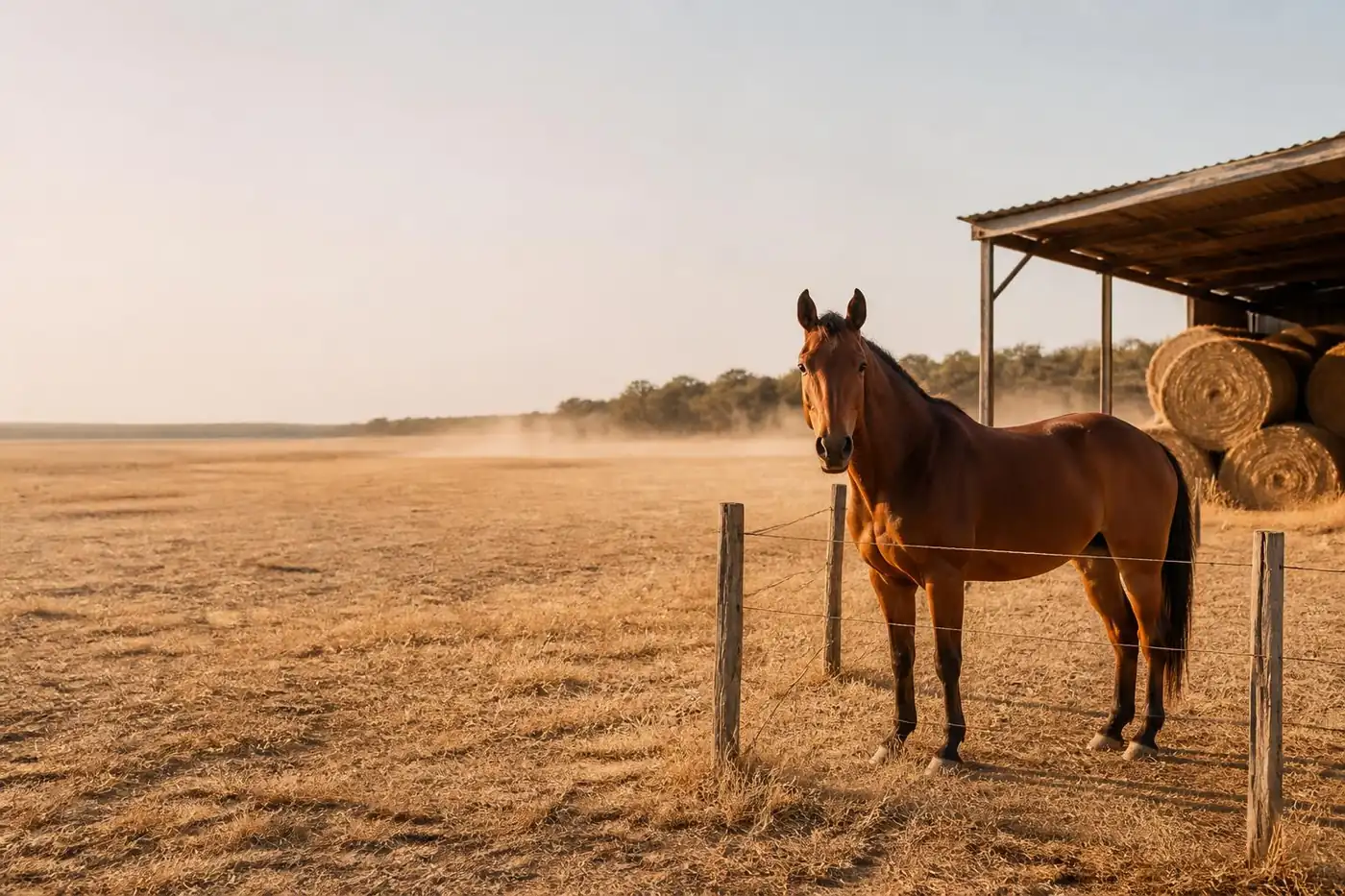
The indicator is called Isop. It combines Météo-France data, an agronomic model from Inrae and statistical tracking by the ministry, producing a monthly growth rate by region. By 10 August 2026, all of France was at 51.4 per cent of its annual growth, when the reference normal places this same milestone at 76.2 per cent. The report speaks of marked deficits across virtually all regions.
Several regions fell below the 50 per cent mark: Bourgogne-Franche-Comté at 45.7 per cent, Nouvelle-Aquitaine at 47.0 per cent, Grand Est at 47.1 per cent, Occitanie at 47.9 per cent. Even Brittany, which is thought of as the region where grass always grows, peaked at 57.6 per cent against its usual 79.7 per cent. Grass growth came to an almost complete halt by late May, and many farmers have already begun eating into the hay they had stored for winter.
There is an important distinction to make right away, because it determines what will be missing in your barn. One third less grass does not mean one third fewer bales everywhere. In many baskets, the first cutting, made in spring before the drought, was decent. It is the second and third cuttings, the aftermath growth, that did not materialise. Yet aftermath hay is precisely the more flexible, leafier, more palatable hay that is often reserved for fussy eaters, the old and the young. Winter hay will therefore not only cost more: its average quality will decline, and the really fine batches will sell first.
The Shortage in 68 Seconds
One Third Less Grass, Summarised in Video
The Isop figure, your horse’s actual ration over an entire winter, and the three false economies that cost more than they save. One minute to know what to order, and when.

A batch of hay is judged by smell and hand, but its true value emerges over the entire winter: note your horse’s weight, condition and digestive episodes in the Equirider health record, and you will know in spring what that hay was truly worth.
The Billion-Euro Support Plan Does Not Target the Leisure Horse Owner
On 4 September 2026, the Ministry of Agriculture announced a support package of over one billion euros for producers affected by drought and summer heat. Two components: compensation for exceptional losses, and restarting production by facilitating the purchase of inputs, including forage. An envelope presented as an agricultural re-armament fund, of 235 million euros, is to be deployed by the regional and departmental prefectures, with amounts defined department by department following consultation with agricultural organisations. Permanent departmental drought cells are being established.
This scheme is aimed at agricultural operators. Ownership of leisure horses does not, in itself, entitle you to these subsidies. An equestrian facility with agricultural status may, however, be eligible, and the criteria are decided locally: if you fall into this category, the question must be put to your local chamber of agriculture and departmental land authority, not on a forum.
For a horse owner, the consequence is not polemical, it is mechanical. The same rare forage will be purchased by farmers whose purchasing power has just been boosted. A private individual looking for eight round bales in December is therefore negotiating in the last position, on stock that is already committed.
How Much Hay Your Horse Will Actually Eat This Winter
This is the calculation almost no one does before calling a supplier, yet it is the one that protects against the double trap: ordering too little, or paying for an unnecessary reserve.
The basic physiological rule does not change. A horse must receive a minimum of 1.5 per cent of its body weight in dry matter of forage each day, and 2 per cent is the target when hay forms the bulk of the ration. For a 1,100 lb (500 kg) horse, this represents 16.5 to 22 lb (7.5 to 10 kg) of dry matter per day.
Dry hay contains approximately 85 per cent dry matter. In bale weight, this equates to roughly 20 to 26 lb (9 to 12 kg) of hay per day. You must add losses: on the ground, under hooves, at the manger, to the wind, reckon on the order of 10 to 15 per cent, considerably less with a small-mesh hay net.
Then comes duration. Depending on the region, pasture exposure and stocking rate, the period without nutritious grazing extends over 150 to 200 days. The product of these three gives a usable range that you can apply immediately: between 3,100 and 5,300 lb (1.4 and 2.4 tonnes) of hay per 1,100 lb (500 kg) horse per winter. Or roughly 5 to 9 round bales of 550 to 660 lb (250 to 300 kg), or 70 to 120 small square bales of 44 lb (20 kg). For a 660 lb (300 kg) pony, reckon on just over half, around 2,000 to 3,100 lb (0.9 to 1.4 tonnes).
Two horses at pasture year-round is therefore, in the worst case, nearly 11 tonnes to find and store. This figure completely changes a conversation with a farmer in September, and it cannot be made up in January. If you want to refine by physiological stage, workload level and feed units, our horse ration calculator sets out the detailed figures.
What to Judge When a Hay Batch is Offered to You
- The price per pound, never per bale: a round bale at £60 means nothing until you know whether it weighs 480 or 700 lb (220 or 320 kg). Convert everything to price per pound, it is the only way to compare two offers.
- The actual weight of the bales: ask for the average weight observed, not the theoretical weight from the press. A difference of 110 lb per bale over a batch of ten is half a tonne of hay that exists or does not exist.
- Batch uniformity: same field, same cutting, same harvest week. A mixed batch forces you to redo a dietary transition with each new bale.
- Harvest stage: hay cut early is leafier and more digestible, late-cut hay is coarser and poorer. Neither is bad, but they do not fetch the same price and do not suit the same horses.
- Pressing and storage conditions: hay pressed when damp heats and moulds at the core. Hay stored under cover, on pallets, keeps for an entire season. A bale left under cover sheet in the field all winter does not.
- What is at the heart of the bale, not on top: have a bale from the batch opened before you buy. The smell should be fresh, with no sharpness or mustiness, and dust should remain discreet when you shake a handful.
- Transport and handling: hay is bulky and light by weight, transport can weigh very heavily in the delivered price. Know before you commit who loads, who delivers, and whether you have the equipment to move a round bale.
- Written commitment: quantity reserved, delivery schedule, fixed or revisable price, and what is planned if a batch arrives mouldy. A year of shortage is precisely when the verbal agreement falls apart.
On the purely practical side, where to find hay near you and how to spot it at a glance, we have already published a dedicated guide to finding hay around you, which details channels, from the local producer to the forage merchant.
False Economies That End Up at the Vet’s
A shortage prompts three reflexes, and all three cost more than the hay saved.
Buying a dodgy batch because it is cheaper. Dusty or mouldy hay directly attacks the respiratory system. Equine asthma, long called emphysema, is a chronic disease whose established forms do not repair: they are managed. Our page on managing hay in the asthmatic horse details soaking, misting and dust thresholds. A cheap batch that requires soaking 26 lb of hay per day throughout winter is not cheap.
Rationing forage to last until spring. The horse’s stomach secretes acid continuously, even when empty. Extending periods without forage is the most direct route to gastric ulcers, and to the wood-chewing and stable behaviours that go with them. If the quantity must drop, it is the density that adjusts, not the chewing time: small-mesh hay net, split feeding, clean straw as occupational complement.
Changing hay abruptly. A horse’s microbiota takes about ten days to adapt to new forage. A change overnight, especially to coarser hay that is less readily accepted, is a classic factor in impaction colic in winter, when the horse drinks less. The moves to know and the signs that demand immediate veterinary attention appear in our article on first aid for colic. Allow 10 to 15 days of transition, mixing the two hays in decreasing proportions.
As for substitutes, each has its own rule. Straw occupies and encourages chewing, but it is not replacement forage: poorly digestible, it raises impaction risk if it becomes the basis of the ration. Haylage delivers much, provided the film is intact, the bale is consumed quickly once opened and it is not soiled with earth, otherwise the risk of poor storage, botulism included, becomes real. Fibre pellets, dehydrated lucerne and sugar beet pulp are excellent stopgaps nutritionally, but they do not provide the hours of chewing that long hay brings. Our comparison of fibrous feeds, hay, lucerne and haylage sets out the choice criteria.
The Horses That Will Pay Most Dearly for This Shortage
Three profiles weather a year of scarce hay poorly, and they are rarely the ones people think of.
Metabolic horses first. When forage is short, the temptation is to make up with concentrate. This is the surest way to trigger laminitis in an already sensitive horse, and to weaken a horse with Cushing’s, whose autumn is precisely the most delicate time: we explained why in our feature on the autumn window in equine Cushing’s. In these horses, a low-sugar hay, even if coarser, always beats a bucket of pellets.
Older horses next. Worn dentition cannot cope with late, fibrous hay. They then lose weight without anyone understanding why, because they spend hours at the manger without swallowing anything useful. For them, soaked hay, forage pellets and rehydrated lucerne cubes are not a luxury: they are the only truly available fibre.
Year-round grazing horses finally. The idea that autumn grass will catch up on summer is not serious this year: a pasture scorched in July restarts slowly, and with depleted root reserves. You will need to feed hay earlier than usual, and the planned stock must account for it.
In all cases, the right reflex for winter 2026 is close monitoring of body condition, every two to three weeks, with a written note. Weight loss in a rugged horse is not visible to the eye: it is felt at the ribs, withers and tail base. Recording these observations over the winter in the Equirider digital health record turns an impression into a curve, and that is what lets you react in December rather than March.
What You Still Have Time to Do This Week
The useful window is short, and it is open now.
Calculate your real need with the range above, horse by horse, including losses. Call three suppliers rather than one, and ask each the same questions: average bale weight, cutting, harvest date, storage conditions, delivered price. Travel to see the stock and have a bale opened, which almost nobody does and which changes everything. Reserve in writing, with a staggered delivery schedule rather than a single delivery, so you do not end up stacking six months of hay in a poorly ventilated space.
Prepare storage before the hay arrives: under cover, isolated from the ground, on pallets or on a layer of sacrificial straw, with air circulating. A significant part of hay bought each year is lost after purchase, through poor storage conditions, and that is the only loss entirely in your hands.
Finally, if your horse is at livery, talk to your yard now. Hay is the first variable cost line for a yard, and a lasting increase always ends up in the monthly bill. Our benchmarks on horse livery prices let you judge a tariff revision and understand what it covers. A yard that announces a rise in October and explains it is more reassuring than a yard quietly cutting quantities.
How many pounds of dry matter, how much hay, what supplement when forage quality drops: the calculation takes ten minutes, once for the whole winter.
Key Takeaways
- By 10 August 2026, French grassland growth had reached 51.4 per cent of its expected annual value, against 76.2 per cent as reference: roughly one third of the year’s grass is missing.
- It is chiefly the aftermath cuttings, second and third harvests, that have failed. Fine and palatable hays will sell first.
- The support package of over one billion euros announced on 4 September targets agricultural operators, not leisure horse ownership.
- Reckon on 3,100 to 5,300 lb (1.4 to 2.4 tonnes) of hay per 1,100 lb (500 kg) horse per winter, roughly 5 to 9 round bales, losses included.
- Three false economies to avoid: the dusty batch, rationing forage and abrupt hay changes.
Sources
Agreste, statistics and foresight service of the agricultural ministry, Isop grassland growth monitoring system, data as of 10 August 2026, in partnership with Inrae and Météo-France. Agricultural Ministry and Food Sovereignty, announcement of 4 September 2026 of a support package of over one billion euros following drought, including an agricultural re-armament fund of 235 million euros deployed by prefectures. French agricultural press from late August and early September 2026, Réussir, Web-Agri and La France Agricole, for regional forage balance and early depletion of winter stocks. French Institute for Horse and Equestrianism and Inrae references for equine nutrition regarding 1.5 to 2 per cent body weight thresholds in dry matter and management of dietary transitions. This article provides management benchmarks and does not replace the advice of a veterinarian or equine nutritionist on a particular horse.