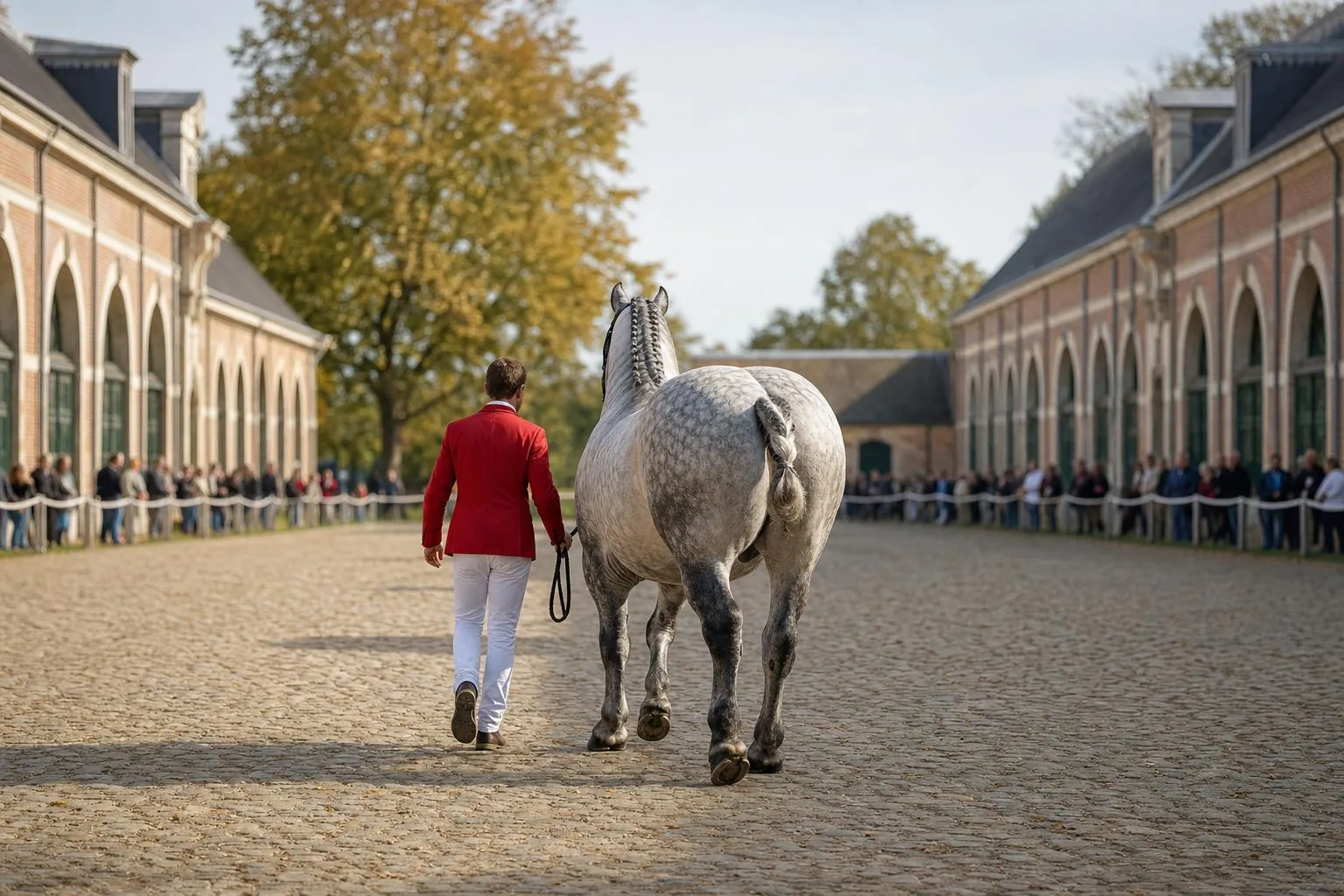

From Thursday 24 to Sunday 27 September 2026, the Haras national du Pin in Normandy’s Orne department hosts the French Percheron Championship, run by the Société Hippique Percheronne de France. Entry is free, the main courtyard is open to the public, and one rule sums it all up: every horse is scored out of 100 on the Percheron grid, and a male that fails to reach 62 points will never become a stallion. Last year close to 350 Percherons paraded across these cobbles, in front of buyers from Argentina, Mongolia and China. Here is the programme day by day, and what spectators really see from the rail.
French Percheron Championship 2026: dates, times and programme at the Haras du Pin
The official calendar of the Haras national du Pin lists the “National Percheron” from 25 to 27 September 2026 in the historic heart of the stud, and the Orne departmental council confirms the dates with the words “free for all”. The general regulations of the Société Hippique Percheronne de France (SHPF) add Thursday 24th: arrival day for the males, checked in between 10 am and 4 pm, followed by the presentation of stallions aged three and over in the main courtyard from 4 pm.
- Thursday 24 September: arrival of the males, document checks, height measuring and marking of the two- and four-year-olds. Presentation of males aged three and over in the main courtyard from 4 pm.
- Friday 25 September: presentation of two-year-old males from 8.30 am in the main courtyard. Driven selection classes for the Salon de l’agriculture in the Poste arena. Horses stabled in the historic core leave their boxes before 8 pm.
- Saturday 26 September: fillies aged two and three, main courtyard from 8.45 am.
- Sunday 27 September: mares with foals at foot, that is, presented with their foal of the year, main courtyard from 8.45 am. Ridden selection class in the morning in the Poste arena.
Le Pin-au-Haras lies about nine miles (15 km) from Argentan, in the heart of the Normandy bocage. The stud, founded under Louis XIV in 1715 and nicknamed the Versailles of the horse, lends its main courtyard, historic stables and Poste arena to the SHPF under a formal agreement. First-time visitors can combine the trip with the Jeudis du Pin, the stud’s equestrian show, and our guide to Normandy on horseback.
Percherons scored out of 100: the 62 points that make a stallion
The heart of the championship is not a podium but an approval board. All Percherons, male and female, are judged “on the Percheron grid out of 100 points”, according to the 2026 regulations. For a male, the bar is set at 62: below it, he is not approved and will not breed within the breed’s stud book. Two safeguards apply as well. Three marks of 4 or lower on the grid’s individual items, or a single mark of 2 or lower, and the horse is not approved “whatever its overall score”. A serious fault in conformation or movement cannot be made up for by a handsome frame.
Two types of Percheron are approved on this same grid: the trait, the heavier one, and the diligencier, lighter and more active, heir to the post and coach horses. The 2025 results, incidentally, name a trait champion, Muguet des Forges, and a diligencier champion, Nectar de Juhel. Our full profile of the Percheron sets out both orientations and the breed standard.
Height does not judge, it sorts: among two-year-old males, the small class runs up to 16.1 hh (1.67 m) inclusive and the tall class starts at 16.2 hh (1.68 m); for three-year-olds and over, the dividing line falls between 16.3 hh (1.69 m) and 16.3½ hh (1.70 m). A single centimetre on the measuring stick on Thursday decides which section a horse competes in for the championship prize, which can only be awarded once to the same horse in a given section. To put these sizes in context, our table of draught horse weights by breed gives the orders of magnitude. The recalls, a second pass by the best horses in front of the jury, take place without spectators in the presentation area, and talking to the judges during judging is forbidden.
Percheron fillies and broodmares: Saturday and Sunday in the main courtyard
Females are selected on their results in level 2 shows, or in qualifying level 1 shows, with the same minimum mark of 62 out of 100. Three-year-old fillies must have been covered or have taken part in at least one PEJET Travail class, the Parcours d’Excellence du Jeune Équidé de Travail (the young working horse excellence pathway). A single entrant may not enter more than ten females; the entry fee is €20 per mare, against €80 for a two-year-old male and €130 for a male aged three and over.
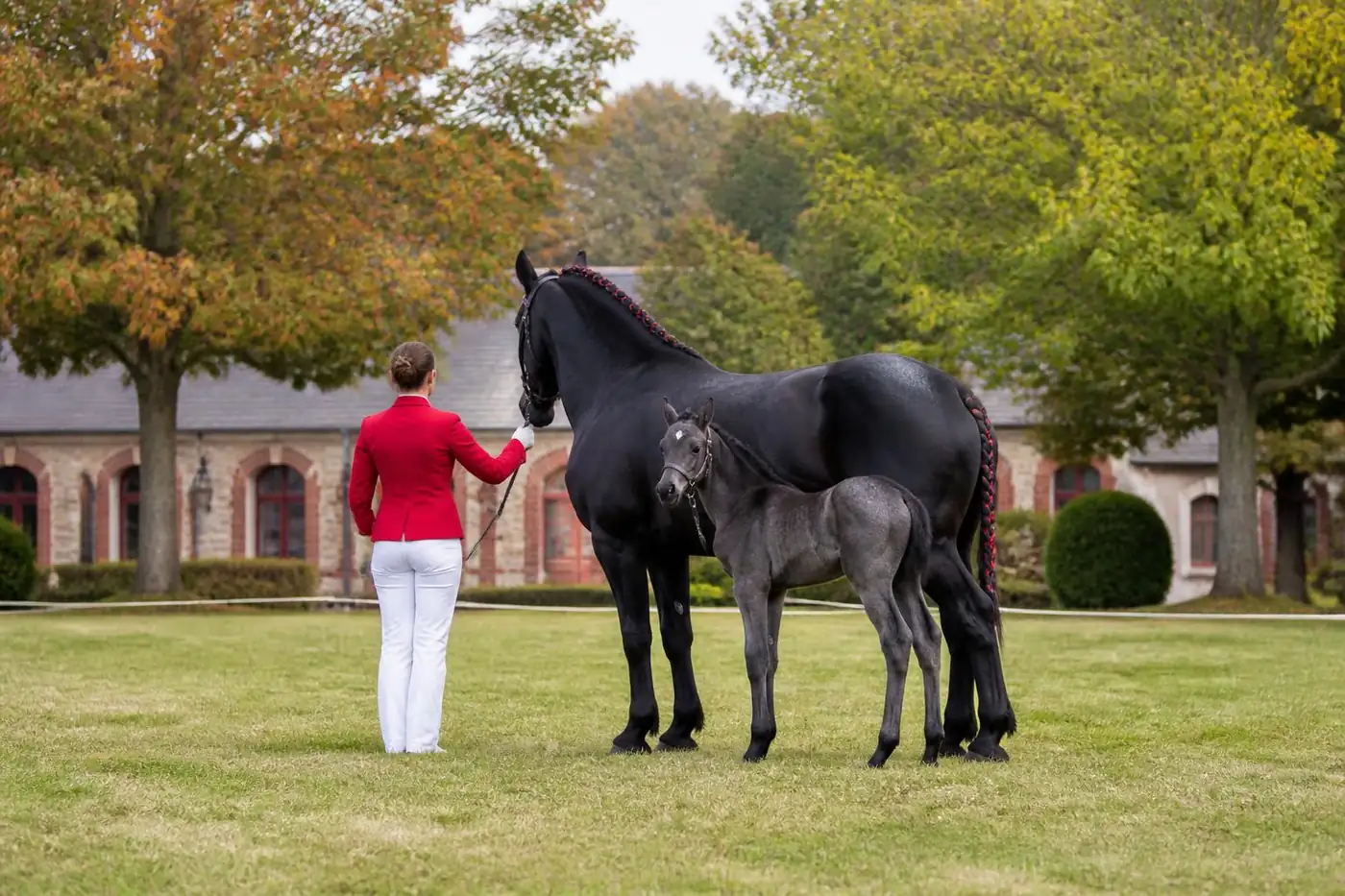
On Saturday 26th it is the two- and three-year-old fillies, measured and categorised like the males. On Sunday 27th the mares with foals at foot enter with their foal of the year, held on a headcollar. In 2025, 131 fillies and 80 mares were shown. The high point of Sunday is the mare championship prize, awarded by section.
Coat genes and the dam’s DNA: what the Percheron stud book checks before approving a stallion
A Percheron is grey or black, and the stud book now checks this through genetics. For males presented for approval, a sample for analysis of the three colour genes, E, A and G, had to be taken before 15 August 2026. The regulations are explicit: “males carrying e/e, or [E/e; A/a] will not be approvable”. In plain terms, a horse that is genetically chestnut, or that carries a combination likely to produce bay or chestnut foals, does not enter the breeding programme, even if he looks grey to the eye. Our guide to horse coat colours explains the role of these three genes.
A stallion’s file also includes the DNA typing of his dam, recorded with the SIRE (the French equine register) before 15 July, and parents entered in the stud book over three generations. Without a complete file, approval is not validated, whatever mark is earned in the main courtyard.
Red tie and braided mane: the presentation code for Percheron horses
What the public notices first is the turnout. The regulations require handlers and followers to wear “the traditional outfit: white trousers, white shirt, red tie, red jacket”. Horses must be shown “in perfect cleanliness and braided (mane and tail)”: a braided mane frees up the neck and withers, and a raised tail shows off the croup and hocks.
The SHPF has, however, shut the door on anything that artificially flatters a horse: “artifices will be totally banned and penalised: black ointment on hooves, altered white socks or blazes”. A blackened hoof or a painted-on white marking can earn a horse a deferral. The regulations also “strongly” ask that horses are not deprived of their whiskers, the tactile hairs around the nose, eyes and mouth.
The health rules are just as clear: any horse that is lame, suffering from skin disease, in poor condition or showing clinical signs of illness is turned away, and a horse whose tetanus and influenza vaccinations are not up to date is “refused and excluded from the site”, with the influenza protocol spelled out in detail (a primary course of two injections 21 to 92 days apart, a booster at four months, then an annual booster). The only way to avoid being sent back to the lorry is a vaccination record kept up to date, which the horse health record and our vaccination calendar make easy. Finally, any brutality towards a horse and any violence towards a competitor, judge or volunteer goes before an SHPF commission, which can impose immediate exclusion.
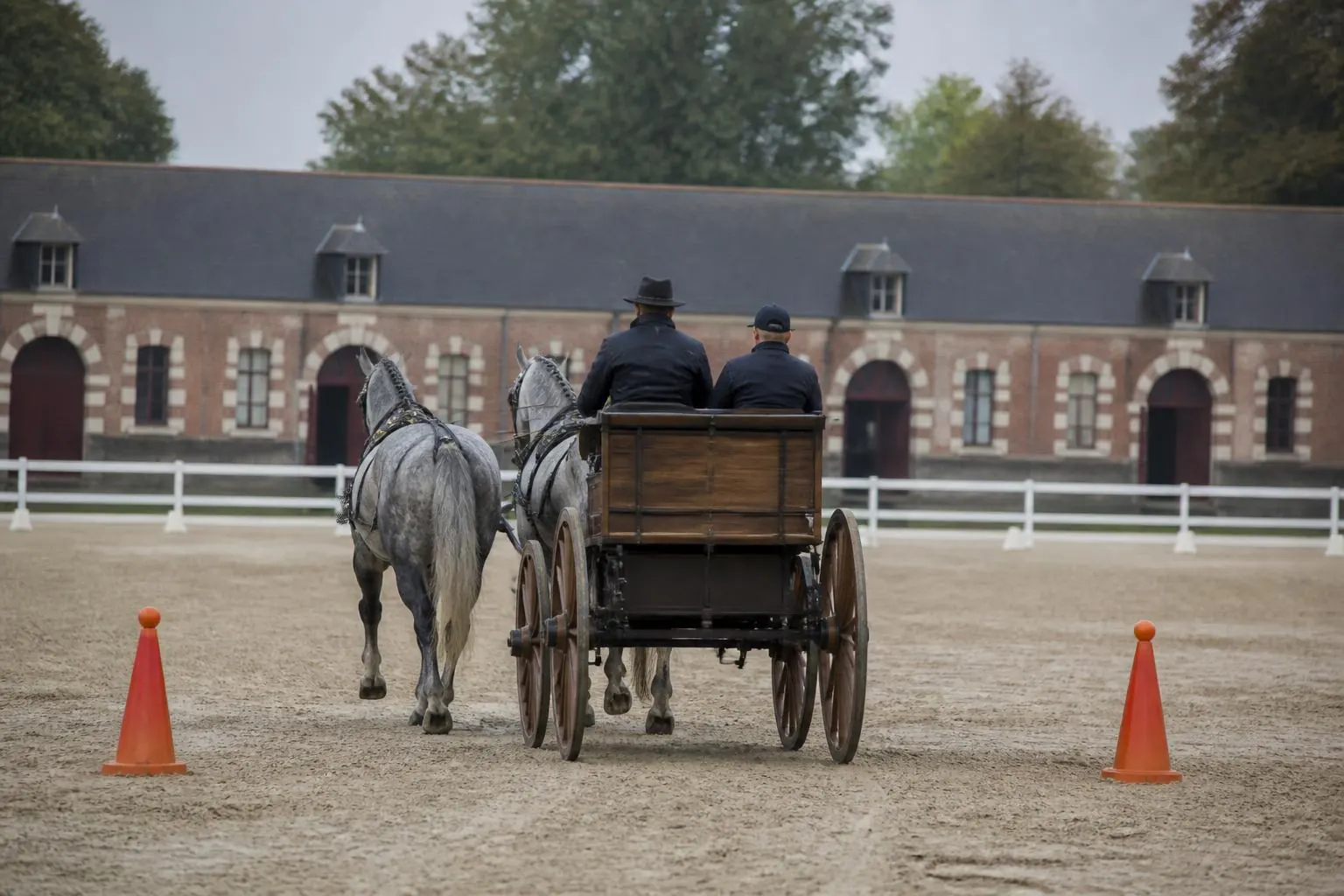
Driving, pulling, handiness: Percherons qualify for the 2027 Salon de l’agriculture
The championship does not judge conformation alone. Two half-days are reserved for working classes, which select horses for the trophies at the Salon international de l’agriculture: Friday 25th for the driven classes, and Sunday 27th in the morning for the ridden class, in the Poste arena. Single driving combines pulling, handiness and work for horses aged four to eight; pair driving adds a marathon, for horses aged four to fifteen; the ridden class is open to horses aged three to fifteen. Riders, drivers and grooms must be at least 16.
This is the part easiest to follow for a spectator who has never read a scoring grid: a knocked cone, a hesitation in the pull, a trot that breaks can all be seen from the rail. It is also a reminder of what the breed still is: a working horse. The rules of competitive carriage driving and our feature on the modern uses of the draught horse help explain what is being asked.
What a Percheron is judged on in the Haras du Pin courtyard
- Conformation: an expressive head with a broad forehead, a thick, arched neck, a short back and a long, muscular croup. The grid marks item by item, and three low marks mean elimination.
- Limbs and straightness: clean, dry cannon bones without heavy feathering, which sets the Percheron apart from the Shire or the Clydesdale. Poor straightness weighs more heavily than a handsome coat.
- Movement: a long, free walk and an energetic, elevated trot; the diligencier must cover the ground, the trait must stay regular under its mass.
- Colour and genetics: grey or black, with a compliant E/A/G file for stallions; cosmetic disguise is penalised.
- Height and section: 16.2 hh (1.68 m) or 16.3½ hh (1.70 m) at the withers depending on age, measured on arrival day, fixes the section for the championship prize.
- Presentation: braided mane and tail, a clean horse, the handler’s white and red outfit, and calm among dozens of entires.
- What the public does not see: the recalls without spectators, and the genetic and administrative file on which approval depends.
350 Percherons, buyers from three continents: what the Haras du Pin championship is worth
The SHPF’s report on the 2025 edition gives the measure of the event: close to 350 horses shown over four days, including 111 males before the approval board, 131 fillies and 80 mares, and foreign buyers from Argentina, Mongolia, China, Belgium, Germany, the Netherlands, England and Romania. The championship serves as a commercial shop window for a breed whose exports have always mattered, ever since the American farms of the nineteenth century. The number of horses entered for 2026 had not been released at the time of writing.
The event also tells the story of a breed that nearly vanished with mechanisation, as we traced in the history of the Percheron, and which today is finding new roles in towns and vineyards. To understand where the Percheron sits among the nine French draught breeds, with their real strength and their uses, our main guide to the draught horse is the place to start.
The championship falls a week after the international eventing competition at Le Pin, held on the same grounds from 17 to 20 September. Riders looking for a club or a yard in the region will find the stables of the Orne and neighbouring departments in the Normandy equestrian directory, and the other autumn fixtures in our calendar of equestrian events.
French Percheron Championship at the Haras du Pin: key points
- When: Thursday 24 (stallions aged three and over from 4 pm) to Sunday 27 September 2026; two-year-old males Friday 8.30 am, fillies Saturday and mares with foals Sunday 8.45 am.
- Where: Haras national du Pin, Le Pin-au-Haras (Orne), main courtyard for the judging, Poste arena for the working classes.
- How much: free entry for all. Entry fee €20 per female, €80 per two-year-old male, €130 per male aged three and over.
- The rule: every Percheron is scored out of 100, with 62 points the minimum to be approved as a stallion or to go through to the recall; three marks of 4 or one mark of 2 mean elimination.
- The code: braided manes and tails, white outfit and red tie, no cosmetic tricks, influenza and tetanus vaccinations up to date on pain of exclusion.
At Le Pin, the handsomest Percheron does not win; the winner is the one no item on the grid drags below the bar. A horse of nearly 2,000 pounds (900 kg) judged to the centimetre and the point, in a courtyard laid out under Louis XIV: you see it only once a year.