
From Thursday 10th to Sunday 13th September 2026, the Pôle Européen du Cheval at Le Mans will host the Grande Semaine de Dressage for the first time: the national finals for four, five and six-year-old horses and ponies run by the Société Hippique Française, combined with the France Dressage finals from foal through three-year-olds. For the four-year-olds, everything hinges on a test lasting roughly three minutes, marked with five separate scores out of ten, and a ridden presentation in hand with the saddle removed, marked out of twenty. The 2026 SHF rules state plainly that the rider’s position, seat and effectiveness of aids “are not taken directly into account in marking”. Here is what judges actually watch.
Four days at Le Mans, and a first
For three years, the dressage young horse final took place at the Grand Parquet in Fontainebleau. On 8th January 2026, the SHF announced its move to Le Mans to “restore the Grande Semaine de Dressage as a gathering place for the breeding community”. The SHF finals for four, five and six-year-olds sit alongside the France Dressage finals, which judge young stock “from foal through three-year-olds, horses and ponies”, and a regional federation competition run by the Pôle Européen du Cheval. The circuit, prize money and rules are detailed in our guide to the Société Hippique Française, but what concerns us here is how four-year-olds are judged, a system quite unlike any other dressage class.
Video · 70 seconds
What the video shows
Four-year-olds: five marks out of ten, conformation marked out of twenty, and rules stating the rider isn’t marked. What judges really watch.

Five marks out of ten, and not one per movement
In a regular dressage test, each figure receives its own mark: at the World Championships in Aachen last August, seven judges marked thirty-three movements individually, as we described in our article on how dressage is judged at the Worlds. For four-year-olds in the SHF, nothing of the sort. The official protocol for the 2026 final test runs to five lines: trot (rhythm, suppleness, elasticity, activity, supple back, stride length), walk (rhythm, relaxation, activity, stride length), canter (rhythm, suppleness, natural balance, impulsion, uphill tendency), rideability (quality of contact, straightness, obedience, transitions) and potential, meaning “the prospect as a dressage horse, the capacity to collect and carry more weight behind”.
Each criterion receives a mark out of ten, to one decimal place, and the total out of fifty is converted to a hundred-point scale. Errors cost 0.5 per cent the first time, 1 per cent the second; a third mistake eliminates.
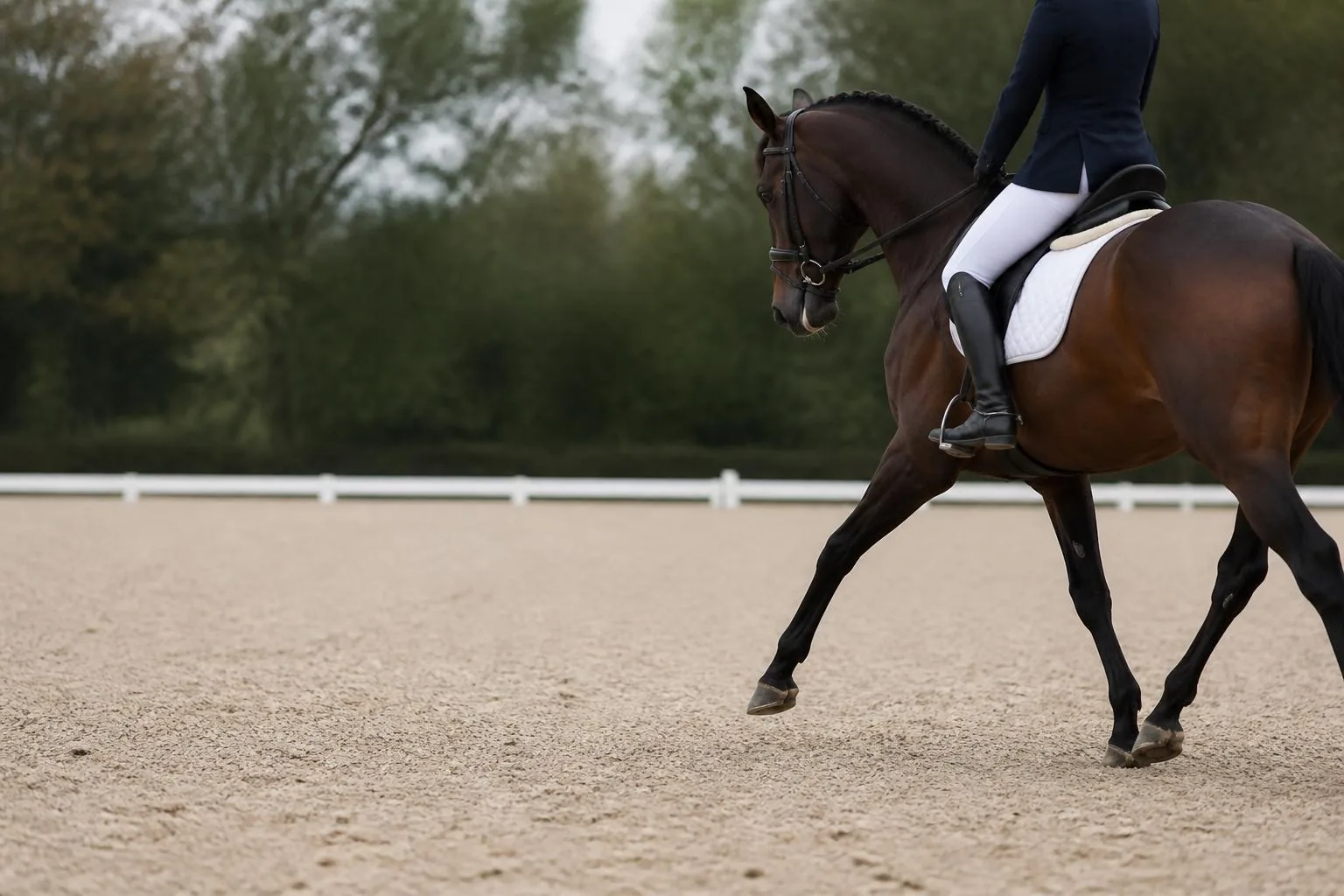
The arena is Grand Prix size, 196 feet by 66 feet (60 by 20 metres), but the tempo is quite different: nine minutes between horses, movements lasting roughly three minutes, and six minutes after the bell, a period that “may be used to familiarise the young horse with the arena before beginning”. Rising trot is permitted. The test comprises half-circles of 66 feet (20 metres), working canter circles on each rein, and two stretching sequences where the rider allows the horse to “gradually extend on a longer rein”. No lateral movements, no flying changes: at four years old, judges are watching the three gaits and how the horse carries itself.
The rider isn’t marked: what the rules say
The rule appears in the SHF 2026 regulations under “Judging Principles for Young Horse Classes”: “The rider’s position, seat and effectiveness of aids are not taken directly into account in marking young horse classes.” None of the five marks concerns the rider. A judge does not penalise a high hand or a round back from the saddle: he marks what the horse shows.
It would be wrong, however, to conclude that horsemanship doesn’t matter. The same rules state that “the quality of training appropriate to the horse’s age is as important as the correctness of the gaits”. The rider isn’t marked, but his work reads in the horse at every stride.
The rules also demand a clemency suited to young horses. For a four-year-old, minor faults include “some tension at the start of the test”, a halt that isn’t perfectly straight, transitions “not exactly at the letters”, a false start immediately corrected. Horses that are “a little playful” at the beginning of the test “must be judged with somewhat more leniency than in other types of competitions”. Conversely, irregular rhythm, a tense back, repeated contact problems or “insufficient engagement of the hindquarters” lower marks, because they reveal either the horse or its training. The final point of this same section is most revealing: “A horse with the potential to become a high-level performer must be preferred to a horse that merely executes the test obediently but shows no real prospect of progressing further.” The Le Mans final doesn’t reward the quietest horse. It rewards the one judges believe will go furthest.
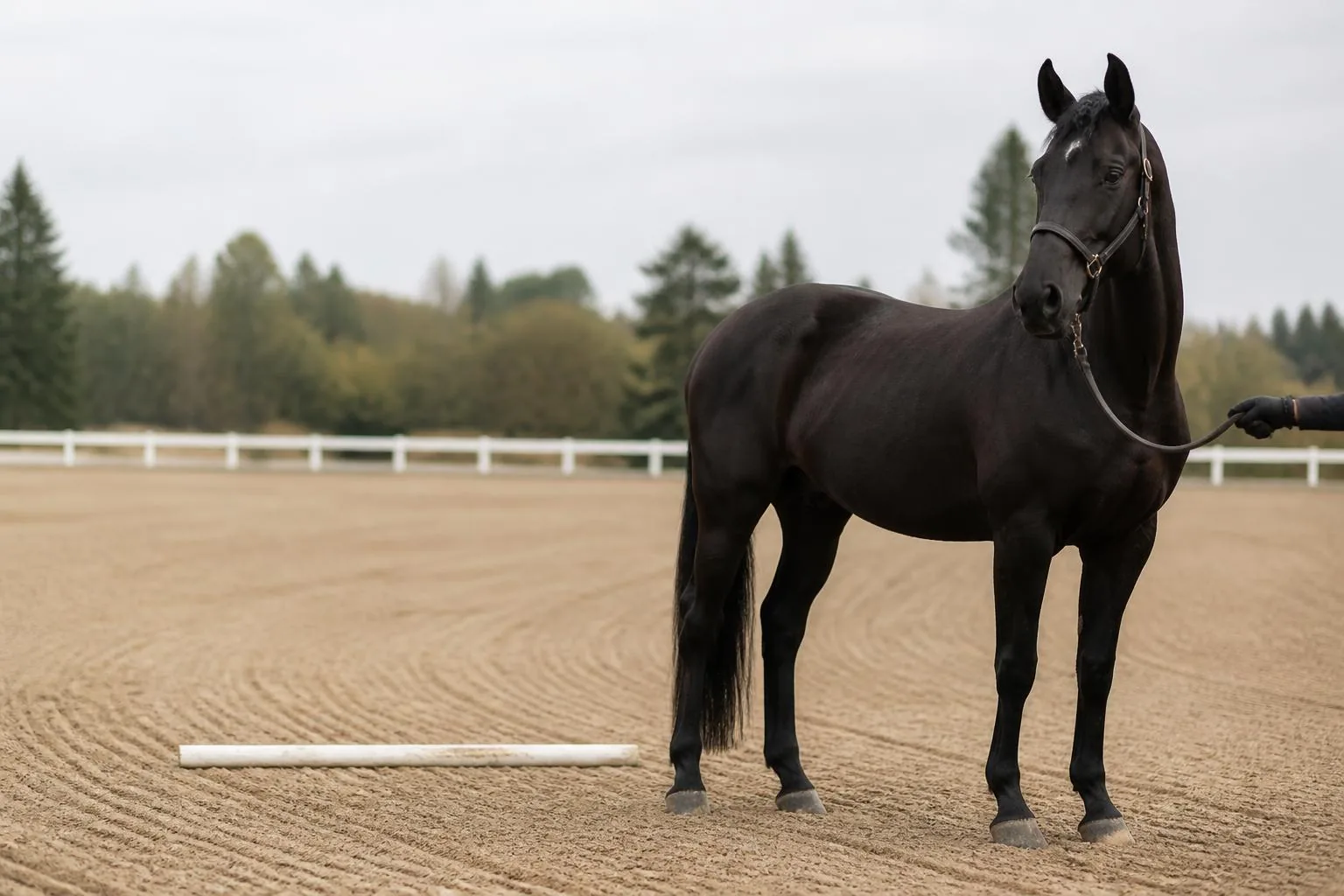
Unsaddled and in hand: the conformation mark out of twenty
The national four-year-old final comprises three phases: a preliminary test, a conformation assessment and a final test. The top twelve from the preliminary enter the final directly; the remainder compete in a smaller final whose top three reserve their place. In between comes the conformation phase: “The jury examines the young horse unsaddled and in hand, led by the rider or an assistant. They award a conformation and condition mark out of twenty.” Helmet and lead rope are compulsory. The horse is shown standing in profile before a pole on sand, walks then trots in a straight line on an out-and-back, and presents itself in profile once more.
This mark counts in the Four-Year-Old Championship with a weighting of 0.3, against 2 for the final test; the total out of 230 is converted to a hundred-point scale. Conformation thus accounts for roughly 13 per cent of the result: enough to separate two closely-matched horses, but not enough for a beautifully-built horse to win if it doesn’t move well. The rules describe what a judge looks for: a horse “developing well”, hindquarters “well angled”, shoulder “inclined rather than vertical”.
This Championship is not open to all. Every four-year-old can run in the Criterion, ranked solely on the final test, but the champion title is reserved for breeds affiliated to the SHF, including the Selle Français, French Dressage Horse, Anglo-Arab or Connemara. A KWPN or Hanovrian can therefore win the Four-Year-Old Criterion at Le Mans without being eligible for the champion title.
The four-year-old conformation assessment took place on Thursday 10th September. The scoring sheet published by the SHF, timestamped 18:46, lists five horses: Miami Vice de Hus, a black Selle Français by Dream Boy, leads with 17.2 out of 20, ahead of Majestic G (17.0) and Maybach de Massa, a French Dressage Horse by Everdale (16.6). None is yet champion: at this stage, they have earned only a 0.3 weighting.
Snaffle bridle, 9/16 inch (1.4 cm) cannon, whip handed in before the arena
Tack is controlled to the millimetre. Tests are ridden “in a snaffle bridle”, a double bridle being “forbidden in warm-up and in the competition arena”. For four-year-olds, the bit cannon must measure at least 9/16 inch (1.4 centimetres) at the corners of the mouth, compared to 1/2 inch (1.2 centimetres) for five and six-year-olds: a thicker, softer bit for the youngest mouths. Our guide to choosing a bit explains what this diameter changes, and we have described signs of a mouth suffering from the bit. The noseband must allow two fingers in; excessive tightness is “considered cruel treatment”. The whip, permitted throughout the season, must be handed in before entering the National Final presentation area, on pain of a two-point deduction. During warm-up, only a single earpiece is tolerated, and the rider must remain able to hear what is happening around them.
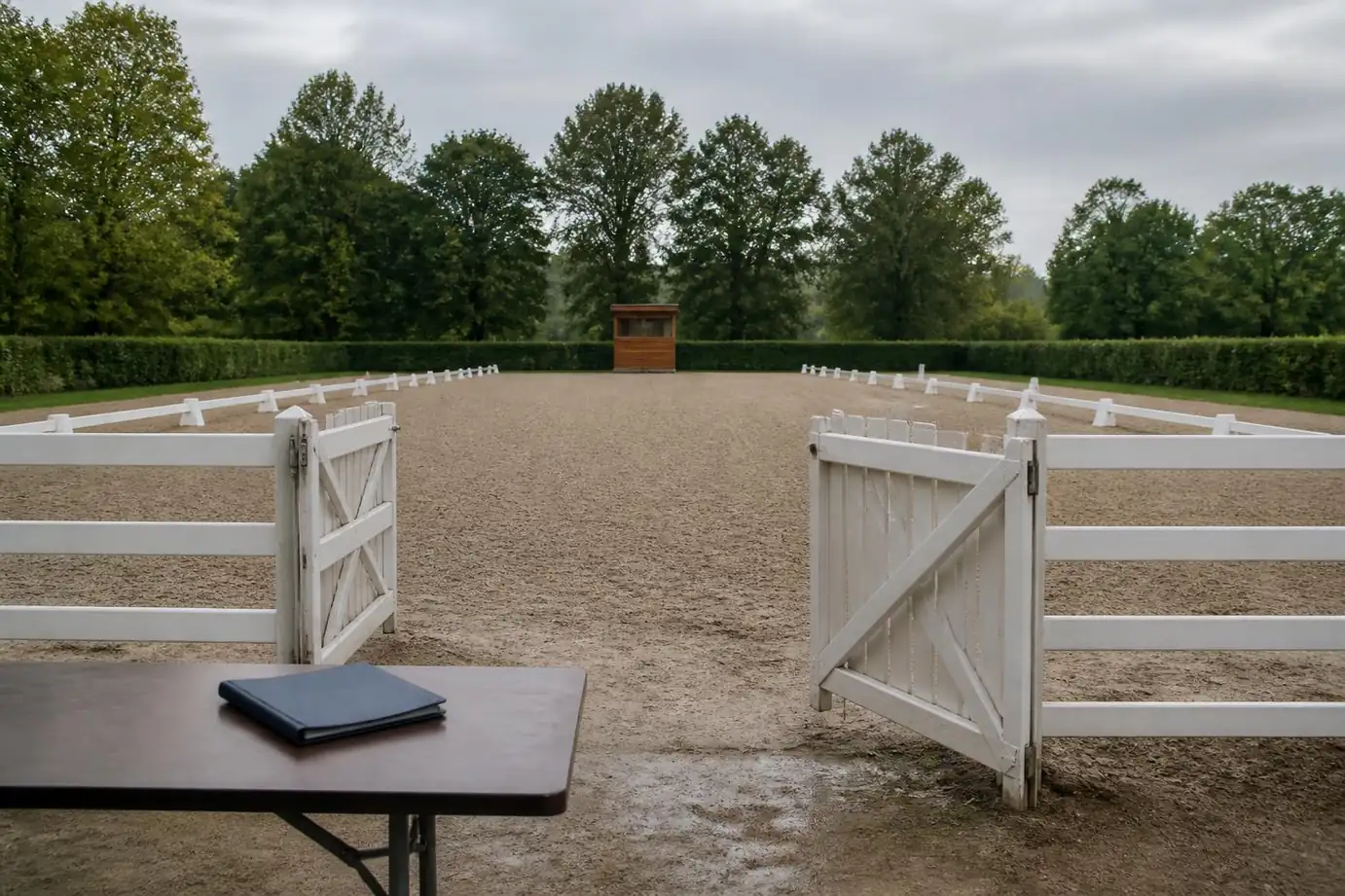
Passport checked at the paddock entrance
On 8th September, the organisers reminded competitors that coat colour checks, castration verification and vaccination inspections would take place during the week. Each horse’s passport is handed over at the entrance to the preliminary test paddock, and “failure to present the passport will automatically result in the horse’s disqualification”, with no possibility of correction afterwards. We have already explained why a horse’s passport cannot be replaced.
The 2026 SHF vaccination protocol covers influenza and rhinopneumonitis: two primary vaccinations spaced 21 to 60 days apart for horses vaccinated after 1st January 2022, a first booster 120 to 180 days later, then a booster at most one year after the previous one. On-site, a vaccine dated more than 14 months ago or less than 8 days old means “disqualified and barred from competing”. This is the sort of deadline that a digital equine health record makes easy not to miss; our sheet on equine influenza vaccination protocols details the schedules.
Twelve starts maximum: the four-year-old’s season
To be admitted to the final, a four-year-old must have run in at least four Classic Cycle classes, including two Label competitions, and earned at least 200 euros. But the rules also set a ceiling: twelve dressage tests maximum in a calendar year, eighteen across all disciplines, and no “outside breeding circuit” events. The SHF limits the youngest horse’s season for the same reason it prohibits timing in four-year-old jumping finals, as we explained when covering the four-year-old showjumping final at Fontainebleau: at this age, the horse is there to show what it will become, not to be used up. Yards specialising in young horse training therefore plan their season backwards from the final: a horse arriving at Le Mans has rarely competed in more than a dozen tests.
What four-year-olds are judged on at Le Mans
- Three gaits, one mark out of ten each: regularity of rhythm, suppleness, stride length, uphill tendency.
- Rideability, one mark out of ten: stable contact, straightness, obedience, transitions.
- Potential, one mark out of ten: the prospect of collecting and “carrying more weight behind”.
- Conformation, one mark out of twenty, horse unsaddled in hand, weighting 0.3 in the Championship (against 2 for the final test).
- The rider: position, seat and aids “are not taken directly into account in marking”.
- What costs points: irregular rhythm, tense back, unstable contact. What is forgiven: tension at the start, a false start corrected.
What we don’t know
The number of horses entered in each final has not been published in verifiable form; the four-year-old conformation sheet contains only five names, which doesn’t indicate the size of the Criterion, which is open to all breeds without a compulsory conformation assessment. The judging criteria for France Dressage finals from foal through three-year-olds do not appear in the documents reviewed. Finally, test results were not available on the morning of 11th September: final placings will be announced by Sunday.
Sources: General Regulations for Breeding Classes 2026, Dressage, SHF, version 4 (chapters 3.3, 5.1.1 and 6); “Classic Cycle Four-Year-Olds, Final Test 2026” protocol, SHF; four-year-old conformation scoring sheet, note.shf.eu, 10th September 2026; SHF announcement of 8th January 2026; “Grande Semaine de Dressage 2026: all useful information”, SHF, 8th September 2026; SHF vaccination protocol, April 2026; France Dressage “French Championships” page. Equirider is affiliated with neither the SHF nor France Dressage.