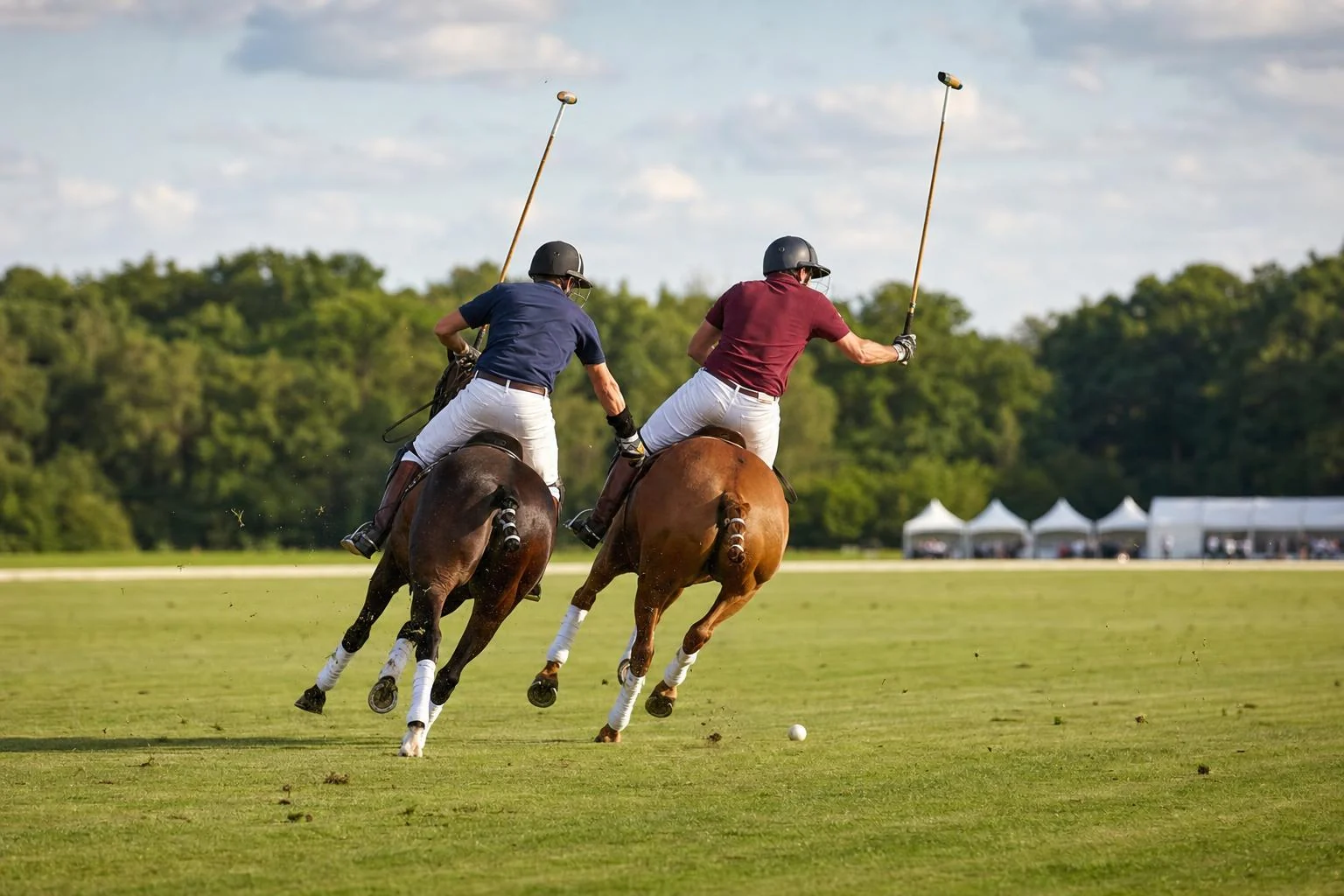

The BARNES Open de France polo final is played this Sunday, 20 September 2026, at 3.30 pm on the main field of the Polo Club du Domaine de Chantilly, at Apremont farm (Oise), between Akasha and Kazak, two teams rated at 17 goals in a tournament capped at 16. It closes three weeks of competition, four tournaments, more than 1,200 horses and 21 nations gathered on the edge of the Chantilly forest. Entry is free, parking is free and the matches are commentated. Before it, the final of the SkinCeuticals Women’s Open de France at noon; after it, the Trophée Castel final at 5.30 pm. Here is the programme, the teams, the handicaps and what to watch from the touchline.
Polo Open de France 2026: the programme for Sunday 20 September finals day at Chantilly
The 26th edition of the BARNES Open de France opened on 4 September and ends this Sunday. Twelve teams, split into four groups, with a combined handicap of between 14 and 16 goals: it is the highest level played in France, and one of the strongest tournaments in Europe at this time of year. Around it, the club has run three other competitions in parallel: the SkinCeuticals Women’s Open de France (14-16 goals, 15 to 20 September, seven teams, 28 players from 14 nations), the Trophée Castel (6-8 goals, 4 to 20 September, reserved for young professionals) and the Trophée du Capitaine des Jeux (0-4 goals, amateurs, finished on 13 September). A Mini Open de France for under-13s occupies the side fields on Saturday and Sunday.
Finals day follows a fixed order, published by the club:
- 11 am: the village opens beside the main field.
- 12 noon: SkinCeuticals Women’s Open de France final.
- 3.30 pm: BARNES Open de France final, Akasha v Kazak.
- 5.30 pm: Trophée Castel final.
To place the event in the season, our equestrian events calendar lists the other fixtures of late September; Chantilly hosts two at once this weekend, since the château is showing Rosa Bonheur and her horses a few miles from the Apremont fields.
On video · 123 seconds
Polo Open de France 2026: Free Entry, 1,200 Horses
Akasha v Kazak, 17 goals each, Sunday 20 September at 3.30 pm at Apremont farm: the programme for the three finals, the teams, the handicaps and what to watch. Free entry.

Akasha v Kazak: a 17-goal polo final in a tournament capped at 16
It is the detail regulars at the club are talking about. In polo, every player carries a handicap, from -2 for a beginner to 10 for the handful of players who dominate the Argentine circuit. A team’s handicap is the sum of its four players. The BARNES Open de France is open to teams rated 14 to 16 goals. Yet both finalists show 17: the handicap of Ciro Urturi, twenty years old and playing for Akasha, was revised upwards during the season, and Kazak also fields a total of 17. As the two sides are level, neither gives the other a goal at the throw-in: the final will start at nil-nil, which is not true of every handicap match.
Akasha (17): Alexandre Carese (0), Ciro Urturi (3), Facundo Fernández Llorente (7) and Tomás Beresford (7). Kazak (17): Sébastien Aguettant (0), Pedro Chavanne (5), Leon Donoso (5) and Teodoro Lacau (7). Donoso is sixteen. Chavanne scored six goals in the semi-final. The two zero-handicappers are the team patrons, the people who fund the structure, the horses and the salaries of the professionals, a model we explained in how much a professional polo player earns.
The road to the final shows the depth of the tournament. In the quarter-finals, on 13 and 14 September, Akasha knocked out Talandracas 12-11 with a golden goal from Beresford in extra time, and Kazak edged past Essso 7-6 after two extra periods, with a golden goal from Chavanne. On Thursday 17 September, in the semi-finals, Akasha beat the defending champions Octogone 9-7, unbeaten until then with David Stirling, ten-time winner of the Argentine Open, and Kazak saw off Jolly Roger 8-6. There is a scent of revenge in the air: in 2021, Kazak lost the final 12-5 to La Magdeleine, the team that preceded Akasha.
The tournament’s top scorer, however, is a player who went out early: Guillermo Caset, of Essso, scored 26 goals in the group stage, including eleven on his own in a 14-6 win over Sainte-Mesme. Octogone, before falling, had produced the match of the first phase, a 12-10 win over Essso after trailing by four goals in the fifth chukka.
Polo handicaps: what 0, 5 and 7 goals mean for the players at Chantilly
A 7-goal player belongs to the world elite, the ones who play the big tournaments in Argentina, England and the United States. A 5 is an established professional, able to hold a position in any European tournament. A 3 at twenty, like Urturi, is a rising player whose rating the federation raises before the end of the season, which explains Akasha’s 17. A 0 is not a beginner: he or she is a solid amateur, often the patron, who rides their own horses and plays number 1 or number 4, in front or behind. On the field, the four shirts carry numbers from 1 to 4: the 1 attacks, the 2 and 3 build play, the 4 defends, and the 3 is almost always the highest-rated player.
SkinCeuticals Women’s Open de France: Augustinus Bader v Why Not, at noon
The women’s final opens the day at 12 noon and brings together two 16-goal teams. Augustinus Bader field Alicia Gariador (3), Mendoza Houben (1), Paloma Lauro (4) and Argentina’s Lia Salvo (8). Why Not answer with Allegra Barnaba (1), Lorena Renggli (2), Hana Grill (3) and Britain’s Hazel Jackson, rated 10 goals, the top mark in the women’s handicap. Jackson played the BARNES Open with Octogone the same week: at Chantilly, the best women also play the mixed tournaments, something that exists in almost no other top-level equestrian sport.
The tournament brought together seven teams and 28 players from 14 nations over six days, with players such as Elena Venot (France, 7 goals) and Catalina Lavinia (Argentina, twenty years old, 7 goals). To understand where this rise of women’s polo in France comes from, read our article on the 2026 French women’s polo championship, played in July.
Trophée Castel: the young professionals’ polo final at 5.30 pm
The Trophée Castel, at 6-8 goals, is the gateway to professional polo: teams from Germany, Italy, Belgium and Saudi Arabia took part this year. The 5.30 pm final pits Animales Polo Team (8), with Augustin Emsens (0), Pierre Hamelin (2), Elouan Badarello (2) and Guillermo MacLoughlin (4), against Casa Del Riyadh (8), with Salman Bin Sultan (-1), Côme Dubois (2), Jules Legoubin (3) and Hilario Ruiz Guiñazú (4). Animales qualified thanks to a golden goal from Badarello in extra time. Players trained in France appear in both teams, a sign that the club’s training pathway, with its eight instructors and sixty school horses, now feeds the top of the draw.
1,200 horses at Apremont: the polo pony, the athlete the crowd does not watch
We say “pony” out of tradition, but these are horses of 14.3 to 15.3 hands (1.50 to 1.60 m), most often bred in Argentina, from crosses between the Thoroughbred, which gives speed and wind, and the Criollo, which gives balance and handiness. Our profile of the Thoroughbred explains why this breed is the foundation of almost every fast sport horse. A polo pony must gallop flat out, stop in three strides, pivot on its hocks and set off in the other direction, all while accepting that another horse will barge into it shoulder to shoulder, the famous ride-off.
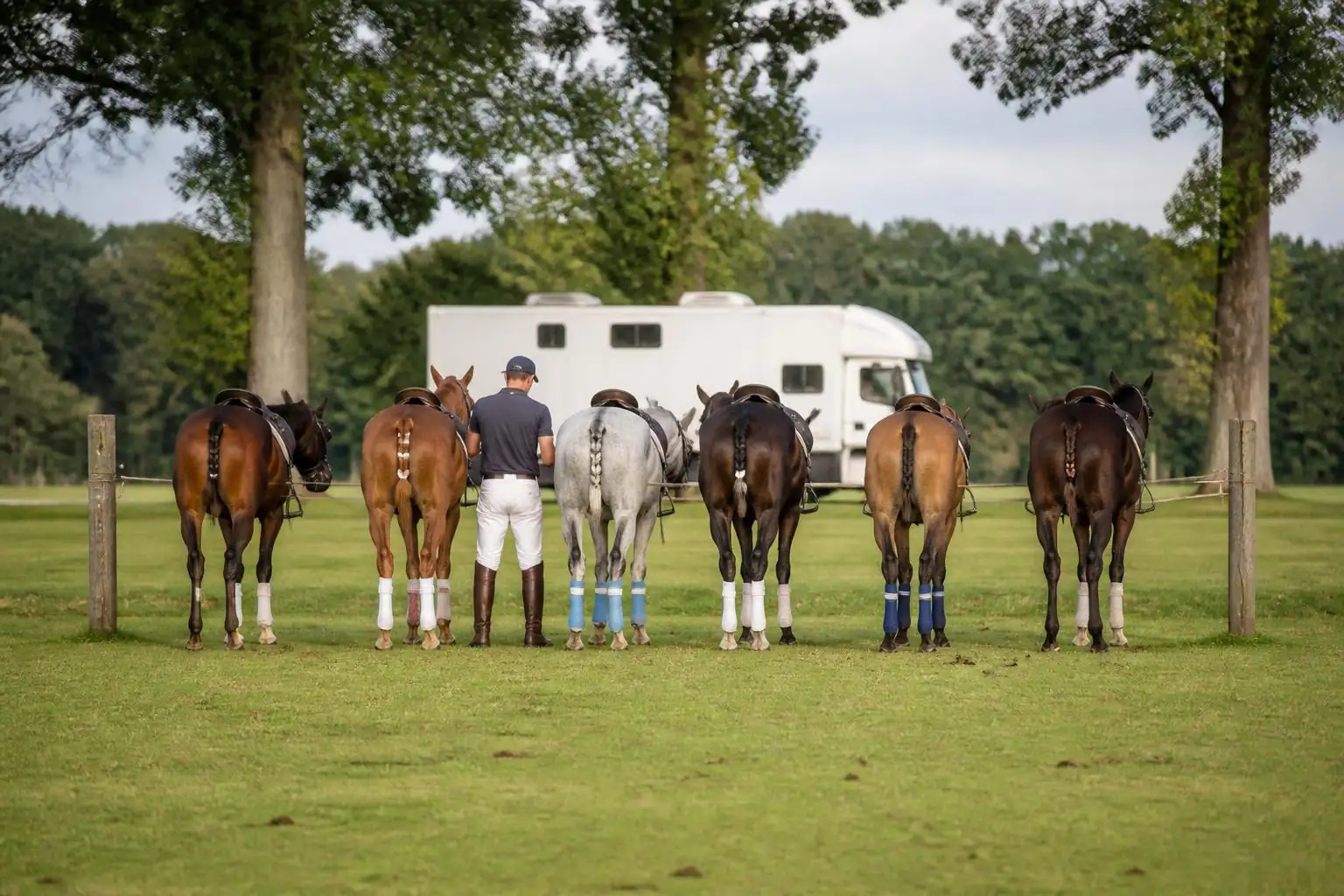
A match is played in seven-minute periods, the chukkas, and a player changes mount every period, sometimes in the middle of one if the horse is out of breath. A top-level team therefore brings between six and ten horses per player to a tournament. We worked through that sum in how many horses a polo player needs to own. Multiply by 50 teams and you understand the 1,200 horses announced by the club, housed in 200 permanent stables, 200 to 400 temporary stables and thirty paddocks of 7.5 to 15 acres (3 to 6 hectares).
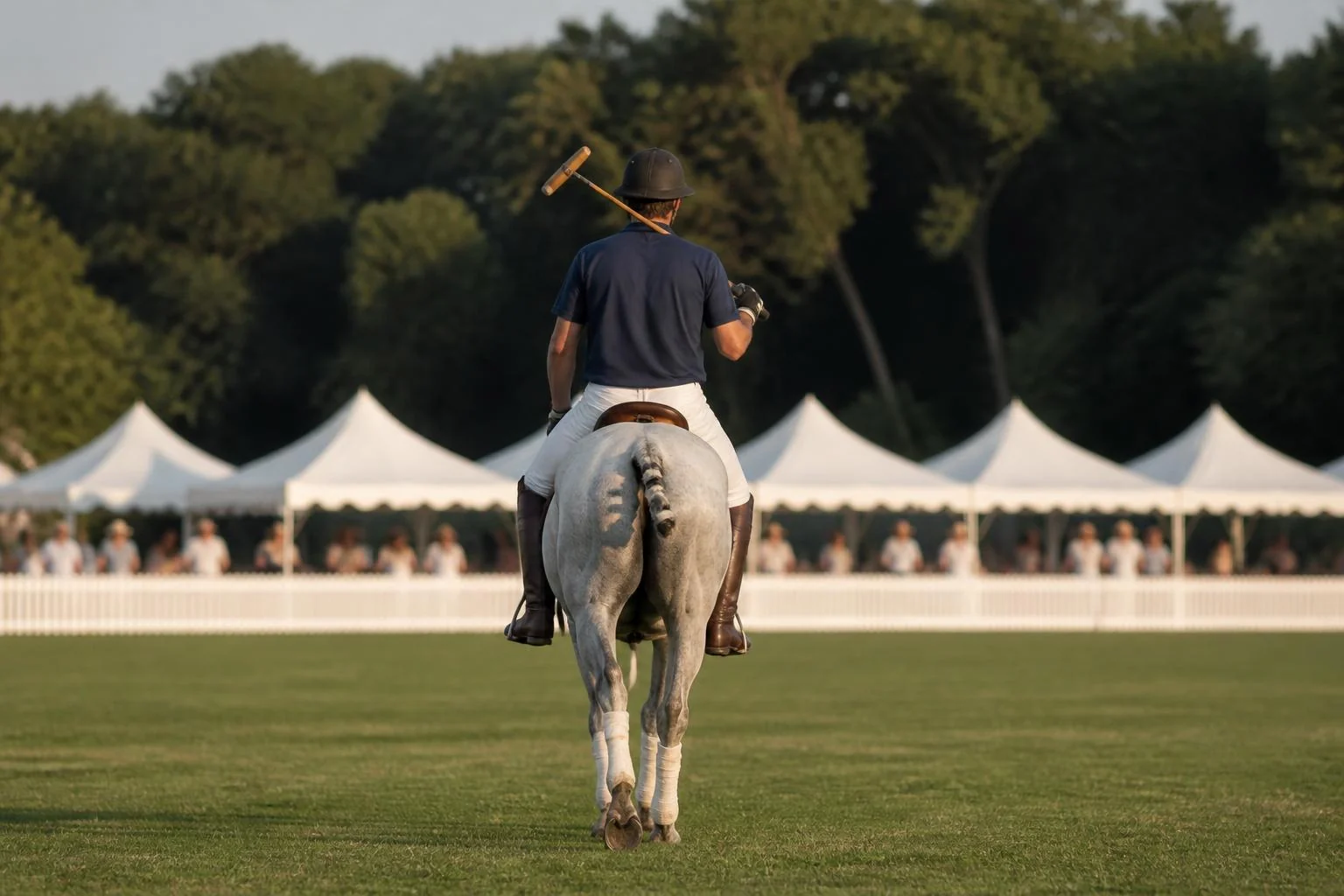
The detail you can see from the stands: legs are bandaged up to the knees to protect the tendons from mallet and ball strikes, the mane is clipped so it does not get in the way of the mallet, and the tail is braided and folded up into a bun so it cannot wrap around the shaft. Choosing a mount, its age, temperament and price are covered in another guide, which horse for playing polo.
What to look for when judging a polo match from the touchline
- The line of the ball. The whole rulebook rests on an imaginary line drawn by the ball’s path: the player following it has right of way, and the one who crosses it commits a foul. When the mounted umpire blows the whistle, it is almost always for this.
- The ride-off. Pushing an opponent shoulder to shoulder is allowed, provided both horses meet at the same angle and at a comparable speed. A collision that is too sharp or too oblique is a dangerous foul.
- The hook. You may block an opponent’s mallet with your own, but only below the height of the horse’s shoulder and on the same side as the ball.
- Changing ends. Teams switch ends after every goal scored, not at half-time, to even out the wind and the state of the ground.
- The number of horses brought. A team that puts fresh horses out in the last chukka often wins the final on legs, not on talent.
- The golden goal. If the scores are level at the end of normal time, an extra period is played and the first goal wins: three of this edition’s four quarter-finals were decided that way or by a single goal.
Chantilly, 507 acres of polo on the edge of the forest: how to get there, what is free
The Polo Club du Domaine de Chantilly occupies the 507 acres (205 hectares) of Apremont farm, a 17th-century estate converted in 1995, 40 minutes from Paris on the A1 and a few miles from the château and its Grandes Écuries. There are nine international-size grass fields, 300 yards by 159 yards (275 m by 145 m), and two sand arenas, including the largest uncovered sand arena in Europe, 175 yards by 82 yards (160 m by 75 m), installed in 2025. The club has 420 affiliated players, making it the leading polo club in France and one of the largest in Europe.
Practically speaking for Sunday: access to the fields, the finals and the village is free, parking is free, and the weekend’s matches are commentated over the microphone, which helps enormously when you are discovering the sport. Address: Ferme d’Apremont, 60300 Apremont. The stands at the main field are limited, and the rest of the crowd settles along the touchline, behind the low boards; bring something to sit on and shoes suited to grass, and you may be invited to tread in the divots at half-time, a polo tradition that helps repair the field.
If you are looking for a club to try the sport after the final, the Oise and the Hauts-de-France have several venues that offer introductions to polo and its cousins; our equestrian directory for the Hauts-de-France lists them, and our quiz on polo, horse-ball and TREC lets you check what you remembered on the way home. For those travelling from further afield, Chantilly racecourse and the exhibition Rosa Bonheur and the horse at the château round off a day devoted entirely to the horse.
Polo Open de France at Chantilly: the key points
- When: Sunday 20 September 2026, village open from 11 am, women’s final at 12 noon, BARNES final at 3.30 pm, Trophée Castel at 5.30 pm.
- Where: Polo Club du Domaine de Chantilly, Apremont farm, 60300 Apremont (Oise), main field.
- Who: Akasha (Carese, Urturi, Fernández Llorente, Beresford) v Kazak (Aguettant, Chavanne, Donoso, Lacau), 17 goals each, no handicap goals given.
- The numbers: more than 1,200 horses, 21 nations, around fifty teams and some 200 players over three weeks and four tournaments.
- The cost: free entry, free parking, commentated matches.
- The defending champions: Octogone, knocked out in the semi-final 9-7 by Akasha.
Sources: programme and presentation of the 2026 BARNES Open de France on the Polo Club du Domaine de Chantilly website, the club’s September 2026 tournament calendar, semi-final report by Presse Agence (17 September 2026), line-ups published by Polo Press (18 September 2026) and quarter-finals reported by Pololine (14 September 2026). The results of the finals will be known on Sunday evening.