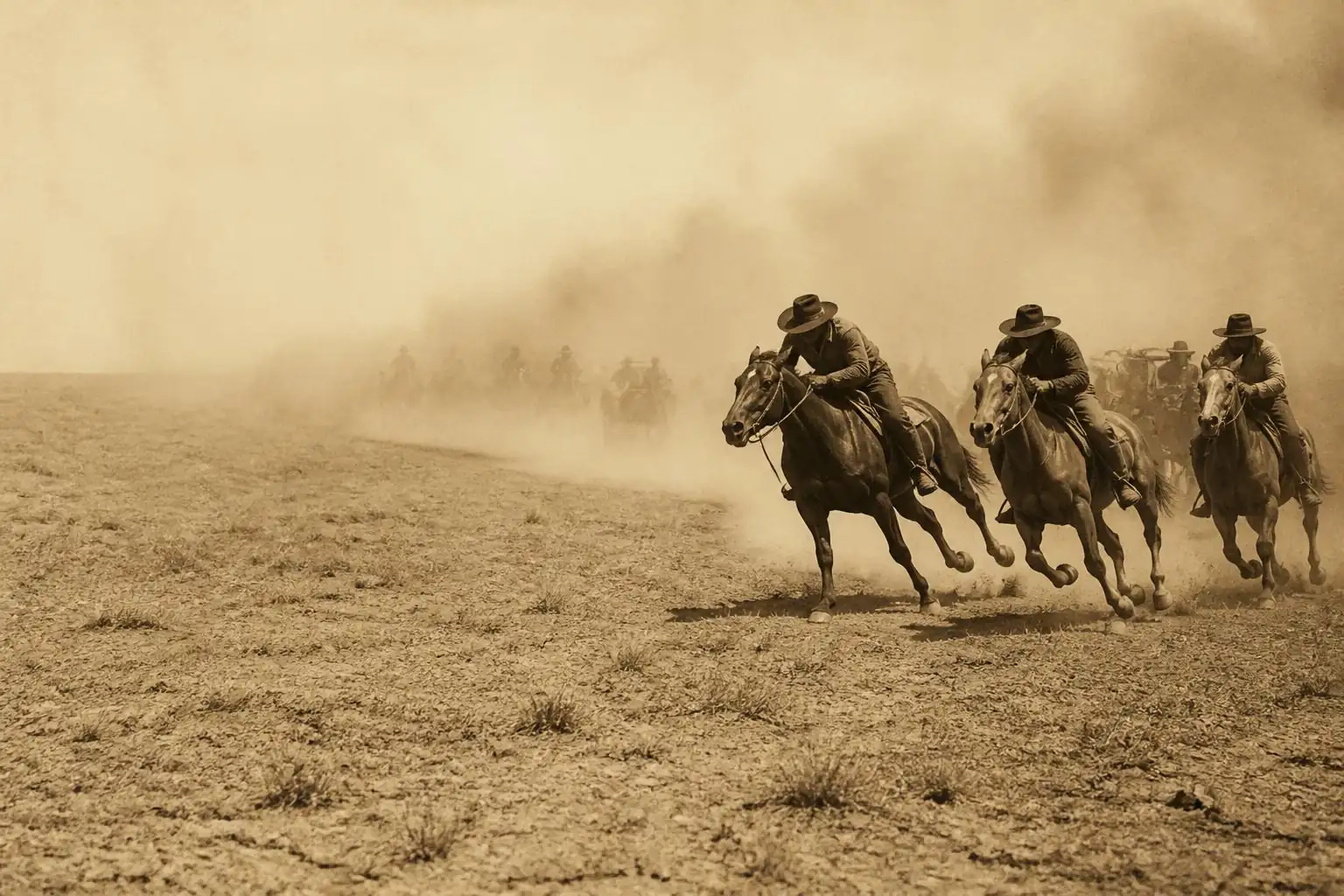

On 16 September 1893, at noon precisely, gunfire cracked along a line stretching hundreds of miles south of the Kansas border. More than 100,000 people surged forward simultaneously, on horseback, in wagons, on foot, by bicycle and even by train. They were chasing 40,000 parcels of land. Six in ten would go home empty-handed, and the sorting would happen at the speed of horses. This was the Cherokee Outlet opening, the largest land run ever organised, and one of the very few moments when an entire territory was distributed at a gallop.
A Territory Handed Out by Horse Race
The Cherokee Outlet was a strip of land created in 1834, roughly 60 miles (97 km) wide and 225 miles (362 km) long. It had been granted to the Cherokee Nation to give them access to hunting grounds in the West. On 17 March 1893, Congress approved its purchase by the United States for $8,595,736.12, just over a dollar per acre. The Cherokee Nation would contest this price for decades, finally obtaining a settlement of approximately $14.7 million in 1964, plus $2 million in interest.
The government then faced the question of how to redistribute millions of acres. It adopted a method already tried four times in Oklahoma Territory, a method contemporary documents called without hesitation the horse race method. First come, first served. President Grover Cleveland’s proclamation set the start for noon precisely on 16 September 1893. This would be the fourth and largest of five Oklahoma land runs.
The Rush in 73 Seconds
The 1893 Rush Brought Back to Life
Watch the line go, then the dust settle. You’ll find the only figure we have about horses on this day, and the reason America eventually switched to drawing lots for land.

What was missing from that starting line exists today: record your horse’s efforts, fatigue and care in the Equirider health record, then review it before your next big outing.
Nine Registration Booths, 115,000 Certificates, 40,000 Parcels
A new requirement in 1893: to have the right to run, you had to register first. Nine booths opened, four in Oklahoma Territory at Orlando, Hennessey, Goodwin and Stillwater, five in Kansas at Kiowa, Cameron, Caldwell, Hunnewell and Arkansas City. Approximately 115,000 certificates were issued. The day before the start, 20,000 people were still waiting in queues.
These queues were the first tragedy of the story, and it happened before the starting gun. It was hot, extremely hot. The Oklahoma Historical Society records at least ten deaths from heatstroke and related conditions. The Arkansas City press reported fifty cases of heatstroke in a single day and six deaths in the following night. This detail tells you everything about what was to come: if men were collapsing whilst standing still in a queue, the horses were waiting in the same heat, saddled, often without shade, and they were about to be asked to gallop.
Four land offices were set up to record claims at Perry, Enid, Woodward and Alva. Infantry guarded these offices, cavalry maintained eight camps along the line at Alva, Bluff Creek, Chilocco, Clear Creek, Hennessey, Pond Creek, South Wharton and Waynoka. The Army was not there to protect the horses. It was there to hold the starting line.
What Noon Means When You’re on Horseback
This is a point that narratives of Western expansion almost always pass over in silence. A horse is not a fast means of transport over distance. It is a very fast means of transport over a short distance, then reasonably fast over a medium distance, provided it hasn’t spent its speed at the start.
The clearest demonstration of this ceiling comes from an American breed. The Quarter Horse takes its name from the quarter mile, or 402 metres (1,320 feet). The best specialists cover this distance in just over twenty-one seconds, which represents an average speed close to 70 km/h (43 mph). This breed was selectively bred for two centuries to excel at this distance and no other. Beyond it, the engine changes nature: power is no longer what matters, it is heat dissipation.
Because a horse under exertion is first and foremost a very poor thermal machine. Most of the energy produced by its muscles is converted to heat, and it has only two ways to shed it: breathing and sweating. Under intense effort in high temperatures, equine exercise physiology literature places sweat losses at roughly 10 to 15 litres per hour. On a plain with no water, in thick dust kicked up by wind and thousands of hooves, neither of these mechanisms works properly.
To grasp the contrast with modern standards, look at contemporary endurance racing. In international competitions, horses are stopped every 12 to 25 miles (20 to 40 km) for a veterinary check, and cannot restart unless their heart rate has dropped below 64 beats per minute. Despite this safety net, a study published in PLOS ONE in 2015, covering a large sample of international events, recorded 39 per cent eliminations, of which approximately 64 per cent were for lameness and 15 per cent for metabolic disorders. Four horses in ten don’t finish, with vets checking them every 19 miles (30 km). On 16 September 1893, there were no thresholds, no checks, no obligation to stop.
What Counts When Assessing an Effort Like That of 16 September 1893
- The actual distance covered at full gallop: beyond 2 to 3 km (1.2 to 1.9 miles) at top speed, a horse can no longer sustain its pace, it only endures it.
- Temperature and humidity: it’s the sum of both that matters. Dry heat allows sweat to work, humid heat makes it nearly useless.
- Access to water before, during and after: a horse deprived of water for several hours before exertion starts with a handicap no level of fitness can compensate.
- The weight carried and the saddle: a rider, a weapon, stakes, provisions and sometimes tools, on a back that was never prepared for it.
- Training status: most of the horses present that day were farm horses or light draught horses, not racehorses.
- The right to stop: this is the only criterion entirely absent in 1893, and it’s the one modern horsemanship has made mandatory.
The Only Figure We Have on the Horses
A settler reported seeing forty horses collapsed in the first mile and a half after the starting line, dead from heat, thirst and exhaustion. This account circulates through Oklahoma’s historical literature. We know of no comparable official count. So this must be read for what it is, a testimony, not a final tally.
What is firmly documented, however, is the setting of the day. It was hot and dry. Dust, whipped by wind and thousands of feet, was described as unbearable. And the sorting happened early: the sooners, those illegal entrants who had sneaked in before the hour, had already claimed the best of the eastern third of the strip and much of the town land, particularly around Perry. Some of the horses that gave out that day were running for parcels that hadn’t been free since the day before.
What We Don’t Know
Three gaps in the record deserve mention, because they appear everywhere and are often taken for certainty.
The number of dead horses was never officially counted. The figure of forty applies only to a mile and a half witnessed by a single person. It cannot be extrapolated or extended to the entire starting line.
The early start is another story repeated without evidence. Local tradition claims a soldier fired accidentally around 11:55 and launched the race five minutes too early. The Cherokee Strip Museum itself presents this episode as tradition, not established fact.
Even the figures themselves vary. Sources give six or seven million acres opened to settlement, 40,000 or 42,000 parcels, 100,000 participants against 115,000 certificates issued. A certificate is not a starter, and the difference between the two was never clarified.
Why America Stopped Distributing Land at Gallop
The sequel is the true verdict on the method. The race procedure was used just once more after 1893: the Kickapoo lands run on 23 May 1895 was the fifth and last. Too many disputed claims, too many sooners impossible to catch, too much chaos.
Subsequent openings changed course entirely. The Kiowa, Comanche and Apache lands, along with those of the Wichita and Caddo, were distributed in 1901 by lottery: more than 165,000 people registered at El Reno and the future site of Lawton for 13,000 farms, and names were drawn from a hat. The Big Pasture followed in 1906 via sealed-bid auction. Nobody ran anymore.
In other words, the horse ceased to be the instrument of American land distribution not because something faster had been found, but because it could not guarantee fairness. It was not replaced by an engine. It was replaced by a hat and lottery tickets.
What a Today’s Rider Takes from This
This story is not merely a Far West episode. It describes the exact trap a leisure rider still falls into on a hot day: riding fast because the horse wants to, and discovering thirty minutes later that it has nothing left. The thresholds that matter, apparent temperature, humidity, breathing rate on return, recovery time, are identical in 1893 and 2026. We detail them in our guide on the temperature at which a horse is truly in danger.
The backlash is not always visible on the day itself. A horse that stiffens, sweats abnormally or refuses to move forward after violent exertion is an emergency, and the first instinct is precisely not to make it walk. We devoted an entire article to this specific case, the horse that locks up when returning to work.
As for the horses of that plain, some of their descendants still run. The wild herds of the American West, whose history we trace in our profile of the mustang, are the last living witness to a time when people relied on horses for everything, including what horses couldn’t do.
One final, very practical point. What the horses of 16 September 1893 lacked was not willingness, but a record of their prior condition: nobody knew what they had already endured in the preceding weeks. Today, this gets recorded. Vaccinations, wormers, fatigue episodes, heatstroke, injuries, it all goes into the Equirider digital health record, and that’s what lets you know, before you leave, whether a horse has the right to run.
Key Takeaways
- On 16 September 1893 at noon, over 100,000 people surged into the Cherokee Outlet chasing approximately 40,000 parcels.
- The official distribution method had an explicit name, the horse race: first come kept the land.
- At least ten people died of heatstroke around the event, and the heat had already struck in the registration queues.
- The only known figure for dead horses comes from a single testimony, forty animals across one and a half miles. No official count exists.
- After one final run in 1895, the United States abandoned the race in favour of lottery and auction.
Sources
Oklahoma Historical Society, Encyclopedia of Oklahoma History and Culture, entries for Cherokee Outlet Opening, Kickapoo Opening, Kiowa-Comanche-Apache Opening and Land Openings. Cherokee Strip Museum and Rose Hill School, Perry, Oklahoma. Gateway to Oklahoma History, photographic records from the 1893 run. National Cowboy and Western Heritage Museum, file on land runs. International Federation for Equestrian Sports, endurance regulations and heart rate criteria at veterinary checks. Study published in PLOS ONE in 2015 on speed and heart rate recovery variables as predictors of endurance elimination. Equine exercise physiology literature for thermoregulation and sweat loss parameters.