The horse industry is crying out for workers, yet it cannot find them. Every year, riding schools, stables, studs, and independent craftspeople post vacancies that remain open for months. The paradox is well known in the sector: passion for horses attracts tens of thousands of people, yet very few take the step towards professional training. Here are the roles with the strongest recruitment drive, what they genuinely demand, and how to judge whether the work is right for you.
A sector that employs thousands, yet struggles to recruit
France’s équine sector employs tens of thousands of people: riding centres, private stables, studs, racing yards, farriery, veterinary care, training, and equestrian tourism. The sector’s employment observatory, run by Equi-Ressources and the IFCE (Institut Français du Cheval et de l’Équitation), publishes an annual employment survey that invariably reaches the same conclusion: some vacancies find candidates within days, while others remain posted for months due to a shortage of trained applicants.
The reason is straightforward, and it is not glamorous. Many of these positions require you to be available early in the morning, at weekends, outdoors, in all weathers. These are not desk jobs dressed up as passion projects. Those who succeed are those who understood this before signing the contract.
- Real market demand: do vacancies stay open for weeks, or are there 80 candidates competing for one position?
- Required training: state-recognised qualification mandatory, private certification, apprenticeship, or learning on the job?
- Employment status: employed on a collective agreement, or self-employed building your own client base?
- Working patterns: unsociable hours, weekends, seasonal work, on-call duties.
- Physical toll: back, knees, hands. Many horse careers take their payment in years of bodily wear.
- Career progression: can you advance to head groom, trainer, business owner, or does the ceiling come quickly?
Stable groom: the most advertised role, and the most underestimated
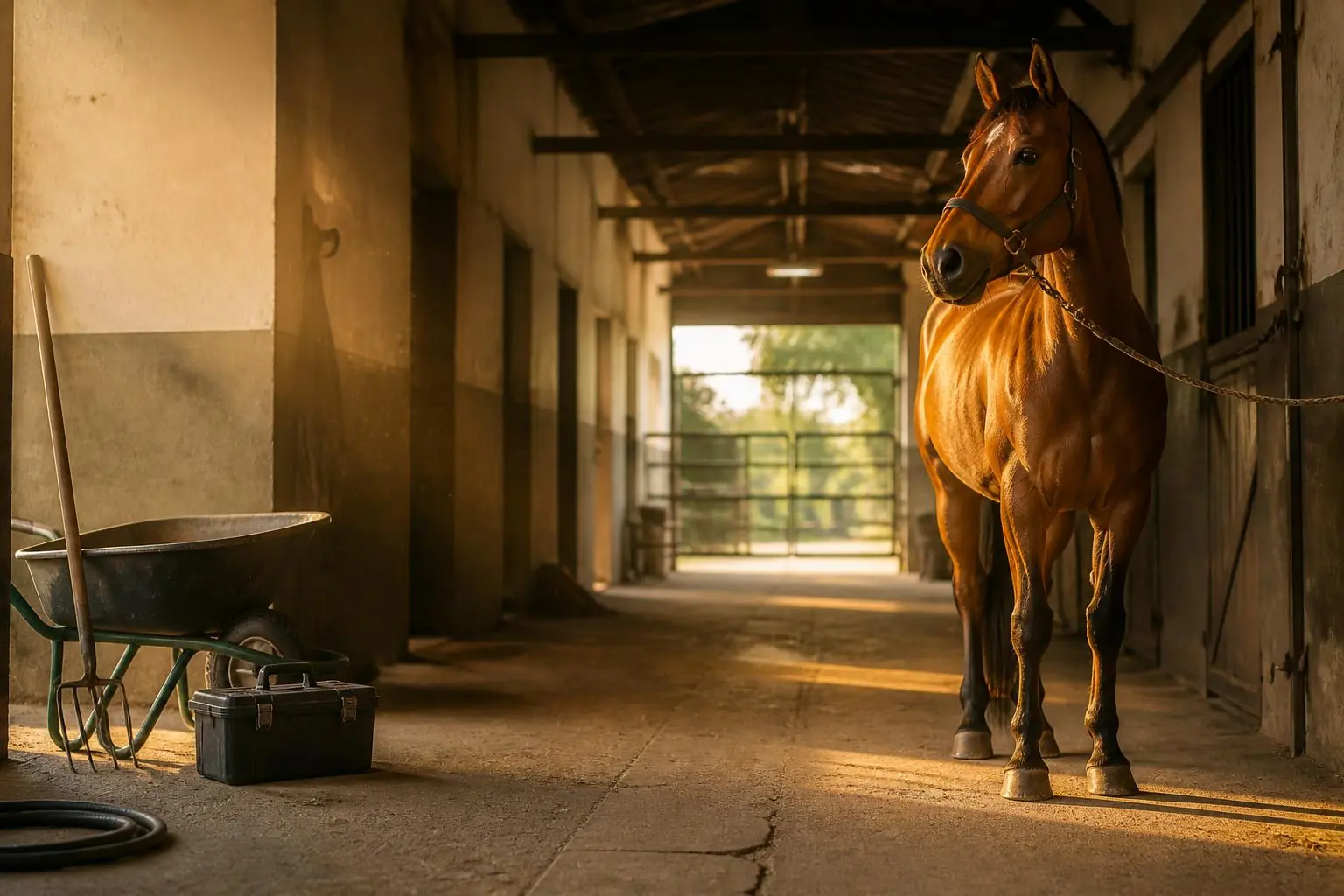
This is the role generating the highest volume of vacancies on specialist platforms such as Equi-Ressources. A stable groom feeds, exercises, grooms, monitors, maintains the boxes and spots the horse that is not thriving before anyone else notices. This last skill is what separates a first-rate groom from someone merely going through the motions: the groom who sees the horse leaving feed in the manger, the one hanging back in the box, the one who is off at walk.
The standard training route is a CAP in agricultural work (palefrenier soigneur) or equivalent professional qualification, accessible through apprenticeship. Many employers also recruit motivated candidates and train them in-house. Starting pay hovers around the sector’s minimum wage for equestrian enterprises, so roughly the national minimum wage (SMIC) for a beginner, with variation depending on région, accommodation provided, and the type of opération (stud, racing yard, or riding centre).
To understand concretely what a typical day involves, the qualifications required, and working conditions, our detailed guide on the role of stable groom covers the tasks, diplomas, and career paths.
Farrier: a shortage that has persisted for years
Ask any horse owner how long they are waiting for their farrier. Their answer tells you everything. Farriery is one of the few horse trades where demand structurally outstrips the supply of practitioners right across France, including in rural areas where horse numbers have grown faster than the number of craftspeople.
The pathway is the CAP in agricultural farriery (maréchal-ferrant), often followed by a vocational technician qualification for further specialisation, notably in remedial shoeing. The vast majority of farriers operate as self-employed: income therefore depends on the number of horses you shoe, your round, your pricing, and your overheads (vehicle, forge, equipment). This is a craftsman’s trade with genuine independence, and one that wears the back.
If the field appeals to you, start by grasping the technical reality of the craft and the training required in our dedicated page on the farrier profession.
Équine osteopath and équine dentist: emerging professions, demanding, poorly regulated
These are the roles that generate the most conversation in yards and the most misconceptions. In animal osteopathy, practice is regulated: since veterinary medicine was reformed, only veterinarians and individuals registered on the national aptitude register held by the Veterinary Order can legally practise. In other words, training alone is not enough: you need the title.
In équine dentistry, the boundary is even stricter. Acts falling under veterinary medicine are reserved for veterinarians; an équine dental technician works within a defined scope and often alongside a practitioner. Before investing several thousand pounds in private school fees, verify what the qualification actually allows you to do, not what the prospectus promises.
Both trades are built as self-employed work, with a client base that develops slowly, often combined with another activity in the early years. Our page on the équine osteopath profession sets out the legal framework, training, and the real day-to-day reality of the work.
Riding instructor: many vocations, many departures
Teaching remains the most sought-after role by candidates, and yet riding centres recruit year-round. The contradiction is explained by turnover: the hours (Wednesday afternoons, Saturdays, school holidays), the mental load of rider safety, and the versatility expected (teaching, but also caring for horses, maintaining facilities, managing the business) mean some qualified instructors leave after just a few years.
The essential requirement is a state qualification: the BPJEPS (Professional Certificate) in équitation, with pathways to the DEJEPS for sports coaching. The technical prerequisites (riding level, entrance tests) are real and screen out many candidates before they begin. The reward is employee status governed by the sector’s collective agreement and a clear route towards running a facility.
Our guide on the riding instructor profession covers the detail of qualifications, prerequisites, and career progression.
Overlooked roles that are also recruiting
Groom and compétition groom
Highly sought-after by compétition yards and studs, with significant travel involved. The ideal candidate can ride competently, prépare a horse for compétition, and manage a horsebox on the road. Employers regularly complain about finding this combination of skills.
Équine veterinary nurse and clinic auxiliary
Équine clinics recruit specialist auxiliaries, a less visible role than the practitioner but offering genuine hands-on training. The role of équine veterinary surgeon remains the pinnacle of the pathway: tough sélection, long studies, work undertaken either in practice rounds or at a clinic.
Racing sector roles
Trainers, stable lads, training riders: training centres in the racing sector, notably those run by AFASEC (Association Française d’Amélioration de l’Équitation de Concours), train young people from secondary school onwards with employment placement rates among the highest in the équine sector. This is probably the quickest route to a first job, provided you accept the pace of a racing yard.
How to test before you change direction entirely
Career changes into the horse world rarely fail through lack of motivation. They fail because the reality of the job does not match the image. A few simple safeguards avoid disappointment:
- Spend genuine time immersed in a yard before committing to training: a complète week from first to last thing, including early mornings. Not a two-day observation placement.
- Talk to three established professionals in your target role, including one with more than ten years of expérience. Ask what they would do differently.
- Check the status of the qualification: state-recognised and registered in the national directory of professional qualifications, or merely a private certificate?
- Follow real job adverts in your area for two months before committing, on sector job boards and on France Travail.
- Prépare your body: these roles demand maintained fitness and genuine back care discipline.
Finally, whatever role you pursue, the common foundation remains unchanged: the ability to observe a horse, assess its condition, and spot what is amiss. This is the foundation covered in our guide on équine care and welfare, and it is also what most employers assess on your first day.
- The most widely advertised roles are stable groom and farrier: in both cases, demand persistently outstrips the supply of trained professionals.
- The role of riding instructor attracts many candidates but continues to recruit nonetheless, due to turnover caused by working patterns and the breadth of the role.
- Équine osteopathy and dentistry are legally regulated: verify your credentials before paying for private training.
- Starting salaries in employed positions sit at the sector minimum, therefore close to the national minimum wage; self-employed roles depend entirely on the client base you build.
- Genuine immersion in a working yard remains the best test before any career move.
Sources cited in this article: Equi-Ressources and the équine sector employment observatory, the IFCE, AFASEC, France Travail, and the national collective agreement for equestrian enterprises. The salary figures mentioned are guidelines based on sector minima and are not guarantees: they vary by région, the individual business, and benefits in kind.