
In August 1227, somewhere in what is now northern China, died the man who had united the largest continuous empire in recorded history under a single authority. The cause of his death remains unknown. Yet the only Mongol source written close to the events, the one recounting his life from within, mentions neither battle nor conspiracy. Instead, it speaks of a hunting expedition, wild horses stampeding, and a mount that shied.
The Answer in One Sentence
The Secret History of the Mongols, compiled in the generation following his death, recounts that Genghis Khan fell from his horse during a hunt in the winter preceding his final campaign, that he ran a fever through the following night, and that he refused to turn back. His death is dated between 18 and 25 August 1227 depending on the source, and its cause remains disputed. What is not disputed is the role of the horse in everything that preceded it.
A Wild Horse Hunt, and a Mount That Shied
The passage is brief, and unusually precise. In the autumn of the Year of the Dog, Genghis Khan sets out on campaign against the Tangut, a kingdom in northwest China, accompanied by one of his wives, Yisüi. En route, during winter, he hunts wild horses in a region called Arbuqa, on the great bend of the Yellow River.
That day he rides a horse named Josotu Boro in the text, which translators render as a reddish grey. A herd of wild horses gallops past. The horse shies. The rider falls. The account notes that his flesh ached him, that tents were pitched where he lay, and that they spent the night there.
The next morning, Yisüi summons the princes. Her words are recorded exactly as spoken: the sovereign has passed the night burning with fever. An officer proposes turning back, arguing that the Tangut have fortified cities and fixed encampments, that they will not abandon them, and that the campaign can resume once the fever breaks. The entire council agrees. Genghis Khan refuses: if they retreat, he says in substance, the Tangut will think we have lost our nerve.
The campaign continues. It ends with the crushing of the Tangut kingdom. And the Secret History, having detailed the fall with such care, dispatches the death of its hero in a single line: in the Year of the Pig, he ascended to Heaven. Nothing of the place, nothing of the ailment, nothing of the body.
Other Accounts of His Death, and What They Are Worth
This silence gave rise to the rest. Around that single line accumulated competing versions, all later in date. Marco Polo, writing nearly seventy years afterwards, has the conqueror die of an infection following an arrow to the knee. Other traditions have him killed in battle, or stabbed by a Tangut princess. An Australian and Italian research team proposed in 2021, in a journal of infectious diseases, a different reading: the fever described over eight days before death, combined with testimony of plague among Mongol troops in that period, points more toward plague. These same authors stress that the spectacular accounts were probably fabricated later, to furnish a mundane end that occurred at the worst possible moment of a decisive campaign.
In other words, the most sober version is also the oldest, and it begins with a fall. We cannot say the fall killed him: eight months separate the accident from his death. We can say that the only contemporary source judges the episode important enough to record, whilst judging the death itself not worth recounting.
The Horse That Made Conquest Possible
The true subject lies here. This empire was not built with impressive horses, but with a small steppe pony, stocky, with a heavy head and short legs, which estimates cited by historians of Mongol warfare place around 500 to 600 pounds (230 to 270 kilograms). At the same period in Europe, the knight’s destrier was also more modest than popular imagery suggests, but it was distinctly heavier and grain-fed through an entire agricultural system, as evidenced by the final charge of Richard III at Bosworth.
The Mongol horse, by contrast, cost almost nothing to maintain. It lived outdoors year-round, from blazing summer to forty degrees below zero in continental winter. It found its own food, even beneath snow. Its feet were neither trimmed nor shod, and the horn withstood it all.
Genetic analyses reveal a rare characteristic: among tested breeds, it displays the highest genetic diversity, far surpassing tightly selected breeds like the Thoroughbred. This is the signature of an ancient population that mankind has sorted very little, almost the inverse of a closed stud book, in a landscape of horse breeds largely shaped by selective breeding. A useful clarification, as confusion is common: this horse is not Przewalski’s horse, whose direct kinship has been ruled out by genetics. Like its steppe neighbour, the Turkmen Akhal-Teke, the age of a breed is not deduced from its appearance.
Three to Five Mounts per Rider, and Supply Lines That Graze
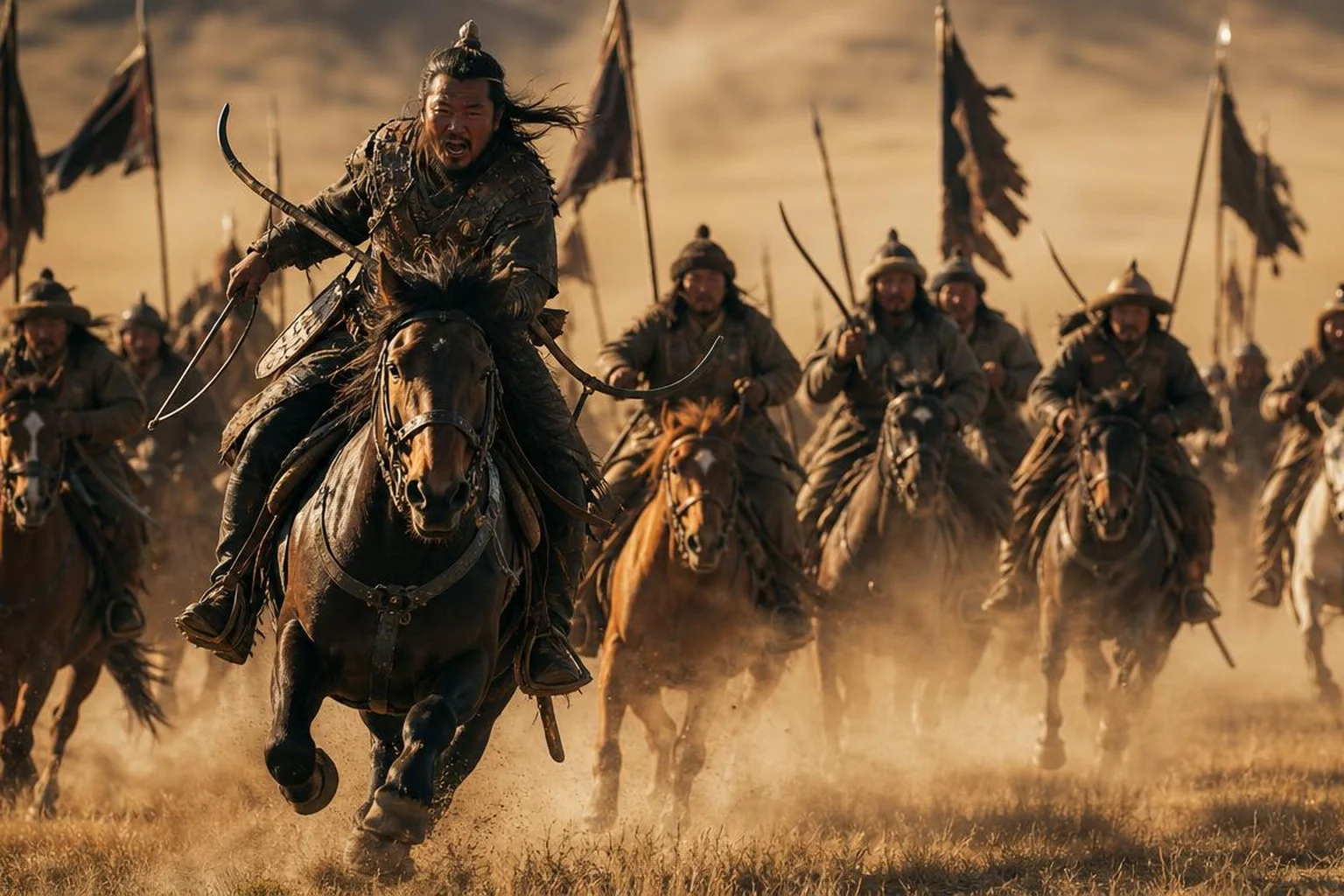
Mongol superiority rested on a simple and formidable idea: a rider does not travel with one horse, he travels with his herd. Three to five spare mounts per warrior on average, sometimes far more. You change horses en route, you always keep a fresh animal, and the army advances at a speed no oat-fed cavalry can maintain over distance.
The corollary is even more interesting for today’s rider: this army had virtually no supply train for its horses. Forage was not transported, it was grazed. Warriors actually preferred to ride mares in lactation, whose fermented milk, airag, was part of the daily ration.
Compare this with what a modern stable requires, where the ration is calculated according to work demanded and supplemented whenever effort increases. The Mongol model approached the problem from the other end: it adapted effort to what the steppe could provide.
Shooting at the Gallop, Hands Free
The gesture that struck European and Chinese chroniclers was always the same: these riders shoot whilst turning in the saddle, at full speed, without touching their reins. This requires a short composite bow, manoeuvrable enough to shift from one side of the neck to the other, and a seat that leaves the hands entirely free.
The Mongol saddle, mediaeval as it is today, is fitted with short stirrups, comparable to those of a jockey. The rider is not seated, he is balanced above the back, and he steers with his legs and bodyweight. This is the principle rediscovered by practitioners of mounted archery, a discipline now recognized in competition, where one travels down a lane at the gallop shooting multiple arrows, reins knotted.
The Empire Stopped Where the Grass Stopped
An empire on horseback has a boundary that maps do not show: pasture. An army that lives on grass does not station itself long where grass fails.
A recent scientific debate illustrates this well. In 2016, two researchers proposed explaining the Mongol withdrawal from Hungary in 1242 by a harsh winter followed by a very wet spring, which would have degraded pastures and the cavalry’s manoeuvrability. Others answered them in the same journal the following year that neither environmental data nor written sources supported this reading. The debate is unresolved, but it poses the right question, and it holds for any stable: a horse’s autonomy under work depends first on what it finds to eat where it is. This also explains the dominance, over long distances, of horses best adapted to their environment, such as the Arabian in endurance racing.
What Remains Today of Genghis Khan’s Horse
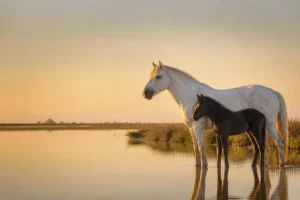
The most remarkable thing is that this horse has not vanished and has changed very little. Mongolia today has nearly four million horses, according to national livestock censuses, for approximately three and a half million inhabitants: there are more horses than Mongols, and they still live in free herds.
Each summer, the national festival features races bearing no resemblance to a racecourse: distances up to nineteen miles (30 kilometres), hundreds of starters, children in the saddle because they weigh less. These races are not without risk, and the supervision of young jockeys is itself debated within Mongolia.
What Defines Hardiness in a Horse, Then and Now
- The ability to feed itself. A hardy horse makes good use of poor forage. It is a matter of metabolism, not virtue, and becomes a handicap on rich grass.
- Thermoregulation. Winter coat, dense undercoat and protective fat shield better than textiles. Clipping or blanketing alters this balance.
- Permanent access to pasture and herd. Hardiness is built outdoors, in movement, with companions. It cannot be decreed in a stable.
- Quality of the horn. Hard feet sometimes do without shoes, but this depends on ground, work and the individual, never on doctrine.
- Shelter and water. Living outdoors requires shelter from wind and sun, and unfrozen water in winter. This is where situations often go wrong.
- Actual body condition. It is judged by hand, over ribs, withers and tail-set, not by eye through thick coat.
- Gradual transition. You do not transform a sport horse into a steppe horse in one autumn. It takes months.
- Veterinary oversight. Hardiness does not mean absence of care: sensible worming, dentistry and vaccination remain fundamental.
There remains a common misunderstanding to avoid. What a Mongol horse achieves in its environment, with its bloodlines and its way of life from birth, does not transfer wholesale to a Norman field: a European saddle horse left out unaccustomed does not become hardy, it loses weight. The right question is not whether to blanket your horse on principle, but which individual, in which environment, with what work. The rest lies in daily oversight and your veterinarian’s advice.
Key Takeaways
- The oldest Mongol source recounts a fall from a horse during a hunt, followed by a night of fever, several months before Genghis Khan’s death.
- This same source dispatches his death in a single sentence, without place or cause: all spectacular accounts postdate this.
- The dates proposed range from 18 to 25 August 1227, and the cause remains disputed, including by a recent plague hypothesis.
- The Mongol horse is small and light, lives outdoors year-round, feeds itself and is not shod.
- Each warrior had three to five spare mounts, which eliminated the need for most supply operations.
- Mongolia today has more horses than people, and the breed has changed very little.
To Blanket or Not This Winter
Weights, clipping, horse profiles, common mistakes: the guide to deciding without relying on received wisdom.
Sources
Secret History of the Mongols, paragraphs 265 to 268, in the annotated translation by Urgunge Onon, for the Arbuqa hunt, the horse Josotu Boro, the fever, the princes’ council and the final statement on death, as well as for the date of 25 August 1227 noted in commentary. Reference entries on Genghis Khan for the range 18 to 25 August 1227. Study published in 2021 in an international journal of infectious diseases for the plague hypothesis. Reference works on the Mongol horse for morphology, way of life, spare mounts and genetic diversity. Articles from 2016 and 2017 in a general scientific journal for the debate on the Hungarian withdrawal. Mongolian national livestock statistics for horse numbers. Equirider is affiliated with none of these institutions.