
France’s most physically demanding equestrian discipline takes centre stage from Monday 10 August at Lamotte-Beuvron, yet remains virtually unknown to the general public. Horse-ball is a six-handled leather ball collected from the ground at a gallop without dismounting, four riders per team, three mandatory passes before shooting, and a metal ring one metre (3ft 3in) in diameter suspended at the end of the arena. From 10 to 15 August 2026, the Parc équestre fédéral hosts the European Championship for this discipline born in France, whose Argentine ancestor, a game where two riders fought over a sack containing a live duck, eventually became too dangerous and was banned. Here is what it is, and how matches are judged.
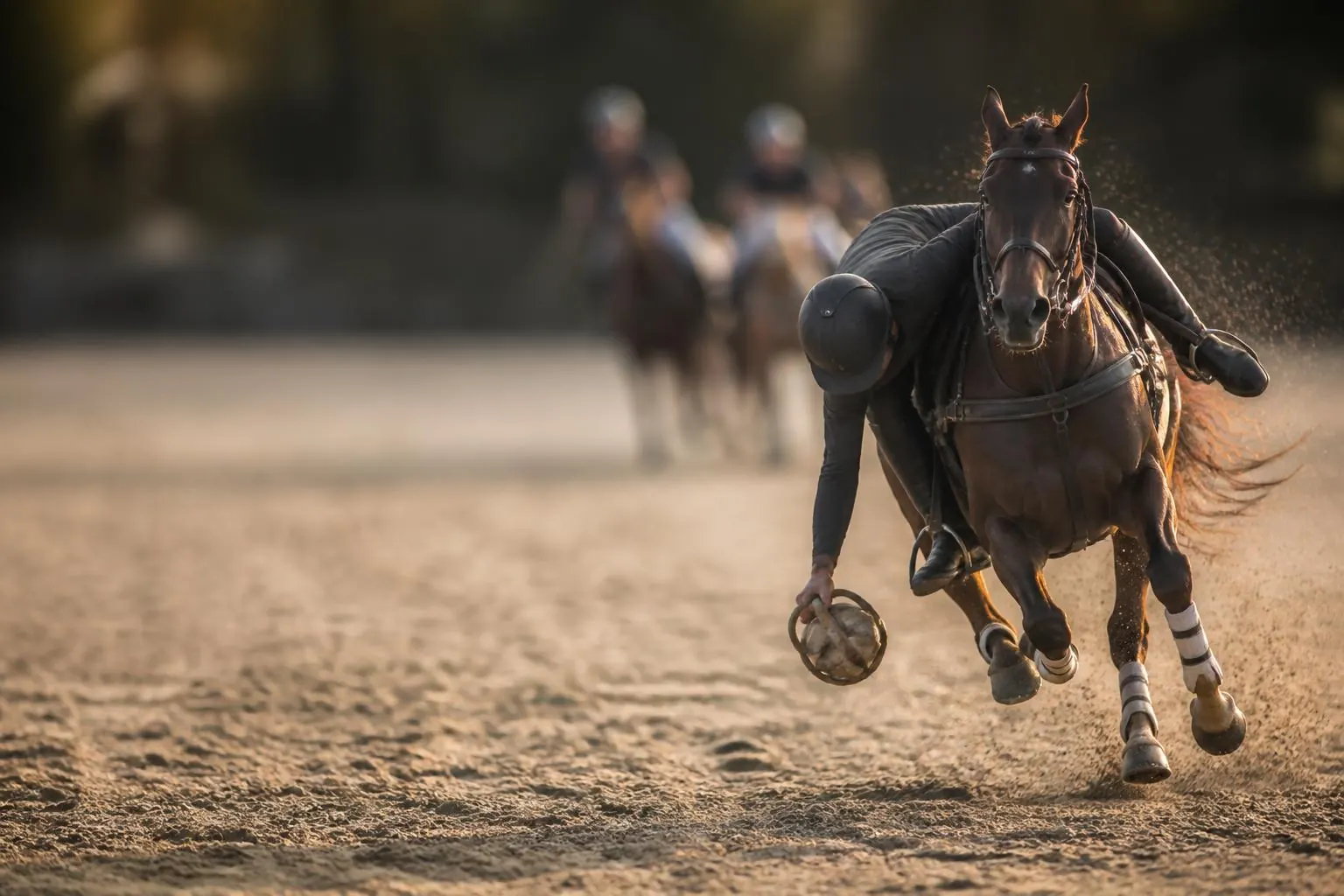
A six-handled ball, collected at a gallop without touching down
The international rules of the International Horse-Ball Federation (FIHB) fit into one sentence: two teams of six riders must collect from the ground, without ever dismounting, a ball fitted with six leather handles, and send it through passing plays into goals positioned at each end of the arena. The event’s official briefing describes it as a fine blend of rugby and basketball.
It is not a football, contrary to what is often read, but a light-coloured leather ball encased in a harness of straps, fitted with six sturdy leather handles, approximately 26 inches (65 centimetres) in circumference and weighing 1.3 to 1.5 pounds (600 to 700 grammes). These handles allow a player to catch it one-handed whilst holding the reins in the other.
Six players and six horses per team, but no more than four competing simultaneously, never fewer than three. The playing area measures 197 to 246 feet (60 to 75 metres) long and 66 to 98 feet (20 to 30 metres) wide. At each end, the goal is a metal ring 3 feet 3 inches (one metre) in diameter, lined with white netting, with its base fixed 11 feet 6 inches (3.50 metres) above the ground. Players must aim upwards, whilst moving at speed.
To collect the ball, riders use a strap running beneath their horse from one stirrup to the other. It provides purchase to lower the body extremely low, head towards the ground, against the horse’s flank as it gallops. This is the signature move in horse-ball, the gesture that lifts spectators from their seats.
The only equestrian sport where contact is permitted
The rules call it physical marking: bringing your horse into contact with an opponent’s horse to deflect its path and regain possession. This is what sets horse-ball apart from all other equestrian disciplines, and it is regulated to the finest degree.
You may push only with the weight and momentum of your horse, using your shoulder and arm, elbow held to your body. Embracing an opponent is forbidden, as is holding them with your hand, striking with the fist, elbow or head. Above all, marking is permitted only in the direction of the ball-carrier’s travel: beyond 45 degrees, it is a foul, because the collision becomes dangerous for the horses.
When two players contest possession, it is called a tug: only one hand allowed, the struggle is decided by arm strength and seat. Add short periods and relentless pace, and you have a discipline that reads like seven-a-side rugby, with 1,100-pound (500-kilogramme) horses specifically trained, hurtling in both directions.
The three-pass rule, the one that forbids charging straight for goal
This is the central mechanism. A goal is valid only if the team has completed a minimum of three consecutive passes amongst at least three different players, in all phases of play. There is no collecting the ball and scoring alone. The crucial detail that changes everything: passing the ball hand-to-hand does not count; it must genuinely leave one player’s hands. The count resets to zero if it drops to the ground or an opponent intercepts it, and no one may retain it longer than ten seconds. A circulation game, never one of individual brilliance.
Collection follows its own laws. It must be performed on horseback, from the right or left, at any pace, but never with the horse stationary, on penalty. A player who misses the pickup may neither stop nor slow down: they must clear the collection zone by 16 feet (5 metres). Obstructing this player or forcing them to change direction to avoid collision is explicitly sanctioned, and no one may interfere with them until they are remounted.
What the rules forbid, and what that says about genuine risk
The list of prohibitions speaks volumes about the discipline’s intensity. The helmet, meeting European standards, must remain fastened whilst the rider is mounted; back protection is recommended, and any bleeding injury removes the player until cleared by the medical officer. We detail what helmet protection standards cover in our guide to riding helmets.
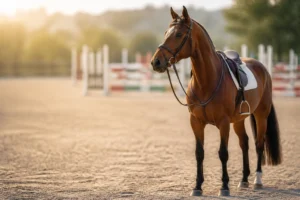
Surprisingly to many: the crop is forbidden in play, and only spurs with rounded ends of maximum 1.2 inches (3 centimetres) are permitted. For horses, fixed martingales, leg protection and boots on all four feet are mandatory; blinkers are forbidden. A horse must be at least four years old, be fully vaccinated, and may compete in no more than one match per day. All official competitions include veterinary inspection of every registered horse.
Penalties are graded in three levels. Penalty 1 punishes brutality and dangerous play with a direct shot from 16 feet (5 metres), horse stationary. Penalty 2 addresses obstruction and intimidation, offering the choice between a 33-foot (10-metre) shot and a hand restart from 49 feet (15 metres). Penalty 3 sanctions simple infractions. Yellow and red cards may be added.
What is at stake from 10 to 15 August at the Parc équestre fédéral
The horse-ball European Championship takes place from 10 to 15 August 2026 at the Parc équestre fédéral in Lamotte-Beuvron, in Sologne, under the auspices of the FIHB. Four categories are on the programme, officially designated U16, U21, Ladies and Pro Elite: the sport is mixed, but retains a category reserved for female riders. The equestrian press reports approximately 225 athletes, a tournament open to under tens, finals on 15 August, and free admission.
The particularity of summer 2026 lies elsewhere: this is the first time the venue simultaneously hosts two international championships. On the same grounds takes place the pony-games World Championship, organised by the International Mounted Games Association, in Open and U18 categories. France arrives as reigning world champion in Open and vice-champion in U18, playing at home.
The location is no accident. Lamotte-Beuvron is home to the French Equestrian Federation and Europe’s largest equestrian park: welcoming over 800,000 visitors and 30,000-plus equines annually. It previously hosted the TREC World Championships in 2022, the pony-games Euro in 2024, and each summer hosts the Generali Open de France. Frédéric Bouix, president of the FFE, sees it as a privileged window for promoting collective equestrian sports. The French selections were announced by national selector Raphaël Dubois, assisted by Romain Depons and Florian Moschkowitz. No predictions or results here: the objective is to understand what you are watching.
From the Argentine duck to the leather ball, a French invention
The discipline’s history begins far from Sologne. Horse-ball descends from Argentine pato, a game in which two riders each pulled on the handles of a sack containing a live duck, pato meaning duck in Spanish. Deemed far too dangerous, it was banned in 1882, before resurfacing in the 1930s in sportive form and minus the animal: four riders per team, a ball to send into a basket. The discipline also claims descent from Afghan buzkashi and the mounted games of the Republican Guard, where a French officer, Captain Clavé, show-jumping world champion, adapted pato on a smaller field.
The Second World War saw the game disappear, surviving only as a mounted exercise in a few clubs. It took 1970, when mounted games were integrated into the French Equestrian Federation’s teaching curriculum, for the momentum to resume. In February 1979, in Poitiers, the first mounted games championship was held: Bordeaux prevailed over Hénin-Beaumont and claimed the Captain Clavé Cup. In October, a meeting at Castillon-la-Bataille officially renamed the game horse-ball. International organisation began in 1978, with a commission created by France, the United Kingdom, Belgium, Italy, Germany and Portugal, then in 1999 with the founding of the FIHB.
Today, the discipline has its own competitive circuit sanctioned by the federation, youth categories through to adults, and appears on the programme alongside other equestrian sports. A sport that France invented and where she remains a reference nation, yet which scarcely features in rankings of most popular equestrian disciplines.
How a horse-ball match is judged
Seven points that separate watching from understanding
- The quality of the pickup. Bending at a gallop without breaking stride, remounting immediately, carrying on.
- Ball circulation. The team that builds its three passes quickly attacks with an edge.
- Respect for the ten-second rule. Beyond that, it is a penalty: teams that delay penalise themselves.
- The angle of marking. Contact is legal only in the ball-carrier’s direction of travel, never beyond 45 degrees.
- Clean contested possession. One hand only, never embracing. This is where cards fall.
- Protection of the ball-collector. Strict refereeing on this point transforms a match.
- The state of the horses. One match per day, protection on all four legs, veterinary inspection, removal in case of injury.
Key facts
- Horse-ball European Championship 10 to 15 August 2026 at the Parc équestre fédéral in Lamotte-Beuvron, under FIHB auspices, in U16, U21, Ladies and Pro Elite categories. The Pony-Games World Championship takes place on the same grounds, a first.
- Two teams of six riders, four in play maximum. Two periods of ten minutes, three-minute half-time.
- Leather ball with six handles, collected at a gallop without dismounting. Goal is a one-metre ring, base at 11 feet 6 inches (3.50 metres) from the ground.
- Three passes between three different players before scoring, and no more than ten seconds ball in hand.
- Contact permitted in the ball-carrier’s direction only, never beyond 45 degrees. Crop forbidden in play.
Tempted by horse-ball
Rules, equipment, competition levels, how to get started at a club: our guide covers everything.
Sources: FIHB international rules (version 3.6), official event briefing document, official discipline pages, specialist equestrian press. Equirider is affiliated neither with the FFE nor the FIHB. Times and access arrangements may change: verify with the organiser before travelling.