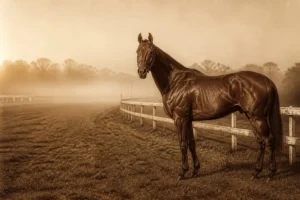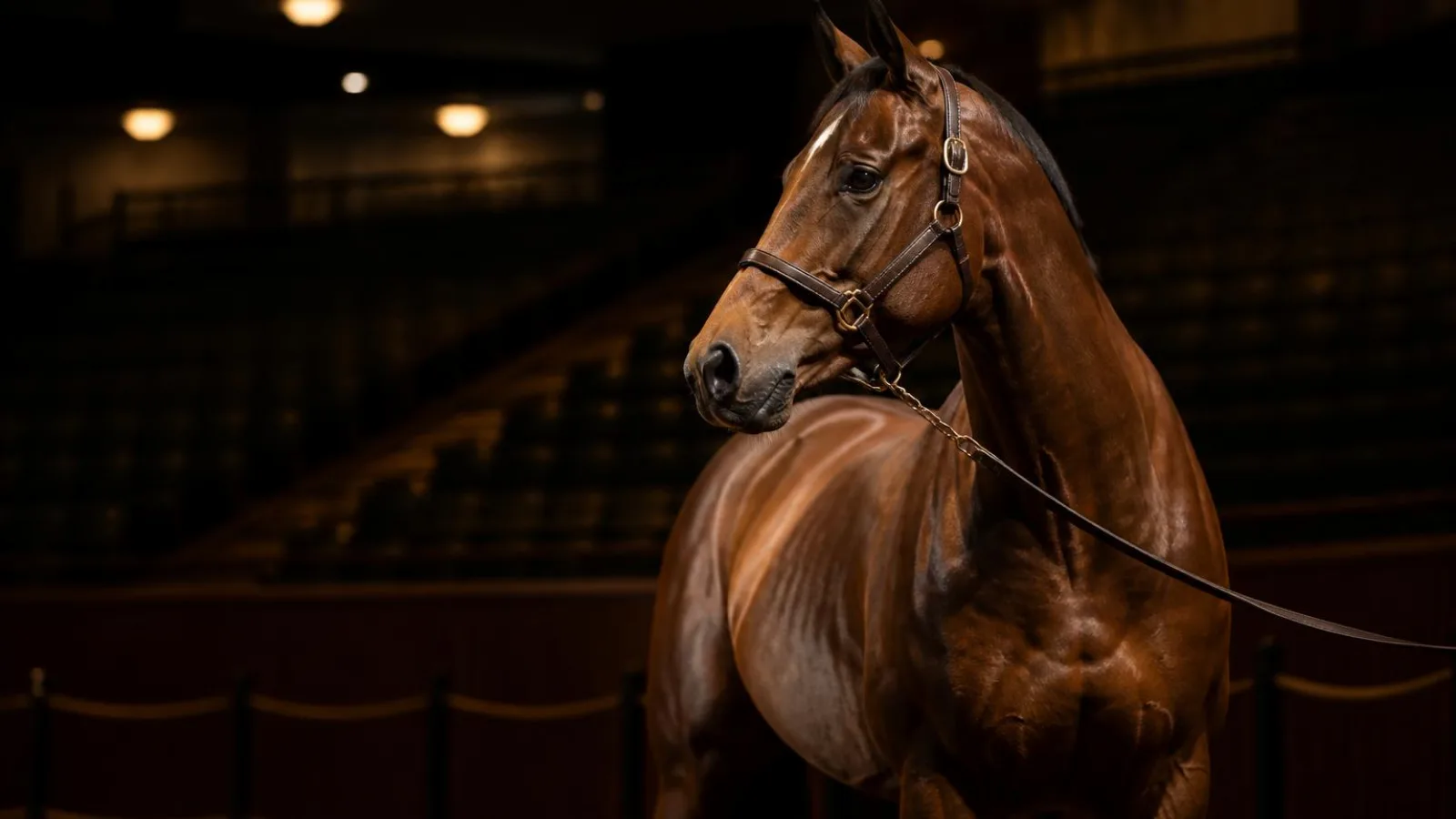

The short answer: Fusaichi Pegasus, an American Thoroughbred, remains the most expensive horse in history, valued at approximately 70 million dollars in 2000. Yet this unbroken record conceals a truth few recognise: at stud, this champion proved a commercial catastrophe. His covering fee collapsed from 150,000 dollars to 7,500 dollars, and his buyers almost certainly never recovered their investment. Here is why the largest sum ever spent on a single horse became a warning for an entire industry.
- Fusaichi Pegasus, winner of the 2000 Kentucky Derby, was valued at approximately 70 million dollars: still the world record in 2026.
- His value rested on his future as a stallion, not on his racing earnings.
- His offspring disappointed: his covering fee fell from 150,000 to 7,500 dollars within a few seasons.
- He nonetheless produced over 1,200 winners, but far short of expectations tied to his price.
A 70-million-dollar cheque for a single horse
It was 2000. Fusaichi Pegasus had just won the Kentucky Derby, America’s most-watched race. His owner, Japanese businessman Fusao Sekiguchi, had purchased him as a yearling for 4 million dollars. Within months of his victory, he sold him to the formidable Irish stud farm Coolmore and its Japanese partner Shadai for a sum that entered the annals of the sport: approximately 70 million dollars.
To understand this figure, one must abandon ordinary logic. Nobody pays 70 million dollars to win races. They pay it for what comes after: breeding. A leading stallion can cover more than one hundred mares annually, at fees of tens of thousands of dollars per covering. On paper, the investment could have recovered itself within a handful of years.
Why a horse can command a price greater than a villa on the Côte d’Azur
The value of a future stallion rests on three pillars: racing performance, pedigree, and conformation. Fusaichi Pegasus ticked all three boxes. A descendant of the legendary Mr. Prospector, a classic winner with spectacular physique: buyers wagered he would transmit all of this to his progeny.
It is this genetic promise that drives prices to dizzying heights. The same logic explains why, each summer, yearling sales at Deauville or Keeneland see one-year-olds, who have never raced, exchange hands for millions. One does not purchase an athlete: one purchases reproductive potential.
- Racing record: victories in Group 1 races, the most prestigious.
- Pedigree: quality and consistency of paternal and maternal lines.
- Conformation: frame, height, soundness, and transmissible athletic aptitude.
- Demand: appetite from major stud farms, which drives bidding to extremes.
- Expected return: number of possible coverings multiplied by the fee.
The pitfall: a great champion does not always make a great sire
This is where the story turns. A horse can be an immense athlete yet a mediocre sire. There exists no guarantee that talent transmits. Fusaichi Pegasus became the textbook example.
Based at Ashford Stud in Kentucky, he commenced stud duties in 2001 at a covering fee of 150,000 dollars, a record for a first-season stallion. Then his early offspring appeared on the track. They raced respectably, but none became the anticipated star. The market punished him at once.
A covering fee divided by twenty within seasons
The collapse in his fee tells the entire story: 150,000 dollars at the outset, then 75,000, 45,000, 30,000, 15,000, and finally 7,500 dollars in his final years. His market value was divided by twenty. Most analysts believe Coolmore never fully recovered its 70 million dollar investment. The most expensive horse in history is also among the worst investments in history.
To be fair: Fusaichi Pegasus was not an absolute failure. He sired over 1,200 winners and 75 victors in conditions races, and his progeny earned more than 135 million dollars worldwide. Yet measured against his price and pedigree, results fell dramatically short of expectations. He spent a quiet retirement at Ashford until the end of his life.
He was not the only record to disappoint
The Fusaichi Pegasus case is not isolated. In 2006, a yearling nicknamed The Green Monkey sold for 16 million dollars in the United States, an absolute record for a horse sold at public auction. The result? Three races started, zero victories, early retirement. Again, the dream shattered against racing reality.
These rollercoasters concern more than Thoroughbred racing. In equestrian sports, outstanding dressage and showjumping performers have changed hands for ten million euros or more, with varied fortunes once the transaction closed. The common thread in all these records: a measure of irrationality, driven by hope and scarcity.
What these astronomical sums teach us
Behind every staggering price lies a wager. Sometimes it pays off: certain stallions return one hundred times their purchase price. Sometimes it collapses, as with the most expensive horse of all time. It is this blend of prestige, genetics, and chance that makes the high-end horse market as captivating as it is unpredictable.
Curious to see what the other top performers in the rankings are genuinely worth, and who is challenging Fusaichi Pegasus? We have compiled the figures, breeds, and stories in our complète guide to the world’s most expensive horses.