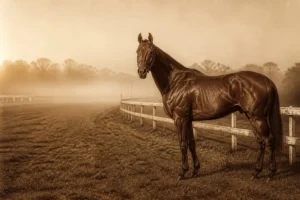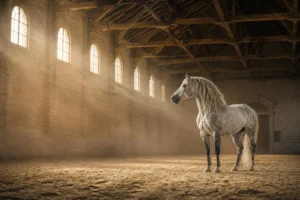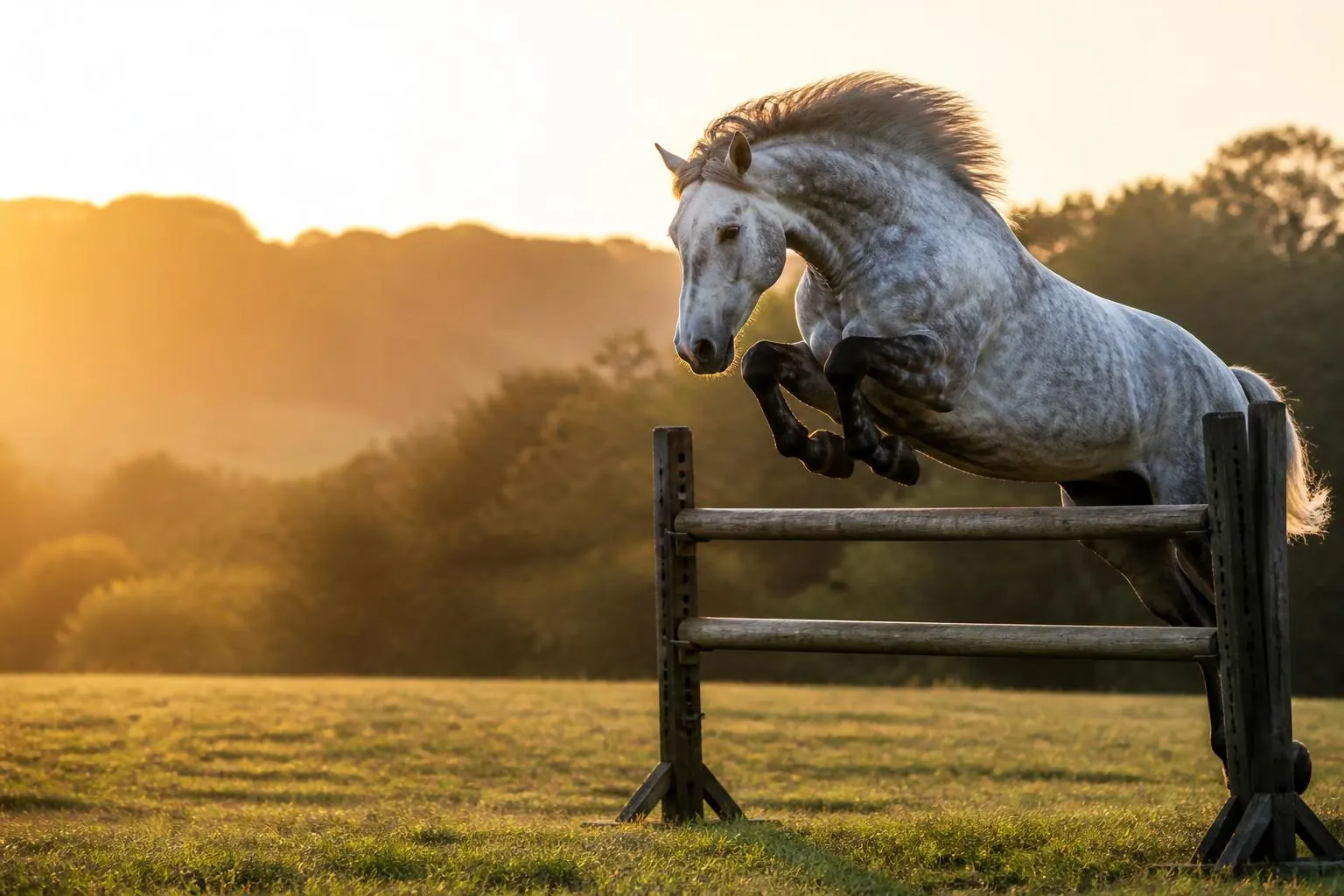

In 1956, a Dutch horseman living in the United States arrived late to a horse auction in Pennsylvania. The better animals had already sold. On the lorry bound for the slaughterhouse sat a large grey gelding, dirty and exhausted, destined for meat. He paid 80 dollars for him. Two years later, this farm horse defeated America’s finest show jumpers at Madison Square Garden. His name: Snowman.
A Lorry to the Slaughterhouse, an Eighty-Dollar Gamble
Harry de Leyer had not come seeking a champion. A Dutch immigrant working as a riding instructor at a private school on Long Island, he was simply looking for an affordable mount for his pupils. When his car broke down en route to the New Holland sale, he arrived after the final bid. The remaining horses, deemed worthless, were already loaded onto the dealer’s truck to be sold by weight as meat.
Among them, a grey gelding around eight years old, heavily built, marked by years in harness, his eyes dull. Nothing suggested an athlete. De Leyer offered 80 dollars. The deal was done within seconds. On the drive home, through light snow, one of his children found a name for the exhausted grey: Snowman.
From Farm Horse to Schoolmaster
In those early weeks, Snowman showed no sign of a competition horse. He was a former farm horse, built for draught work, not jumping. They cleaned him, fed him, nursed him back to health, and he became exactly what de Leyer needed: a calm, reliable mount, perfect for nervous beginners. His placid temperament reassured hesitant riders. Nothing more than that.
This background as a farm horse should have closed every competition door. High-level show jumping was then the preserve of light, athletic horses, selected over generations for scope and speed. A draught horse had no place on paper. De Leyer, lacking a better use for him, eventually sold Snowman to a neighbouring doctor as a hack.
The Horse Who Jumped Fences to Come Home
That is when the unexpected began. Sold just a few miles away, Snowman refused his new life. Night after night, he jumped the fences of his new field and made his way across the countryside to return to de Leyer’s stable. Higher barriers, reinforced enclosures: nothing held him. The exasperated doctor eventually gave up and returned him.
De Leyer understood what he possessed. A horse capable of jumping alone at night obstacles that most sport horses only tackled with an experienced rider possessed a quality that cannot be taught: the desire to jump. He decided to enter him in show jumping competitions. An absurd gamble in the eyes of every observer. A winning one.
Madison Square Garden, Champion Twice Over
Progress came at breathtaking speed. In 1958, Snowman won the championship for hunters and jumpers at the National Horse Show at Madison Square Garden, America’s most prestigious jumping competition, beating the best-bred and best-trained horses in the nation. That same year, he was crowned Horse of the Year. In 1959, he did it again. The press dubbed him the “Cinderella Horse,” risen from the slaughterhouse lorry to the lights of New York.
The public embraced the story. Snowman appeared on television, became a national star, inspired books. What struck judges and trainers was not simply his success: it was how he achieved it. A heavy, pedigreeless horse beating athletes tailored for the discipline forced the entire sport to confront a simple question. What, fundamentally, makes a great jumper?
What Defines a True Jumper
- Heart and courage. Boldness at the fence and the will to press forward often matter more than conformation. Snowman proved this beyond doubt.
- Technique in takeoff and bascule. A good jumper collects, extends, and rounds over the rail, freeing his back and neck.
- Power in the hindquarters. This is the engine of the jump. A heavier horse can compensate for lack of refinement through powerful thrust.
- Consistency. Jumping a clear round demands steadiness, not just an isolated feat.
- Durability. An athlete is judged by his ability to remain sound and available season after season.
What Snowman’s Story Teaches About Equestrian Talent
Snowman’s story is not an invitation to buy rescue horses at random and hope for miracles. Such trajectories remain extraordinarily rare, and a poorly prepared horse can injure himself over fences too high. Rather, it echoes a truth every rider knows well: paperwork tells only part of the story. A prestigious pedigree improves the odds; it guarantees nothing. And conversely, a horse without bloodlines may carry a rare quality that only work can unlock.
It is also a lesson in human perception. De Leyer did not create Snowman’s talent: he saw it where no one else looked, on a lorry, then gave him the means to express it. Much of equestrianism rests on this meeting between horse and believer. To understand where jumping sits among other disciplines, our overview of equestrian disciplines helps measure the demands of each.
An Eighty-Dollar Horse, a Value That Became Priceless
Snowman retired in the early 1960s and died in 1974, surrounded by de Leyer’s family. His story continued to circulate, notably through Elizabeth Letts’ bestseller “The Eighty-Dollar Champion,” which reintroduced him to a new generation. Even today, he embodies the idea that no horse can be summed up by his purchase price.
The contrast is stark. Whilst auctions spiral upwards and we track the world’s most expensive horse, the most admired rider of his era had paid for his legend 80 dollars. Proof, if proof were needed, that a horse’s true value is measured by far more than a cheque.
Key Takeaway
Jumping talent rests first on heart, courage, and hindquarter power, far before pedigree. Whatever your horse’s background, our guide to show jumping outlines the foundations of sound, progressive training.