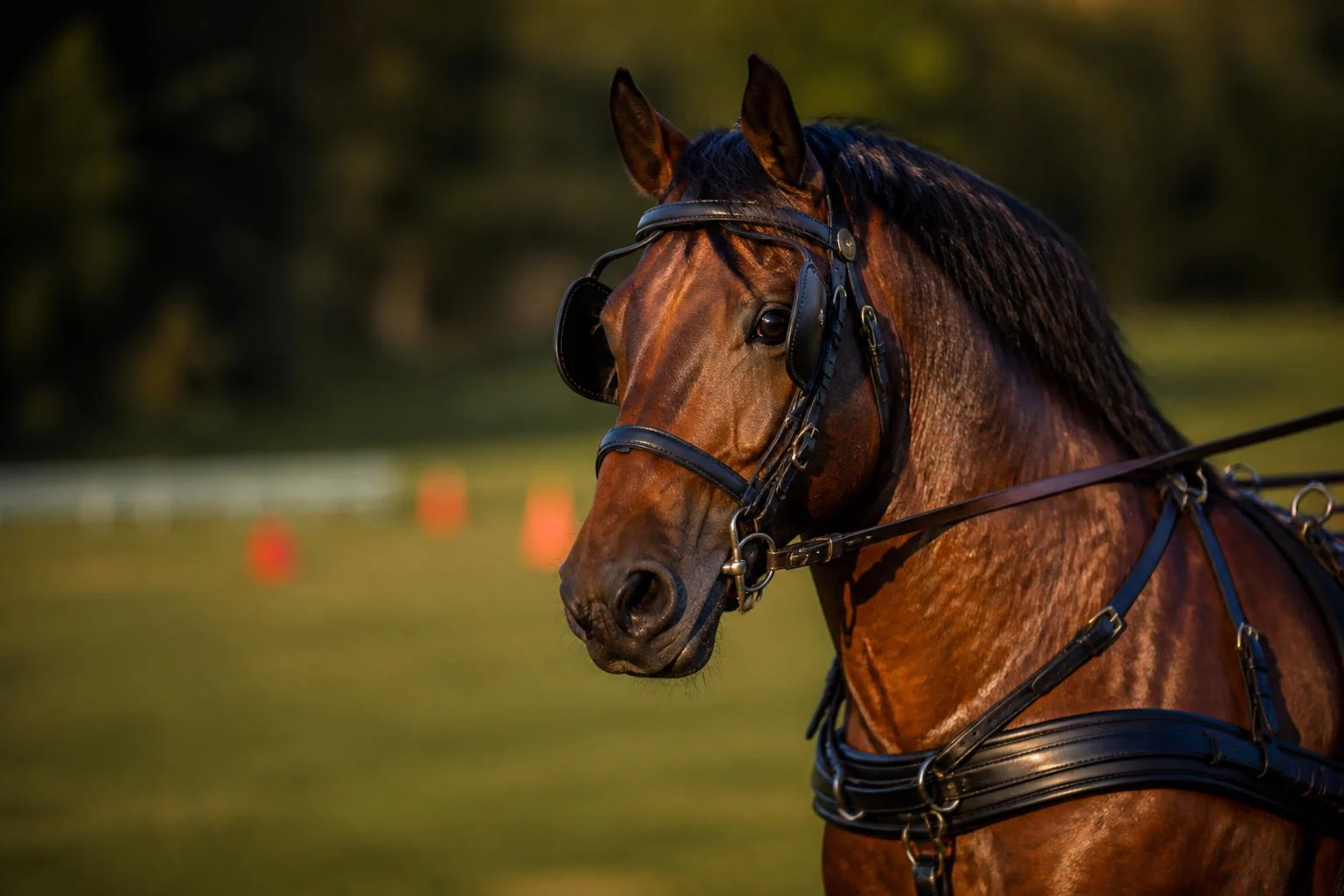
The single-horse driving world championship takes place this week at the Olympia-Reitanlage in Munich-Riem, Bavaria. Competitors arrive on Tuesday 1 September, pass the veterinary examination on Wednesday, with competitions running through Sunday 6 September: dressage on Thursday and Friday, marathon on Saturday, precision driving and medal presentations on Sunday. Around twenty nations are expected, representing nearly ninety driving teams. The defending individual champion is Swiss, driving a mare from a breed that high-level sport scarcely notices, and France comes to defend its team title. Here is what hangs in the balance, and above all how to judge a discipline most riders have never seen in person.
A Swiss title, a French team to defend
The reigning world champion is Mario Gandolfo. He comes from Ajoie in the canton of Jura, and he won his title in 2024 at the Haras national du Pin in Normandy with his mare Favela. The August 2026 update of the International Equestrian Federation world rankings places him at the top of single-horse drivers with 79 points, ahead of French driver Marion Vignaud in second place with 75 points, who held the top spot before him.
This proximity at the summit tells much about the state of the discipline. When interviewed by regional Jurassian broadcaster RFJ on 25 August, Gandolfo explained he approaches Munich relaxed, having already achieved his major objective, and in his view the level of the world’s top 15 has tightened so much that anyone can win. He adds a statistic that no one in his entourage seems to dispute: only one driver has managed to be world champion twice in succession in this category. Defending a title here is therefore rarer than winning it.
On the French side, the logic is different: France has been team world champion since Le Pin. National coach Félix-Marie Brasseur has announced eight pairs for Munich, of which only three will compose the team, designated after the veterinary inspection. These include Anne-Violaine Brisou with Guillaume Swing, Clément Deschamps with Brume de Chablis, Tony Ecalle with Kensington, Claire Lefort with Darwin de Féline, Fabrice Martin with Idromel Noir*IFCE, Didier Mathis with Darka, Alexandre Thibaudeau with Isys des Sources and Marion Vignaud with First Quality.
A useful clarification to avoid confusing two championships in the same month: the four-horse teams played their title in August at the Aachen world championships. Munich is the single-horse category, which has its own championship, its own medals and its own calendar.
Favela comes from a breed sport scarcely notices
The mare with which Gandolfo was crowned is a Franches-Montagnes. It is the only Swiss native horse breed still in existence, born in the Franches-Montagnes district in the Jura, where mountain working horses have been documented since the fourteenth century. The breed developed in the nineteenth century from robust local mares of Comtois type crossed with European stallions, notably Anglo-Norman stock. Its stud book opened in 1924.
A Franches-Montagnes must stand between 14.2 and 15.3 hands high (1.50 m to 1.60 m) at three years old, and weigh between 1,210 and 1,430 pounds (550 to 650 kg). Specialists rank it among the last light draught breeds of Western Europe, midway between the riding horse and the draught horse proper. In other words: it is neither a sport horse bred for performance nor a heavy ploughman. It is a refined farm horse, selected for temperament as much as for movement, with behavioural tests introduced in 2001 and a mandatory three-year-old field test including both driving and ridden elements.
The geographical proximity is striking when you look at a map: the breed’s homeland sits just a few dozen kilometres from that of the Comtois, the draught horse of the French Jura, whose mares actually served as the foundation for Swiss selection. The Franches-Montagnes belongs to that family of versatile horses expected to do the work before winning podiums, exactly like those found in current draught horse uses. To see it ranked number one globally in a discipline Olympic through its cousins, among Dutch and German sport horses, remains a statistical anomaly, and it is probably what makes the story so compelling in French-speaking Switzerland.
Three phases, one score, lowest wins
A driving championship is not won against the clock but on penalty points, and the victor is the one with the fewest. The total combines the three phases of competition driving: dressage, marathon, precision driving. A weak dressage test on Thursday cannot be recovered by speed on Sunday; it stays on the scoreboard.
Dressage takes place in a marked arena with prescribed figures: straight lines, circles, transitions, halts. Judges assess regularity, impulsion, straightness and obedience, on principles close to those of ridden dressage, except that the driver has neither legs nor seat to communicate with the horse. He has only two lines, his voice and his whip. Everything that in saddle passes through the body must here pass through the hands.
The marathon, four and a half to five and a half miles
This is the phase that has given the discipline its reputation, and the one the public comes to watch. The International Equestrian Federation rules set a distance of 4.3 to 5.6 miles (7 to 9 kilometres) for a single-horse championship, with seven or eight obstacles, and a reference speed of 7.5 to 8.7 mph (12 to 14 km/h). The regulations foresee roughly 0.6 miles (approximately one kilometre) of course per obstacle, preferably not fewer than 460 yards (700 metres) between consecutive obstacles.
In the marathon, pace is free. The driver chooses trot or canter depending on terrain and what his horse can do. Obstacles are fixed devices, often constructed from timber, sometimes with water crossings, where lettered gates must be negotiated in a prescribed order. This is where gaps appear between competitors, and where weather weighs heavily. Gandolfo is frank about Munich: the ground did not suit him last year because it rained, and his mare’s only fault, in his view, is that she panics when it gets slippery.
The marathon vehicle is not the same as the dressage carriage. For a single horse, rules mandate four wheels, a minimum weight of 330 pounds (150 kg) and a track width of at least 4 feet 1 inch (1.25 m). This weight is not incidental: it prohibits ultra-light vehicles and puts everyone before the same physical constraint, that of pulling a real mass with one horse for several kilometres.
Precision driving is decided by fractions of an inch
On Sunday, it all comes down to a slalom through cones topped with a weighted ball, set so that it falls only if the cone is touched. The course measures between 1,640 and 2,625 feet (500 to 800 metres), can have no more than twenty obstacles, and the required speed for single-horse teams is 820 feet per minute (250 metres per minute).
Here lies the figure that takes the breath away. For the single-horse category, cones are set 5 feet 3 inches (1.60 m) apart, whereas the vehicle used in precision driving must have a track width of at least 4 feet 6 inches (1.38 m). This leaves, at best, 9 inches (22 centimetres) total clearance, or 4.5 inches (11 centimetres) on each side, and less still if the vehicle is wider than the minimum. The regulations moreover allow up to ten obstacles to be tightened by a further 2 inches (5 centimetres), marked by cones of a different colour, and by up to 4 inches (10 centimetres) in a jump-off.
Every knocked ball costs points. The rules assess three penalty points for most obstacles knocked, exactly like a pole down in show jumping, and add time penalties beyond the allowed time. Other sanctions reflect that this is a sport with real risk: twenty penalty points each time the driver dismounts the carriage, and outright elimination if the vehicle overturns.
The helmet, mandatory on pain of elimination
A detail that mounted riders know well takes a very strict form here. During precision driving, the rules make wearing a correctly fastened protective helmet mandatory for all persons on the vehicle, and non-compliance results in immediate elimination from that phase. The same applies on the marathon, from the pre-competition inspection through to the end of the course.
This is not a rule committee whim. A single-horse team travelling at 8.7 mph over a marathon obstacle with a water crossing is several hundred kilograms in motion, with a high centre of gravity and two people sitting above the wheels. The logic that applies to a mounted rider applies to a driver: the helmet is the last line of defence, and it should be chosen by the same standards of fit and certification as those of an approved riding helmet.
The groom is not a passenger
Each vehicle carries more than just the driver. In the single-horse category, a teammate is provided, and his position is regulated: in precision driving, he must stay seated at his designated seat, in the middle, behind or beside the driver. On the marathon, he works. He shifts his weight in tight turns to prevent the vehicle from tipping, he calls instructions, he counts, he dismounts if the harness becomes unfastened, and dismounting costs points.
It is one of the rare equestrian disciplines where two human beings and one horse form a single unit of result. The spectators sometimes miss it, but drivers will readily tell you that choosing a groom is discussed as much as choosing the horse.
The veterinarian decides as much as the stopwatch
This is the least spectacular aspect of the championship and probably the most determining. The rules foresee four veterinary examinations around the competition. An initial inspection before the first phase, conducted by the ground jury president and the delegated veterinarian, with the horse presented in hand, at walk then trot, without bandages or rugs. An in-harness inspection before the marathon, where the horse’s condition is clinically assessed, which may include measurement of heart rate, respiratory rate and temperature, with mandatory elimination of any horse that is lame, injured or evidently exhausted. An examination within fifteen minutes of crossing the finish line of the marathon. A further inspection before precision driving, with elimination if the horse is not presented.
This is why France announces eight pairs and will name only three. The team is composed after the veterinary check, not before. No team coach announces a title on Monday, because on Monday they do not yet know who will compete. This same principle of control reappears, at different scales, in every competition on the calendar, down to regional events.
One final rule is worth knowing: on the marathon as in precision driving, health monitoring applies also to the vehicle, and the same architecture of phases and checks applies to para-driving, whose provisions appear in an annex of the same regulations.
Fourteen years old to drive, no maximum age
One final feature distinguishing single-horse driving from almost all other sports: age. The rules set the minimum age for a driver at fourteen years in senior category for single-horse driving, against sixteen for pairs and eighteen for four-horse teams. And they set no upper limit. A teenager and a seventy-year-old driver compete in the same phase, against the same clock and the same cones.
Horses, meanwhile, must be at least six years old in international competitions of two-star level and above, which is the case for a world championship. The driving horse is a late athlete: where a racehorse has finished its career before age ten, a driving horse often enters its best years afterwards.
How a single-horse team is judged
- Total penalty points, not time. The three phases are added together and the driver with the fewest points wins. An average dressage test counts all the way to Sunday.
- Regularity in dressage. With no legs or seat, everything goes through the lines, voice and whip. A horse that hollows or lags is seen instantly.
- Marathon management. Four and a half to five and a half miles, seven or eight obstacles, free pace: the driver chooses where to take risks and where to conserve the horse.
- Recovery after effort. The horse is examined within fifteen minutes of finishing the marathon. One that recovers quickly arrives fresh at the cones the next day.
- Precision in the driving phase. Cones at 5 feet 3 inches for a vehicle at least 4 feet 6 inches wide, with obstacles tightened by 2 inches: margins are measured in inches.
- The solidity of the driver and groom partnership. The teammate balances, calls instructions and intervenes. Every dismount costs points.
- Passing the veterinary examination. Four inspections frame the championship and can eliminate a lame or exhausted horse, regardless of its standing.
- Weather and ground conditions. Soft footing shifts the hierarchy more surely than a random draw, especially for a horse that dislikes slipping.
What to watch from 1 to 6 September
The official schedule has arrivals on Tuesday 1 September and the veterinary check on Wednesday 2. Dressage takes place Thursday 3 and Friday 4, with a nations’ evening on Thursday and a gala on Friday. Saturday 5 is devoted entirely to the marathon. Sunday 6 sees precision driving closing the championship, with individual and team medals awarded immediately after.
For a spectator discovering the discipline, Saturday is the obvious day: that is where endurance, courage and groom work are seen. But Sunday is the cruelest. It regularly happens that a driver arrives leading and loses the title when a ball rolls across the ground in the closing metres, undone by 4.5 inches of imprecise negotiation.
Key facts
- The single-horse driving world championship takes place at Munich-Riem, with arrivals on 1 September and competition from 3 to 6 September 2026.
- Around twenty nations and nearly ninety driving teams are expected.
- Swiss driver Mario Gandolfo, 2024 world champion at the Haras du Pin and ranked first in the August 2026 world standings, defends his title with the Franches-Montagnes mare Favela.
- France defends its team title. Eight pairs have been announced, three will be selected after the veterinary inspection.
- Ranking is by cumulative penalty points across three phases, with the lowest total winning.
- In precision driving, cones are set 5 feet 3 inches apart for a vehicle at least 4 feet 6 inches wide, leaving 4.5 inches clearance on each side at best.
On a driving marathon as when mounted, the helmet is mandatory and forgetting it brings immediate elimination. The trick is choosing the right one, in the right size and to the right standard.
What we could not verify
Three reservations rather than confident assertions. The exact number of competing teams is unknown at the time of writing: German organisers announced in spring approximately ninety teams and twenty nations, a figure that moves until the veterinary check. The final composition of the French team will not be known until that same check, and the list of eight announced pairs comes from federation communication relayed by the specialist press. Lastly, the statistic that only one driver has retained the world title in this category is one advanced by Mario Gandolfo himself: we have not found a complete official palmarès allowing us to confirm it year by year, and we therefore give it as his reading rather than as an established fact.
This article describes the sporting regulations as of 31 August 2026. The distances, widths and penalty figures are those of the regulation in force for the season, and an organiser may reduce speeds in case of poor ground, which the text explicitly allows.
Sources
International Equestrian Federation, driving and para-driving regulations 2026, chapters on the marathon, cones, vehicles, horse inspections and minimum age. International Equestrian Federation, monthly update of world rankings for August 2026 for driving standings. Programme and organisational information published by the Bavarian equestrian federation and German equestrian press for the Munich-Riem championship. Radio RFJ, interview with Mario Gandolfo published 25 August 2026. French Equestrian Federation communication on French team selection, relayed by specialist equestrian press. Notice on the Franches-Montagnes breed for origin, height and weight. Equirider is neither organiser nor partner of this event.