
On 10 September 1898, at approximately 1.35 p.m., a woman of sixty years walked along the quay beside Lake Geneva in Geneva, boarding the steamship Genève. A man shoved her. She rose, climbed aboard, took a few steps, and collapsed. She died half an hour later. This was Elisabeth of Austria, whom all of France had known as Sissi since the colour films of the 1950s.
What those films never showed was that during the 1870s and early 1880s, this woman was one of Europe’s most formidable horsewomen. Not decoratively so. She spent whole winters in England and Ireland hunting the chase, she had her horses shipped across the sea, she led gallops that few professional riders could keep up with, and entire crowds gathered to watch her jump a hedge. Up to five hundred riders, one day in 1879, in County Meath.
Then, in 1881, the British government made it clear that a third Irish visit would not be welcome. She never returned. Here is her story, and what it still teaches anyone who rides across country today.
22 February 1879: A Countess Arrives in Dublin with Twelve Horses
The invitation came from Lord Spencer, former Lord Lieutenant of Ireland and passionate huntsman. The Empress accepted at once. The visit was private. she travelled under a minor title, Countess of Hohenembs, which fooled no one for more than three days.
She arrived in Dublin on 22 February 1879, after crossing England by special train from Dover to Holyhead, then the Irish Sea aboard the steamship Shamrock. Her entourage numbered about twenty people, including Prince Rudolf of Liechtenstein, Count Larisch, and her personal physician. She settled at Summerhill House, with Lord Longford, in Kilcock, County Meath. A Catholic chapel was installed within the house and a telegraph line was fitted so she could write directly to Franz Joseph.
And most importantly, her horses arrived. Twelve hunters, her usual hunting horses, brought from England. One detail says everything about her standards: she had not bought these twelve horses locally on arrival. She had them shipped with their grooms, because they already knew her seat and her hands.
What She Did in the Field Impressed Professionals
Her pilot, the rider who opened the way ahead and chose the line, was Captain George Middleton, known as Bay Middleton, then regarded as one of England’s finest horsemen. A pilot in a hunt is not a bodyguard. He is a rider who jumps first to show that an obstacle is jumpable and must stay in front. Staying in front of her was no sinecure.
She rode with three packs: the Ward Union, which hunted stag, the Royal Meath, and the Kildare, nicknamed the Killing Kildares for the severity of their ground. On 4 March 1879, the Irish Times summed up one day in a single sentence, later quoted by History Ireland: the Empress, mounted on the famous horse of Mr Morrogh, was in the lead from the first minute to the last.
Forty Minutes at the Gallop
The notable facts are documented and require few words. She led a chase at full gallop for forty minutes. She fell at least once and remounted immediately, to applause. The hedges and ditches she had to cross were lined with spectators on foot and on horseback, and one day as many as five hundred riders came simply to watch her pass.
Franz Joseph, in Vienna, received reports of the risks she was taking. He was not pleased. Irish ditches, wide, deep, often banked on the far side, are nothing like trimmed English hedges. This is terrain that punishes a horse that hesitates and a rider that looks down.
The Stag That Took Refuge in a Building Site Chapel
On 24 February 1879, the Ward Union pushed a stag into the grounds of St Patrick’s College, Maynooth. A chapel was under construction there. Workers had opened a breach in the wall and set a makeshift gate. The old gatekeeper, seeing the animal approach, opened the gate and let it through. Workers pulled it from the hounds. Moments later, the riders arrived, the Empress in the lead.
The acting president of the college, William Walsh, later Archbishop of Dublin, came to greet her. The stag was released. She offered to return for Mass the following Sunday, which she did, arriving in a four-horse carriage, gave Walsh a gold ring set with olivine, and obtained two days’ leave for the students. On 17 March, St Patrick’s Day, she wore a sprig of shamrock and found at the meet at Culmullen a triumphal arch bearing the inscription Welcome to the Empress.
The Price Paid by the Horses: Three Hunters Dead in Training
There is one line in this story that never makes it into tourist brochures. To accustom the English horses to Irish ditches, Bay Middleton worked them hard. Three of the twelve died.
This is not a picturesque anecdote. It is the true cost of that kind of horsemanship, and it is exactly what has changed since. A cross-country horse is not made in a fortnight by confronting it with the unknown. It is built across a season, obstacle by obstacle, through gymnastic work and short outings, and success is judged the morning after the ride, not the moment the horse jumps. This is the principle of modern event riding, where the fence is fixed and will not fall: the only solution is a horse that understood what was asked before it arrived there.
Riding Side-Saddle and Jumping: What It Really Demands
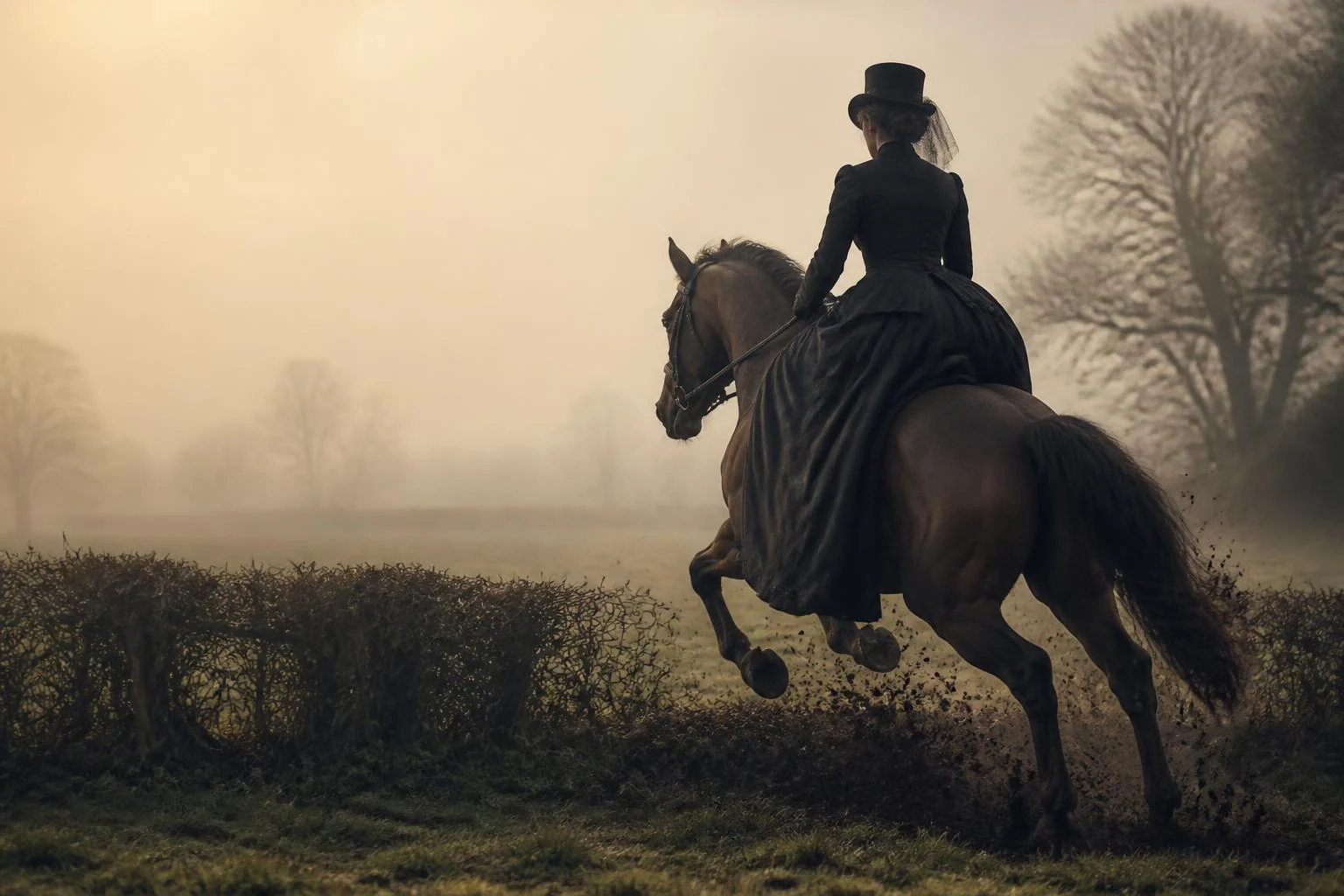
One enormous constraint is forgotten: she rode side-saddle, both legs on the same side. This position is far from a mere detail when galloping over uneven ground and jumping solid obstacles.
The side-saddle has a fixed head at the top, over which the right leg folds. And a second head, beneath the left thigh, added around 1830 in France, which blocks the left leg from below and is, technically, what made jumping possible for a nineteenth-century woman. Without it, landing from an obstacle would unseat you. The exact parentage of this head is still debated by historians, between the Baucher school and the Pellier family, but the date is stable: Elisabeth’s generation inherited it.
The rest depends on balance. One leg to act, a single stirrup on the left, a whip to replace the right leg, a pelvis that must face forward while the shoulders open. The horse carries asymmetrical weight from start to finish of the day, which demands a free back and proper equipment. This holds equally true today, in classical riding, when one chooses a saddle fitted to the horse’s back rather than to the fashion of the moment, and when one checks the sizing and channel clearances before buying.
How a Cross-Country or Hunting Horse Is Judged, Then and Now
- Sustained gallop, not top speed. Forty minutes of galloping requires aerobic capacity built over weeks, not a horse fast for a quarter-mile.
- Recovery. The true measure is the horse’s state the next morning: appetite, looseness at walk, coolness of the tendons.
- Boldness at a fixed obstacle. Over a fence that will not fall, a doubtful horse is an injured horse. Boldness is built, not forced.
- Balance between obstacles. What matters is not the jump but the six strides before and six after.
- Footwork and locomotion over heavy ground. Soft earth, a bank, a doubled ditch: the feet pay the price first.
- Temperament in company. Remaining manageable in the middle of thirty horses in full flight is a quality in itself, and it is learned.
- Number of outings per season. A cross-country horse is managed in annual volume, not isolated performance.
- Equipment. A saddle that frees the withers and loins, and a helmet at the correct standard and size, which did not exist in her time.
1880: She Returns and Jumps Every Fence at a Racecourse
She left Ireland on 23 March 1879, though not without diplomatic clumsiness: on the return journey, she did not visit Queen Victoria, pleading the urgency of floods in Hungary. In Dublin, a lemonade seller was already marketing mineral water as supplied to the Empress of Austria.
She left her English horses there, bought Irish hunters, and came back. On 4 February 1880, she was at Summerhill again, and the next morning was already hunting with the Ward Union. Passing by Fairyhouse racecourse, she demanded to jump every one of its fences, in succession. She gave Maynooth college a statue of St George, one of the few saints depicted on horseback, then, perhaps realising she had just given the patron saint of England to an Irish seminary, she gave a set of liturgical ornaments in gold cloth bordered with green silk, embroidered with shamrocks and the arms of Austria, Hungary and Bavaria. They were deemed too precious to use and went to the college museum.
She left on 7 March 1880. This time, she could not slight Victoria twice running: the two women met briefly in London.
1881: London Closes the Door
She wanted to return for a third winter. The British government made it clear she would not be welcome, and the reason had nothing to do with horsemanship.
The harvest failures of 1879 had thrown entire families onto the street. The Land League was gaining strength. Coercive measures were being voted. The Irish countryside was on the brink of upheaval. Yet the Empress’s visits had taken on, without her seeking it, the character of an official ceremony: Catholic crowds acclaiming a Catholic sovereign, Austrian flags and triumphal arches, at precisely the moment Victoria’s popularity was ebbing. The Lord Lieutenant, whose wife was nonetheless the Empress’s guest, had already expressed anxiety in writing about Irish enthusiasm. Elisabeth was known to support the Hungarian cause. No one in London wanted to know what she might think of the Irish cause.
A horsewoman who had come to hunt stag had become, in two winters, a problem of domestic politics.
1882: Sciatica Takes Her Horse
Barred from Ireland, she turned to England. She rented Combermere Abbey in Cheshire in 1881, then again in 1882, and hunted with the local pack. Her entourage then numbered eighty people, including twenty five grooms, which suggests the number of horses kept there.
The 1882 season would be her last. Sciatica made long hours in the saddle impossible. She rode no more, or scarcely. She replaced the horse with walking, forced marches, daily, exhausting to her companions, whatever the weather. The sport remained, the horse disappeared. Seven years later, the death of her son Rudolf would withdraw her from the world entirely, and she would spend the rest of her life travelling and in mourning.
10 September 1898: Thirty-Five Minutes
Sixteen years after her last hunting season, the Empress was staying in Geneva, at the Hôtel Beau-Rivage, under an assumed name which the local press had already uncovered. On Saturday, 10 September 1898, early in the afternoon, she walked toward the landing stage to board the steamship for Montreux.
Luigi Lucheni, twenty-five, an Italian anarchist, threw himself at her and struck her in the chest with a needle file honed to about four inches (10 cm), set in a wooden handle. The weapon fractured a rib and reached the heart. The corset and the narrowness of the wound delayed the bleeding. She got up, thanked him, boarded, and did not understand what was happening until she lost consciousness on deck. Brought back to the hotel, she died around 2.10 p.m., roughly thirty-five minutes after the blow. Her funeral took place in Vienna on 17 September.
On 10 September 2026, it will have been one hundred twenty-eight years.
What Remains of Her in the Stables
A portrait shows her riding side-saddle on a horse named Merry Andrew: it still hangs at the Royal Dublin Society. Her favourite horse from her Irish stay was called St Patrick. Her Irish wolfhound was called Shadow, and the carriage museum at Schoenbrunn in Vienna holds paintings of her Irish hunters and the dog.
In French clubs, something else remains, which no one associates with her any longer. The discipline of the hunter class was born from those hunting grounds, and it judges today what a hunt staff judged in 1879: style, regularity and ease of the horse, not merely poles left standing. The horses she bought, Anglo-Irish hunters descended from Thoroughbreds crossed on colder-blooded mares, are the direct ancestors of the Irish Sport Horse that still wins event competitions.
Everything else has changed, and for the better. A cross-country horse is now managed year-round: vaccinations, dentistry, farriery, tendon monitoring, weight, outing dates. Three horses lost in training in one season would never pass muster today, and this progress owes nothing to sentimentality: a monitored horse lasts longer.
What We Could Not Verify
- The exact number of horses she kept in England and Hungary, frequently cited but never with a source accessible online in the archives.
- The body measurements that circulate everywhere, height, weight, waist: they come from biographies, not from a document we could open.
- The legend that she was sewn into her riding habit before each outing. It is reported by biographers, but we found it in no primary source.
- The details of her classical riding lessons with circus riders: the fact is constant in specialised literature, but names and precise dates vary from author to author.
- The exact nature of her relationship with Bay Middleton, subject of rumours in her lifetime, which no source settles.
Our sources for this article are History Ireland (volume 19, number 3, 2011) for the two Irish visits and quotations from the Irish Times of 1879; standard biographical notes for the timeline of the Geneva attack; and specialised literature on the side-saddle for the technical section. Our method is detailed on our sources page.
Read Next
- Kincsem, the Hungarian mare unbeaten in 54 races, the Empress’s exact contemporary, but on the track rather than in the field.
- Louis XIV’s last hunt, another sovereign whom the horse accompanied to the end.
- Marie-Antoinette and her horse Pluton, another Austrian archduchess who rode against protocol.
Your Horse Deserves a Log, Not a Memory
Vaccinations, wormers, dentist, farrier, outings, injuries: what once got lost in stable records now centralises in seconds. That’s how you spot fatigue before it costs a season.
Discover Equirider’s digital health record
Looking for a livery for a cross-country horse? Compare horse livery options, and check what your horse and rider insurance actually covers before your first outing.