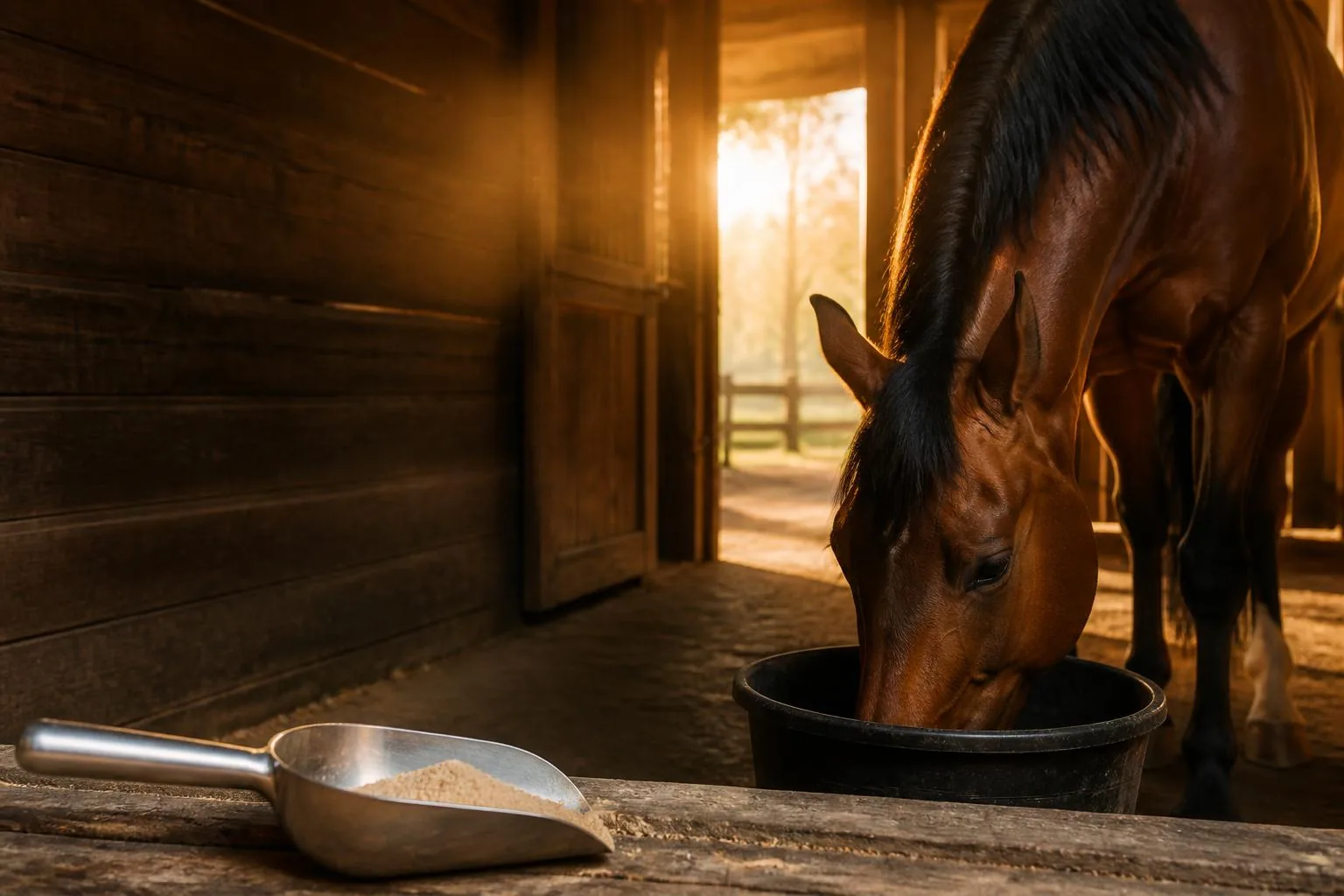

The uncomfortable truth that tack shop shelves would rather you didn’t know: for a healthy horse receiving proper nutrition, most équine supplements do nothing at all. They won’t make him more muscular, glossier or performant than what a decent feed ration already provides. Yet come summer, there is one that genuinely matters when heat and sweat enter the equation: electrolytes. The real skill lies in distinguishing the genuinely useful supplement, deployed at the right moment, from the colourful tub that feeds nothing but marketing.
The équine supplement market carries considerable weight, buoyed by seductive promises: greater endurance, sounder limbs, the coat of a champion. Yet nutritional science speaks far more cautiously. Before adding anything to the feed bucket, the first question isn’t which supplement should I buy, but what is actually missing from what my horse is already eating.
The real foundation is forage, not a tub
A horse is first and foremost a herbivore built to consume fibre continuously. Quality hay and grass cover the bulk of his needs for energy, protein and roughage. No supplement can compensate for poor-quality hay distributed in insufficient quantities. Before spending on supplements, verify the fundamentals: quantity, quality and balance of the ration. To pin this foundation on facts rather than guesswork, you’re better off calculating your horse’s ration than layering in additives as a precaution.
The logic boils down to one sentence: you supplement an identified deficit, you don’t over-cover a need already met. Giving biotin to a horse with sound feet already, or stacking three “joint” products on a healthy young horse, most often simply enriches his droppings.
Supplements that genuinely serve a purpose (in the right circumstances)
Some products have real utility, provided they address the right situation. Here are those worth considering, and why.
Electrolytes: the summer essential
This is the quintessential seasonal supplement. A horse sweating heavily, in heatwave conditions, during transport or after hard work, loses sodium, chloride and potassium through perspiration. These losses cannot be replaced with water alone. Electrolyte supplementation, coupled with constant access to clean water, aids recovery and reduces dehydration risk. By contrast, a horse at rest in the field with a salt lick requires them neither daily nor year-round.
Mineral and vitamin supplement (MVS), if the ration is unbalanced
A ration built on hay and grains is often deficient in certain minerals and vitamins, with calcium-to-phosphorus ratios out of whack. An appropriate MVS corrects this gap. Useful, then, but only if the imbalance genuinely exists: ration analysis, not fear of “missing something”, should drive the decision.
Joint supplements, for specific profiles
In the older horse, the heavily worked performance horse or an animal recovering from injury, certain joint-support actives may offer benefit. Yet stay realistic: effects are often modest and variable from horse to horse. On a healthy young horse, it’s money spent on anticipation without proven gain.
Digestive supports, in at-risk contexts
Stress, confinement, transport, grain-heavy diets: certain situations strain the stomach and gut flora. Digestive supports can help in these targeted cases, but they never replace the real remedy, which is addressing the cause (more forage, fewer concentrates, less stress). For horses sensitive to sugar metabolism, such as those prone to laminitis or with Cushing’s disease, supplement choice must be made with your vet, never by shelf browsing.
Where money gets wasted
Conversely, many purchases rest on a promise rather than a need. The most frequent pitfalls:
- “Coat shine” courses on an already healthy horse. A dull coat usually reflects an underlying problem (parasites, diet, health), not a supplement deficiency. Address the cause, and shine follows.
- Stacking products that duplicate each other. Three tubs containing the same vitamins result in waste, or even unnecessary excess.
- Miracle “performance” supplements. No bucket replaces progressive training, rest and a solid base ration.
- Fanciful dosages. A good product dosed poorly, below effective levels or in excess, becomes pointless and may unbalance the ration.
Before adding a product to your basket, run it through a few simple filters:
- Real need: does my horse present an identified deficit or situation (work, age, condition), or is this vague insurance?
- Clear composition: does the label plainly state actives and quantities, or just flattering names?
- Effective dose: is the beneficial daily amount actually delivered, and sustainable long-term?
- Coherence with the ration: does the product fill a gap without creating duplication or excess with everything else?
- Professional opinion: for a sick, older or performance horse, your vet’s judgement outweighs packaging promises.
How to stop throwing money into the feed bucket
The economical approach is also the healthiest for the horse. Start with the base ration and supplement only what is missing, product by product, observing effects. Avoid introducing three new things at once, or you’ll never know what works. A thorough overview of supplement families and their genuine uses is set out in our guide to équine supplements, cross-referenced with real-world observation.
The best “supplement”, ultimately, remains free: clean water on demand, quality forage, a horse at ideal weight and regular daily care. Everything else comes as targeted support, not habit.
Key takeawayOn a healthy, well-fed horse, most supplements are surplus. The one useful summer exception: electrolytes for a horse sweating heavily. For everything else, supplement an identified gap, never a promise. It’s the ration that makes a fit horse, not the tub.
This article is informational and does not replace veterinary or équine nutritionist advice. Sources: INRAE (équine nutritional requirements), IFCE (nutrition and forage), ANSES-ANMV (supplements and complementary feedstuffs).