
Next Saturday, 22 August, will mark 541 years since an English king died in a muddy field in Leicestershire, charging on horseback at his rival. Everyone knows the line he supposedly cried out: a horse, a horse, my kingdom for a horse. He never said it. It was written more than a century after his death by a playwright. And the truth of that 22 August is far grimmer than the legend.
On 22 August 1485, at Bosworth, Richard III became the last English king to die in battle. He was 32 years old. He died on foot, unseated, struck by multiple assailants, and his body left the field of battle naked, slung across a horse. Five centuries later, he would be found beneath a municipal car park. Between the two, a theatrical line would cast him as a coward begging for a mount to flee. It is the exact opposite of what the sources tell us.
The most famous line ever written about a horse came from the theatre
A horse, a horse, my kingdom for a horse. The phrase appears in the tragedy that William Shakespeare dedicated to Richard III, Act V, Scene 4. It is the last thing the character says before dying on stage. The text was first printed in 1597, 112 years after the battle.
No contemporary chronicle of the events, English, French or Burgundian, records these words. They exist nowhere before the Elizabethan stage. This does nothing to diminish their power: it is probably the most quoted line in the world about a horse, and it fixed forever the image of a king willing to trade a crown for a mount.
The original version did not say kingdom: it said a fresh horse
There exists an earlier, anonymous play, printed in 1594 under the title The True Tragedy of Richard the Third, which the majority of scholars consider one of Shakespeare’s sources. In its Scene XVIII, the wounded king cries out something subtly different: a horse, a horse, a fresh horse.
The nuance changes everything. To call for a fresh horse on a battlefield is not to ask for escape: it is to ask for what you need to return to combat. By replacing fresh with my kingdom, Shakespeare transformed a military order into a confession of panic. The portrait that resulted held sway for four centuries.
He was offered escape and refused it
The accounts closest to the event tell the opposite of the legend. The Ballad of Bosworth Field, a poem composed before 1495 in the circle of the Stanleys, portrays a knight coming to warn the king that the battle is lost and that it is time to leave. Richard refuses.
A second testimony, the so-called Castilian report, written shortly after by a Spanish diplomat based on the account of a captain present at the scene, agrees: pressed to seek shelter, the king replies that he will leave this field as King of England or not at all. The Crowland Chronicle, written in England in the months following, summarises the end the same way: the king falls on the ground, pierced by mortal wounds, a bold and most valiant prince.
These sources are partial, each in its own way, and none is neutral in a civil war that has just changed dynasties. But they converge on one point: no one at the time describes a king seeking a horse to escape.
The last cavalry charge of an English king
What happened was a charge. Seeing his rival Henry Tudor’s standard poorly protected, Richard III launches his cavalry directly at him, skirting the main melee. The figures vary greatly according to sources, from several hundred cavalry to a simple escort of household knights, and historians today lean towards the latter hypothesis.
The detail that every chronicle retains is the assault’s effectiveness. The king kills William Brandon, Henry Tudor’s standard-bearer, with his own hand. He unhorsed John Cheyne, a famous giant, with a lance thrust from a broken lance. According to the accounts, he came within a sword’s length of his opponent. Then the men of William Stanley, who had remained a spectator until then, switched sides and closed the trap.
No English king would ever lead a cavalry charge of this kind again. Three centuries later, the Duke of Wellington would conduct Waterloo in the saddle from morning to night on the same type of animal, and his horse Copenhagen would end his days with full military honours. But the era in which the war chief charged ahead in person ends on 22 August 1485.
The exact moment everything changed: the horse becomes bogged down
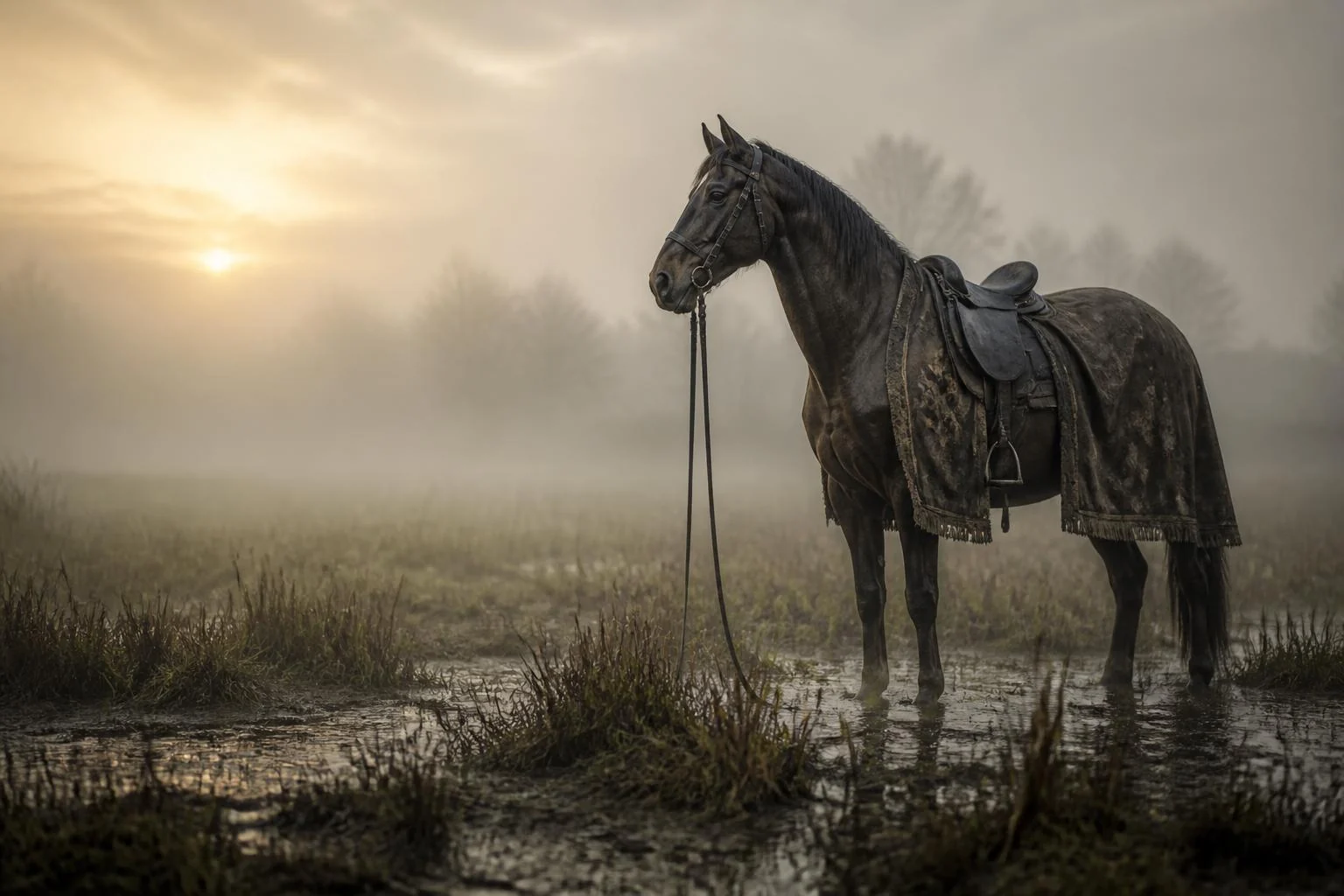
The Burgundian chronicler Jean Molinet, writing a few years later, gives the most precise and most terrible account: the king’s horse becomes trapped in boggy ground from which it cannot extricate itself, and there a Welsh soldier armed with a halberd delivers the fatal blow. The humanist Polydore Vergil simply writes that Richard was killed fighting valiantly in the thick of his enemies.
The two accounts do not oppose each other as much as they appear to. They describe the same sequence seen from two places: a king who loses his mobility, and therefore his advantage, and who continues to fight on foot to the end. On a medieval battlefield, a cavalryman immobilised in mud is no longer a combatant, he is a target. Everything the saddle gave him, height, speed, the ability to break contact, disappears in seconds.
This marsh story is not a literary flourish. Between 2005 and 2009, a research campaign led by the Battlefields Trust completely reconsidered the location of the battle. Soil analysis showed there had never been a marsh on the hill where the encounter was traditionally placed, but that waterlogged terrain did indeed exist in the meadows situated two to three kilometres (1.2 to 1.9 miles) further south-west. That is where the battle took place.
A silver-gilt boar and some thirty bullets
The same campaign yielded two discoveries that changed the military history of the period. First, a series of some thirty lead projectiles, from the smallest calibre handgun to an artillery ball: it is the largest collection of this type ever found on a European medieval battlefield, and it proves that Bosworth was decided under cannon fire.
Next, a tiny object, barely an inch (2.5 cm) across: a heraldic silver-gilt boar, found in 2009 in a field next to the small road that crosses the site. The white boar was Richard III’s personal emblem, and the silver-gilt indicated a member of his immediate circle. It is not proof, but it is the strongest clue we have as to where the king and his guard fell.
Eleven wounds, nine of them to the head
The rest is told by the bones. The analysis published in 2014 in the medical journal The Lancet by the University of Leicester team recorded eleven wounds inflicted at the moment of death: nine to the skull, two to the rest of the skeleton. Nine head wounds mean the king had lost or removed his helmet. Two of them, at the base of the skull, are considered fatal on their own.
The authors describe a sustained attack, carried out by multiple assailants with weapons typical of the late Middle Ages. Another injury, to the pelvis, was probably inflicted after death, which corresponds to accounts of the corpse being desecrated. The skeleton also bore a marked scoliosis, a lateral curvature of the spine that the theatrical character caricatured as a hunchback.
His last journey, he made it on horseback
After the battle, the body is stripped and brought to Leicester slung across a horse, publicly displayed for several days to prove the king is truly dead, then buried without ceremony in the choir of the Greyfriars Church. The gold circlet found on the field is taken to Henry Tudor, proclaimed king on a nearby height.
There is something vertiginous about this image: a man who has just refused a horse to escape leaves the battlefield strapped to the back of another. The great equestrian narratives of history often turn on such reversals, from the horse no man could tame except one adolescent to the sole survivor of the Little Bighorn disaster, and the horse Napoleon would never be parted from.
527 years later, beneath a car park
The Greyfriars Church disappeared at the Dissolution of the Monasteries, the neighbourhood was rebuilt, and the site ended up as a car park for an administrative office building in the centre of Leicester. On 25 August 2012, three days after the anniversary of the battle, an excavator breaks through the tarmac. Archaeologists from the University of Leicester uncover a human burial in the first trench, six hours into a project expected to last two weeks.
The skeleton bears a crooked spine and combat trauma. On 4 February 2013, the university announces identification is confirmed, notably through mitochondrial DNA comparison with descendants in the maternal line. Richard III is reburied in Leicester Cathedral on 26 March 2015, before cameras from around the world. 530 years after Bosworth.
And the horse in all this
There remains the question that interests riders: what did a king’s mount actually look like in 1485. In Shakespeare, he is called White Surrey, and the king orders him saddled for the following day. This name appears in no document from the period: it is a stage name, like the line itself. If you are seeking ideas somewhat less fictional, our selection of horse names will prove more reliable than a theatrical piece.
The destrier itself is deserving of deconstruction. The image of a two-ton colossus bearing an armoured knight comes from the nineteenth century, not from the sources. The research programme conducted between 2020 and 2022 by the universities of Exeter and East Anglia assembled the largest corpus of English horse bones ever studied, nearly 2,000 elements from 171 archaeological sites covering thirteen centuries. The verdict: medieval warhorses rarely exceeded 14 hands 3 inches (147 cm) at the withers. By today’s standards, a light riding horse, sometimes even a large pony.
In other words, the horse of Bosworth had almost nothing in common with the shire or the other draught horses to which it is spontaneously associated. It was compact, quick, trained to charge in line and to endure noise. What was heavy was the man and his equipment, not the animal. The rest of the kit followed the same path: the history of the saddle shows clearly how the high cantle of the war saddle, designed not to be overthrown at impact, disappeared as soon as battles ceased to be won by the lance. And certain reflexes of the modern rider date from that era, beginning with the habit of always mounting from the left.
How to judge a historical account like this one
- The gap between the date of events and the date of the text describing them: 112 years for Shakespeare’s line, a few months for the Crowland Chronicle.
- The author’s interest: a ballad written in the circle of the Stanleys flatters the Stanleys, a chronicle commissioned by the Tudors blackens their predecessor.
- The convergence of independent sources: a fact reported by an Englishman, a Burgundian and a Spaniard carries more weight than a single account.
- Material confirmation: bones, wounds, projectiles, objects lost on site, soil analysis.
- The distinction between what the source says and what we infer from it: an emblem found in a field places a man there, not necessarily the king.
- The physical coherence of the account: a horse immobilised in waterlogged soil, we still see this at training today.
- What science refuses to settle: the order of blows struck on Richard III remains unknown, and the study’s authors say so.
A kingdom for a horse, and today
Shakespeare’s line poses at its heart a very concrete question every rider knows: what is a horse worth when you truly need one. In 1485, the answer lay in a charge and an immobilised mount. Today, it is read in the sales rings, where the world’s most expensive horses reach sums that would make a Plantagenet king smile.
A kingdom for a horse was a theatrical line. The real prices, they are documented.
Sales records, stud fees, the gaps between disciplines: what the world’s most expensive horses actually cost.
Key points
- The Battle of Bosworth took place on 22 August 1485, in Leicestershire.
- Richard III was the last English king to die in battle, at the age of 32.
- A horse, a horse, my kingdom for a horse comes from Shakespeare’s play, printed in 1597.
- The anonymous play of 1594 that preceded it had the king cry out for a fresh horse, meaning to return to combat, not to flee.
- Sources close to the events describe a king who refused to leave the battlefield.
- According to chronicler Molinet, his mount became bogged down in waterlogged ground before the fatal blow.
- Eleven wounds were found on his skeleton, nine of them to the head.
- The body was brought naked to Leicester slung across a horse, then forgotten for five centuries beneath what would become a car park.
- Medieval warhorses rarely exceeded 14 hands 3 inches (147 cm) at the withers.
Equirider is affiliated with none of the institutions mentioned. The archaeological and forensic-medical facts reported here come from academic publications and public excavation campaigns, whose references appear below.
Sources
- Appleby J. et al., Perimortem trauma in King Richard III, a skeletal analysis, The Lancet, 2014
- University of Leicester, Grey Friars research programme, 2012 excavation and identification announced 4 February 2013
- Battlefields Trust, Bosworth Field battlefield location campaign conducted 2005 to 2009 under the direction of Glenn Foard
- Ameen C. et al., In search of the Great Horse, a zooarchaeological assessment of horses from England, International Journal of Osteoarchaeology, Warhorse project of the universities of Exeter and East Anglia
- Jean Molinet, Chroniques, and Polydore Vergil, Anglica Historia, for contemporary accounts of the battle
- Ballad of Bosworth Field, poem composed before 1495, and Crowland Chronicle
- William Shakespeare, The Tragedy of King Richard III, Act V Scene 4, and The True Tragedy of Richard the Third, anonymous play printed 1594