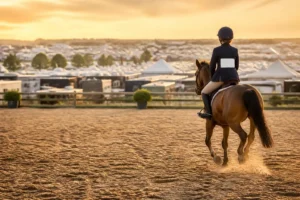

On Sunday 23 August, at 2:20 pm, the main arena at Aachen will crown the world showjumping champion. Twenty-five combinations will enter the ring, twelve will return for a final round, and the title will go to the rider who has accumulated the fewest penalties throughout the week. Each will ride their own horse. It has become so routine that hardly anyone remarks upon it.
Forty years ago, on this same ground, it was entirely different. On 13 July 1986, at Aachen, the four best riders in the world entered the arena under an extraordinary obligation: to jump four courses, not just their own but those of their three rivals, on the horses of their three rivals. That day, a 26-year-old Canadian whom almost nobody knew completed four rounds without a single fault. The fourth, she rode on Jappeloup.
Her name is Gail Greenough. She remained for thirty-two years the only woman ever crowned world showjumping champion in open competition against men. And the event that made her champion no longer exists.
What Sunday will decide at Aachen, and what will be missing
The International Equestrian Federation’s World Equestrian Games are being held at Aachen from 11 to 23 August 2026, six disciplines on a single site. Showjumping closes the fortnight. The mechanics of it rest on four fixtures: a speed class on Wednesday, where faults are converted to seconds then points, the two team final rounds on Thursday and Friday, then the individual final on Sunday afternoon.
Nothing resets along the way. A rider arrives at Sunday carrying the total of penalties accumulated since day one, and the leading nations also play their qualification for the Los Angeles 2028 Games. This is a championship of mental endurance as much as a showjumping championship.
The old showjumping world would have found this format rather tame. Until 2014, the final day was something else entirely.
Four riders, four horses, sixteen courses
The format was called the Final Four. The four best riders from the championship started afresh on the last day. Each jumped a shortened course on their own horse, then on the three horses of their opponents. Sixteen courses in total, four per horse. The world champion was whoever performed best across the board, including on horses they had never ridden before.
The detail that made it so formidable: the warm-up happened in the arena, under the eyes of the crowd. A few minutes to learn a mouth, a stride length, a temperament. Then you went.
It was not a late gimmick. The International Equestrian Federation recalls that the world showjumping championship was born in Paris in 1953, and that the team event only arrived twenty-five years later, in 1978. The Final Four, by contrast, was there from the earliest editions: for decades, the d’Inzeo brothers, Pierre Jonquères d’Oriola and Hans Günter Winkler handed their horses to one another in front of the stands to decide the title.
13 July 1986: the unknown and the three heavyweights
Gail Greenough was born in Edmonton, Alberta. She has been riding since she was eleven, she competed in World Cup finals, and joined the Canadian team at twenty-three. At Aachen in 1986, she was disputing her first major team championship. Her horse was a Hanoverian gelding with an almost comic name: Mr T.
Against her in the final: three men who had won everything. Conrad Homfeld, individual silver medallist at the Los Angeles Games, on Abdullah. Nick Skelton, future Olympic champion at fifty-eight, on Raffles Apollo. And the Frenchman Pierre Durand, on Jappeloup de Luze.
Her preparation, as she has since recounted, involved watching videos of the three horses repeatedly, trying to match each one to a horse she already knew, to guess what the feeling in the saddle would be like. Then she jumped four times without knocking down a single rail. Zero points on Mr T, zero on Abdullah, zero on Raffles Apollo, zero on Jappeloup.
Conrad Homfeld took silver on Abdullah, Nick Skelton bronze on Raffles Apollo, Pierre Durand fourth place with 32 points. The Canadian team, which also included Ian Millar, finished fourth in the team championship, won that year by the United States. Greenough became the first woman, the first Canadian, and the youngest rider to win the world title, and the first to prevail without a single penalty in this final. She received the Order of Canada four years later.
A detail that records often gloss over: women had already been world champions before her, but in a separate championship reserved for women riders, held only three times. Marion Coakes won it at Hickstead in 1965, Janou Lefebvre at Copenhagen in 1970 and then at La Baule in 1974. From 1978 onwards, men and women competed in the same championship. It was that title, the only one that remained, that Greenough went after eight years later.
Jappeloup, the horse she understood best
For a French audience, it is that fourth course that catches the heart. Jappeloup de Luze was not an easy horse. Small, spirited, fiery, he had two years earlier thrown Pierre Durand to the ground at the Los Angeles Games for refusing an obstacle, the bridle left in his rider’s hands, before the cameras of the watching world. Two years after Aachen, in 1988, he became Olympic champion in Seoul, and his story would end up in cinema. Those two moments, the Los Angeles fall and the Seoul triumph, feature in our panorama of showjumping, from the pony club to the Olympic podium.
Between the two came that July Sunday when a young woman who had never ridden him took him without fault around a world championship course. That is precisely what the Final Four was meant to prove: that a truly great rider is not simply the man of one horse.
What matters when a rider mounts another’s horse
Six things the experts watched during a Final Four
- The first stride after entering the arena. A rider who takes ten strides to find the contact has already lost ground on a course that should take eight or nine.
- The hand. Every horse has its own mouth and bit sensitivity. The classic fault came from too firm a hand on a sensitive horse, or too light a hand on a strong one.
- Respect for the horse. No one accepts seeing their horse manhandled by a rival for a few minutes. A rider too aggressive on another’s mount played very badly with the crowd.
- The approach to the first fence. The moment when the rider discovers the horse’s true athleticism. Faults clustered here.
- The ability to yield. On an unfamiliar horse, maintaining an impossible stride length is the surest way to knock down a rail. The winners were often the most modest.
- The horse itself. Four courses in one afternoon, four different riders, four different balances. The horse’s consistency counted as much as the men’s talent.
Why the FEI abolished the format
The decision came down at the International Equestrian Federation’s general assembly in Tokyo, from 19 to 22 November 2016. The final phase was simply abolished from the showjumping rules, effective from the following World Games. Since then, the world champion is the rider with the fewest penalties across all team and individual classes, with a tiebreak jump-off against the clock if needed.
Two criticisms had been voiced for a long time. The first concerned sport itself: you normally judge a combination, not a rider in isolation, and having a horse ridden by someone else amounted to marking something different from what the rest of the week had measured. The second concerned the horse: four courses in one afternoon with four different riders was an ordeal being loudly debated even by 2014.
The riders themselves were divided. Jeroen Dubbeldam, the last world champion crowned under this format at Caen in 2014, had been blunt: horses at this level are trained and sharpened, and anyone who refuses the exchange has no business in this final. He had been the only one that year to complete all four rounds without a fault. Like Greenough twenty-eight years before him.
The first edition without a Final Four was Tryon in 2018. It crowned German rider Simone Blum, the second woman world champion in history, thirty-two years after the Canadian.
Aachen, the arena that has seen it all
The Soers complex is not hosting this championship by chance. The showjumping worlds were held there already in 1955, 1956, 1978, 1986 and 2006. No other venue has hosted as many. On Sunday, the 2026 champion will be crowned a few metres from where Gail Greenough dismounted Jappeloup in 1986, under an ovation that belonged not only to her.
He will ride only one horse, his own. That is not an impoverishment, it is a different wager: one that rewards a partnership built over years, as the eventing world champion crowned last week at eighteen, or as dressage combinations are judged on the subtlety of their understanding. Simply, no one will ever know what the world’s best rider would have done on his neighbour’s horse.
Understanding a course before watching the final
Penalties, time allowed, vertical, oxer, jump-off: our complete guide to showjumping explains what the experts see when everyone else just sees poles.
Sources
International Equestrian Federation, archives of world showjumping championships, for the mechanics of the Final Four, the creation of the championship in Paris in 1953, the introduction of the team event in 1978, the women’s world championships of 1965, 1970 and 1974, the records of the Aachen editions and Gail Greenough’s 1986 title. Horse and Hound, 2 December 2016, for the abolition of the Final Four decided at Tokyo general assembly and the replacement format. Canadian Horse Journal for Gail Greenough’s course, her video preparation, the horses ridden in the final and the Canadian team’s fourth place. GRANDPRIX and the official 2026 World Games site for the showjumping programme and the individual final schedule for 23 August. Canadian Olympic Committee, Hall of Fame, for the youngest title winner, the complete clear round and the Order of Canada in 1990. Equirider is not affiliated with the International Equestrian Federation or the French Equestrian Federation.