Britain’s most demanding horse trials opens this Thursday 3 September at Burghley House in Stamford, Lincolnshire, and concludes Sunday 6 with the prize presentation. Fifty-one combinations are expected to compete. The sports statisticians’ favourite is a British rider in her early fifties who has contested this event since 1996 without ever winning it, and who lines up this week on a horse she bred herself, the son of the mare she rode at European Championships. Here is the story, and the framework for understanding what will really be decided between Thursday and Sunday.
Thirty years of Burghley, and never a victory at the top
Her name is Sarah Bullimore, born 18 May 1973, and she rode her first Burghley in 1996 at twenty-three years old. Thirty years later, she returns as the plateau’s strongest contender, with a record distinguished by a notable absence: no victory at the highest level of international competition.
She is no unknown quantity. She finished second at the Pau five-star in 2017, fourth at Burghley in 2018 and again in 2019, second at Blenheim in 2022, and claimed individual bronze at the 2021 European Championships. What she lacks is precisely one line: victory in a CCI five-star, the highest level of horse trials, where only a handful of events take place worldwide each year.
This missing line is what makes this week’s draw peculiar. Number 34 will start Thursday in the middle of the field, beholden to no one, at the top of the probability rankings.
She bred the horse in her own yard
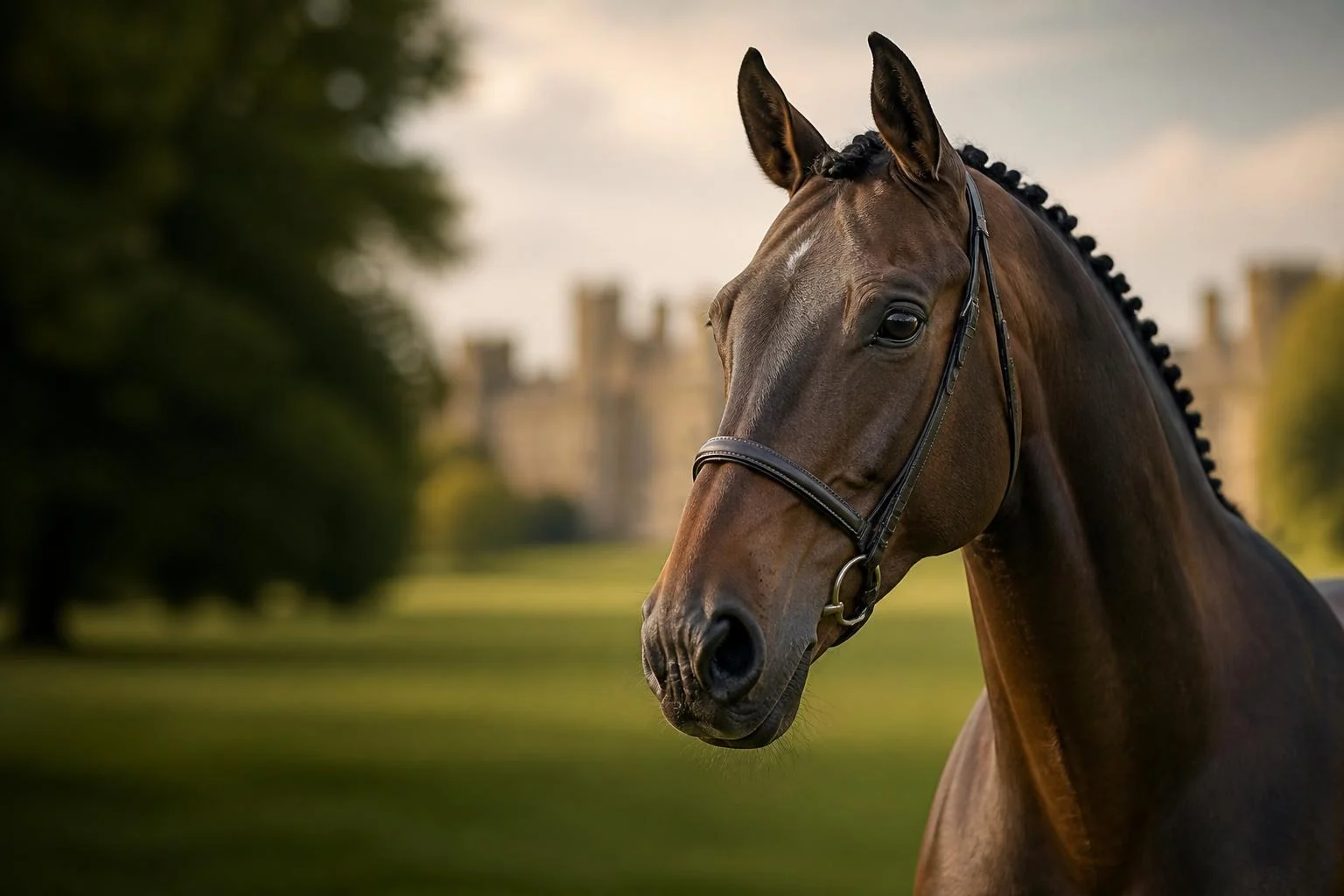
Corimiro is ten years old. He is the fourth offspring of Lilly Corinne, the mare that Sarah Bullimore rode at the 2015 European Championships. His sire is the stallion Amiro Z. His older half-brother, Corouet, same dam and out of Balou du Rouet, is the horse with which she won European bronze in 2021.
In other words, Burghley 2026’s favourite is launching on a horse born in her own yard, out of a mare she rode herself at championships. In a sport where the best horses now sell at prices excluding the vast majority of riders, this has become an uncommon path. It echoes what the figures of breeding tell us: producing your own sports horse remains, for many, the only way to access an athlete of this calibre, at the cost of ten years’ patience and with no guarantee of results.
The horse is owned today by a small syndicate including the rider’s husband, Brett Bullimore, along with Christopher and Susan Gillespie and Bruce Saint. His record is brief but clear: third in the eight and nine-year-old class at Blenheim in 2025, fifth at Pau in autumn of that year for his very first five-star at just nine years old, then tenth at Badminton in spring 2026.
The detail that matters for what follows: at Pau, he was leading after the cross-country. His rider recounts starting without any time objective, dropping her stopwatch after five minutes, giving up on calculating and simply letting the horse gallop at his own rhythm. She came home well within the time allowed. On a course of that standard, such things do not happen by accident.
The winter she turned the mare out with her son
The anecdote was recounted by the rider herself in the British magazine Horse and Hound’s podcast in February 2026, and it says much about how this horse is managed. Corimiro is difficult to turn out: too restless, too enterprising, rather rough with companions, to the point he could not be pastured with anyone.
The solution found last winter was to put him in the paddock with Lilly Corinne, his own dam. The mare does not take nonsense; she ignores his boisterousness and puts him in his place with a squeal when he comes too close. The horse gained confidence: the two end up sharing hay under the shelter, and he coaxes her on walks around the field. A top-level horse is not merely a jumping machine; it is a social animal whose mental balance is also developed away from ridden work.
What it means to be favourite with odds of 21 in 100
The favourite is not designated by a jury but by a model. The data analysis company EquiRatings, which calculates probabilities from each combination’s past performances, gives Sarah Bullimore and Corimiro a 21 per cent chance of victory, a 37 per cent chance of finishing on the podium and a 63 per cent chance of placing in the top ten. These are the strongest odds on the line-up.
Read these figures the right way. Twenty-one chances in 100 means the model gives four to one odds to the opposite outcome. In a competition where Saturday’s cross-country eliminates part of the field each year, the favourite for a five-star remains first and foremost a rider with slightly better odds than the rest.
One precedent tempers any rash backing of a ten-year-old: the last winner at that age at Burghley was Ballaghmor Class in 2017, ridden by Oliver Townend. Nine years without a ten-year-old managing it in an event that ordinarily rewards experience, and you understand the scale of the feat. The question of longevity and maturity in top-level horses was indeed the summer’s great lesson from the World Championships, where the title went to an eighteen-year-old.
What judges a favourite at Burghley
- The total penalty score, never a single phase. Dressage, cross-country and show jumping are added together in penalty points, and the smallest total wins Sunday afternoon.
- The dressage mark from Thursday or Friday. It does not win; it gives the advantage. Three or four marks surrendered in the test equal a fence down on Sunday.
- Time management on the cross-country. The stopwatch is Saturday’s silent opponent. Every second beyond optimum time incurs penalties, and no one catches up a deficit taken at Burghley.
- The ability to gallop uphill. The park is undulating, which is not the case at every major course. A horse that cannot hold the climb loses time without faults.
- The combination’s experience, not just the horse’s. Nine riders are discovering this event this year. Reccing a course of this size for the first time changes how you ride it.
- Recovery on Sunday morning. A veterinary inspection takes place before show jumping. A horse that left too much in the tank the day before can be eliminated when well placed.
- Composure in the final arena. The last twenty go in front of a full grandstand, in reverse order of the standings. One fence is enough to turn the podium.
- The state of the ground. Hard or waterlogged going reshuffles the cards more surely than any draw, especially for a young horse discovering this level of effort.
What awaits number 34 on Saturday
Burghley’s cross-country is designed by American Derek di Grazia. It measures just over four miles, around 6.5 kilometres, and comprises thirty fixed obstacles across parkland where the gradients themselves present a separate challenge. This is Saturday’s phase, the one that draws the biggest crowds.
Its signature obstacle carries a number and a name: the twentieth, the Cottesmore Leap, an enormous brush fence set above a ditch some ten feet (3 metres) wide, with a brush rising to about 4 feet 9 inches (1.45 metres). It takes its name from a hunting establishment in the neighbouring county, and it is probably the world’s most photographed cross-country obstacle. According to the course notes published by the organisers, riders should approach it around the eight-minute mark of their run, at full gallop, with the long stretch known as the winners’ avenue immediately after to try and make up time.
The cross-country penalty system, meanwhile, does not change from event to event, and we detailed it in August regarding the World Championships cross-country: unfallen obstacles, optimum time, refusals, run-outs. Sunday’s show jumping course is designed by Paul Connor and runs in two sessions, the second reserved for the top twenty.
£120,000 to the winner, £388,000 in total prize money
This year’s winner will receive £120,000, some £5,000 more than in 2025 and £5,000 less than Badminton’s spring winner. The event’s total prize fund reaches £388,000. Second place receives £66,000, third £50,000, fourth £36,000, fifth £25,000, and the scale descends to a few thousand pounds for places of honour, the number of prize places depending on field size.
One detail of this scale merits mention in an article about a horse bred by his rider: last year, a £1,000 prize was awarded to the breeder of the highest-placed British horse. It is modest in context, but it is one of the rare occasions when the sport pays the person who produced the animal rather than the person who rides it. For anyone considering taking up breeding, the gap between these two lines of prize money says nearly everything about the sport’s economic model.
The Grand Slam jackpot of $350,000 won twice in twenty-seven years
Burghley is one of three events composing the Grand Slam of horse trials, with Badminton in England in spring and the Kentucky in the United States in April. The series was created in 1999. Its rule is simple and brutal: you must win all three events consecutively, not necessarily in the same year, to claim a prize of $350,000.
In twenty-seven years, only two riders have managed it. Britain’s Pippa Funnell achieved it in 2003, taking Kentucky and Burghley on Primmore’s Pride and Badminton on Supreme Rock. Germany’s Michael Jung signed the second, between Burghley 2015 and Badminton 2016. No one else since the series was created.
There is a less glorious sequel. In September 2024, the three events’ organisers announced they were seeking a new title sponsor for the series after more than two decades of partnership with the watchmaker bearing its name. The series was not held in 2025, a first since its creation, with organisers noting they were exploring alternative formats while discussions continued. In other words: the sport’s hardest prize to win ground to a halt before a third rider could reach it. No one this week was in position to pursue it anyway. You would have needed to arrive here having won the two preceding series events: yet Badminton 2026 went to Ros Canter, absent from Burghley, and the Kentucky 2026 to American Will Coleman, who does start this week but on another horse, and whose series was interrupted at Badminton.
Who is missing, who is coming, and why number 13 does not exist
The notable absence is Ros Canter, two-time defending champion, victorious in 2024 and 2025 on Lordships Graffalo. She preferred to take her horse to the World Championships in Aachen in August and has not entered any of her other five-star horses. Two of her teammates will be there, however: Laura Collett and Gemma Stevens.
Fifty-eight horses from seven nations appeared on the August entry list. After the closing date, the draw of 18 August, and four withdrawals, fifty-one combinations are expected. Switzerland’s Felix Vogg withdrew his mare Cartania, winner of last year’s five-star at Maryland, because blood tests showed her red blood cell count too low; he will save her for Pau in late October. Australian Sophia Hill withdrew to return home after an entire season of travelling. Britain’s Harry Meade, third here three years in a row, withdrew the horse meant to lead off, judging it short of preparation runs, and finds himself with two mounts instead of three. Aaron Millar also declared a withdrawal.
Among new arrivals, 2022 World Champion Yasmin Ingham is discovering Burghley, as are eight other riders. Caroline Powell, 2010 winner, is back. And one curiosity the organisers have long maintained: no rider carries number 13, deemed unlucky. In the starting order drawn on 18 August, the horse placed fifty-fifth was therefore numbered 56.
No French riders are entered. The tri-colour discipline’s appointment remains Pau, France’s sole event at this level, in late October. To follow French fixtures, our competition calendar remains the simplest entry point.
Why this event has mattered since 1961
The first trials took place in Burghley House park in 1961, and victory went to Anneli Drummond-Hay on Merely-A-Monarch. The record for wins belongs to William Fox-Pitt, victor six times between 1994 and 2011. The event claims over 173,000 visitors across four days and more than six hundred exhibitors, making it as much a country fair as a competition.
This dual nature explains its place in the season. It falls in September, after the summer championships, and thus serves both as a repechage for horses that missed their target event and as a test case for those climbing the levels. The three phases that follow each other, dressage, cross-country and show jumping, do not demand the same qualities: it is precisely this contradiction that defines the discipline.
Key facts
- The event runs Thursday 3 to Sunday 6 September 2026 at Burghley House, Stamford.
- Fifty-one combinations are expected to start, from fifty-eight entries and four withdrawals.
- Statistical favourite Sarah Bullimore has contested this event since 1996 without winning it.
- Her horse Corimiro, aged ten, was bred in her yard and is the son of the mare she rode at European Championships.
- Saturday’s cross-country measures just over four miles across thirty fixed obstacles, with the Cottesmore Leap at the twentieth.
- The winner receives £120,000 from a total prize fund of £388,000.
- The Grand Slam prize of $350,000 has been won only twice since 1999, and the series has lacked a title sponsor since 2024.
The schedule, hour by hour
The times below are those published by the organisers in British time. Add one hour for mainland France.
Wednesday 2 September at 16:00 sees the first veterinary inspection in the main arena: horses are presented in hand and may be eliminated before even competing. Thursday 3 and Friday 4, dressage occupies the day in two sessions at 10:00 and 14:00. Saturday 5, cross-country starts at 11:00 and takes the afternoon. Sunday 6, the final inspection is at 08:45, show jumping begins around 10:30, the top twenty session is scheduled for 14:30 and the prize presentation at 15:40.
On the cross-country, a body protector and helmet are not accessories: they are the only two defences between a rider and an obstacle that does not fall. That said, you must wear the right standard and the right size.
The same applies to the head: helmet standards, sizes and service lives are matters to read before purchase, and our guide to choosing your riding helmet correctly details what actually distinguishes two models at the same price.
What we could not verify
Four caveats rather than convenient certainties. The favourite status rests on a probability model published 11 August, before withdrawals, and a model is not a prediction: it describes a distribution, not an outcome. The final field composition will be known only after Wednesday 2 September’s veterinary inspection, and a horse may still be withdrawn or refused between now and Thursday. Sarah Bullimore’s first Burghley entry in 1996 is taken from British specialist press and we found no primary archive source to confirm it. Finally, on the Grand Slam, we establish that the series lacked a title sponsor in autumn 2024 and that it was not held in 2025; we found no public announcement confirming a new partner for 2026, which is not the same as proving there is not one.
This article contains no prediction and will not be outdated Sunday evening: it explains what is judged and how, not who will win.
Sources
Official website of the Defender Burghley Horse Trials for dates, hour-by-hour schedule, description of the cross-country course and its twentieth obstacle, the names of course designers and the September 2024 press release on seeking a Grand Slam title sponsor. British specialist equestrian press for the 11 August entry list, the starting order drawn 18 August, withdrawals, the 2026 prize fund scale and the probabilities calculated by data analysis firm EquiRatings. Podcast from the same magazine, February 2026, for the rider’s remarks on her horse and turning her mare out with him. Reference sources for the event’s 1961 foundation, the first palmarès and the six-win record. Equirider is neither organiser nor partner of this event.