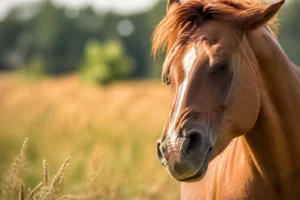

He is eighteen, he has spent the summer at grass, and for the past few days his coat is coming through faster than the others’. His back has lost muscle, he is drinking more, he seems a bit sluggish. We put it down to age. That would be the most common mistake of late August, because we are right in the only period of the year when this disease can no longer hide itself: from July to mid-November.
The disease is called Cushing’s in the stable. Veterinarians say PPID, for pituitary pars intermedia dysfunction. According to the French Institute for the Horse and Equestrian Sport (IFCE), approximately twenty per cent of horses over fifteen years old are affected, and forty per cent of those over thirty, against half a per cent of the total equine population. In other words, in a field of five older horses, there is statistically one carrying it, and there is a good chance nobody knows yet.
What we call Cushing’s is nothing like ageing
In a healthy horse, the hypothalamus, a small gland at the base of the brain, continuously restrains the intermediate lobe of the pituitary by secreting dopamine. With PPID, this brake degrades: the pituitary is no longer contained, it enlarges and releases ever-increasing quantities of ACTH, the hormone that commands the adrenal glands to produce cortisol.
Cortisol is not a poison; it is the hormone that manages sugar, proteins, fats, immunity and the rhythms of the day. In permanent excess, it slowly undoes all of this: muscle melts away, fat is redistributed, immune defences drop, the feet become fragile. This is not a horse growing old; this is a horse whose central regulator is broken.
The point that matters for the owner is this: the disease progresses very slowly, and the IFCE notes that it can be years before telling signs appear. During those years, everything we see looks like age.
Signs that are wrongly blamed on old age
This is the heart of the misunderstanding. The early signs of PPID are exactly those we spontaneously attribute to a horse getting on in years, and the IFCE says so plainly: these clinical signs can be wrongly confused with normal ageing.
The coat is the most famous sign, and the latest to appear
Hypertrichosis, that abnormally long and sometimes curly coat that persists regardless of the season, is the emblematic sign. It is also the most deceptive, because it marks a disease already well established. A review published in 2018 reminds us that it is characteristic of the advanced stage and that it is useless for spotting cases that are still silent.
What shows earlier is a delayed or incomplete coat change at the season turn, excessive sweating that persists even after clipping, sometimes discoloured patches in the mane and tail. In late August, a horse whose winter coat is coming through noticeably before his field companions’ deserves a second look, not a shrug. This proves nothing on its own: a horse can shed or change its coat for many other reasons.
What shows before the coat
The silhouette speaks first. Muscle loss settles along the topline and over the abdominal region, creating that pendulous belly we blame on age. At the same time, fat does not disappear; it moves: it accumulates above the eyes, in the hollows of the cheeks, over the poll, at the tail base and in the perineal region. A horse that is losing muscle along the back whilst keeping bizarrely placed fat deposits is not a horse ageing normally.
Then comes lethargy, a drop in performance, and increased drinking and urine output. Then infections on repeat, because immunity takes a poor hit from excess cortisol: dermatophilosis, ringworm, dental and sinus infections, foot abscesses, pneumonias, wounds that heal slowly. Each of these episodes is treated in isolation, and nobody joins the dots.
A horse that passes twenty years old inevitably changes, starting with teeth and digestion. Knowing what a twenty-year-old horse can legitimately show allows you to spot what falls outside the normal range.
Why autumn is the season that gives it away
Here is the fact that makes this end of summer special, and it is physiological before it is pathological. In all horses, healthy ones included, ACTH secretion rises in late summer and autumn, when the day length shortens. It is a normal seasonal rise, linked to photoperiod, and it comes back down the following spring.
The 2018 review cited above adds the decisive nuance: this rise exists in everyone, but it is the horses with PPID that rise the highest. In other words, autumn spreads out the curves. A healthy horse rises a little, a sick horse rises a lot, and the gap between the two finally becomes readable on a blood test.
A study conducted in a subtropical zone, reported in that same review, shows the gain: sampling in autumn achieved one hundred per cent sensitivity and ninety-five per cent specificity, against eighty and eighty-two per cent for the rest of the year. These values are specific to a latitude and laboratory and do not transpose directly to Britain and France, but what they demonstrate transposes perfectly: it is in autumn that the test sees early cases best.
The same figure, two verdicts: the trap of seasonal thresholds
The direct consequence is a trap of interpretation, and this is where the difference lies between useful screening and a false alarm. Since ACTH rises physiologically from July to mid-November, an autumn result cannot be read by the same rule as the rest of the year.
Leading international recommendations recognise two windows. From December to mid-June, an endogenous ACTH concentration above ten picomoles per litre can support a diagnosis of PPID in a horse whose age and clinical signs match. From July to mid-November, this threshold rises to twenty picomoles per litre. The same raw number can therefore be unremarkable in September and worrying in March.
Three precautions flow from this, and they cost nothing: verify that the laboratory report mentions a seasonal reference range and not a single value valid all year, never compare from memory a result from March to a result from September, and do not transpose a threshold found on a forum, since units change from one laboratory to another and intervals depend on latitude.
What to look for in an autumn ACTH test
- The date of sampling, written in black and white: from July to mid-November, it is not read by the same criteria as the rest of the year.
- The presence, on the report, of a seasonal reference range and not a single value valid all year.
- The unit used by the laboratory, picomoles per litre or picogrammes per millilitre, never converting a threshold found elsewhere.
- Concordance with the real horse: his age, his shape, his coat, his history of laminitis, his recent infections.
- The sampling and transport conditions, which your vet controls and which determine the validity of the result.
- Stress on the day: a horse panicked at the needle is not in the conditions of a baseline test.
- What the result does not say: a value in the equivocal zone is neither a green light nor a diagnosis; it calls for a second examination or a follow-up test weeks later.
- Associated screening for insulin dysregulation, because equine metabolic syndrome can coexist and change how you proceed.
What a test alone cannot settle
Blood ACTH testing is the first-line test, and it has the advantage of being simple: a blood sample, no hospitalisation, no heavy protocol. It is not always enough. The IFCE indicates that in cases of equivocal results, or when clinical signs are still subtle, other tests can be carried out: the dexamethasone suppression test or the TRH stimulation test, which compare ACTH levels before and after injection. The institute also reminds us that these tests remain difficult to interpret because of daily and seasonal variations, and the TRH test is itself sensitive to the season.
Finally, one horse can have both PPID and equine metabolic syndrome. The two share visible signs, laminitis and abnormal fat distribution, but they are not managed the same way. This is why screening for insulin regulation failure is part of the workup. The detail of these tests and their limitations is developed in our file on diagnosing Cushing’s and ACTH testing.
The real urgency is not the coat, it is the foot
An owner who discovers the word Cushing’s thinks first of the coat. The complication that costs the most, and sometimes the horse’s life, lies elsewhere: in the foot.
Recurring episodes of laminitis are among the locomotor signs of the disease, and they do not always warn beforehand. More rarely, degeneration of the suspensory ligament of the fetlock appears, with that characteristic dropping of the fetlocks. An older horse that develops laminitis with no obvious dietary cause should raise the question of PPID, not simply receive crisis treatment. The mechanisms, early signs and what to do are detailed in our guide on laminitis in horses.
The season plays a role here too. The IFCE advises restricting grazing access during critical periods, spring and autumn. Grass regrowth following late summer rains is rich in sugars, and the phenomenon is the same as what makes spring dangerous, explained here about lush grass and fructans. In a horse whose insulin is already poorly regulated, that regrowth is not a gift.
When the diagnosis comes through, what really changes
The news is not a death sentence. The treatment of choice is pergolide, a molecule that mimics the effect of the missing dopamine and restores the brake that the pituitary has lost. It is given by mouth, every day, and the IFCE is clear on two points: it does not cure, and it is given for life. What it brings is a lessening of clinical signs and a better quality of life. The useful dose varies from horse to horse, which requires regular monitoring of clinical condition and ACTH level by your vet.
A warning deserves repeating, because it concerns the humans in the yard. According to a report from Anses relayed by the IFCE, eleven cases of accidental ingestion of pergolide tablets by people were recorded over the year 2018, either by eating the feed prepared for the horse or by confusion with a human medicine. The signs observed were digestive, general, cardiovascular and neurological. The practical rule boils down to one sentence: do not prepare medicated feeds in advance, and keep the box out of reach.
The rest of the management is a matter of routine, and this is where the owner makes the difference. The IFCE recommends in these horses monitoring faecal egg count by coproscopy to calibrate worming frequency, very regular dental and farrier care, clipping in summer to limit skin infections, and closer vaccination boosters, once a year for tetanus, every three to six months for flu and equine herpesvirus, because these horses respond less well.
On the ration side, the logic is to limit energy intake: energy-poor forage, hay harvested late, as few concentrates as possible, and if energy needs are high, a supply of fats rather than grains. The principle is developed on our page on feeding adapted for the Cushing’s horse, and the general calculation method in our tool for calculating your horse’s ration.
This protocol only works if it holds over the long term: one test a year, closer boosters, coproscopies, a farrier visit that does not get skipped. These are the sort of reminders that get lost, and this is what a health record that keeps track of care and delivers reminders at the right time is for. For day-to-day care, our horse care guide covers the basics.
Your horse is past fifteen and something changed this summer?
Early symptoms, ACTH testing, pergolide, feeding, laminitis: the complete file to know what to watch for and what to ask your vet.
Key points
- Cushing’s syndrome in horses, or PPID, is a dysfunction of the pituitary pars intermedia: the dopamine brake degrades, ACTH climbs, cortisol follows.
- The IFCE estimates that approximately twenty per cent of horses over fifteen years old and forty per cent of those over thirty are affected.
- Early signs, loss of muscle over the back, lethargy, increased drinking, poorly distributed fat, are those we spontaneously blame on old age.
- Long, curly coat is the most famous sign but the latest to appear: it characterises an already advanced stage.
- From late summer through autumn, ACTH naturally increases in all horses as photoperiod drops, and more in affected horses.
- International recommendations set two thresholds: above ten picomoles per litre from December to mid-June, above twenty picomoles per litre from July to mid-November.
- Pergolide is the treatment of choice, daily, for life: it improves quality of life without curing, and eleven accidental ingestions by people were recorded in 2018 according to an Anses report.
- The complication that counts is laminitis, with grazing restriction in critical periods, spring and autumn.
Warning
This article is general information; it does not replace a veterinary examination. No PPID diagnosis is made on coat appearance or on a figure read out of context, and no treatment is started without a prescription.
Pergolide is a veterinary medicine subject to prescription: it is not shared between owners, does not self-adjust and is never given without monitoring. A horse showing sudden lameness, a camped stance, warm feet or a marked digital pulse requires an immediate call to the vet, without waiting for any laboratory result.
Equirider is not affiliated with any of the institutions cited. The facts reported here come from public institutional sources and veterinary publications, whose references are listed below.
Sources
- Institut français du cheval et de l’équitation, file Cushing’s syndrome published on Equipédia: mechanism, prevalence, clinical signs, diagnosis, pergolide, 2018 Anses report, prevention.
- Animal Health Laboratory, University of Guelph, Equine endocrine testing: seasonal thresholds of endogenous ACTH.
- Review, Equine pituitary pars intermedia dysfunction: current perspectives on diagnosis and management: seasonal ACTH elevation, gain in sensitivity of autumn screening, limitations of hypertrichosis.
- Equine Endocrinology Group, Recommendations for the diagnosis and treatment of pituitary pars intermedia dysfunction: leading international framework.