On 25 June 1876, Lieutenant Colonel George Custer’s column is annihilated at Little Bighorn. Two days later, across that blood-soaked battlefield, soldiers find only one living being belonging to the 7th Cavalry: a bay gelding riddled with bullets, named Comanche. Nursed for months, he survives. By official regimental order, no one is ever permitted to ride him again. Here is the story of the horse who became legend, and the truth behind the myth of the “sole survivor”.
Little Bighorn: the day Custer’s cavalry vanished
On 25 June 1876, in Montana, five companies under George Custer charge a vast encampment of Lakota, Cheyenne and Arapaho warriors led by Sitting Bull and Crazy Horse among others. Within a single afternoon, Custer’s detachment of approximately 210 men is entirely killed. It becomes one of the most devastating defeats in American military history, remembered as “Custer’s Last Stand”.
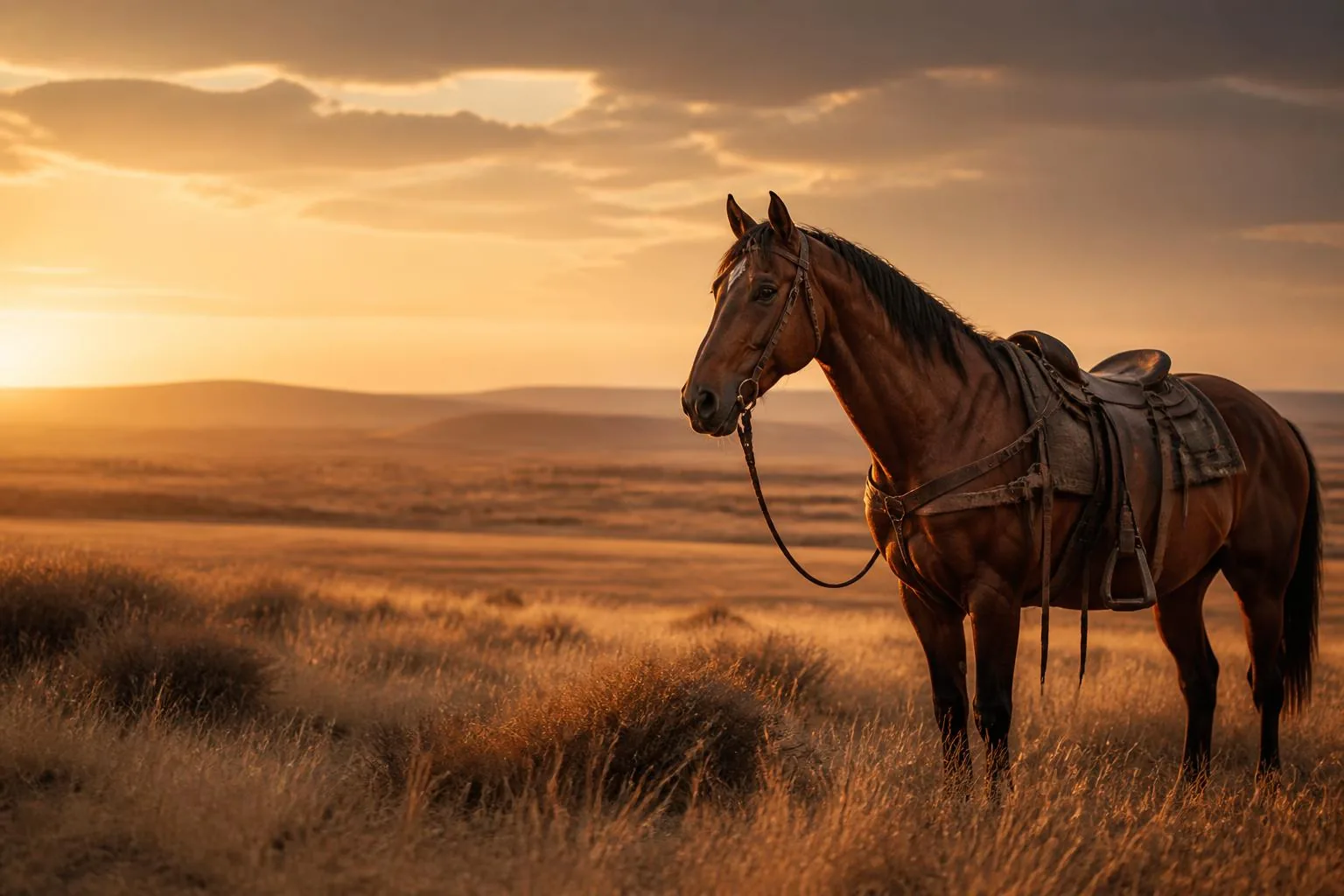
Among the horses committed to battle is Comanche, a bay gelding acquired by the Army in 1868 and mounted by Captain Myles Keogh. Sturdy and tireless, built for the long rides across the western frontier, he belongs to that class of versatile cavalry horses still seen today in the world of Quarter Horses and American ranch stock.
Found two days later, torn by gunshot wounds
When reinforcements finally reach the site, the scene is terrible. Amid the bodies, a movement: Comanche, standing but trembling, bears multiple bullet wounds. Regimental tradition counts seven, some grave. Many would have put him down. The regiment decides instead to attempt a rescue.
Loaded aboard a steamboat and brought back to Fort Lincoln, he receives médical care for nearly a year. His long and uncertain convalescence underscores how entirely a wounded horse depends on the quality of its care, a principle that remains true for all équine health monitoring and treatment today. Against all odds, Comanche recovers.
The général order that made him a legend
In April 1878, Colonel Samuel Sturgis signs an order that would become celebrated. Comanche is declared the living mascot of the 7th Cavalry. Standing instruction: he is never to be ridden or put to any labour. He receives a comfortable stall, a dedicated groom, and at military ceremonies, he paraded alone, without rider, dressed in black harness with boots reversed in the stirrups as a sign of mourning.
For thirteen years, this horse carries the memory of the fallen. He dies in November 1891, aged approximately 29 years (14.2 hands, 900 lb / 408 kg). Few animals receive such a status in their lifetime, and this distinction places him in that rare circle of horses who have entered legend, those whose mystique far transcends mere monetary worth.
- Verifiable facts: dates, witnesses, archival documents (here, General Order No. 7 of 1878), rather than oral tradition alone.
- The mythical élément: a good story improves with age. Distinguish what is attested from what has been embellished.
- The animal’s actual fate: beyond the symbol, how the horse was cared for, housed and respected.
- The legacy left behind: monuments, testimonies, cultural presence, transmission to succeeding generations.
“Sole survivor”: what history actually says
The phrase “sole survivor of Little Bighorn” travelled the world, but it deserves refinement. Comanche was the only living being of the 7th Cavalry found on site by the Army. In truth, other regimental horses survived the battle: some were taken by the victorious warriors, others, too grievously wounded, were put down. Comanche was the one the Army chose to save and celebrate.
It was this decision, as much as his survival, that made him a symbol. His taxidermied remains are now housed in a natural history museum in Kansas, where he continues to draw visitors. Legend, meanwhile, simplified the narrative: from “only survivor retrieved by his regiment” to simply “sole survivor”.
What Comanche still teaches us about horses
Beyond the historical curiosity, this story speaks to the robustness and resilience of the horse. Mounts of the western frontier, bred for endurance and soundness, gave rise to breeds still recognised for these qualities, which you can explore in our comprehensive guide to horse breeds. Comanche belonged to that line of hardy horses, capable of withstanding extreme conditions.
He also reminds us that the human-horse bond transcends mere performance. This dimension of attachment and regard appears across all disciplines, from working horses to sport, as our survey of greatest horses by equestrian discipline demonstrates. A century and a half on, Comanche’s story continues to move us because it speaks to that connection.
- Comanche, a bay gelding of the 7th Cavalry, was found alive after the Little Bighorn disaster (25 June 1876), bearing multiple gunshot wounds.
- Nursed for nearly a year, he recovers and becomes the regiment’s mascot.
- By général order of 1878, he was never ridden or put to work again until his death in 1891.
- The myth of the “sole survivor” requires nuance: he was the only regimental horse found alive by the Army, not the only survivor of the battle.
- His taxidermied remains are preserved today in a Kansas museum.
Sources: 7th Cavalry archives (General Order No. 7, 1878), University of Kansas Natural History Museum, historical accounts of the Battle of Little Bighorn.