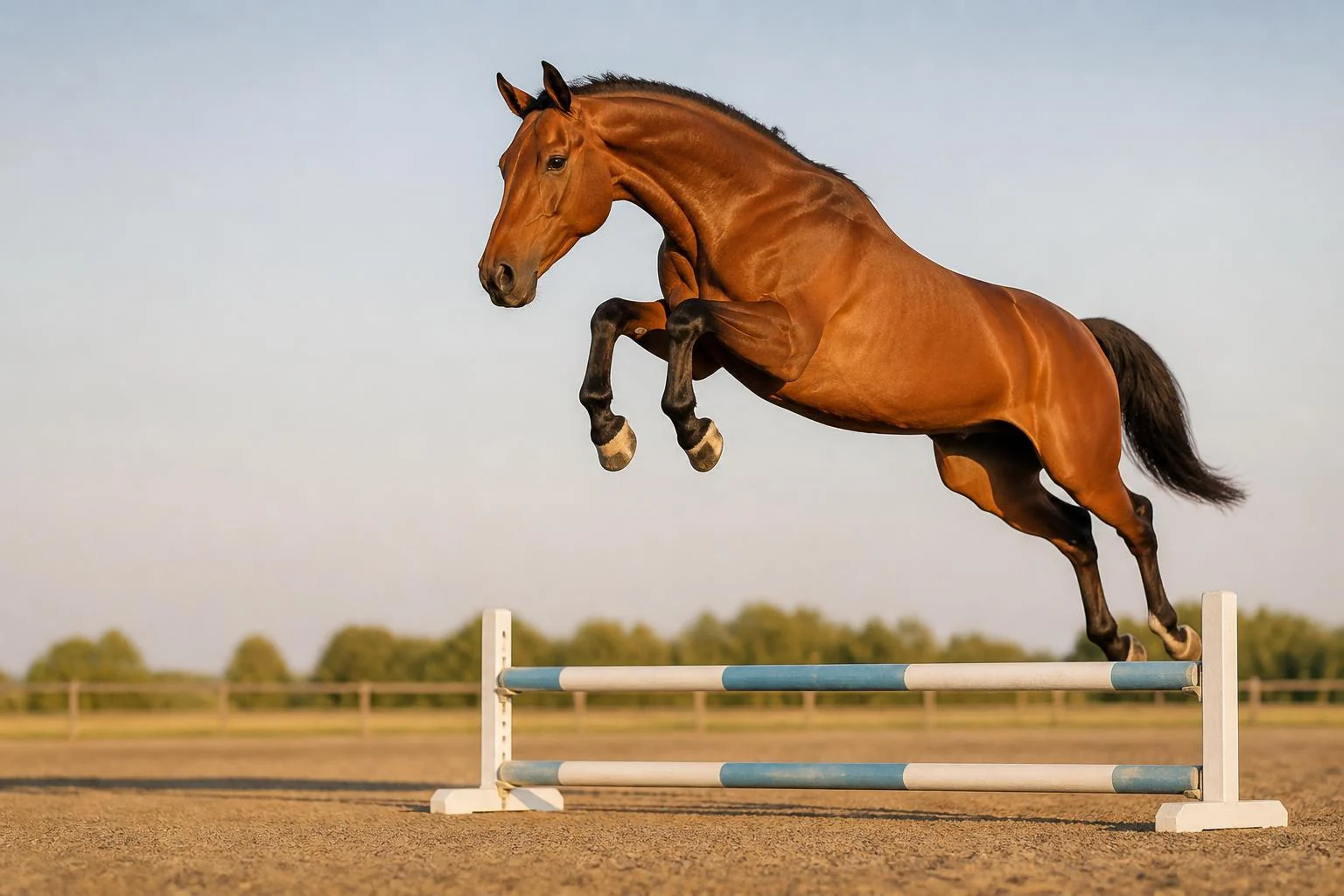

From 28 August to 6 September, the Grand Parquet equestrian stadium in Fontainebleau will host the national final for young showjumpers. Three age groups are expected: four-, five- and six-year-olds. The youngest will jump verticals set at 3ft 9in (1.15 m). Both their rounds will be ridden under Table A without a stopwatch and without jump-offs, at a set pace of 325 metres per minute.
In other words: no four-year-old will win this final because it was the fastest. Placings are decided on penalty points alone, and ties are broken by seasonal rankings. For the youngest competitors, the stopwatch simply does not exist.
This detail of the regulations is no mere technicality. It summarises the entire logic of France’s young horse development circuit: at four years old, a horse is not there to win a race. It is there to show how it jumps. Here is what actually happens at Fontainebleau, what the rules allow, what they forbid, and what research tells us about training a horse that is still growing.
What is at stake from 28 August to 6 September
The Grande Semaine de CSO et de Hunter is the national final of the young horse circuit run by the Société hippique française. It brings together over ten days the best four-, five- and six-year-olds of the season, plus freestyle classes and hunter classes.
Selection is based on a national ranking, the Top 100, closed on 4 August 2026. For four-year-olds, a horse must rank in the top 550 to be eligible, and in the top 225 to be actually selected. For five-year-olds, 350 horses are chosen from the top 700. For six-year-olds, 300 horses from the top 550. Horses entered but not selected receive a refund of their entry fee.
The so-called classic cycle circuit is organised strictly by age and not by breed: in regional competitions and in the final, regardless of origin, a horse competes in the same classes as those of its generation. Seven-year-olds have their own championship organised within the federation, outside this final.
Why no one times the four-year-olds
The four-year-old final consists of two rounds: a qualifying round, then a final round. Both are ridden under Table A without a stopwatch and without jump-offs, at 325 metres per minute. All horses with no penalties qualify for the second round, plus at least the top 50 per cent from the qualifying round.
This changes things considerably. Without a stopwatch, a rider has no incentive to cut a corner, jump at an angle, or depart long to gain two-tenths of a second. Without a jump-off, there is no second frantic pass at the end of the day on an already tired horse. The only path to the top of the rankings is a clear round.
The stopwatch does not suddenly appear either. For six-year-olds, the first qualifying round remains without timing, but the second round is timed, still without jump-offs. Speed is introduced generation by generation, exactly as in top-level showjumping we do not demand the same of a horse that is learning as of a horse that is performing.
The exact height a four-year-old jumps
The Société hippique française publishes an annual memorandum for course builders so that tracks are consistent from region to region. In the first part of the season, a four-year-old course is built with verticals at 3ft 7in (110 cm), oxers at 3ft 5in (105 cm) high and oxers 3ft 5in to 3ft 9in (105 to 115 cm) wide. In the second part of the season, these rise to 3ft 9in (115 cm) for verticals, 3ft 7in (110 cm) for oxers, and 3ft 7in to 3ft 11in (110 to 120 cm) wide. The course has ten jumps, measures 480 to 530 metres, and is ridden at 325 then 350 metres per minute.
The final has its own table. At the Grand Parquet, a four-year-old course is built with verticals at 3ft 9in (115 cm), oxers at 3ft 7in (110 cm) high and oxers 3ft 9in to 4ft 1in (115 to 125 cm) wide. One line of the regulations deserves reading to the end: at the national final, certain jumps may be raised by 5 cm (2 in). A vertical can therefore reach 3ft 11in (1.20 m). This is the only margin the text allows itself, and it applies only to part of the course.
The detail that matters: these are maximums, not instructions. The regulations even specify that they should not apply to the first jumps or to combinations, and that all heights were reduced by 5 cm (2 in) until 17 May 2026 inclusive. A four-year-old thus starts its season lower than where it finishes.
The small details that reveal the regulations’ intent
At four years old, ground rails are mandatory on all jumps, as are pole cups. They give the horse a visual reference on the ground to build its approach stride. They become optional at five, and largely disappear at six.
Another clue: the cups, those small pegs on which the poles rest, must be 30 to 35 mm (1.2 to 1.4 in) deep at four years old, and are no longer permitted in this format afterwards. The deeper the cup, the more secure the pole. The shallower it is, the more easily the pole falls. At four, we want the pole to fall easily rather than see a young horse hang on.
Sixteen runs in the year, and not one more
This is the least known provision to the general public, and probably the most protective. To be selected for the final, a four-year-old cannot have competed in more than 16 official runs during the year across all disciplines, with a maximum of 10 in the classic cycle and a maximum of 2 in federation competitions. It must also have completed at least two runs in training classes between 1 January and 16 August.
The quotas rise with age: 20 runs maximum at five years old, of which 12 in the classic cycle, and 24 runs maximum at six years old, of which 14. The counter runs from 1 January to the day before the final. A horse that has run too many times is not selected, whatever its ranking.
This ceiling says something important about what damages a young horse: it is not the height of a pole. It is repetition. Sixteen courses in a year works out to just over once a month. The rest of the time, it trains, it goes out, it grows.
No protection behind: the rule that says the most
In classic cycle, freestyle cycle and training class competitions, at both regional and final level, no protection is permitted on the hind legs. Neither in the ring nor on the warm-up ground. Front boots remain unrestricted, but the total weight of equipment on a limb must not exceed 500 grammes (1.1 lb), checked at the weigh-out after the round.
Only one exception exists, on grass terrain, and it is regulated to the millimetre: only fetlock boots are permitted behind, with the inner face not exceeding 6.3 in (16 cm), outer face at least 2 in (5 cm), smooth interior, single shell, non-elastic velcro fastening with no hooks or loops.
This level of detail is anything but incidental. In showjumping, protecting the hind legs is historically the entry point for practices designed to make a horse more sensitive to the pole. Banning it outright for young horses closes the door before it can open.
Jumping a horse that has not finished growing
There remains the objection everyone raises watching a four-year-old clear 3ft 9in (1.15 m): at this age, the skeleton has not finished growing. This is true, and the regulations make no claim otherwise, since their entire purpose is precisely to limit what is asked of a horse that is not finished.
But the conclusion usually drawn from this is false. The Institut français du cheval et de l’équitation is explicit: exercise is essential to skeleton development and bone quality, and it increases resistance to injury. The IFCE notes specifically that weaned foals raised in stables have a smaller cannon bone circumference than those raised on permanent pasture or part-time pasture twelve hours a day. Movement builds bone. Immobility weakens it.
A descriptive study conducted in 21 Normandy studs, following 378 French saddle horses, trotters and thoroughbreds from the eighth month of gestation to six months old, is cited by the IFCE on this point. At six months, 47 per cent of foals presented an orthopaedic developmental disease, of which 37 per cent was osteochondrosis. The identified risk factors were breed, with nearly three times more risk in French saddle horses than thoroughbreds, height at withers at six months and growth rate, and exercise.
The picture that emerges is not one of a magical threshold age, but of dosage. What weakens a young horse is prolonged confinement, too-rapid growth, and intense load applied suddenly to an animal not prepared for it. This is precisely what the tour quotas, capped heights, and absence of a stopwatch seek to prevent. This cancels no individual vigilance: a young horse that refuses, stiffens or walks badly after a competition requires diagnosis of lameness and a veterinary opinion, not extra work.
Disclaimer
This article describes a sporting regulation and the state of published knowledge, not a training protocol. The handling of a growing horse, the pace of its work and the interpretation of any sign of discomfort are the responsibility of the veterinarian following the animal. No element of this text replaces a clinical examination.
What judges a four-year-old
Eight points an informed observer watches for in the Grand Parquet stands
- The regularity of the canter between jumps, before even the quality of the jump itself. A horse that maintains the same canter over ten jumps is more promising than a horse that jumps high once.
- The bend of the forelegs: knees lifted and above all at the same height, forearms horizontal. A trailing foreleg is a technical fault.
- Respect for the pole, that is to say the attention the horse pays to avoiding contact, independent of its strength.
- The back gesture, the ability to round over the jump rather than jump with a hollow back.
- The landing and restart: a horse that moves on in balance without rushing or stopping.
- Behaviour in the combination and at the in-and-out, the only places in the course where a young horse must really think quickly.
- The head and ears throughout the entire course, a crude but telling indicator of the horse’s mental state.
- Consistency over two days. The ranking adds the rounds together. A horse that is brilliant one day and absent the next does not climb.
What this week means for a breeder
France registered 55,692 equines in 2024, from 21,331 breeding establishments, an average of 2.61 foals per breeding farm, as detailed in our review of French breeding figures for 2024. For the vast majority of breeders, annual production is counted on the fingers of one hand, and a national final is the only moment of the year when their product is seen by the entire sector in one place.
The regulations account for this with a waiver system that protects breeding circuits. The top 50 per cent of foals from each regional three-year-old ridden competition automatically receive qualifying points for the four-year-old final. Stallions approved for breeding in the French Saddle Horse stud book, or labelled in Anglo-Arabs, benefit from waiver access provided they have actually run the regional circuit. And for six-year-olds, the 60 horses in the final are divided by sex, entire colts, geldings and mares, in proportion to the starters in the first qualifying round.
How to watch a young horse course
The first reflex of the uninitiated spectator is to count the poles down. This is the least informative. A four-year-old course has a minimum of two lines and a combination, and that is where everything is revealed: the way the horse adjusts its strides between two jumps tells far more than its performance over an isolated vertical. The second point of observation is jump number one, isolated on day one and placed in a line at seven strides minimum on day two. A horse that approaches it calmly in the atmosphere of a final has already solved part of the puzzle.
The regulations further require that the course plan be displayed with the pace, distance, time allowed and time limit, and that the course builder watches the first three combinations pass before freezing this time allowed. If you are discovering these circuits, our guide to equestrian competitions and their calendar details the overall logic, and the page on FFE Compet, entries and licences explains the administrative mechanics of each entry.
Key points
- The national CSO young horse final runs from 28 August to 6 September 2026 at the Grand Parquet, Fontainebleau.
- Four-year-olds jump verticals set at 3ft 9in (1.15 m) in the final, over 10 jumps covering 480 to 530 metres (1,575 to 1,740 ft). Some jumps may be raised by 5 cm (2 in).
- Both their rounds are Table A without a stopwatch and without jump-offs, at 325 metres per minute.
- A four-year-old cannot exceed 16 official runs in the year to remain selectable.
- No protection is permitted on the hind legs, either in the ring or at warm-up, with one exception tightly controlled on grass terrain.
- Exercise builds the young horse’s bones. Risk comes from confinement, rapid growth and sudden loading, not from movement itself.
The circuit that builds French sport horses
Behind these ten days lies an institution few club riders can name, which organises development circuits in six disciplines, awards encouragements to breeders, issues the licence required to enter a horse, and in parallel runs a breeding circuit that judges foals, two-year-olds, three-year-olds and mares in foal.
A horse that wins a four-year-old final at Fontainebleau has won nothing definitive. It has shown, at one moment in time, a technique and a temperament. What follows is played out over the next five years, between daily work, the quality of the breaking-in it has received, monitoring of its back by an equine osteopath and the patience of those around it. This is precisely why it is not timed yet.
Understanding the circuit before you go to a final
Classic cycle, freestyle cycle, breeding circuit, licences, encouragements: our feature details who organises what in French sport horses, and what each level of the circuit is for.
Sources
Société hippique française showjumping regulations 2026, version of 12 June 2026, for qualifications, selection, finals conduct, tables and protection. Memorandum for building young horse courses, classic cycle, updated 13 March 2026, for distances, paces, heights, ground rails and cups. Document of tour quotas before CSO final 2026. Announcement of SHF Grande Semaines 2026. Institut français du cheval et de l’équitation, Équipédia sheet on daily exercise, for the effects of exercise on musculo-skeletal development and the study of 378 Norman foals. Equirider is affiliated with neither the Société hippique française nor the Fédération française d’équitation.