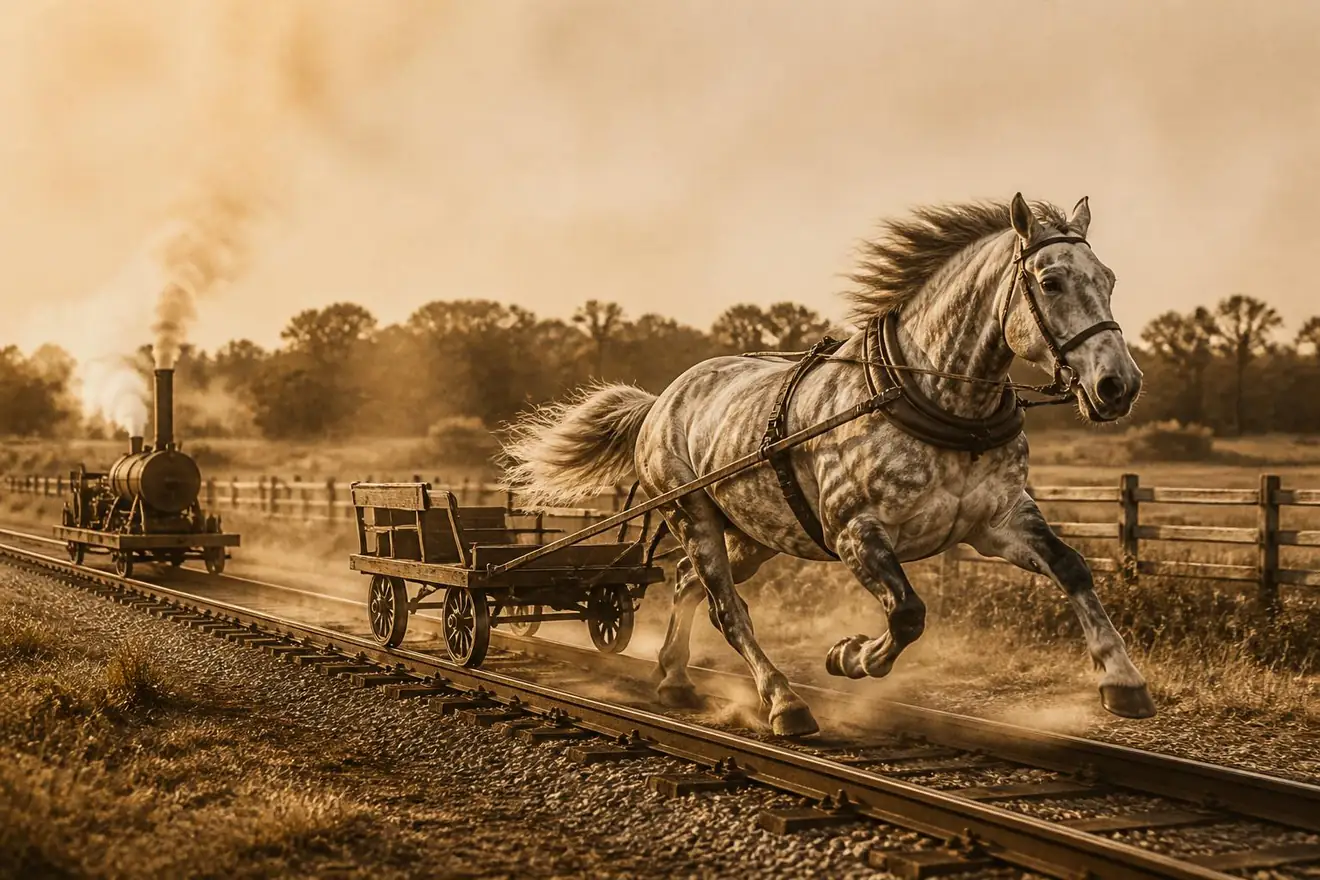

On 28 August 1830, along thirteen miles of America’s first railroad, a man-sized steam engine supposedly lost a race to a grey horse pulling a wagon. For a century and a half, this anecdote has been told as the founding moment of American railways. It has one fatal flaw: nobody wrote it down at the time.
The one-sentence answer
What the archives document from 28 August 1830 is a genuine success: the diminutive locomotive Tom Thumb ferried Baltimore and Ohio company executives to Ellicott’s Mills at a speed of 10 to 14 miles per hour (16 to 22 kilometres per hour). The race against the horse, however, appeared in black and white only in 1868, thirty-eight years later. The museum that houses the engine now freely admits it has never been supported by a contemporary document. The horse may well have won that particular race. What is certain is that it dominated the first fifteen years of American railroading, and that at least is verifiable.
What 28 August 1830 actually documents
The Baltimore and Ohio Company was founded on 28 February 1827. Its first section, thirteen miles (approximately 21 kilometres) between Baltimore and Ellicott’s Mills, opened on 24 May 1830. It operated entirely by horse: wagons were drawn by teams along two parallel tracks laid side by side. This detail of two parallel rails is what makes the race story materially plausible.
Peter Cooper, a New York industrialist and Baltimore landowner, built in 1829 a tiny experimental engine to convince the company’s directors that steam could negotiate the prohibitive gradients and curves that British engineers had dismissed as impossible. The boiler was vertical, the tubes fashioned from rifle barrels, a forced-draft fan mounted in the chimney was driven by a belt from the driving axle, and the whole thing generated roughly 1.4 horsepower. It was never intended for commercial service.
The B&O Museum, which preserves a 1927 replica, dates to 28 August 1830 the historic run: the machine carried executives to Ellicott’s Mills at 10 to 14 miles per hour. On that day, the technical proof was secured. The company decided to invest in steam.
The race story, as it reached us
The version everyone knows comes from a lecture delivered in Baltimore in 1868 by John H. B. Latrobe, the company’s lawyer. He recounts how the owners of the Stockton and Stokes stagecoach line, seeing their business threatened, challenged the machine to a race over eight miles between Relay House and Baltimore.
In his account, the horse is “a magnificent grey, full of beauty and power.” It gallops off and has already gained a quarter-mile lead when the locomotive begins to move. Then steam builds. The machine catches up, draws alongside, and Latrobe writes the sentence that would echo through railway history: “the race was head to head, nose to nose.” At that precise moment, the ventilation belt jumps from its pulley. Without draft, the boiler cools slowly, the engine loses steam. Cooper, driving and firing simultaneously, burns his hands trying to replace the belt. Too late: the horse was already too far ahead, crossing the finish line victorious.
Why historians only half believe it
The problem is not the account itself, which is charming and detailed. The problem is that it stands alone. Travis Harry, director of operations at the B&O Museum, is blunt: he has never seen solid evidence of the event, the first written mention of this race in any document dates to 1868, and none of those supposedly present left a trace in any letter, diary, or contemporary article. Railway historian John P. Hankey believes the race never happened, for lack of material evidence. His colleague James D. Dilts thinks it possible but places it instead on 20 September 1830, a day about which the newspapers reported nothing either.
One clue exists, and it is troubling: Baltimore’s press did report on speed trials during which the engine’s belt broke. The breakdown is documented. The horse is not. As for Peter Cooper himself, when questioned in 1882 about this by now-famous episode, he dismissed it in a single sentence: it had no significance whatsoever.
How to judge a story like this
- A contemporary source. A newspaper, a register, a letter dated within days of the event. Here: nothing.
- A witness speaking for himself. The 1868 account is second-hand, written by a man with every reason to embellish his company’s founding.
- Confirmation from the principal. Cooper lived until 1883 and never promoted this race as a feather in his cap.
- Material consistency. Two parallel tracks, a fragile fan belt, a service operated by horses: all of this is accurate, and that is precisely what makes the legend credible without proving it.
What the legend got right: railways were born on horseback
If this story has survived two centuries, it is because it is plausible. In 1830, the horse was not the railway’s adversary but its engine. On the Baltimore line, passengers were pulled by teams for more than a year. The motive power available at the time was the collar of a horse, period: the rail simply eliminated friction, just as water had eliminated it beneath barges during the era of canal towage.
In France, the first line ran seventeen years without steam
The French case is clearer still. France’s first railway, from Saint-Étienne to Andrézieux, was granted by royal ordinance on 26 February 1823 and opened on 30 June 1827. Twenty-one kilometres, almost the exact length of the American line. Coal wagons descended toward the Loire by gravity, along an average grade of 7.7 per mille, and returned uphill pulled by horses. The cast-iron rails rested on buried stone blocks, to avoid impeding the hooves of horses walking between the tracks. The first passenger train ran on 1 March 1832, still by horse. The first two steam locomotives, La Loire and Le Furens, were not purchased until 1844, and horses still worked alongside them in 1845.
They even tried putting the horse inside the machine
The clearest sign that the outcome was not yet decided is the hybrid contraptions built to keep the horse while imitating the locomotive. Thomas Brandreth patented on 9 September 1829 the Cycloped, a platform in whose centre a horse walked on a treadmill that drove the axles. The machine competed at the Rainhill trials in England in October 1829, against Stephenson’s Rocket. The horse fell through the wooden platform. Disqualified.
Engineer Christian Edward Detmold built at New York in 1829 an engine on the same principle, named Flying Dutchman, put into service in 1830 on six miles of the South Carolina Canal and Railroad Company: twelve passengers at roughly twenty kilometres per hour, propelled by a single horse on a treadmill. It was withdrawn the same year and replaced by a steam engine, the Best Friend of Charleston. Between horse and steam, there was that brief moment when nobody yet knew which would win.
The real ending: a competition in 1831
It was not a race of prestige that decided the matter, but a call for tenders. In 1831, the Baltimore and Ohio Company offered 4,000 dollars for the best locomotive. Five machines competed. The winner was called the York, built by Phineas Davis, a clockmaker from York, Pennsylvania, using Cooper’s vertical-boiler principle but on a larger scale: it hauled fifteen tons over the thirteen-mile trial at fifteen miles per hour (24 kilometres per hour). The company ceased using horses within the year. Tom Thumb itself ran only for internal service until early 1831, then was scrapped. The machine that lost the most famous race in railway history never hauled a single paying passenger.
The train did not kill the horse; it multiplied it
This is the true irony of the story. We imagine the locomotive chasing horses from the roads; the numbers say the opposite. The federal American census, cited in an 1925 bulletin from the Department of Agriculture, counted 4,335,669 horses and mules in the United States in 1840, when railways began. Seventy years later, at the 1910 census, the same table counted more than twenty million. Roughly five times as many, in the full century of the railway age. Every station required carts; every cargo unloaded required a team to finish the journey; every expanding city demanded omnibuses. The horse was not beaten by steam; it was replaced much later by the internal-combustion engine.
This century also saw the beginning of measuring the horse instead of merely telling tales about it. Forty-eight years after Baltimore’s phantom race, it would take twelve cameras lined up on a California track to prove at last that a galloping horse leaves the ground. Here too, legend was no longer enough.
What remains, two centuries on
The collar has not vanished. It has changed its terrain. The draught breeds that industry rendered obsolete have found work again where the machine cannot go: logging in sensitive forests, soil work between vineyard rows, waste collection in a few municipalities. The value of a horse is no longer measured at all in tons pulled: it now reads in sale rings, where auction records climb into the millions.
One image remains, and it is probably false. A grey horse, a small breathless machine, and eight miles of rail to divide two worlds. If the race never happened, someone certainly felt the need to invent it. Perhaps that is the real document.
Sources
- B and O Railroad Museum, notice “Tom Thumb” (date of 28 August 1830, speeds, status as legend of the race)
- The Baltimore Sun, “Fact or fable, locomotive story rolls on” (Latrobe’s 1868 account, doubts of John P. Hankey and James D. Dilts)
- History, “When a Horse Raced Against a Locomotive” (museum statements, comments from Peter Cooper in 1882)
- Linda Hall Library, Phineas Davis (1831 competition, 4,000-dollar prize, performance of the York)
- BnF, Passerelles: la première ligne de chemin de fer en France (Saint-Étienne, Andrézieux, 1827)
- USDA, Statistical Bulletin no. 5, “Horses, Mules and Motor Vehicles, 1840, 1924” (table 1, figures for 1840 and 1910)