
The pit horse occupies a particular corner of French folklore: an animal forced into darkness, rendered blind within months, never to see daylight again. Yet the archives of mining companies and the records of mining engineers tell a more measured story. Systematic blindness amounts to legend, formally documented as such by the Puits Couriot, the mining museum and heritage park at Saint-Étienne. The net descent, by contrast, genuinely occurred, and its 1836 description surpasses any fiction. Here is what the sources allow us to confirm, and what they require us to correct.
1821, Rive-de-Gier: The Day the Horse Went Underground
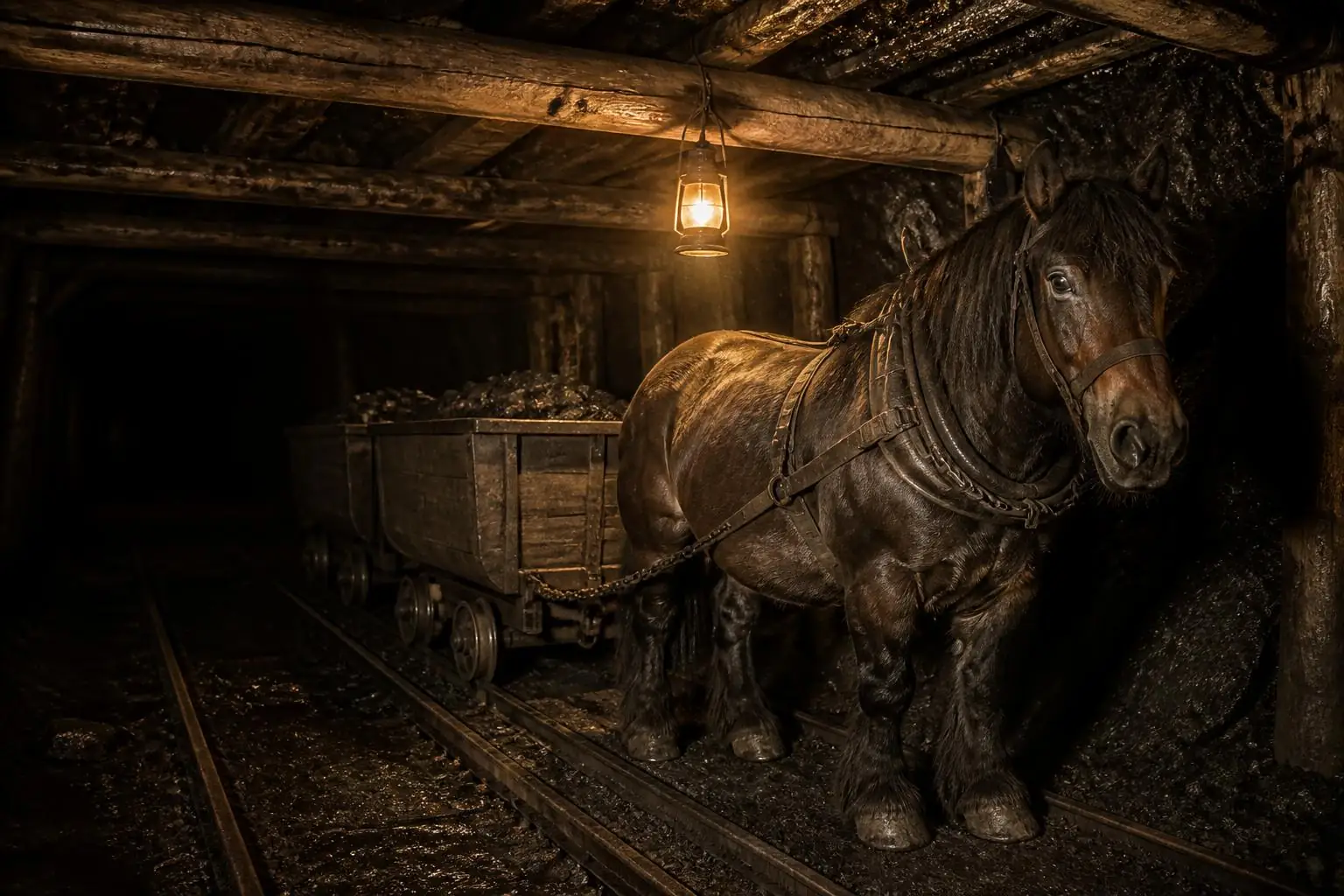
In England, ponies worked the sloping galleries of coal mines, known as “slants,” that opened onto hillsides from the mid-18th century onward. In France, the use of horses in underground workings began in 1821 in the Rive-de-Gier mines in the Loire, which pioneered animal haulage at depth. The practice became widespread across the Loire coalfield by 1824, arrived at Blanzy in Saône-et-Loire in 1829, reached the Nord in 1847, and Lorraine in 1865.
The reason was purely practical. Before horses, coal was carried on the backs of men, women and children, then hauled in buckets on ropes. Mining companies needed a force capable of pulling trains of wagons along rails across distances that grew longer as workings extended from the pit shaft. A horse became economically viable beyond 150 metres (490 feet) of haulage. Below that distance, it served no purpose.
Net Descent Described by a Mining Engineer in 1836
The most harrowing account in this record comes not from a novel but from the Annales des mines. In 1836, engineer Gervoy described how horses were introduced into the pits of Saint-Étienne and Rive-de-Gier: a net of ropes was placed around the animal such that, once suspended by cable, it sat upon its haunches; its eyes were covered; leather sleeves fitted with rings were attached to its feet; a rope threaded through these four rings was then pulled sharply to stun the animal and make it fall onto a bed of straw. With head and limbs bound to the main ropes, the horse descended to the pit bottom, where it was received.
This technique belonged to the narrow cages of the early 19th century. It gradually fell from use and eventually disappeared: between the 1920s and 1940s, larger cage dimensions allowed horses to descend standing on all four legs. Around 1908, a postcard publisher based in Firminy was still selling staged images of the net descent, the horse strapped vertically with eyes bandaged. These pictures circulated widely in mining towns and fixed the scene in collective memory.
Germinal Did the Rest
Zola describes the same operation in Germinal: the horse bound in a net, struggling at the surface, petrifying the moment the ground falls away, disappearing without a tremor, its eye enlarged and fixed. Literature invented nothing on this particular point. It froze a technical state that was about to be abandoned and attached it to an entire century to follow. The Saint-Étienne mining museum puts it plainly: this history is a reality heavily distorted by literature and urban legend. The problem is not that Germinal lies; it is that we ask it to be an inspection report.
How Long Did They Stay Underground
Nuance matters here. In the early 19th century, when extraction cages were narrow, horses were brought to the surface only when their health required it, and they indeed spent several consecutive years at depth. By century’s end, historian Jean Lorcin estimates their stays at five to ten years without surfacing in the Loire coalfield. But he adds a sentence that popular imagery never retained: as soon as equipment dimensions permitted, horses descended and thus could be brought up by cage, and from 1920 onwards they saw daylight regularly.
In Wales, national museums have preserved comparable figures on work regulation: minimum age of four years to descend, forty-five to sixty hours weekly in the 1930s, a forty-eight-hour ceiling and seven shifts maximum after 1949, one then two weeks of annual leave acquired between 1938 and 1948. We are far from an animal abandoned to darkness and forgotten.
Where the Blind Horse Legend Came From
The museum suggests a material explanation. Above ground, some installations relied on a “vargue,” a turning stable where the animal walked in circles, always in the same direction, on a perfectly repetitive route. A blind horse remained useful there and could end its career so employed. Seeing a blind horse work for a mining company was therefore unremarkable. To conclude that the depths caused blindness is a leap the sources do not permit.
What engineers did observe, by contrast, is real and documented: the vision of pit horses deteriorated; they were more prone to glanders, especially during sudden temperature changes; and damp soil tended to ulcerate their feet. A head groom from the Montrambert pit, testifying in the company journal in the 1960s, cited colic, strangles, “street nails” (hoof wounds caused by nail or scrap metal), and behavioural tics he described as psychological disorders. Some horses went blind, but by accident, not by inevitability, and they were then brought to the surface and retired. To understand why prolonged darkness and trauma affect vision, the anatomy of the horse’s eye remains the best starting point, and the first actions in colic have not changed since.
Four Stable Cards, Four Careers
The archives of a mine at Chambon-Feugerolles in the Loire preserve individual record cards from the late 1920s. They bear names and numbers: Veinard, Souris, Vigilant and Volvic, numbered 1108, 1162, 1096 and 1131, and they record both arrivals and departures.
Veinard was a golden chestnut standing 4ft 8in (1.44 metres) at the shoulder. After four years in service, brought to the surface three times following injuries, he went blind and was retired. Souris suffered both blindness and a thrush, that purulent eczema common in poorly maintained stables, after his right eye was lost two years earlier. Vigilant, a difficult gelding, refused to be shod and was handed over to a horse dealer. Volvic, wounded in his left hind leg, made only a few descents to 1,700 feet (516 metres) depth. Four cards, four trajectories: this is precisely what legend forbids us to imagine.
One point offers more reassurance than any other. A pit horse’s life expectancy was close to that of a draught horse employed above ground: roughly twenty years. Kept away from coal-cutting operations, they were generally spared explosions and evacuated almost as carefully as the men in the event of disaster.
How to Judge a Working Horse
The criteria mining engineers applied in the 19th century remain those any professional in animal haulage considers today.
- Height at the withers relative to gallery height, never in absolute terms.
- Quality of foot: broad, sound, capable of withstanding permanent dampness.
- Ventilation and temperature of the workplace, which condition everything else.
- Distance to be hauled: below 150 metres (490 feet), animal traction was not economically justified.
- Route profile: changes of direction and elevation cost more than metres.
- Actual collar load, not the weight of the animal itself.
- Health monitoring: dedicated groom, farrier, veterinarian, individual record card.
The Breeds of the Deep: Neither Percheron Nor Mare
The word Percheron is often used colloquially to mean any draught horse. Underground, it was seldom employed: recognised for its trotting qualities, the Percheron served primarily in above-ground horse-drawn transport. Other types emerged in the depths, more powerful and robust than fast: the Trait du Nord, the Breton draught horse, the Ardennais, supplemented by animals from Belgium and Russia.
In 1836, the Loire employed two hundred and fifty horses, classified in two categories: ordinary horses standing 4ft 11in (1.5 metres), from Switzerland or Berry, and smaller horses of 4ft 5in (1.36 metres) from Vivarais, Velay, sometimes Corsica or the Landes. The latter were often preferred: cheaper to buy and maintain, faster, less affected by heat and foul air. In the Nord mines, where galleries were narrower, Shetlands and Pottoks were employed, as in Great Britain. One telling detail: no mares were recorded in the Loire mines. For scale, our table on draught horse weights gives the dimensions breed by breed.
The horse was not alone in being tested. Oxen were introduced in 1833 in the Cros and Grande-Croix mines, half the cost but slow and bulky. Mules performed the same work for less but remained difficult to manage. There remained cats, sent below to hunt rats, and canaries, sentinels against carbon monoxide.
What a Pit Horse Actually Hauled
The 1836 figures are precise. In well-maintained roadways, well-ventilated and not-too-warm galleries, the strongest horses transported up to 500 kilograms (1,100 pounds) of coal. In poor conditions, they were not asked to move more than 200 kilograms (440 pounds). They then covered five to seven kilometres (3 to 4 miles) per day. A “balance” or “gravity” system, which offset the effort of lowering full tubs and raising empty ones, allowed a single horse to move up to four tonnes (4.4 tons) of coal over doubled distance. A typical train consisted of twelve to thirteen tubs.
These figures do not express the sheer strength of the animal but the efficiency of the installation. It is the same misunderstanding we encounter today before a weighing scale: a draught horse’s weight and the effort it actually exerts in the collar do not measure the same thing. The mining industry grasped before almost anyone else that you do not judge a horse by its kilos, but by the geometry of the route imposed on it and the quality of its shoeing. The work of the farrier was a cornerstone of the system, as essential as the daily care ensured by basic horse care.
1960, 1976, 1999: The Last of Them
Mechanisation finished the job. Around 1925, roughly ten thousand horses worked in French mines. The Puits Couriot, opened in 1919 at Saint-Étienne, already made no provision for animal power: an electric underground tramway was installed from the outset. In the Loire, the last horse was brought to the surface at the end of 1960, at the Béraudière pit in the municipality of La Ricamarie. In the Nord-Pas-de-Calais, a horse named Bambino ceased work underground in 1976.
Across the Channel, the timeline follows similar lines at a larger scale. Welsh national museums record more than two hundred thousand horses at work in British mines in 1878, still seventy thousand in 1913, then four hundred and seventeen in 1967. The last horse descended at Big Pit in 1972, and the last two British pit ponies, Gremlin and Robbie, were retired from service at Pant y Gasseg in 1999. Robbie later lived at the National Coal Mining Museum in England until its death in 2009.
The horse thus left the pit, but not work itself. It also hauled barges on canals, a trade thought dead but of which precise traces survive into the 1920s, and it is returning today to vineyards, forests and some town centres.
Key Points
- The widespread blindness of pit horses is a legend, disproven by the Saint-Étienne mining museum on the basis of engineering records.
- Net descent with eyes covered is authentic, but it was an early 19th-century technique abandoned when cages enlarged.
- After 1920, pit horses regularly returned to daylight. Before then, stays of five to ten years without surfacing are documented.
- Their life expectancy matched that of above-ground draught horses: roughly twenty years.
- Last known services: late 1960 in the Loire, 1976 in the Nord-Pas-de-Calais, 1999 in Great Britain.
Haulage, forestry, market gardening, vineyards, urban collection: the list of occupations entrusted to the draught horse is longer than mining, and still growing.
Sources
Puits Couriot, Parc-Musée de la Mine de Saint-Étienne, thematic folder on the employment of horses in mining, education department, 2017. M. Gervoy, On interior transport in the coal mines of Saint-Étienne and Rive-de-Gier, Annales des mines, volume X, 1836. J. Lorcin, The horse in the mines of the Loire Basin, proceedings of the Montbrison History Festival, 1994. É. Zola, Germinal, part one, chapter 5. Amgueddfa Cymru, National Museum Cardiff, information on Welsh colliery horses. National Coal Mining Museum for England, file on pit ponies. Individual record cards for horses from Chambon-Feugerolles held in the Puits Couriot collections. Equirider is affiliated with none of these institutions.