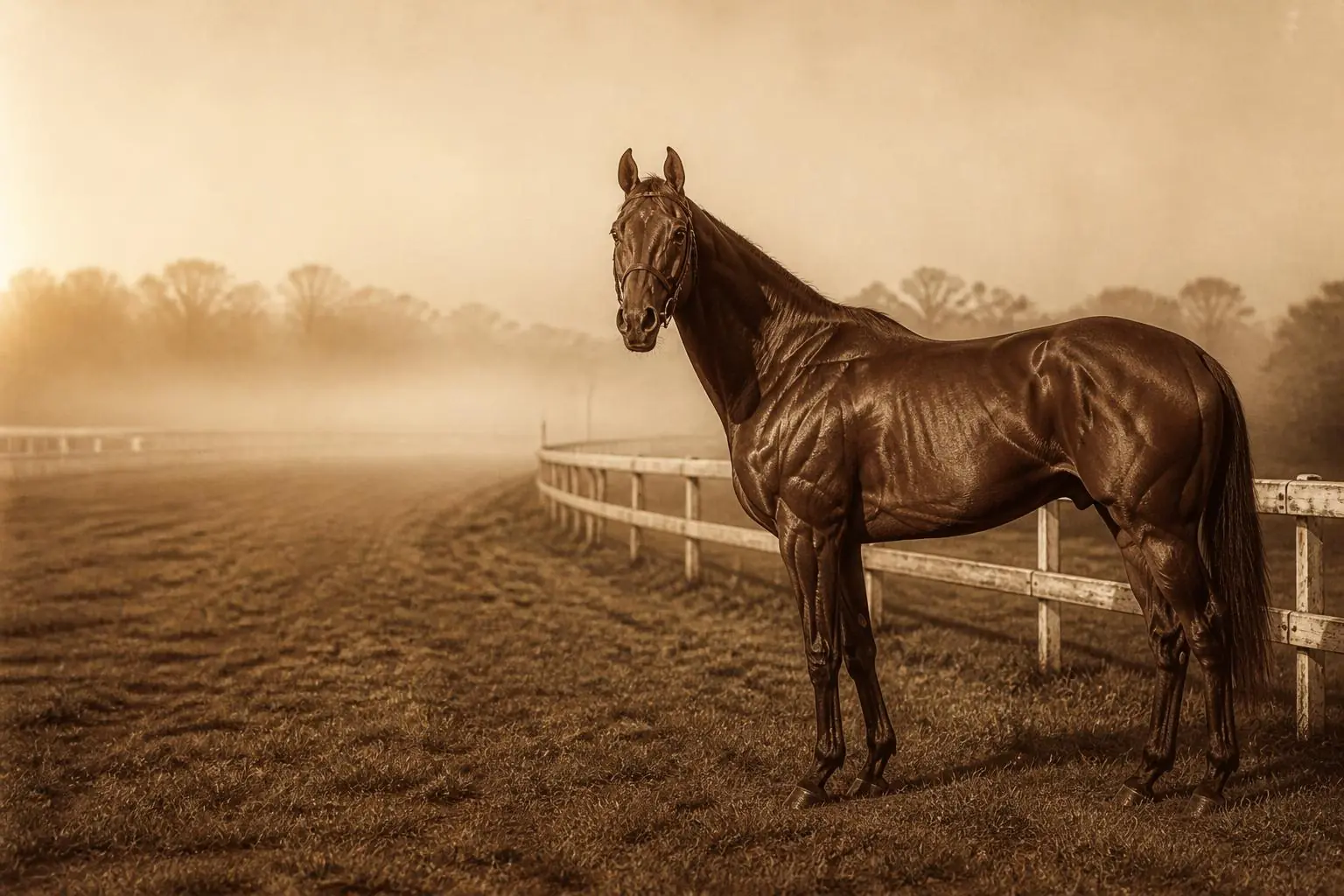

She was foaled in Hungary in 1874, raced for four seasons across five countries, ran distances ranging from sprint to over 2.5 miles, competed against both colts and fillies, and sometimes carried weights that no modern flat racer would recognise. She won fifty-four times. She never lost once. One hundred and forty-seven years after her final race, nobody has done better.
The answer in a sentence
Kincsem, a chestnut mare foaled on 17 March 1874 at the Hungarian stud of Erno Blaskovich, ran fifty-four races between 1876 and 1879 and won every single one, in Hungary, Austria, Germany, England and France. It is the longest unbeaten sequence ever achieved by a racehorse, and it has never been approached since.
Fifty-four starts, fifty-four victories
The figure impresses most when you examine what lies beneath it. Kincsem did not build her record by cherry-picking opponents on a single track. Her races ranged from roughly 3,100 feet (950 metres) to 2.5 miles (4,022 metres), which in modern terms would be asking the same horse to win both a sprint and a distance race within the same career. She faced colts, including established performers, and as she matured, she carried handicap weights in some races that contemporary reports placed beyond 187 pounds (85 kilograms).
Her trainer was an Englishman based in Hungary, Robert Hesp. Her principal jockey, Elijah Madden, rode her to forty-two victories, with Archie Wainwright claiming nine and Tom Busby three. In other words, the result did not depend on any one man in the saddle. It depended, first and foremost, on the mare.
Physically, she did not match the image of a champion. Bright chestnut, without a single white marking, she stood roughly 5 feet 5 inches (1.65 metres) at the withers, which was tall for her era. Hungarian observers found her magnificent and praised her scope. An American writer, years later, described her as long as a boat and lean as a starving leopard. Both assessments were probably true simultaneously, and it made no difference to the result on the track. The Thoroughbred of that period bore little resemblance to the standardised model produced by modern stud farms anyway.
The only day she was not favourite
Her most celebrated race was in England. In 1878, she travelled to Goodwood for the Goodwood Cup, two and a half miles (4,022 metres). The British public knew little of this mare from central Europe, and it was the only time in her career she did not start as favourite. She was offered at three to one. She won by two lengths.
That same year, she won the Grand Prix de Deauville in France, and she captured the Grosser Preis von Baden three years running, in 1877, 1878 and 1879. On paper, it reads like a tour. In reality, it meant weeks of train travel across Europe, unfamiliar stables, different going, different water, different feed, and resuming competition at journey’s end.
The legend of the cat, and what the sources actually say
One story has followed Kincsem everywhere for a century and a half: that she travelled with a cat, refused to board her box without it, let it sleep on her back. It is charming. It is also the most fragile part of the narrative.
Contemporary sources make no mention of a cat. They mention a stable companion named Csalogany, who was a horse. The shift from one species to the other occurred later, in popular accounts, and it became the version everyone repeats. The same applies to two other persistent legends. The water story first: people say she carried water from Hungary, when the documented version is more prosaic, trainer Hesp having solved a water problem at Newmarket by boiling and cooling it. Then the theft: the thieves in that story were after her dam Waternymph’s stable, not the filly.
The detail is worth more than an anecdote, because the substance is true even if the cat is not. A competition horse that travels extensively stabilises with a familiar box companion, and modern racing yards know this perfectly well: pony, goat, stable cat, appointed van neighbour. It is not sentiment, it is stress management, and that stress later costs you refused water and digestive trouble.
A difficult mare to feed, a concern that still resonates with horsemen
Kincsem was reputed calm and affectionate, but exceptionally particular about two things: she refused hay and grain that did not come from her owner’s stud, and she was fussy about water quality. Her contemporaries described this behaviour as a star’s caprice. A modern horseman reads it differently.
A horse that undergoes a sudden forage change undergoes a digestive flora shift, and a horse that drinks less because the water tastes different silently dehydrates. This is exactly what racing yards fear when loading a horse into a box for a long journey: journey rations and watering matter as much as athletic preparation. Bringing hay from home and offering water the horse knows remains, in 2026 as in 1878, the simplest measure to prevent the problem.
What makes an unbeaten record significant
- Number of starts. Remaining unbeaten across six races and fifty-four demands very different things. The risk of defeat accumulates with each outing.
- Career length. Four seasons of racing expose a horse to injury, underperformance and wear. A short career protects a record.
- Quality of opposition. An unbeaten horse that never faced the best of its generation has not proven the same thing as one that beat them all.
- Weight carried. Handicaps are designed to equalise chances. Winning whilst giving weight away is a more reliable indicator than victory at level weights.
- Range of distances. Winning from sprint to marathon requires a versatile engine, not specialisation.
- Number of tracks and countries. Every racecourse has its own going, configuration and quirks. Multiplying venues multiplies the chances of defeat.
- Travel conditions. Racing several days after journey is a physiological strain, not a formality.
- Timing of retirement. A horse retired to stud at three closes her record. One who continues racing accepts putting it at risk.
Why Kincsem’s 54 will probably never be beaten
Kincsem’s record is not under threat, and the reason has little to do with the talent of today’s horses. It lies in the economics of modern racing. A top galloper today races four to six times annually at the highest level at most, because each outing is a risk, and he goes to stud the moment his value as a stallion exceeds what he can still win in races. The career therefore ends precisely when the win counter could lengthen.
Modern unbeaten horses illustrate this perfectly. In Australia, the mare Black Caviar retired on twenty-five wins from twenty-five races. In England, Frankel finished on fourteen wins from fourteen starts, and his story is significant also for what he left behind, as told in the account of the man who cared for him every day. These are exceptional sequences. They remain at half and a quarter of the Hungarian total.
There is also a generational effect. Kincsem raced in an era when a good horse was run frequently, sometimes multiple times at the same meeting, and owners sought public demonstration above all else. The racing calendar and stallion values have since inverted that logic.
She was not beaten by a horse, but by parasites
Kincsem died on 16 March 1887, the day before her thirteenth birthday. The reported cause was a verminous aneurysm, that is, a lesion of the arterial wall caused by the migration of internal parasite larvae.
This mechanism is well known to veterinarians. Larvae of the large strongyle, Strongylus vulgaris, leave the intestine, migrate up the arteries supplying the digestive tract and lodge in the wall of the mesenteric artery. The wall dilates, weakens, and a clot may break loose and block blood supply to a segment of intestine. The result has a name every owner knows: colic. At the end of the nineteenth century, there was no effective wormer against this parasite. The finest racing mare of her century died of something we now know how to prevent.
The word prevent is not incidental. Modern compounds have driven back the large strongyle, but resistance to wormers is documented and increasing, which has shifted French recommendations from routine treatment to targeted treatment based on faecal analysis. The principle is straightforward: measure before treating, do not worm everyone identically, and adapt to pasture. This is the whole purpose of targeted worming with faecal screening and rotation of active ingredients, to be established with your veterinarian. And when signs of colic appear, immediate action and calling the vet make the difference, never delay.
What remains of her in Hungary
Kincsem means my treasure in Hungarian. She left five offspring, two of which were classic winners, and her descendants still appear in the pedigrees of modern English classic winners such as Polygamy and Camelot. Budapest’s principal racecourse bears her name, Kincsem Park, where a life-sized statue stands. A museum is dedicated to her in the Hungarian capital, and a Hungarian film told her story in 2017.
For a country that never dominated world racing, it is a place apart. She did not merely win fifty-four times: she went and won on others’ ground, in England and France, at a time when the journey itself was an ordeal.
Key takeaways
- Kincsem, a Hungarian mare foaled in 1874, ran fifty-four races from 1876 to 1879 and won them all.
- She raced in Hungary, Austria, Germany, England and France, over distances ranging from roughly 3,100 feet to 2.5 miles (950 to 4,022 metres).
- The 1878 Goodwood Cup was the only race where she was not favourite: she won by two lengths.
- The cat that allegedly accompanied her everywhere is legend: contemporary sources mention a stable companion who was a horse, Csalogany.
- She died shortly before her thirteenth birthday from a verminous aneurysm, a parasite-related complication now preventable.
- No racehorse has come near this total since, not Black Caviar with twenty-five wins, nor Frankel with fourteen.
The Thoroughbred, the breed that produced all these records
Origins, temperament, aptitudes, purchase price and retraining reality: what you need to know before taking a serious interest in the world’s fastest breed.
Sources
Reference records and racing databases for dates, record, five countries, distances, the 1878 Goodwood Cup, the 1878 Grand Prix de Deauville and the three Grosser Preis von Baden races, as well as trainer Robert Hesp and the three jockeys. These same sources explicitly note the gap between popular legend and contemporary accounts, particularly regarding the cat, water brought from Hungary and the theft. Veterinary literature on Strongylus vulgaris, larval arterial migration and verminous aneurysm for the cause of her death. French recommendations on targeted worming based on faecal analysis and monitoring of resistance for the prevention section. Official records of Black Caviar and Frankel for comparison. Equirider is not affiliated with any of these institutions, and this article does not replace the advice of your veterinarian.