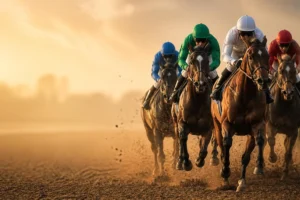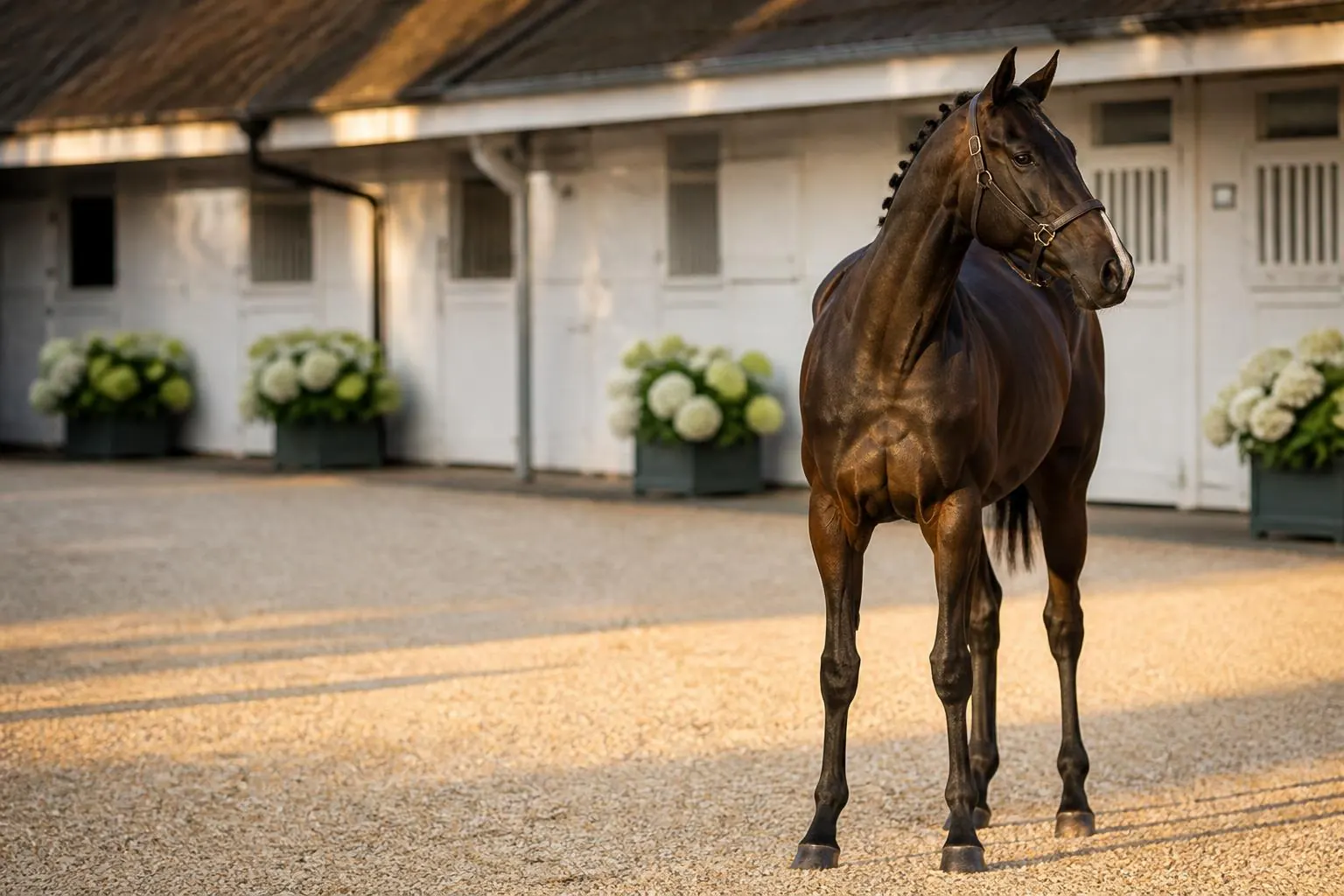

On 15th, 16th and 17th August, 325 yearlings will step into the ring at Deauville. Not one has ever raced. Not one has ever carried a jockey in competition. Last year, the same sale moved €59,982,000 across three sessions, with a single filly making €3 million. This is what buyers stake fortunes on: an animal whose sporting value remains entirely unknown.
Three Sessions, 325 Horses, Zero Race Days
The August Sale stands as the most eagerly anticipated date on France’s thoroughbred auction calendar. This year brings 325 yearlings spread across three sessions at the Elie de Brignac complex in Deauville: Saturday 15th August at 17:30 for lots 1 to 80, Sunday 16th August at 17:30 for lots 81 to 160, then Monday 17th August at 11:00 for lots 161 to 325.
Two days later, on 19th August, a second yearling sale follows with a further 166 lots. The contrast between them proves instructive: the first brings together the finest bloodlines French and international breeding has to offer, while the second targets radically different budgets for horses that will also take to the track.
The house orchestrating this is Arqana, born in August 2006 from a merger between the French Thoroughbred Sales Agency and Goffs France. It runs eighteen sales annually, catalogs over 5,000 horses, and generates roughly €160 million in yearly turnover, making it Europe’s second-largest thoroughbred auction house. It operates from two locations: the Elie de Brignac complex in Deauville and the Manège Boussac in Saint-Cloud.
The timing is no accident. The sale coincides with the Deauville Barrière meeting, running 2nd to 30th August across sixteen days and featuring seven Group 1 races. The Prix Jacques Le Marois runs on 16th August, the Prix Morny on the 23rd. In short, buyers purchase yearlings in the evening just hundreds of yards from the racecourse where the horses they bought in previous years are competing. Market and result coexist in the same town, the same week.
A Yearling, on Paper, is a One Year Old
The term comes from English and denotes a horse of one year. But in racing, that age is administrative convention, not biography. Every thoroughbred born in the Northern Hemisphere shares the same official birthday: 1st January, regardless of actual birth date. In the Southern Hemisphere, the reference date is 1st August. The rule, established in the nineteenth century, serves one simple purpose: without it, organising races restricted to two year olds or three year olds becomes impossible.
The consequence is tangible for anyone reading a catalogue. A colt born in February and a colt born in May carry identical yearling labels, though three months separate their development. At this age, three months matters considerably. Some lots presented at Deauville are already substantial athletes; others remain gangly adolescents who will grow another eighteen months.
These horses are not broken in the sense a rider understands it. They are handled, halter-trained, led by hand, presented several times daily to strangers. That is all. No one has ever timed them. No one knows whether they will stay 1 mile 600 yards (2,600 metres) or 1 mile 2 furlongs (2,400 metres), or whether they will tolerate training. The gamble starts precisely here.
Sixty Million Euros Across Three Evenings
To gauge what unfolds next week, look at what happened last year. At the 2025 edition, 272 yearlings went through the ring, 80 per cent found buyers, and the total turnover reached €59,982,000. The average price settled at €266,576; the median at €170,000.
The gap between those figures tells the market’s essential story. An average of €266,000 and a median of €170,000 means a handful of exceptionally expensive lots drag the entire aggregate upward. Eight yearlings exceeded €1 million: four colts and four fillies, with four reaching or surpassing €2 million. For the first time in the sale’s history, eight seven-figure yearlings were registered in a single edition.
The ceiling came on 18th August 2025 with a filly by Night Of Thunder and Prudenzia, offered by Écurie des Monceaux, hammered down at €3 million. Her principal credentials came down to one pedigree line: her dam produced Chicquita and Magic Wand, both Group 1 winners. Three million euros for a one year old filly about whom nothing else was known.
It was not, in fact, the ring’s absolute record. In December 2023, within the same venue, a four year old filly made €4,025 million. But she had raced. That is an altogether different matter, and a different market.
What judges a yearling
- Pedigree. Sire, dam, and crucially what the dam has already produced. A mare whose two offspring have won at the highest level commands more than elegant theory on paper.
- Walk. The only gait truly observable in an unmounted horse. Stride length, straightness, shoulder suppleness, engagement of the hindquarters.
- Conformation. How the limbs are set and bear load. The first line of defence against training injuries.
- Frame. Overall balance, chest depth, neck length, bone quality, harmony of the whole.
- Veterinary file. Radiographs, endoscopy, ultrasound. Accessible before sale by the veterinarian appointed by the buyer.
- The vendor. The stud selling. Certain breeding establishments command reputations for preparation and integrity that carry a price.
- Market momentum. A stallion whose first runners have just won well sees his yearlings fly the same season.
The Veterinary File the Room Never Sees
This is the invisible side of the sale, and it often decides everything. Arqana provides a secure platform called the Repository, where vendors upload each horse’s veterinary file. The file may contain radiographs taken under international protocol or per French equine veterinary association standards, endoscopy videos, tendon ultrasounds, and any document the vendor deems relevant for buyers to know.
Files upload roughly three to four weeks before the sale. For the August 2026 edition, access opens on 13th August, two days before the first session. Only veterinarians appointed by buyers can access them, after registration and declaration of the party they represent.
The effect is brutal. A lot can be eliminated by a single radiographic image before ever entering the ring, with no one in the room understanding why the bidding stalled. Conversely, an impeccable veterinary file reassures and attracts two or three extra bidders, enough to shift the price. Silence in the ring is never accidental.
The Walk, the Detail Examined Ten Times Over
Spend a day walking the stable aisles in the days before the sale, and one scene repeats constantly: a handler leads a horse out, walks it thirty metres (100 feet) over the gravel, brings it back, replaces it, repeats. The same horse may be shown fifteen or twenty times in a single day to different buyers.
The reason is straightforward. On a horse never galloped before witnesses, walk is the sole objectively observable metric. It reveals natural stride length, limb straightness, how the shoulder releases, overall coordination. Professionals regard it as critically important, because it is essentially all they have.
And worth stating what cannot be observed, because that is precisely what makes the week so compelling. No one can see the heart in any sense of the word. No one can see respiratory capacity under genuine effort, tendon resilience through months of training, or the will to fight in the final 100 yards (91 metres). The world’s finest yearling judges purchase probability, not certainty.
The World Record for a Yearling Dates to 1985
In July 1985, at Keeneland’s yearling sale in Kentucky, a colt was hammered down at $13.1 million. His name was Seattle Dancer. Forty years on, no yearling has fetched a higher price at public auction.
His racing career spans a single line: five starts, two wins, a second in the Grand Prix de Paris, and £111,303 in earnings. He won the Derrinstown Stud Derby Trial and the Gallinule Stakes in 1987, and a virus in his trainer’s yard prevented him from running at two years old. It was not a failed career, in fact quite respectable. It simply bore no relationship to his purchase price.
This story offers the best possible caution for reading next week’s figures. An auction price does not forecast future performance. It measures what two buyers, in a room, at one moment, are willing to wager against one another.
Price Does Not Make a Champion, and the Reverse is Equally True
The thoroughbred world knows three distinct markets never to confuse. The yearling market sells pure potential, without performance data. The in-training market sells already-proven results. The breeding market sells hoped-for offspring, and there the sums become vertiginous.
The most famous counterexample is American. A champion purchased at fortune to stand at stud may prove disappointing at the farm, his stud fee collapsing within seasons, as witnessed by a horse bought for $70 million then discounted. Conversely, absolute champions have been purchased for modest sums. In breeding, chance retains a share that money cannot reduce.
This also explains public fascination with these sales. You witness, live and in thirty seconds of the gavel, the most subjective valuation imaginable: what is an animal worth when you know nothing about it. For a complete scale of sums reached across the equine world, see our feature on the world’s most expensive horse.
What This Week Reveals About French Breeding
Deauville is no random choice. Normandy concentrates a major share of French flat racing breeding, and the local ecosystem, studs, trainers, veterinarians, transporters, lives largely to the rhythm of these three August evenings. The sales season sets the pace for an entire region, as shown in our panorama of Normandy on horseback.
The horses entering the ring are thoroughbreds, a breed refined over three centuries on one criterion alone: speed at a given distance. Each August catalogue is a snapshot of that selection: the fashionable sires, the mares’ families producing, the studs ascending. Reading a sale’s results is reading a sector’s state of health.
And should prices climb again this year, remember simply this: no one in that room knows which of these 325 horses will ever win a major race. That is precisely why they all go.
Three million for a yearling, seventy million for a stallion, four million for a broodmare: sums in the equine world are difficult to place in relation to one another.
See the complete ranking of the world’s most expensive horses
Key points
- The August Sale runs 15th, 16th and 17th August in Deauville, with 325 yearlings catalogued, followed by a second sale of 166 lots on 19th August.
- A yearling is a one year old in administrative terms: every Northern Hemisphere thoroughbred has 1st January as their official birthday.
- In 2025, the sale totalled €59,982,000, with 80 per cent of lots sold, an average of €266,576 and a median of €170,000.
- The 2025 edition record was €3 million for a filly by Night Of Thunder and Prudenzia offered by Écurie des Monceaux.
- Buyers judge on pedigree, walk, conformation, frame and a veterinary file accessible before the sale.
- The world yearling record dates to 1985, when Seattle Dancer sold for $13.1 million and went on to two race wins.
Sources cited in text: official sale catalogue and schedule, Repository veterinary documentation from the auction house, financial reports from the 2025 edition published by flat racing specialist press, Deauville Barrière meeting schedule, Keeneland yearling sale archives. Equirider is affiliated with neither Arqana, France Galop, nor any sale organiser.