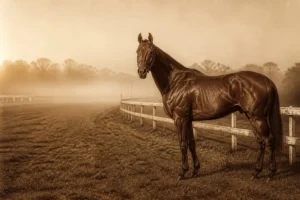
This Thursday, 13 August, ten horses will be drawn by lot in the middle of Siena’s Piazza del Campo. None of the ten city districts backing a rider has chosen its mount: chance alone decides who rides whom. On 16 August, these ten horses will complete three circuits of the square, ridden bareback, in under 90 seconds. And should a rider fall, his horse may finish alone and win regardless.
The Palio dell’Assunta is not a horse race in any conventional sense. There is no racetrack, no straight line, no five-camera photo finish. There is a shell-shaped medieval piazza, a strip of earth laid down for the occasion, two turns that terrify, and a city divided into seventeen neighbourhoods that have cordially detested one another for six centuries. In its present form, the race around the square dates to the seventeenth century, with historians of Siena traditionally marking the first carriera alla tonda at 1633.
The Horse Wins, Not the Rider
This is the rule that surprises everyone and which captures the spirit of the race: the victor is the horse, not the pair. The first horse to cross the line with its spennacchiera intact, the plume in the colours of its district fixed to the headpiece, takes the Palio. The presence of a rider is not required.
A horse that loses its jockey in a turn and continues alone is called a scosso, and this is no theoretical curiosity: the Palio has been won by a riderless horse. It changes the spectacle entirely. When a fantino hits the dirt, the crowd does not watch him: it watches the horse continuing, and an entire neighbourhood can swing from despair to hysteria in half a circuit. It is the exact opposite of what happens on a conventional racecourse, where we often follow nothing but the jockey and his silks.
The Draw Decides Almost Everything
What has just taken place is called the tratta. On the morning of 13 August, candidate horses are led from the Cortile del Podestà and sent in series onto the track, under the eye of the district captains and a veterinary commission. Ten horses are selected, then assigned to the ten districts by lot around midday. The first trial run takes place that evening.
Two details transform the nature of the event. First, the horses belong to private owners, not to the districts: a contrada cannot purchase or reserve its mount, unlike what occurs in flat racing or in the market for the world’s most expensive horses, where money buys the best chance. Second, once the draw falls, the horse cannot change: it remains bound to its district until race day, whereas the jockey may still be replaced. In other words, the only piece that cannot be changed is the animal itself.
Between the tratta and the race, six trial runs are held, morning and evening, with the last being the provaccia, raced on the morning of the Palio itself.
Ten Districts Out of Seventeen, and Seven Who Watch
Siena counts seventeen districts, but only ten race each Palio. The mechanism is unchanging: the seven districts that did not race on the same date the previous year are qualified automatically, and three others are drawn by lot a few weeks beforehand.
For the 16 August 2026 running, the city of Siena published the draw on 5 July: the Eagle, the Wave and the Giraffe complete the field, alongside the Forest, the Snail, the Goose, the Clam, the She-Wolf, the Porcupine and the Tower. The other seven districts will watch the race without taking part, though this does not prevent them from influencing its outcome through their alliances and enmities.
Three Circuits of a Square, Not a Racetrack
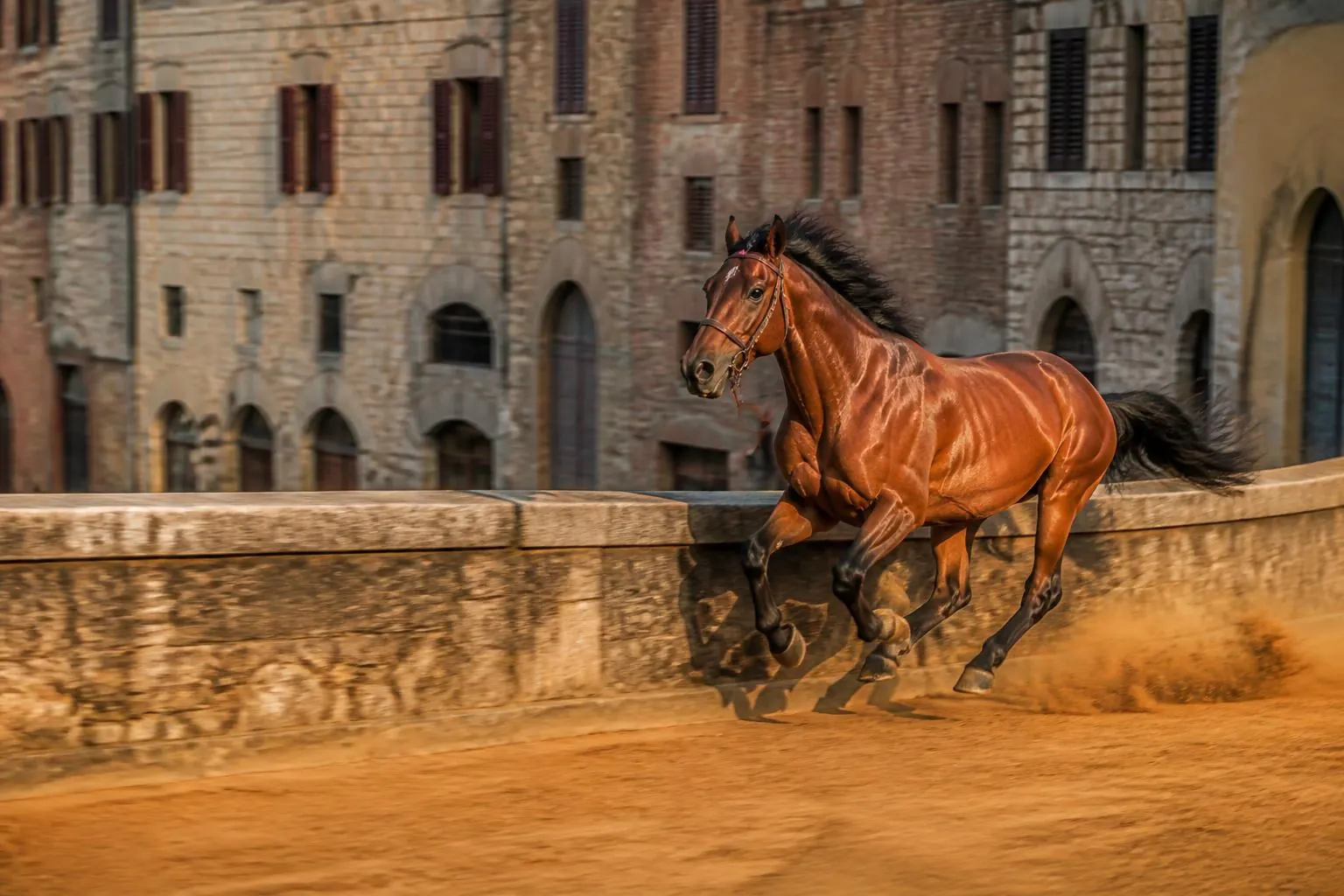
The track exists only a few days each year. A layer of earth is spread around the perimeter of the Piazza del Campo, transforming the paving into an ochre ring. The course bears no resemblance to a regular oval: it follows the shape of the square, with its slopes, a downhill turn and an angle considered infernal. Three circuits suffice, and the matter is usually settled in under 90 seconds.
The jockeys ride bareback, without saddle or stirrups, making even the smallest adjustment acrobatic. As they leave the Entrone they receive a nerbo, a dried ox nerve whip, whose use is far broader than that of an ordinary crop: it serves to urge one’s own mount forward, but equally to hinder rivals. This is one of the points that makes the race incomparable to any event run under federation rules.
The start, the mossa, is suspense in itself. Nine horses line up between two ropes, in an order drawn by lot. The tenth, called the di rincorsa, remains outside and triggers the start by surging forward at the moment of his choosing: he alone decides the instant when the mossiere drops the rope. The wait can stretch for long minutes, with repeated false starts and hushed negotiations between riders.
The Horse Enters the Church
A few hours before the race, each district leads its horse into its oratory. The animal, held by hand, passes through the door, finds itself among the pews, and receives the blessing of the priest, who concludes with the consecrated words: go forth, and return victorious. There are not many places in the world where a horse is brought into a church in the presence of a silent crowd.
The trophy has no monetary value: it is the drappellone, a silk banner painted specially for each running by an artist chosen by the city. The banner for 16 August 2026 is signed by Teodora Axente. The winning district will preserve it in its museum, and it will be worth more in the eyes of its people than any prize money.
The Turn Siena Has Protected Since 1841
The danger point of the track bears a name every Sienese knows: San Martino. The turn there is tight and downhill, approached at full speed after a flying stretch. The need to protect it is not a recent concern: as early as 1841, the city decided to line this corner with mattresses to prevent fallen horses and riders from striking the barrier. Today’s apparatus is considerably more technical, but the principle dates to that era.
What the City Has Changed Under Pressure from Critics
The Palio is regularly attacked by animal welfare organisations. The principal one in Italy, the Lega Anti Vivisezione, recorded forty-eight horses dead between 1970 and 2007, a figure that recurs in every debate. One may find the race indefensible or magnificent, but one cannot say that nothing has moved.
Since 2019, only half-bred horses born in Italy are admitted, with English Thoroughbred blood capped at 75 per cent certified by official papers: the rules thus effectively exclude the English Thoroughbred and the fastest horses, deemed too dangerous on such a track. Registration in the Palio horse register is bounded by age, roughly four to seven years. Prior veterinary inspections and supervised training sessions on the track, held in the mornings before the tratta, filter the candidates. A veterinary commission rules on the fitness of each horse in the days preceding the draw, ELISA testing for prohibited substances is provided during racing and training periods, and the transport of animals is handled by carriers approved under European regulations on the protection of animals in transport.
For riders, the evolution is comparable: helmets mandatory at trial runs since 2011, back protection required, insurance and breath and drug testing. On Palio day, the jockey wears the zucchino, a rigid helmet in the colours of his district, designed as much against falls as against blows from opponents’ nerbo. The same reasoning applies to any pleasure rider: choice of riding helmet remains the first safety decision, before any equipment for the horse.
How to Judge a Race of This Kind
- Pre-selection: how many horses presented, how many retained, on what veterinary criteria.
- The profile of horses admitted: age of registration, morphological type, English blood ceiling, traceable origin.
- The track: nature and depth of earth laid down, maintenance between trial runs, protection of exposed turns.
- The number of compulsory trial runs before the race, which allows identification of a horse in difficulty.
- Pharmacological testing, its frequency and whether unannounced.
- The presence of veterinarians and care facilities on site during the race.
- The welfare of horses after their racing career, the point where transparency is most expected.
- Publication of figures, including falls and injuries: a festival that publishes them is judged better than one that conceals them.
What to Watch on 16 August
The schedule published by the city sets the rhythm of the day: jockey’s mass early in the morning, last trial run around nine o’clock, official signing of riders at the Palazzo Pubblico in late morning, then the long historical procession entering the square in mid-afternoon. The horses do not leave the Cortile del Podestà until early evening, around seven o’clock. Between these times, the square fills for hours and access points close progressively, the final entry via the via Duprè shutting in late afternoon.
For those watching from afar, two moments are worth the journey even without understanding Italian: the mossa, this electric wait between the ropes, and the passage through San Martino on the first circuit. The rest happens in a minute and a half.
And if the thought of a horse in Tuscany makes you keen to ride rather than watch, there is another Tuscan equestrian world, far calmer, on the side of trail rides through hills and villages.
Key Points
- The Palio dell’Assunta runs on 16 August each year on the Piazza del Campo in Siena.
- Ten districts out of seventeen take part: seven qualified automatically, three drawn by lot.
- Horses are assigned by draw on 13 August and cannot change districts thereafter.
- Three circuits, ridden bareback, under 90 seconds in general.
- The winner is the horse: a horse without a rider can win, provided it keeps its head plume.
- The trophy is a painted silk banner, with no monetary value.
- The rules now admit only half-bred horses born in Italy, under veterinary and pharmacological control.
Bareback, no stirrups, at full speed: in Siena, a rider’s only protection rests on his head.
The principle applies to everyone, in the arena or out. Before changing your saddle or bit, you start with your head.
Equirider is affiliated with neither the city of Siena, nor the districts, nor any Palio organisation. The dates, times and draws cited come from official publications by the municipality of Siena.
Sources
- Il Palio di Siena, official website of the municipality of Siena (palio.comune.siena.it)
- Municipality of Siena, draw for districts of the Palio of 16 August 2026
- Municipality of Siena, pre-inspection and regulated trials of horses