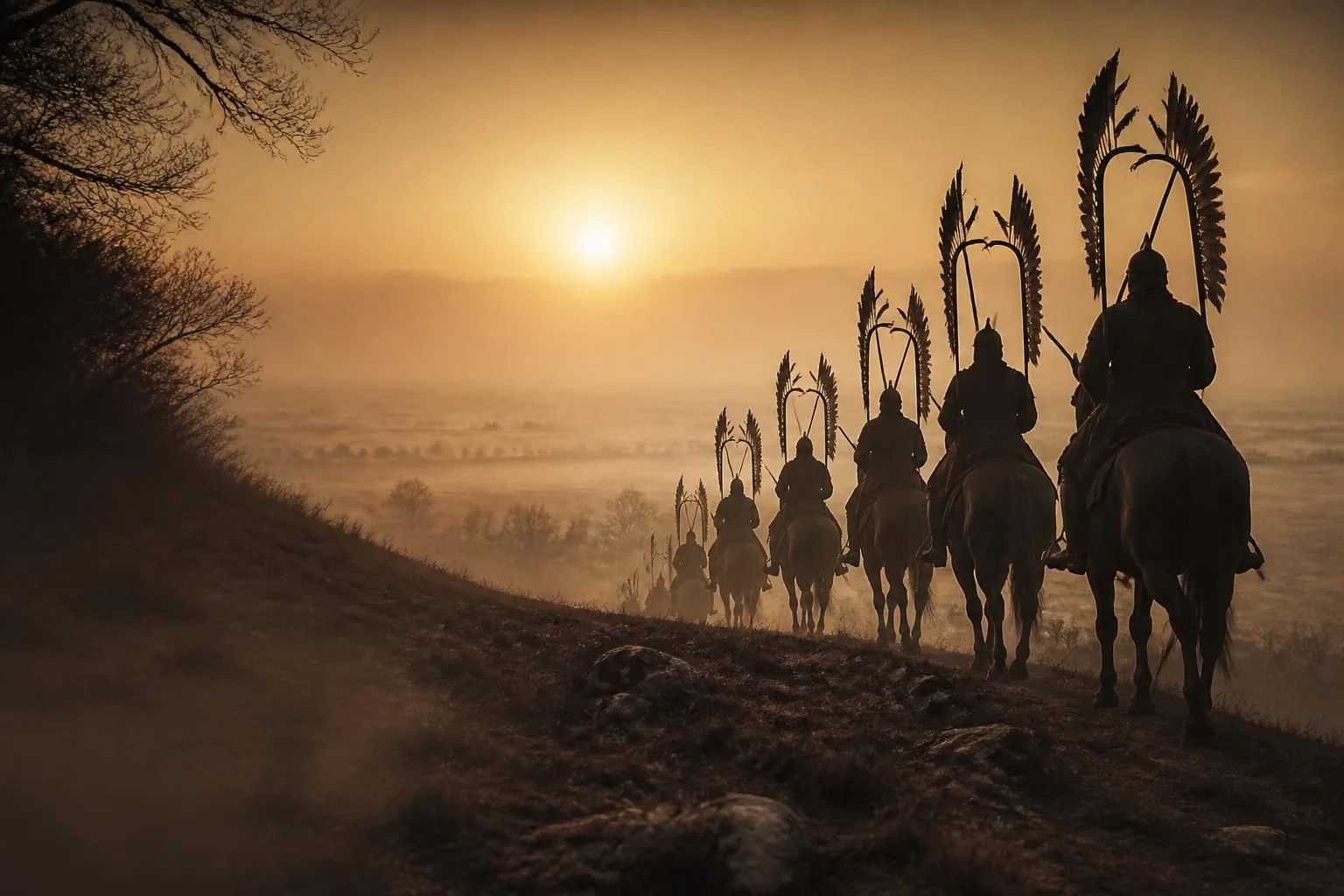

On the afternoon of 12 September 1683, around six o’clock, a mass of cavalry descended the wooded heights west of Vienna and struck the Ottoman encampment. Leading the charge was King John III Sobieski of Poland with three thousand hussars, their tall plumes rising dramatically above their shoulders. It is the most celebrated image in European military history, and also the one most persistently misremembered. The terrifying whistle of wings, the greatest cavalry charge of all time: these two cornerstones of the narrative hold far less firmly than we believe. What does hold, however, is the horse. A breeding animal so strategically vital that, according to specialised sources, selling one beyond the kingdom’s borders carried the death penalty.
What actually happened that September afternoon above Vienna
The siege had lasted since 14 July. The city held under Ernst Rüdiger von Starhemberg, Emperor Leopold I had fled with his family, and Charles of Lorraine, commanding the imperial relief army, lacked the numbers to break the Ottoman lines alone. The decisive reinforcement came from the Polish king, who assumed command of the entire relief forces.
On the night of 11 September, imperial troops occupied the hill overlooking Vienna from the north. Here is a detail nearly all accounts omit: it was then called the Kahlenberg, but Leopold I renamed it immediately after the battle, and it has been the Leopoldsberg ever since. The battle supposedly fought on the Kahlenberg never actually took place there at all; it occurred on what is now the neighbouring hill.
At five in the morning, the imperial forces on the left and German contingents in the centre attacked. The Poles on the right, further from the Ottoman positions and across difficult terrain, made progress only into the afternoon. Around four o’clock, a detachment of one hundred and twenty hussars executed a reconnaissance charge. It was costly, but it proved the Ottoman line could be broken. An hour later, the great Turkish redoubt, the Türkenschanz, was threatened on three sides and became indefensible.
Only then did Sobieski launch the general assault. Towards six o’clock, four cavalry corps, three Polish and one imperial, descended on the camp of Grand Vizier Kara Mustafa, the king and his three thousand hussars at their head. The Ottoman army dissolved into chaos. Sobieski is said to have summarised the day in words modelled on Caesar: “Venimus, vidimus, Deus vicit” , we came, we saw, God conquered.
A word on that ubiquitous superlative. “The greatest cavalry charge in history” rests on no contemporary count, and sources disagree sharply: English-language references cite eighteen thousand riders and claim the title based on a recent popularising work; French sources give twenty thousand for the four corps and speak only of “one of the most important charges in European history up to that time.” What stands on solid ground amounts to three points: the charge did occur on 12 September in late afternoon, it was indeed led by the king in person, and it did decide the battle. That is already considerable.
The horse one could not sell beyond the kingdom
The true subject of that day stood beneath the men. The hussar horse was not a purchased animal: it was the product of directed breeding, obtained by crossing old Polish equine lines with oriental horses, very often of Tartar origin. The goal was an animal capable of three rarely compatible feats: carrying heavy weight, covering vast distances, and recovering quickly.
The numbers convey the demand. A mounted and armed hussar represented over 100 pounds (45kg) of load, rider, armour and weapons combined, the armour alone weighing some 33 pounds (15kg). The horse had to traverse hundreds of miles under this burden, then charge immediately upon arrival. Any rider who has calculated the weight ratio of their own horse recognises what this required of the back, loins and recuperative capacity.
To spare weight, the Poles had borrowed from the Ottomans their saddle type, lighter than the Western saddle of the era: every pound saved on tack went into the rider’s protection. The lance was furnished by the king, not the soldier. It measured from 14 to just over 19 feet (4.5 to 6 metres), fashioned from fir wood, hollowed then reglued in two halves to remain manageable at arm’s length.
And the horse itself was protected by law. Specialised sources emphasise it: selling a hussar horse to anyone outside the Polish-Lithuanian Commonwealth carried the death penalty. This is no mere folklore detail; it is an admission. This horse was a strategic weapon in the same sense as cannon, and it is the reflex found wherever a mount had made a state’s power. It also explains why certain bloodlines later became the most expensive horses in the world. The Ottoman camp cultivated the opposite and equally formidable tradition: the light cavalry of the steppes and mounted archery, demanding speed and manoeuvrability rather than weight-carrying capacity.
A charge that does not begin at the gallop
This is the point films invariably miss, and the one most horsemen will recognise. The hussar charge did not depart at the gallop from the first stride. It began at a slow pace, in deliberately loose formation, with space between the horses. It accelerated gradually, closing ranks as it approached, and reached maximum speed and density only immediately before contact.
The logic is purely equestrian. A force launched at the gallop from the start arrives scattered, on already-spent horses at uneven paces. A force that builds momentum arrives grouped, on fresh horses with reserve, and strikes as a single object. It is the discipline of collection applied to a thousand horses instead of one.
A second overlooked detail: the charge was not singular. Hussars repeated the attack several times if necessary, until the opposing formation broke, and supply carts followed with replacement lances, since the hollowed lance shattered on first impact. The number one selection criterion for a hussar horse was therefore not peak speed but the capacity to deliver maximum effort after maximum effort.
What judges a cavalry charge
1. The starting ground. A wooded slope is not a plain: you must descend before you can launch anything.
2. Timing. A charge is launched against an already-engaged enemy. At Vienna, the decisive attack came after thirteen hours of fighting.
3. Building momentum. Slow start and open formation, gradual acceleration, maximum speed only at contact.
4. Density at impact. A grouped charge breaks through; a scattered one bogs down.
5. Capacity to repeat. The decisive criterion for the horse: delivering maximum effort after the first.
6. The condition of horses afterwards. A victory purchased by ruined horses cannot be exploited the next day.
7. What becomes of the enemy. An orderly withdrawal is not a rout. At Vienna, it was a complete rout.
The wings: what we can prove and what we repeat
Now for the object that made the legend. Hussar wings do not grow from the horse’s back, contrary to what half the circulating illustrations suggest. They are wooden arches fitted with long feathers, fastened either to the rear of the rider’s armour or to the rear of the saddle, rising above his shoulders.
The most frequently cited description comes from Polish chronicler Jedrzej Kitowicz: wooden arcs fixed to the armour at the back, rising above the head, adorned with brightly dyed feathers imitating laurel branches or palm fronds. The problem is that Kitowicz lived from 1728 to 1804. He describes an object he never saw at Vienna; he speaks of it a century later.
A 1665 witness says two things, and the second is troubling
The most interesting testimony predates him. Sebastiano Cefali, an Italian in the service of Prince Lubomirski, wrote in 1665 that hussars were accustomed to attach large vulture wings to their backs which, at the gallop, made a great rustling sound. This is the source most often invoked for the famous noise theory, and it is contemporary.
Except Cefali immediately adds a second piece of information, systematically cut when the first is cited: by the date he writes, almost no one wore them any longer. We are in 1665, eighteen years before Vienna. The most celebrated charge in the history of winged hussars therefore occurred at a time when our nearest witness tells us the wings were already going out of fashion. Historians still cannot definitively say whether they were worn in combat or reserved for parade, lacking a sufficiently detailed battle account.
What a horseman might object to the noise theory
The popular version holds that the whistle of wings terrorised enemy horses. Two objections stand firm, and neither requires expertise in history.
The first is acoustic. At the moment of impact, there are several thousand hooves at the gallop on hard ground, shouts, drums, musket fire and artillery. A rustling of feathers is a very low-energy sound: it would need to explain by what miracle it would penetrate this din.
The second is equestrian. A horse starts first at what it sees, particularly at a tall, moving, unfamiliar shape approaching head-on. A line of figures topped with structures some 6 to 7 feet (2 metres) high, backlighting, in dust: that is a massive visual stimulus, and it needs no sound whatever to function. This is indeed the hypothesis most authors now favour, alongside two more prosaic explanations: hindering the lasso of steppe riders and protecting the back.
There remains one point no one emphasises and which should leap out at anyone who has ever started a young horse. If these wings frightened horses, they frightened first the horse wearing them. A horse rarely accepts at first encounter a snapping object fixed just behind its head. This requires methodical desensitisation, precisely the logic of a properly conducted breaking process. The hussar horse was not merely selected; it was manufactured.
The trophy the king sends his wife is a stirrup
The day after the battle, 13 September, Sobieski wrote to his wife Maria Casimire from the fled grand vizier’s tent and described the spoils. Among the objects he sent her was a stirrup belonging to Kara Mustafa.
The choice was not incidental. At that time, a stirrup ranked among the most prestigious battle trophies one could claim: taking an enemy chief’s stirrup meant taking what held him in the saddle. The queen offered the piece as a votive offering to Wawel Cathedral in Cracow, where it was placed before the altar; a copy remains visible today. The vizier himself was executed on the sultan’s order before year’s end. What was brought home, then, was neither sword nor helmet nor standard, but a piece of horseware. The horse was the centre of gravity of the entire system.
Key points
The Battle of Vienna took place on 12 September 1683, following a siege that began on 14 July. The decisive charge departed around six o’clock in the evening, led by John III Sobieski with three thousand hussars at the head of four cavalry corps. The phrase “greatest cavalry charge in history” is widespread but unestablished: sources vary between eighteen thousand and twenty thousand riders. The hussar horse, a cross of Polish bloodlines with oriental stock, carried over 100 pounds (45kg) across vast distances before charging, and its sale beyond the kingdom carried a death sentence. As for the wings, the only contemporary witness who mentions their noise clarifies in the same phrase that by 1665 almost no one wore them.
What these horses left behind
The hussars were officially dissolved in 1776 and their traditions transferred to the uhlans. The horse type itself did not vanish abruptly: it merged into Central European breeding stock, where oriental blood remains ubiquitous everywhere. It is the same underlying movement that dispersed Arabian blood through much of the horse breeds we ride today.
The region has not finished circling these horses. Two hundred sixty-two years after Vienna, in a ruined Bohemia, American and German soldiers agreed to save a stud farm: that is Operation Cowboy in 1945. Another conqueror had built an empire on the same raw material, and the oldest account of his end begins with a fall: that of Genghis Khan in 1227. As for the exact opposite of Vienna, a royal charge that ended badly, it exists too: Richard III at Bosworth in 1485.
A horse you cannot sell to foreigners on pain of death is a horse beyond price. The logic has not changed in three centuries; it has only changed currency.
What we do not know
Three honest reservations. No one knows with certainty whether hussars wore their wings on 12 September 1683: no sufficiently detailed battle account allows us to assert it, and our nearest witness wrote eighteen years earlier that they were already rare. The charge’s numbers vary by source, and the superlative is a popularisation formula, not a period count. Finally, the prohibition on selling a hussar horse beyond the kingdom on pain of death is reported by specialised sources drawing on Polish authorities: it is consistent with everything known of the value of these animals, but we have not read it in an original legal text.
Sources
Encyclopaedic reference entries, French and English versions, for the hourly sequence of 12 September 1683, the siege from 14 July, Sobieski’s command, the hill’s renaming to Leopoldsberg, the one-hundred-twenty-hussar reconnaissance charge, the six o’clock general charge and the phrase “Venimus, vidimus, Deus vicit.” These same sources differ on numbers, eighteen thousand versus twenty thousand, and on the world record, asserted in English-language sources based on a 2016 popular work and qualified in French sources. The reference work on Polish hussars for breeding, the over-100-pound charge weight, the 33-pound armour, the Ottoman-style saddle, the lance, charging tactics, wing attachment, Jedrzej Kitowicz’s description and the death penalty for selling a hussar horse outside the Polish-Lithuanian Commonwealth. Sebastiano Cefali’s 1665 testimony is cited from Richard Brzezinski’s monograph. Polish history portal and Cracow tourism office for the 13 September 1683 letter and for Kara Mustafa’s stirrup at Wawel, where a copy is displayed.