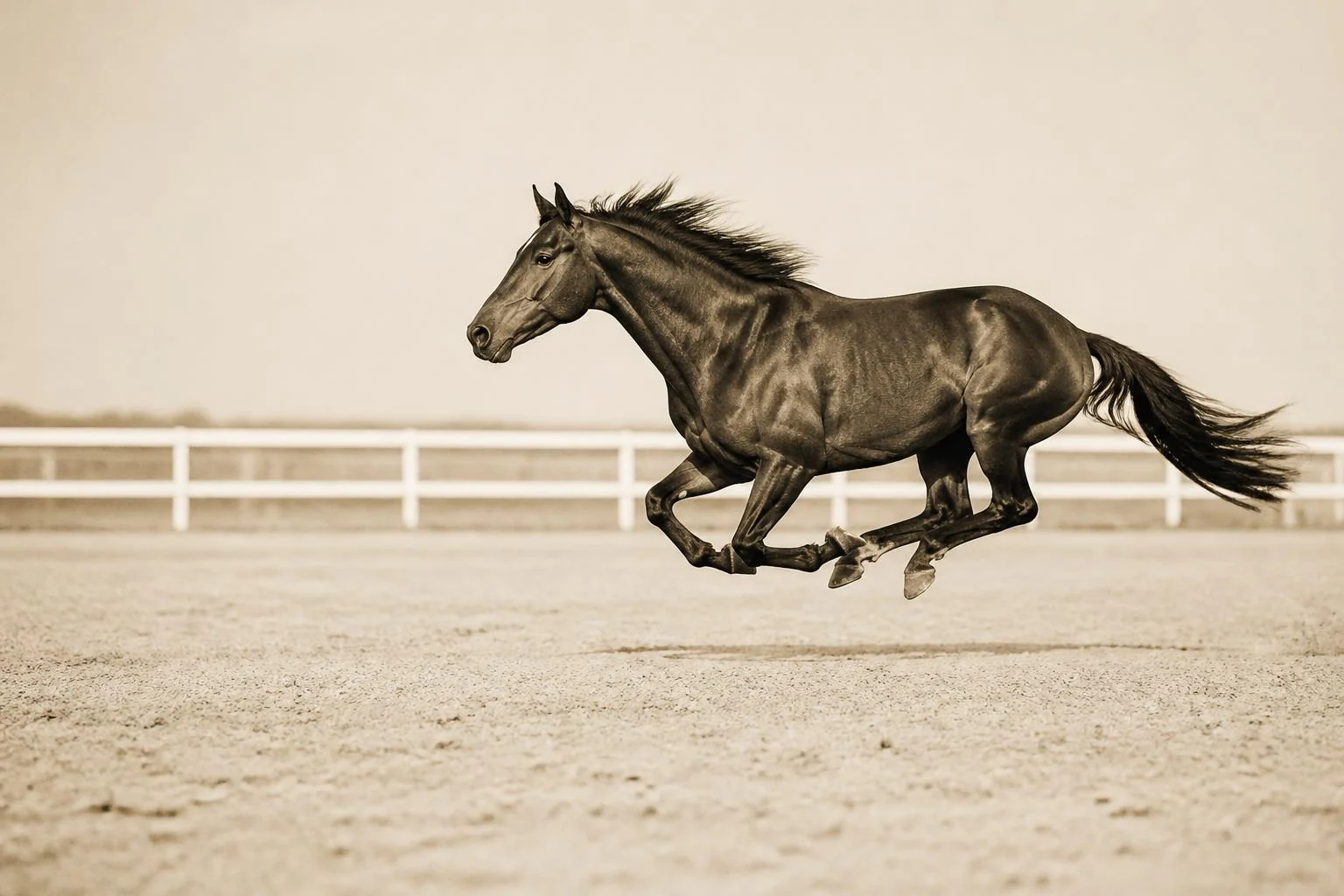

Yes, a galloping horse does completely leave the ground. At a precise moment in each stride, all four hooves are airborne simultaneously. No one managed to prove this before 19 June 1878, on a private track near Palo Alto, California, when a mare named Sallie Gardner was photographed by a row of cameras triggered by wires stretched across the sand.
That day, photography did more than satisfy curiosity. It revealed that painters had been depicting the gallop incorrectly for centuries, and it set in motion the mechanics that would eventually give us cinema. Here is what happened, what the images actually showed, and why this 146-year-old story still matters to anyone filming their horse on a smartphone today.
The question the human eye could not answer
At gallop, a racehorse covers nearly 23 feet (7 metres) per stride at speeds exceeding 37 mph (60 kph). At that velocity, the eye perceives nothing in sequence. It sees only a mass in motion and four limbs churning the air. Impossible to determine whether, at any given moment, the horse is in contact with the ground or airborne.
The question was far from trivial. Breeders, trainers and veterinarians cared deeply, because understanding how the feet load the ground meant understanding where stress concentrates, and therefore where horses break down. Artists cared equally. They had painted the gallop for centuries with forelegs extended forward and hind legs thrust backward, like a rocking horse. This convention, known as the flying gallop, dominated hunting scenes and racing art through the nineteenth century.
In France, physiologist Étienne-Jules Marey was already investigating the question by other means. In La Machine animale (The Animal Machine), published in 1873, he recorded ground contact using air-pressure sensors beneath the hooves and concluded that a period of suspension did exist. His method produced graphs and curves. It showed no image, and a curve does not convince a painter.
A railroad magnate, a trotter, and a commission from 1872
Leland Stanford was one of California’s wealthiest men, a former state governor, owner of a major stud farm, and passionate about trotters. In 1872, he engaged Eadweard Muybridge, a British photographer based in San Francisco, to photograph his horse Occident in motion.
The initial attempts failed: photographic emulsions of the day were too slow, the images too blurred to resolve anything conclusive. It would take six years, specially designed shutters, electronic timing, and a carefully prepared track before usable images could be obtained. In the interim, Muybridge would stand trial for murder, but we shall return to that.
19 June 1878: twelve cameras and wires across the track
The apparatus was installed on Stanford’s private track at Palo Alto. A battery of cameras lined the course, each electrically connected to a wire stretched across the sand. As the horse advanced, it broke each wire in sequence and triggered the cameras in order. Opposite, a white fence marked with calibration points served as a bright backdrop and scale reference.
On 15 June 1878, Stanford demonstrated the system publicly to the press, using the trotter Abe Edgington harnessed to a sulky. Over the following days, several horses were photographed. On 19 June, it was Sallie Gardner’s turn, a mare owned by Stanford, ridden by a man identified in contemporary records as G. Domm, galloping at a pace of approximately one minute forty seconds per mile.
One detail deserves correction, since it is misrepresented almost everywhere. The June 1878 session employed twelve cameras, and the published plates contain twelve images. It was the following year, 1879, that the system was expanded to twenty-four cameras. Contemporary accounts reported shutter speeds on the order of one-thousandth of a second, with images spaced approximately 27 inches (about 68 centimetres) apart, equating to roughly one twenty-fifth of a second between frames. Exposure duration and interval between photographs are two different things, and conflating them has generated considerable imprecision in the historical record.
What the images showed, and what they disproved
The result was unambiguous. At one point in the stride, all four hooves are airborne simultaneously. The question of suspension was settled.
But the real surprise lay elsewhere, and it proved most damaging to the artistic establishment. This moment of suspension does not occur when the limbs are extended forward and backward. It occurs when they are folded and gathered beneath the body, knees and hocks flexed, hooves nearly together. In other words, the only posture in which the horse is actually airborne is precisely the one no one had ever painted, and the posture everyone painted simply does not exist.
This aligns perfectly with modern technical understanding of the gait: the gallop is a three-beat jumping gait followed by a suspension phase. The complete mechanics, including the order of footfalls and the concept of right- or left-lead canter, are taught at foundational levels and we have detailed them in our guide to the three gaits: walk, trot and canter.
How to judge a canter image
- Light visible beneath all four hooves: if even one foot touches, there is no suspension.
- Limb position during suspension: folded beneath the body, never extended simultaneously forward and backward.
- Number of beats in the gait: three beats at canter, followed by a suspension phase, never four regular beats.
- Order of footfalls: one hind, then one diagonal pair, then the leading foreleg that names the lead (right or left).
- The topline shift: at canter, the croup and withers alternate rising and falling.
- Distinction from trot, where diagonal pairs function together and the suspension phase falls between diagonals.
- Shutter speed of the photograph: too slow, and it stretches the limbs and creates a posture that never existed.
- The shadow on the ground, often the most reliable indicator of the actual moment of takeoff in bright sunlight photography.
The twenty-five-thousand-dollar wager does not withstand scrutiny
Every popular account repeats the same anecdote: Stanford allegedly wagered twenty-five thousand dollars that the horse became airborne, and financed the entire project to win the bet. Some versions even name his supposed opponent.
The problem is that no contemporaneous document attests to any such wager. Photography historian Phillip Prodger, an authority on the subject, considers the story apocryphal. What is documented is Stanford’s genuine interest in gait analysis as applied to breeding and training his trotters, and his willingness to finance an expensive and lengthy scientific investigation.
The wager legend is more marketable than the truth. Its chief effect was to misrepresent what was a rigorous biomechanical commission as a billionaire’s whim, when in fact it was pioneering work in a field that would become an entire discipline. We explore this in our article on equine biomechanics in motion.
The man who proved all this had killed his wife’s lover
The darkest element of the affair concerns not the horse. In October 1874, between Stanford’s commission and the decisive session, Eadweard Muybridge discovered that his wife Flora was conducting an affair. He found the man, Harry Larkyns, and shot him dead. He made no denial.
The trial took place in 1875. The jury acquitted him on grounds of justifiable homicide, contrary to the judge’s instructions. Muybridge left California for a time, photographed in Central America, then returned to resume his motion studies. Flora died shortly after. The photographer reassembled his row of cameras as though nothing had happened, and it was this same man who, three years later, would give science its first images of a horse in flight.
From Palo Alto to cinema
What followed happened swiftly. The images circulated, and on 14 December 1878 the French journal La Nature published an article by Gaston Tissandier on equine gaits captured by instantaneous photography. Marey, who had been struggling with his curves, immediately grasped what the camera could accomplish. He developed his photographic gun in 1882, capable of recording multiple images per second on a single medium.
Muybridge, for his part, built a machine to restore movement to still images: the zoopraxiscope, a glass-disc projector he presented in 1880 in San Francisco. A sequence of photographs of a cantering horse, projected in loop, became a horse cantering again. The word “cinema” did not yet exist; the principle did.
His work soon expanded far beyond the horse. Based at the University of Pennsylvania, Muybridge published in 1887 Animal Locomotion, a collection of 781 plates comprising approximately twenty thousand photographs of humans and animals in motion. Born 9 April 1830 in England, he died 8 May 1904 in his native town.
Stanford erased him from the book, and Muybridge lost in court
The collaboration ended in dispute. In 1882, Stanford published a work on the subject, written by physician J. D. B. Stillman, which reproduced the images whilst crediting their author merely as an employee. The reaction was immediate: a British learned society preparing to support Muybridge withdrew its backing. The photographer sued Stanford. His suit was dismissed.
It is an age-old question in art commissioning: who owns the result, the one who pays or the one who creates? The images today bear Muybridge’s name, and the prints held in public collections always record the horse’s owner, the rider, the track and the date.
Why this 1878 story still speaks to riders today
Because the problem of 1878 remains unchanged: the human eye cannot perceive what happens at high speed, so it fills gaps with what it believes it knows. This is true of a canter stride. It is equally true of subtle lameness, a loading fault, an asymmetry that a rider senses but cannot name.
The difference is that the row of twelve cameras now fits in a pocket. Filming your horse in slow motion on hard ground, in a straight line, from front and side, has become the essential preliminary before calling in a professional, and it is exactly what we describe in our guidelines for identifying lameness in the horse. Video does not replace an examination; it gives your veterinarian information they might miss on the day of their visit if the horse happens to move soundly that morning.
The same principle applies to work under saddle. A slow-motion sequence often reveals more than an hour of discussion about canter quality, and it provides an objective baseline for assessment by an equine osteopath or a reassessment of movement patterns. To understand the mechanism in depth, our guide to equine locomotion and its mechanisms works through the footfalls gait by gait. These concepts also feature in federation exams, and our Equirider Galops pack allows you to revise them under exam conditions.
There remains an irony to the affair. The horses that provided the proof were trotters and racehorses, direct ancestors of those who fill modern racing programmes today, and the breeding of the thoroughbred was built over two centuries on a gait that no one had ever properly observed in its entirety. As for painters, they took time to recover. The rearing horse and the extended gallop continued to make handsome pictures, as in the equestrian portraits that built the legend of Napoleon and his mount, a story we have told in our article about Marengo, the Empire’s most celebrated horse.
Key takeaways
- A galloping horse does have a moment when all four hooves are airborne.
- Photographic proof dates to 19 June 1878 on the Palo Alto track, with mare Sallie Gardner owned by Leland Stanford.
- The session used twelve cameras triggered by wires across the track, not twenty-four: the system was expanded to twenty-four cameras only in 1879.
- This suspension occurs with limbs folded beneath the body, never with limbs extended forward and backward as painters had depicted.
- The twenty-five-thousand-dollar wager attributed to Stanford is unsupported by any contemporaneous document and is considered apocryphal by photography historians.
- Eadweard Muybridge, who created the images, had been acquitted in 1875 of the murder of his wife’s lover.
- These sequences led directly to the zoopraxiscope in 1880 and Marey’s photographic gun in 1882, both pivotal milestones in cinema history.
Go further
Gait mechanics, the beats of the canter and footfall patterns are all part of the official Galops syllabus. Revise with quizzes and coaching in the Equirider pack.
Sources
Photographic prints held in American public collections, with period captions identifying Sallie Gardner, property of Leland Stanford, ridden by G. Domm, moving at a pace of one minute forty seconds per mile on the Palo Alto track, 19 June 1878. Catalogue entries for the series The Horse in Motion and records of the June 1878 sessions, which specify the number of images per horse and the public demonstration to the press on 15 June. Works by Étienne-Jules Marey, La Machine animale, 1873, and development of the photographic gun in 1882. Journal La Nature, issue of 14 December 1878, article by Gaston Tissandier on equine gaits captured by instantaneous photography. Scholarship by historian Phillip Prodger on the apocryphal character of the wager attributed to Leland Stanford. Volume Animal Locomotion, University of Pennsylvania, 1887, 781 plates. Gait and locomotion information from resources of the Institut français du cheval et de l’équitation. The precise number of cameras used in June 1878 and the advertised shutter speed are formulated differently across sources; this article follows the version stated in the published plates and notes this for the reader. Equirider maintains no affiliation with any institution cited. For any horse showing irregular movement, the reference remains your veterinarian.