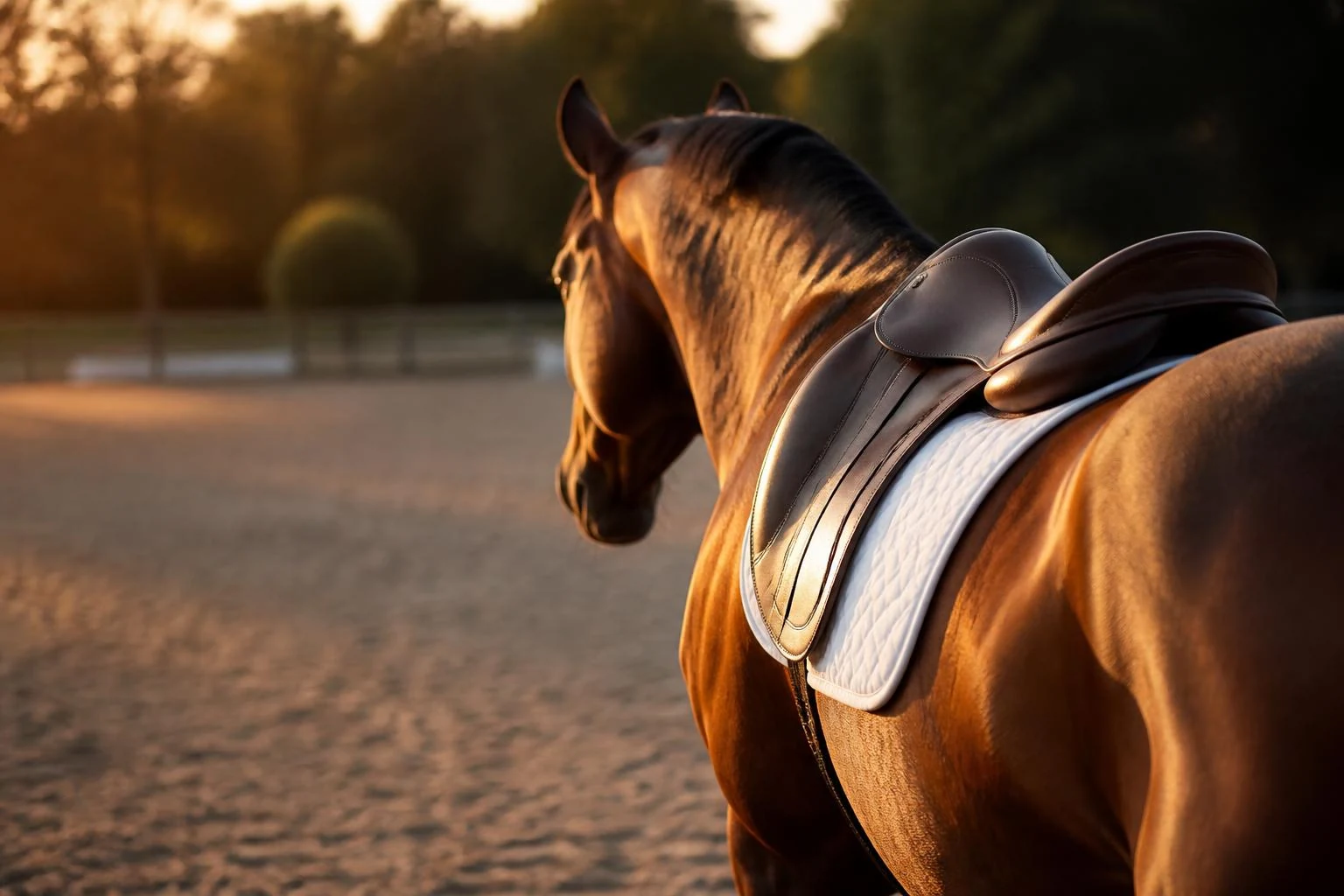

A horse that hollows his back the moment you place the saddle, that puffs out his belly at girthing, or pins his ears at the sight of the saddle pad is not trying to be difficult. In most cases, the saddle is pressing somewhere it should not. A poorly fitted saddle crushes the muscles along the spine, restricts circulation under the panels and leaves visible marks: white hairs, dry patches in the sweat line, muscular hollows behind the withers. These signs appear long before lameness develops. The question is whether we are looking for them.
The saddle is the only object your horse carries for hours, positioned over an area he cannot control. It rests on two long muscles that run either side of the spine and work with every stride. When fitted correctly, he forgets it is there. When it pinches, slips or rocks, he adapts: he contracts, shortens his stride, changes his way of going. And that new way of moving eventually reshapes his musculature.
What a Saddle Does to the Back, Specifically
The rider’s weight must never rest on the vertebral column. It distributes across the back muscles, on either side, through the panels. Between them, the channel leaves a free corridor for the spinous processes of the spine. In front, the arch must follow the withers without pinching or sitting on top of them. Behind, the saddle must stop before the lumbar zone, which is not designed to carry weight.
The moment one of these pressure points is wrong, force concentrates on a few square inches instead of spreading across the surface. The compressed muscle receives less blood, fatigues faster, then wastes away. On a horse ridden several times a week, this process develops over a few months without ever causing a dramatic injury. This is what makes it hard to spot: nothing bleeds, nothing goes lame, the horse simply becomes less pleasant to ride.
The Signs the Body Leaves Behind
The back tells the story of the saddle. Make it a habit to look at it bare, both sides, just after unsaddling, and run your hand flat across it.
- White hairs. Patches of discoloured hair at the withers or along the panels mark prolonged pressure that has destroyed pigmentation. It is a late sign, often permanent.
- Dry patches in the sweat line. After work that produces sweat, the saddle mark should be even. A dry patch in the middle of an otherwise wet back indicates a point where compression has blocked perspiration.
- Rubbed or broken hairs. They reveal friction, meaning the saddle is moving with each stride instead of following his motion.
- Swelling, scabs and lumps. Under the panels or at the top of the withers, these require a veterinary opinion before returning to work.
- Muscle hollows. A depression behind the withers, or noticeably différent muscle depth from right to left, shows muscling that is breaking down under asymmetrical pressure.
- Response to palpation. A horse that hollows, tenses or turns when you run your hand along his spine is telling you where it hurts.
The Signs We Mistake for Bad Temperament
Many behaviours labelled as difficult character are actually responses to discomfort. The typical pattern starts in the stable and continues under saddle.
When you saddle up, he steps away, turns his head, nips, puffs his belly or hollows his back. At mounting, he moves forward before you are settled, or freezes. Under saddle, he refuses to stretch through his back, holds his neck high, puts his tongue out, leans to one side. canter becomes difficult in one direction, downward transitions are accompanied by tension. Over jumps, he jumps flat, catches behind, or refuses without apparent reason.
Another clue is visible from the ground: a saddle that always slides to the same side, or that slips back as the session progresses. A well-fitted saddle stays put at all three gaits. If it moves, either the shape does not match the back, or the back is already asymmetrical, or both.
None of these signs alone proves the saddle is at fault. Teeth problems, foot issues, digestive pain, a back pathology or an unbalanced rider’s seat can produce similar signs. The saddle deserves to be checked first, though, because it is the easiest and least costly explanation to rule out.
Why a Saddle That Fitted Last Year Might Not Fit Now
A back is not a fixed measurement. It changes with fitness, body condition, age, recovery from injury, a mare after foaling, a young horse completing his growth. A horse returned to work after three months at pasture does not have the same withers or shoulders he had the previous autumn. The saddle, meanwhile, has not moved.
Equipment also evolves. Padding compresses, often unevenly, on the side where the rider sits most heavily. A tree can twist after a fall or a saddle dropped from a rack. The result: an ensemble that fitted well becomes unsuitable without anything being deliberately changed. An annual check, more frequent on a developing horse, is the schedule recommended by saddle technicians. It also follows the logic of fitting the saddle to the horse’s back: you adjust an object to a body that is changing, not the other way around.
A Saddle Pad Cannot Fix a Saddle That Does Not Fit
The usual reflex is to slip a cushion under a saddle that causes problems. On a saddle already too narrow, this is like putting a thick sock inside a shoe that is too small: the pressure increases. A cushion makes sense on a saddle that is slightly too wide, as a temporary measure, or to absorb vibration on a well-equipped horse. It corrects neither a twisted tree nor an imbalance.
The pad itself deserves checking. If it is not pulled up properly in the channel, it pinches the withers from the first stride and creates pressure where there should be space. The choice of material and cut matters, as our guide to saddle pads explains, but no accessory will compensate for a poorly adjusted saddle.
Six référence points let you form a judgement, at a standstill and in motion, with the saddle on without a thick pad:
- Channel clearance: the central corridor remains open along its entire length, with the rider mounted, making no contact with the spine.
- Arch width: it follows the angle of the withers and shoulder, without pinching or resting on the point.
- Seat balance: the deepest point sits in the centre, not tipped forward or back.
- Panel contact: even pressure across their entire surface, with no bridging and no hard spots.
- Length: the saddle stops before the lumbar zone, behind the last rib.
- Stability in motion: at all three gaits, the saddle does not slide sideways or slip backward.
Who to Call, and in What Order
If you see heat, a wound, marked pain response or lameness, the vet comes first. Only a vet can rule out back injury, a locomotion problem or pain from another source that manifests as resistance at saddling.
For fitting adjustments, the professional to call is a saddle technician, often known as a saddle fitter. They measure the back, check the tree, rework the padding, then verify the result under saddle. Assessing fit without a rider on board has limited value: a saddle must be judged in motion, with the rider’s weight. If your current saddle has reached its limits, the first step remains to have your saddle fitted to your horse’s shape before considering a différent model, then compare sizes using our guide to choosing a saddle.
An équine osteopath comes next, to release the muscle compensations that have developed. Calling them in without correcting the saddle is like emptying a bath without shutting off the tap: tension returns within a few sessions. The farrier and équine dentist complète the picture, because imbalance in the feet or mouth reverberates along the back.
Key PointsThe back speaks before the horse: white hairs, dry patch in the sweat line, hollow behind the withers, saddle that always slides to one side. These signs come before obvious pain and lameness. Look at the bare back after every unsaddling, have the fit checked at least once a year and whenever his muscling changes, and address the cause, not the symptom.
ImportantHeat, an open wound, acute pain response or lameness mean stopping work immediately and calling your vet. No saddle adjustment replaces a proper diagnosis.
This article is for information only and does not replace the advice of an équine vet, saddle technician or équine osteopath. Sources consulted: IFCE (welfare and equipment of the riding horse), équine veterinary publications on back pressure injuries, saddle fitting practitioners.