
In fifty years, the Percheron descended from France’s most exported working horse to a breed under surveillance. The tractor did the heavy lifting, but it wasn’t the machine that nearly wiped the breed out, nor its decline that rescued it. What kept the colossus alive comes down to three things few people associate with Perche: foreign buyers, stubborn breeders, and uses nobody saw coming.
A giant born in one bocage, not in “Normandy”
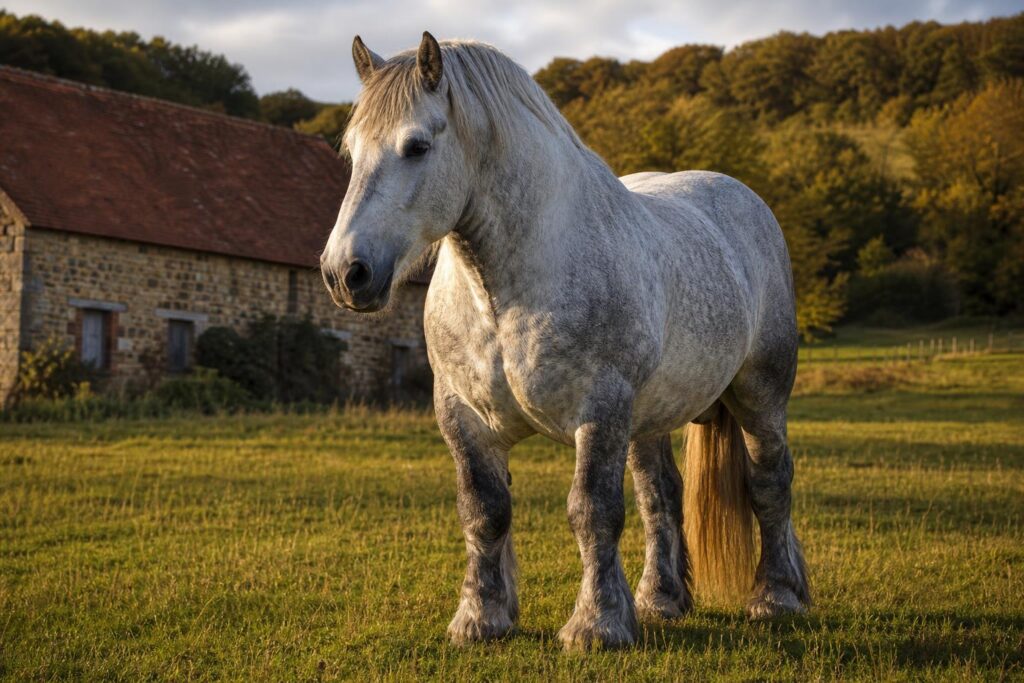
The Percheron did not come from all of Normandy, contrary to what we often read. It came from Perche, a land of hedgerow and hill country straddling Orne, Eure-et-Loir, Sarthe and Loir-et-Cher. A région, not an entire province. This distinction is not a scholar’s pedantry: it was this small territory, its pastures and its breeders that forged the model, generation after generation.
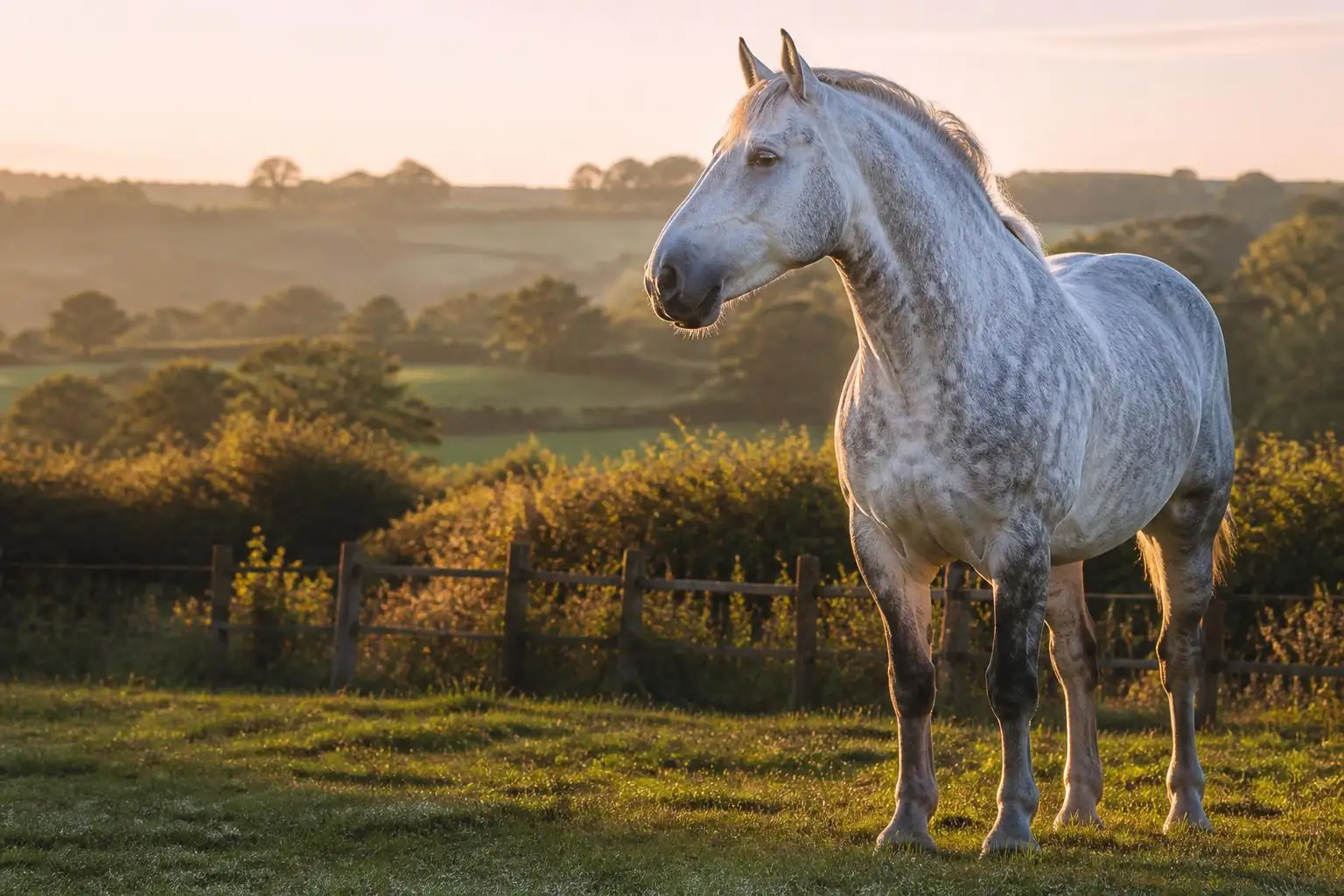
The result is an atypical heavy horse. Where other draught breeds were pushed towards pure mass, Perche selected a giant that moves: a horse standing 16 to 17 hands (1.60 to 1.70 metres) at the shoulder, weighing 1,540 to 2,425 pounds (700 to 1,100 kilograms) depending on bloodlines, capable of trotting long distances under harness. That action made its fortune, and explains why it is still found today in harness work rather than retired to pasture.
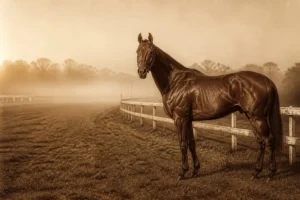
Only two colours are admitted in the French stud book: grey and black. Greys are often born dark and lighten with age, until the nearly white grey of older horses. A chestnut or bay Percheron does not exist in the French register.
It is often said that the Percheron descends from Oriental horses abandoned after the Battle of Poitiers in 732. This is terroir storytelling, not established fact. There is no serious documentary evidence of this lineage. What is documented, however, is the infusion of Arab blood in the nineteenth century, via the studs, to refine the model and give it the long trot that still distinguishes it today.
The golden age: when Perche exported its giants by the boatload
The Société hippique percheronne de France was founded in 1883 at Nogent-le-Rotrou and established the stud book. The timing was perfect: industrialising Europe and North America ran on horses. There was need for pulling omnibuses through Paris, brewery drays, ploughs across vast grain plains.
The Percheron became an export commodity. The United States imported them massively in the late nineteenth and early twentieth centuries, to the point that the American registry for the breed became one of the most extensive in the country. Perche was selling breeding stock, expertise and a brand. For a bocage country, that was an entire economy.
The fall: fifty years was enough to undo a century of selective breeding
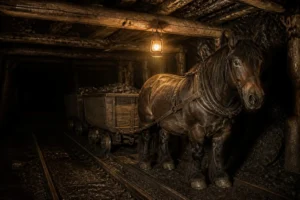
Then mechanisation arrived, and it was brutal. In a single generation, the tractor replaced harness work on farms. The draught horse lost its economic reason for being. It did not disappear immediately: it changed purpose. People continued to breed them, but for the meat trade.
This is where the true risk emerged, and it is counterintuitive: this market maintained population numbers, but it also transformed sélection. Breeders no longer sought a horse that trotted under harness; they sought one that put on weight quickly. The model drifted. When meat consumption declined in turn, the breed was left with collapsed numbers and a loss of type among part of its original bloodline. Losing a breed is not simply losing foals born: it is losing the traits you stopped selecting for.
What actually saved it (and it wasn’t the tractor’s retreat)
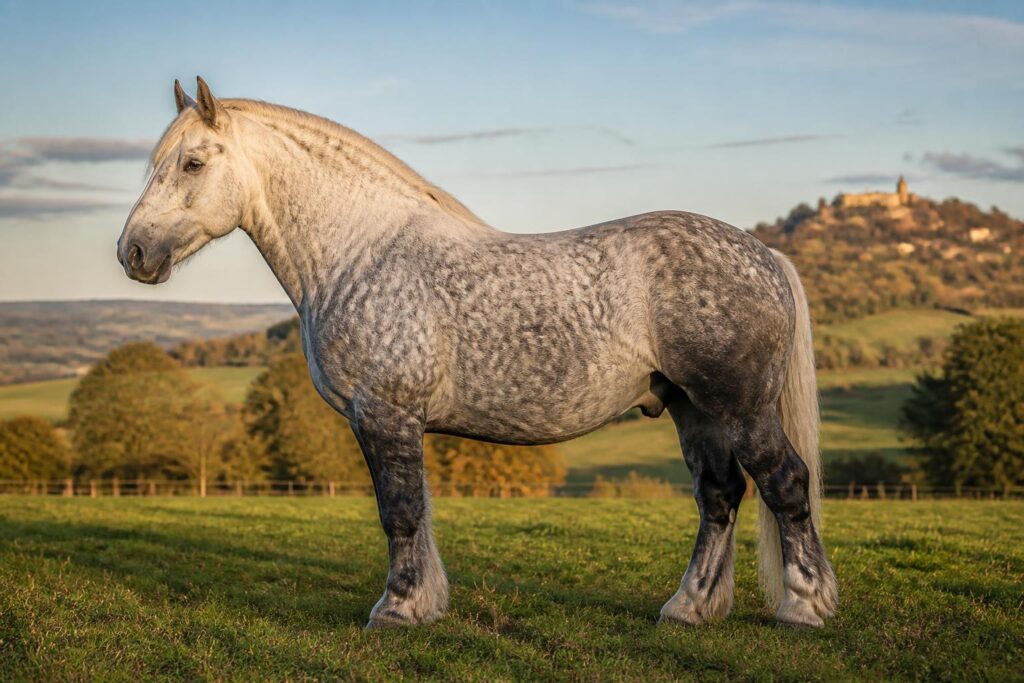
Three forces held the Percheron upright, and none were agricultural.
1. Foreign buyers
While France sidelined its draught stock, North American breed associations continued to compete and work the Percheron, notably in harness showing and among agricultural communities that remained harnessed. The gene pool and type standards survived in part outside our borders.
2. Breeders who refused to follow
A minority of Percheron breeders continued to select for action, conformation and temperament, outside the meat trade logic. They are who make possible today a Percheron suitable for harness capable of real work.
3. Uses nobody expected
Skidding timber in forest on fragile soils, work in prestigious vineyards, urban haulage (waste collection, street watering, school transport in certain villages), market gardening, leisure driving. These markets are small, but they demand exactly what the meat trade had stopped valuing: a horse that moves, that listens, and that lasts a working day. This is the broader movement we detailed in our investigation into the quiet return of draught horses to towns and vineyards.
- Colour: grey or black, nothing else in the French stud book.
- The trot: this is the breed’s signature. A Percheron that does not drive from behind and trails at the trot is not to type, regardless of its weight.
- Conformation and feet: a poorly made giant does not work long. The foot must be wide, sound, proportionate to the mass.
- Head and eye: dry head, broad forehead, calm eye. Temperament is a sélection criterion, not a bonus.
- Papers: registration and pedigree in SIRE. Without traceability, you are buying a grey horse, not a Percheron.
The Percheron today: how many, and what for

The breed has not disappeared, but it survives on numbers bearing no comparison to its heyday: a few hundred foals are born each year in France, figures tracked by SIRE and IFCE. That is enough to prevent extinction, too little to rest easy. The real fragility is not raw numbers, but genetic diversity and the number of active breeders, who are ageing.
Its real uses today: leisure and competitive driving, timber skidding, viticulture and market gardening work, local authority services, tourism, and an increasingly acknowledged role as a heavy saddle horse for adult riders seeking calm temperament. If draught horses interest you beyond this breed alone, our guide to the draught horse details French breeds and their differences, and our piece on uses of the draught horse shows what these horses actually do in 2026.
For the standard, origins and aptitudes in full, our complète Percheron profile covers the breed point by point. And if it’s the size that fascinates you, see why the world’s largest horses are nearly all draught horses.
- The Percheron comes from Perche (Orne, Eure-et-Loir, Sarthe, Loir-et-Cher), not from Normandy as a whole.
- Its signature is not size, it is the trot: a giant that moves.
- Mechanisation did not kill it; it redirected it towards the meat trade, which diluted the type as much as it reduced numbers.
- It owes its survival to foreign buyers, minority breeders and new uses (forest, vineyards, town).
- A few hundred foals born yearly in France: the breed survives, but its margin is thin.
Sources: stud book of the Société hippique percheronne de France, birth data from SIRE, breed références from IFCE and the Haras nationaux.