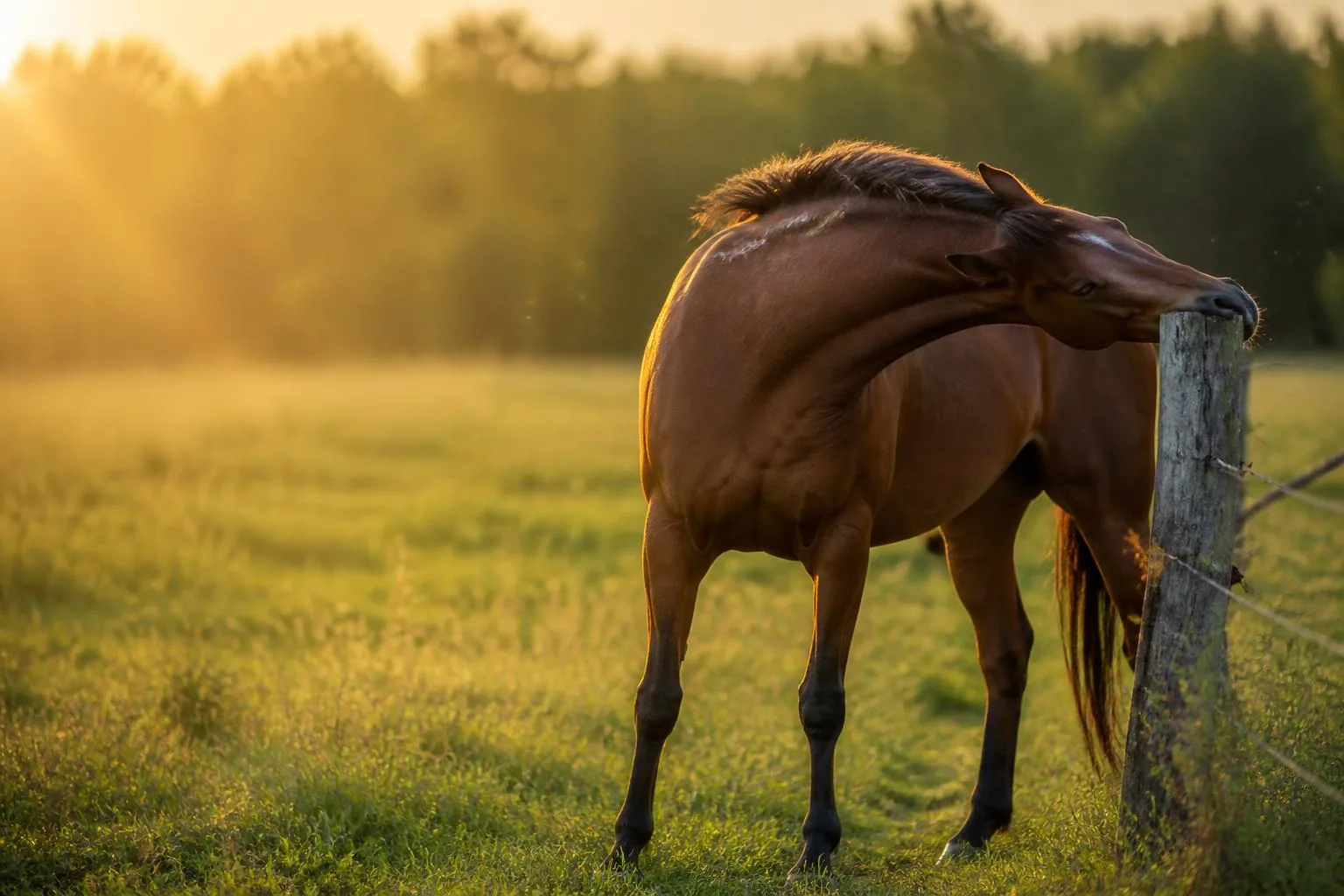

Every summer, the same story unfolds. As the evenings warm, your horse spends hours rubbing its mane raw against fence posts, wearing away the tail base to bleeding skin, shaking its head relentlessly. The skin peels, bleeds, loses hair. It is neither a vice nor mere irritation: it is almost certainly summer itch, an allergy that returns each year and worsens without proper management. Here is how to recognise it, what sets it apart from other causes of itching, and what you can realistically do about it. For more detail, our complète guide to summer itch walks through every step of management.
Summer itch: an allergy to midge saliva
Recurrent équine dermatitis (DERE) is not a classical skin disease: it is a hypersensitivity reaction. The culprit? Tiny biting midges of the genus Culicoides, often called midges or no-see-ums. When they bite, they inject saliva whose proteins trigger, in predisposed horses, a disproportionate allergic response. It is not the bite itself that causes suffering, but the animal’s excessive immune response. To understand why these insects are so troublesome, we have devoted a full article to the role of Culicoides.
These midges have their own rhythm: they fly mainly at dawn and dusk, in warm, humid weather, and detest wind. That is why flare-ups explode in fine weather, particularly between May and September, with a marked peak in July. According to the IFCE and RESPE, summer itch affects a notable proportion of the French horse population, and its frequency increases with warming temperatures.
Mane, withers, tail base: the telltale zones
Summer itch has a very recognisable signature. Itching concentrates on the upper body, where midges bite first: the forelock, mane, withers, topline and especially the tail base. The horse scratches with sometimes spectacular intensity, against fencing, trees, walls. The result: broken or pulled hair, brush-like mane, thin tail, thickened skin, crusting, weeping, sometimes secondarily infected from constant rubbing.
The seasonal pattern is a major clue. True summer itch appears in spring, peaks in summer, then subsides with the first frosts when midges disappear. It returns the following year, often earlier and more sévère, because hypersensitivity tends to establish itself over time. A horse mildly affected at three years old can become severely afflicted at seven or eight if nothing is done.
Not all itching is summer itch. Here is how to distinguish them before drawing conclusions:
- Summer itch: seasonal (summer), upper body zones (mane, withers, tail base), frenzied scratching, disappears in winter, returns every year.
- Lice: mainly winter and early spring, parasites or nits visible to the naked eye in the coat, diffuse itching.
- Mud fever: localised to lower limbs and pasterns, linked to dampness, with crusting and weeping; covered in detail in our article on mud fever.
- Ringworm: well-defined circular lesions, coin-shaped hair loss, contagious and transmissible to humans; see our guide to ringworm.
- Simple itching: transient, without extensive lesions or marked seasonal character.
Some breeds pay a heavier price
Summer itch affects all horses, but not equally. There is a clear genetic predisposition, particularly well documented in imported northern breeds. Icelandic horses born in their country of origin, where Culicoides are virtually absent, develop massive reactions once imported to mainland Europe: their immune system has never learned to tolerate these bites. Friesians, Nordic breeds and certain ponies are also more affected than average.
This hereditary dimension also explains why breeding sélection matters: an affected sire transmits a sensitive constitution. This does not condemn the animal, but demands rigorous, sustained management year after year, rather than crisis treatment.
Managing summer itch: protect first, soothe second
There is no permanent cure: summer itch is managed, not eliminated. The winning strategy is straightforward: minimise contact with midges as much as possible, then relieve the skin. The first measure, and most effective, is practical. Stabling your horse during midge flight hours, from dusk to dawn, in a ventilated box or beneath a fan that deters these fragile insects, often changes everything.
Fine-mesh anti-itch rugs create a physical barrier from neck to tail: it is an investment, but one of the most reliable protections over time. Complement this with horse-appropriate repellents applied regularly, gentle skin hygiene, and sometimes omega-3 supplementation in the feed to support the skin barrier. Avoiding damp areas and standing water, where midges breed, is also part of the strategy. For deeper insight into skin care, consult our guide on équine skin care.
- Stable or protect your horse at dawn and dusk when midges are active.
- Invest in a fine-mesh anti-itch rug covering mane, back and tail.
- Combine repellents, gentle skin care and omega-3 supplementation to strengthen the skin.
- Plan ahead from spring: summer itch is prevented, not remedied once established.
Why neglect makes it worse
A neglected case of summer itch does not plateau, it deteriorates. Each summer, damaged skin heals poorly, thickens, becomes more susceptible to secondary infection. Scratching becomes a self-perpetuating reflex that keeps wounds open, and hypersensitivity intensifies from season to season. A horse managed early and well can enjoy comfortable summers; one left to its itching develops chronic lesions that are hard to reverse. Consistency and anticipation trump any emergency treatment.
Summer itch must be diagnosed by a veterinary surgeon: its symptoms resemble other skin conditions, and only a professional can confirm the allergy and rule out lice, mud fever, ringworm or secondary infection. Never self-treat your horse. Corticosteroids, antihistamines and targeted treatments are dispensed on prescription and carry side effects. The management measures described here support veterinary supervision, they do not replace it.
The essentials
Summer itch is an allergy to Culicoides midge saliva, returning each summer and worsening over the years without proper management. It is recognised by its preferred zones, mane, withers and tail base, and its seasonal nature. Certain breeds, such as Icelandic and Friesian horses, are particularly susceptible. The key is one word: anticipation. Protect your horse from bites before skin damage occurs, rather than fighting fires after they start. To build a complète management plan, season after season, turn to our complète guide to summer itch and, if in doubt, speak to your vet.