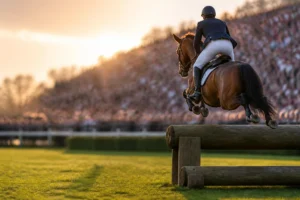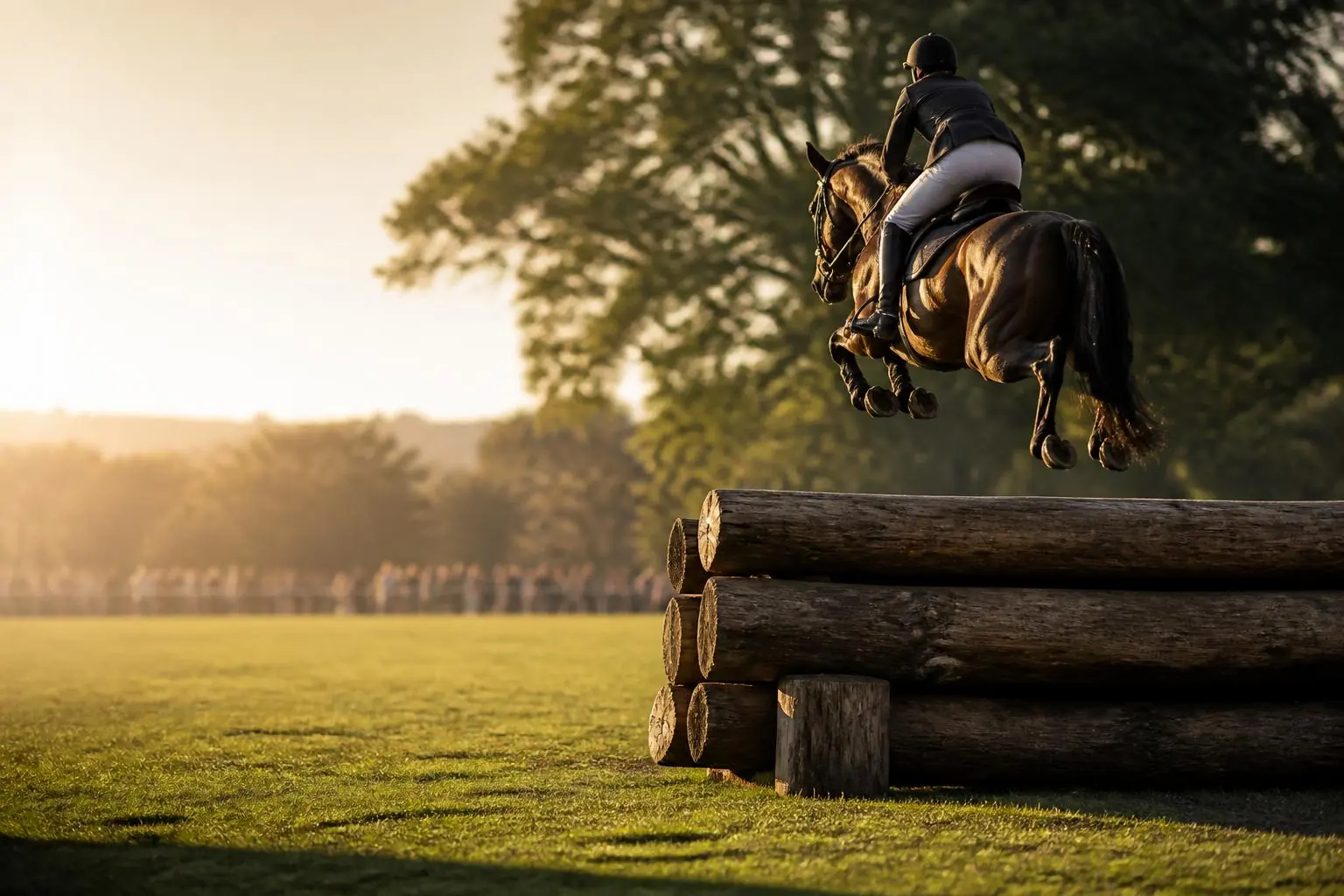

On Saturday, 15 August, the Aachen World Championships shift into their severest day: the cross country phase of the three-day event. Stacked timber that won’t budge an inch, timing measured to the second, and a single fall that ends the week. Here’s how to read this phase if you’ve never watched one before, and why riders have dreaded it for decades.
The International Equestrian Federation World Championships run from 11 to 23 August 2026 in Aachen, Germany. Six disciplines share the programme. The three-day event opens the competition from 13 to 16 August, with cross country scheduled for Saturday the 15th. In France, that’s a public holiday. Many people will stumble across it by accident, with no idea what they’re watching.
Three phases, one score, and cross country in the middle
The three-day event isn’t decided in a single session. It’s an equestrian triathlon spread over several days, with the same horse from start to finish.
- A dressage test, judged on precision and submission, converted into penalties.
- Cross country, across open terrain, over fixed obstacles against the clock.
- A show jumping round the next day, over poles that do fall.
Penalties accumulate. The lowest total wins. Dressage sets the order, show jumping separates the contenders, but it’s cross country that tears up the scoreboard. A pair lying second on Friday evening can vanish from the rankings by Saturday afternoon.
At Aachen, the cross country course is laid out in the Soers, the large park that hosts the city’s annual show jumping competition each year. The dressage phase runs on grass at an adjoining stadium. None of this happens in a neat, enclosed arena.
Why these obstacles never fall
Over a show jumping course, the pole rests in a cup. The horse hits it, the pole falls, the pair takes 4 points and continues. The pole has given way instead of the horse.
Over cross country, there are no cups. The obstacles are stacked logs, solid tables, compact hedges, steps cut into the terrain, jumps into water. They’re built to stay upright. If the horse touches one, the horse absorbs the impact.
This constructional detail changes the entire nature of the phase. In show jumping, a mistake costs points. On cross country, a mistake can cost a fall. Riders don’t speak in the same way before the two phases, and it’s not a matter of temperament.
Add fatigue to the mix. The course stretches over 3 miles (5 kilometres), across natural ground, with climbs, descents, shifting light under trees. The most technical obstacles often come when the horse has already given a lot. The rider must conserve the horse throughout, without losing pace against the clock.
The optimum time, an opponent no one sees
Cross country isn’t a speed race. It’s a race against a time set in advance by the organisers: the optimum time, calculated from the course length and a speed set by International Equestrian Federation rules.
For a world championship, the rules spell it out in black and white: between 3,500 and 3,600 yards (5,600 to 5,800 metres) of course, 38 to 42 jumping efforts, a speed of 1,875 feet per minute (570 metres per minute). This puts the optimum time at around ten minutes. Ten minutes of galloping over terrain that climbs, descends and turns.
The rule is brutally simple: each second beyond the optimum time costs 0.4 penalties. Ten seconds over, 4 points. Twenty-five seconds, 10 points. And finishing early earns nothing at all.
As a result, the rider aims for a window. Too slow and penalties are wasted that no clear round in show jumping will recover. Too fast and the horse is exhausted before the finish line, leaving the rider facing the final efforts on a horse that won’t respond. The best riders complete the course within a few seconds of the predicted time, without appearing to strain.
20, 40, 11: the penalty scale that decides everything
On cross country, the numbers that count aren’t on the clock.
- 20 penalties for a refusal or run-out at an obstacle. That’s as good as a ruined evening at this level.
- 40 penalties for a second refusal at the same obstacle.
- Elimination on a third refusal, and here you must read the rules carefully: these three refusals don’t count per obstacle, they add up across the entire course. A pair refused three times at three different jumps walks home.
- Elimination if the rider falls, and elimination if the horse falls. No restart, no argument, the day ends there.
- 11 penalties when a pair triggers a frangible device, those calibrated pins that release an obstacle pole under violent impact rather than toppling the horse.
That 11 deserves a moment’s thought. It doesn’t penalise ordinary riding mistakes. It signals that the obstacle’s safety system worked, and the horse passed dangerously close to disaster. The penalty exists so no one is tempted to push their luck.
- The line chosen. At each combination, there’s a direct, short, risky option and a longer alternative that costs seconds. The choice reads in real time.
- The number of strides. Between two elements in a combination, two pairs might take a different number of strides. That’s where time is won or lost.
- The quality of the canter in the final third. A horse that stays round and regular after eight minutes of effort tells a different story from one that lengthens and hollows.
- The attitude to water. Water slows, blinds and surprises. Refusals cluster there.
- Recovery at the finish. Breathing, sweating, walk in the minutes after. Teams watch this closely.
- The next morning. A horse that emerges fresh from the veterinary inspection validates, in hindsight, yesterday’s riding.
Today’s cross country isn’t yesterday’s
The discipline comes from the military. The three-day event tested the cavalry horse: obedience, endurance across terrain, ability to work the next day. For a long time, the format included road phases and a steeplechase before tackling cross country itself. That long format disappeared from the top level in the early 2000s. We kept the cross country alone, shorter, more technical, faster.
Safety has been rebuilt in successive waves. Approved helmet and protective vest mandatory, airbag vests permitted, medical armband with the rider’s details, frangible devices on risky obstacles, veterinary checks before and after. The list grows with every rule revision, often after an accident.
It’s not decoration. Cross country remains the phase where the margin for error is smallest of all Olympic equestrian disciplines, and the horse world knows it.
Sunday morning, the real judge
The day after cross country, horses return before a veterinary panel before they’re allowed to jump. They trot up on a hard surface, the judges watch for regularity, anything off is set aside. A horse held back by the vets doesn’t jump, and the pair is out of the competition.
This inspection tells the whole story of Saturday. A rider who pushed the horse beyond reason to scrape together four extra seconds can pay for it here, in front of everyone, without committing any obvious fault on the course. It’s the most silent sanction in the three-day event, and probably the most feared.
What’s really at stake behind the medals
Aachen isn’t an ordinary fixture this year. These Championships open the path to the 2028 Olympic Games, with team places being distributed now. We’ve covered elsewhere what awaits France at Aachen and the qualification route.
Each nation enters a team, and the team standings rest on its pairs’ results. An elimination on Saturday costs more than an individual place in the rankings. It weighs on an entire Olympic project built over years. That’s why faces are closed in the starting box, and why no one boasts before the finish.
And if you ride yourself
The championship cross country course is a summit, not a template to copy. But the spirit filters down to riding clubs. The three-day event is practised at all levels, over courses of a few hundred yards, with low obstacles and simple lines. It’s often the first time a rider discovers what it means to gallop in balance over uneven ground.
Two reflexes before you start. First: headgear. An equestrian helmet that fits properly, meets standards and is replaced after any impact, is non-negotiable outdoors. Second: supervised progression. A galop managed within the rules beats bravado on terrain you don’t know. To compare what different disciplines demand, our discipline overview gives the benchmarks.
- The cross country phase of the three-day event runs on Saturday, 15 August at Aachen, within Championships that span 11 to 23 August.
- The obstacles are fixed. They don’t fall, so a mistake isn’t penalised in points but in risk.
- Each second beyond the optimum time costs 0.4 penalties. Going faster earns nothing.
- A refusal costs 20 penalties, a fall means elimination, a triggered frangible device costs 11 penalties.
- The veterinary inspection the next morning punishes excesses from the day before, even without obvious fault.
Sources: International Equestrian Federation three-day event rules (optimum time, penalty scale, frangible devices, veterinary inspections), official programme for the 2026 Aachen World Championships, communications from the French Equestrian Federation. Equirider is not affiliated with the FEI or the FFE. Starting times and running order may be modified by organisers at the last moment.