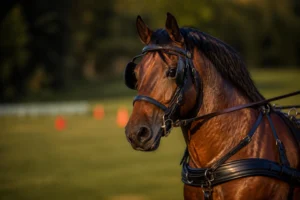

On Friday, 11 September, at Barroca d’Alva, some 20 miles (32 km) east of Lisbon, 112 combinations from 27 nations are entered in a single 75-mile (120 km) endurance ride. On paper, these competitors have almost nothing in common: a 16-year-old Portuguese rider, an Italian who was already competing in championships in 2003, a 24-strong Spanish team, an Emirati delegation of 15. Except for one thing. Every horse at the start is exactly eight years old. Not seven, not nine. Eight.
This is no generational coincidence. It is written into Article 827.2 of the International Equestrian Federation’s endurance regulations, with a precision rarely found in a rulebook: eight years is a required age, not a minimum age. Here is why the door closes on both sides, what a horse must have accomplished before it has the right to compete, and what this arithmetic means to an owner who will never ride 75 miles.
What is at stake at Barroca d’Alva on Friday
This estate, which the international federation places in the Ribatejo region, lies in the municipality of Alcochete on the south bank of the Tagus, opposite Lisbon. It has been on the international endurance calendar since 2004 and has already hosted more than twenty international competitions. Its sandy tracks run between cork oak pastures, and it is this sand that creates the difficulty: it does not break underfoot, but it wears.
The championship runs over 75 miles (120 km) in a single day, divided into loops separated by mandatory veterinary inspections. The total prize fund is 20,000 euros, which, divided among 112 entries from 27 countries, makes clear that nobody comes for the money. Last year, the same title was decided on 2 August 2025 at Jullianges, in Haute-Loire, before 82 horses. It was won by Saif Ahmed Mohammed Ali Almazrouei, for the United Arab Emirates, on Bullio Quasillo, at an average of 13.4 miles (21.6 km) per hour. The second finisher crossed the line 45 seconds later.
In video, 75 seconds
What the video shows
Every horse is exactly eight years old: Article 827.2 of the International Equestrian Federation’s endurance regulations specifies that this is a required age, not a minimum age. What the horse must have accomplished before it has the right to compete, and what this arithmetic means to an owner.

Eight years, not seven or nine: a line that cannot be negotiated
The endurance regulations in force since 1 January 2026 set a minimum age by competition level: five years for novice races, six years for a one-star CEI, seven years for a two-star, eight years for a three-star. For a championship, the regulations add one year compared with a CEI at the same level.
The young horse championship escapes this logic through a separate clause. Article 827.2 states that horses must be eight years old to participate, and specifies in parentheses that eight years is a required age, not a minimum age. The regulations therefore protect not only horses that are too young for a demanding competition: they also prevent a nine or ten-year-old horse, more mature and stronger, from coming to dominate a generation just starting at this level.
There remains a subtlety that surprises owners: this age is not counted from the real birth date. The same text considers that a horse has its birthday on 1 January of its birth year. A foal born in November 2018 and another born in March 2018 therefore have exactly the same regulatory age on Friday, even though eight months separate them.
Look at the names of the starters, they almost all begin with the same letter
There is a detail that only a seasoned eye notices when reading the entry list. Iziboy d’Adeline, Istorya Trois Mas, Iraad de Bouzouls, Izaak du Théron, Isaak des Dolines, Izhia du Théven, Ilico Cabirat, Ismael d’Oc, Izya de Galonne. One letter keeps appearing. This is not a breeder’s fashion: in France, the first letter of a horse’s name designates the birth year, and I corresponds to the generation born in 2018, which turns eight years old in 2026. The system rotates every year, and foals born this season are called by Q, as our horse name generator for the 2026 cohort reminds us.
The pattern is even clearer if you go back one year. At Jullianges in 2025, the same championship fielded Haqtar du Carrelie, Heracles Feuillée, Hacour la Majorie, Hashtag du Mas, Himazziz Milin Riant. 2017 generation, letter H. This is probably the only competition in the world where you can guess the year from reading the entry list. With one caveat: this rule belongs to the French registry, and Spanish, Portuguese or Emirati stud books have their own conventions, and several entries for Friday carry names that do not begin with an I.

Six years of stepping stones before having the right to start
Age opens no doors on its own: to be at the line on Friday, a horse must have climbed a regulatory staircase begun three years earlier, without being able to skip a single step. Everything begins with novice qualifications, managed by the national federation: two races of 25 to 49 miles (40 to 79 km), then two races of 50 to 62 miles (80 to 100 km) capped at 10 mph (16 km/h), all four completed within a three-year window. Then comes the one-star CEI, accessible at age six, but not before one full year after the first novice race, and itself also run at a maximum of 10 mph (16 km/h) so long as the horse is six years old. Two one-star CEIs open the two-star level, at age seven. Two two-star CEIs, plus one competition ridden with the same rider, open the three-star level, at age eight. Translated into distance, that is several hundred kilometres of validated competition, each one subject to a veterinary inspection, before even speaking of a championship.
What determines eligibility at the start, before the first stride
- Regulatory age, calculated on 1 January: exactly eight years, neither seven nor nine, regardless of actual birth date within the year.
- Four validated novice races: two of 25 to 49 miles (40 to 79 km), two of 50 to 62 miles (80 to 100 km) capped at 10 mph (16 km/h), within a three-year window.
- The unavoidable time requirement: a minimum of one year between the first novice race and the first international competition. A gifted horse cannot move faster than the calendar.
- Qualification of the combination: at three-star level, horse and rider must also have finished a competition together, not just each on their own.
- Pre-competition veterinary inspection: on site, a horse that qualifies on paper can still be stopped at the initial inspection. The paperwork never replaces the examination.
Going fast exacts a price in rest days
This is the part of the regulations that the general public ignores, and perhaps the most interesting. After competing, an endurance horse does not return to racing when its connections decide: the federation imposes a mandatory period out of competition that lengthens with distance, 5 days up to 33 miles (54 km), 12 days from 33 to 66 miles (54 to 106 km), 19 days from 66 to 78 miles (106 to 126 km), 26 days from 78 to 91 miles (126 to 146 km), and 33 days beyond.
The 75 miles (120 km) on Friday will therefore mean, for each horse that finishes, at least 19 days without being able to race anywhere, neither international nor national. And the regulation goes further: a horse that exceeds 12.4 mph (20 km/h) average over the completed loops receives a 7-day penalty. The 2025 winner’s average was 13.4 mph (21.6 km/h). At that pace, victory costs nearly a month off. Speed is not forbidden, it is priced, and the price is paid in rest days.
The judge is not the stopwatch, it is the stethoscope
On the course, the real filter remains the end-of-loop veterinary inspection, the vet gate. The 2026 rule is precise to the beat: the horse must be presented with a heart rate of 64 beats per minute or less, within 15 minutes of the loop finish line, and within 20 minutes of the final finishing line. If the heart does not come down, the combination is entitled to a second presentation, provided it remains within the allotted time. There is no third attempt. At the final inspection, only one presentation is allowed, with no second chance. This is followed by the trotting examination, locomotion assessment, hydration, metabolic state, then a mandatory rest period, which on a championship includes at least a 50-minute break.
It is this recovery mechanism that explains the overwhelming dominance of a single breed in the discipline, and we have explained elsewhere why the Arabian horse leaves other breeds far behind in endurance. For the complete run of an endurance ride, from loops to crew stations, our page on equestrian endurance covers the discipline from the beginning.
The only locked-in age is the horse’s
One final contrast makes this championship singular. For horses, age is fixed to the year. For riders, it is not at all: the regulations allow competition in endurance from 1 January of the year a rider turns 14, with no upper limit. On Friday, a 16-year-old Portuguese rider, already a gold medallist in the team event at the 2026 European Young Riders Championship, will start in the same field as an Italian whose first championship dates to 2003, and a French woman competing in her fifteenth. This is called a young horse championship, and it is accurate to the word: the youth in question is the horse’s youth, never the rider’s.
What this regulation says to a horse that will never ride 75 miles
One could read all of this as elite-level folklore. That would miss the essential point, because the logic that governs these 112 horses is the one that should govern any return to work. It rests on three ideas: effort is built through validated levels and never by a single leap, speed has a recovery cost measured in days, and the only proof that a horse can handle what is asked of it is not its pace but how fast its heart rate comes down.
An amateur rider does not have a veterinarian at the end of the road, but he has a watch and a hand: counting beats two minutes after stopping, regularly, on the same track, turns an impression into data. Autumn return to work is when this caution matters most, and when blood-related episodes at return to work surface. The other side of the question, working a young horse before maturity, plays out mostly over jumps, and we have addressed it in discussing four-year-olds in the Fontainebleau showjumping final, where the regulations simply eliminate the stopwatch altogether. Where diet is concerned, a horse working at distance does not eat like a club horse: our benchmarks on endurance horse nutrition and our method for calculating a ration give the figures.
What links all of this is the written record. A championship horse exists in regulation because each of its races, each inspection and each rest period is recorded somewhere. An amateur horse has no such file, and that is what is missing when an underperformance occurs.
Kilometres covered, heart rate after effort, rest days, vaccinations and check-ups: what the federation requires of championship horses fits in a notebook. Yours can have one too.
What is established, what is not
- Established: Friday, 11 September 2026, Barroca d’Alva in Portugal, 75 miles (120 km) in one day, 112 combinations from 27 nations, 20,000 euros in prize money. Figures published by the International Equestrian Federation on 9 September 2026.
- Established: the rule of exactly eight years, birthday on 1 January, the qualification staircase, 64 beats per minute and out-of-competition periods all appear in the endurance regulations in force since 1 January 2026.
- Not established: the number of horses that will finish. Endurance sees many withdrawals, but no completion rate is published in advance and we will therefore not put forward any percentage.
- Not established: the federation’s reasoning. The text sets a required age, it does not explain why it also closes the door to older horses. The fairness argument is a reading of the regulations, not an official statement.
- Not established: the 2026 start time. At Jullianges in 2025, it was 7 a.m. Nothing suggests it will be the same on Friday.
Sources
International Equestrian Federation, press release of 9 September 2026 on the Young Horse World Endurance Championship at Barroca d’Alva, for the date, location, 112 combinations from 27 nations, distance, prize fund and delegations. Endurance Regulations of the same federation, in force on 1 January 2026: Articles 802.4.2 on championship format, 816.6 and 816.8 on cardiac inspections and rest periods, 826.1 on rider age, 827.1 to 827.4 on horse age, 832 and 833 on qualifications, 838 on average calculation, 839 on out-of-competition periods. Official report of the championship on 2 August 2025 at Jullianges, for 82 starters, the winner, averages and start time. French nomenclature of equine names by birth year, SIRE annual letter system, cross-checked against 2025 and 2026 championship entry lists. This article describes a sports regulation and does not replace the advice of a veterinarian.