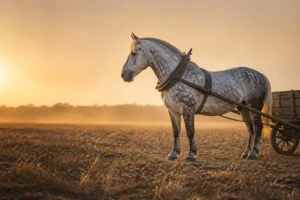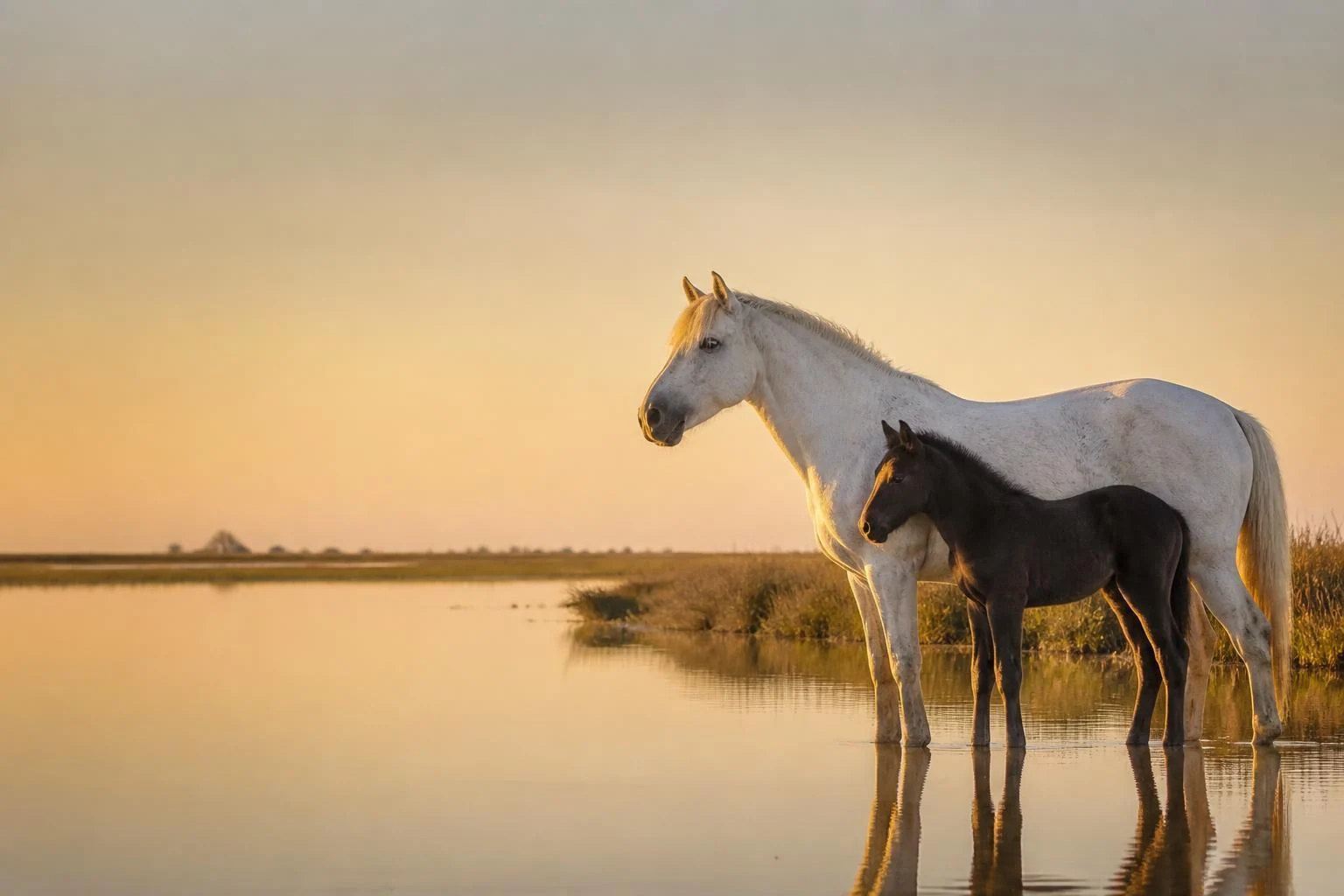

On posters and postcards, they are white, galloping through water, and this image has become shorthand for an entire region. Yet no Camargue foal enters the world this way. They are born dark, often nearly black, and gradually lighten over years. It is neither wear nor a trick of light: it is a gene, identified in 2008, whose mechanism we have only recently come to understand fully. And it carries a price that breeders know well.
No Camargue Foal Is Born White
A newborn Camargue foal in the marshes is dark. Depending on the bloodline, it will be dark bay, brown, nearly black. Nothing at that moment hints at the pale animal it will become. The change usually begins within the first few months, around the eyes and muzzle, then spreads in patches across the neck and body.
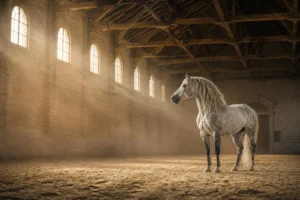
The process unfolds over several years. Breed standards typically place the transition to light grey between five and seven years old, with considerable variation between individuals. In between, the horse passes through the stage everyone knows as dappled grey, with pale rings edged by darker hairs, then a light grey where only scattered dark hairs remain in the coat. In other words, the postcard image shows only the end of the story.
What Really Happens Beneath the Coat
The horse does not lose its colour; it loses the ability to produce it. Each hair grows from a follicle fed by pigment-producing cells. In a grey horse, these cells become exhausted follicle by follicle. Hair that regrows at the next shedding emerges without pigment, therefore white. Because this process does not affect all follicles simultaneously, the coat becomes depigmented in zones, creating the dappled effect.
The detail that settles nearly every debate is elsewhere: the skin remains black. Look at the muzzle, the eye area, the underside of the tail on an adult Camargue: dark skin, dark eye. This is the signature of grey, and what distinguishes it from a true white horse, whose skin is pink and depigmented from birth. True whites do exist, they are exceedingly rare, and they result from an entirely different mechanism, as explained in our guide to horse coat colours.
A Gene Found in 2008, a Breakthrough in 2024
In 2008, a team at Uppsala University in Sweden identified the culprit: a duplication of approximately 4,600 base pairs within an intron of the STX17 gene, which codes for syntaxin 17. This anomaly is dominant. A single copy is enough for a horse to grey, and a grey horse must have at least one grey parent. Grey never skips a generation, making it one of the few coat traits a breeder can predict without testing.
The breakthrough came on 29 August 2024. In Nature Communications, the same Swedish institution, partnering with American veterinary genetics laboratories, demonstrated that the duplication does not exist in just one form. The number of copies matters. The researchers describe three alleles: G1, one copy, the original version, the horse does not grey; G2, two copies, slow greying; G3, three copies, rapid greying. The difference in outcome is striking. Horses with slow greying never become truly white: they stop at a dappled grey they retain for life. Horses with rapid greying typically end up completely white by around ten years old. The analysis covered approximately 1,400 horses from 78 breeds and populations.
This finding reframes how we read a herd: two greys of the same age that do not lighten at the same pace probably do not carry the same version of the gene. And this difference has a medical consequence.
The Price of White: The Tumour That Comes With It
Being grey is not merely a coat colour; it is a predisposition. Grey horses develop melanomas, tumours of pigment-producing cells, at rates far exceeding other colours. Veterinary literature holds that approximately 80 per cent of grey horses over fifteen years old carry them, most often under the tail, at the perineum, around the lips, in the sheath or along the belly groove. The first masses typically appear between seven and ten years old, long before they become visible to an owner who never palpates these areas.
The 2024 study provides the crucial distinction that was missing. Horses carrying the G2 allele, associated with slow greying, show a melanoma incidence comparable to non-grey horses: of twenty-five examined by the authors aged fifteen and older, none carried any. The elevated risk is linked to G3, and is highest in horses carrying two copies. Rapid greying and tumours travel together because they are driven by the same mechanism running unchecked.
Essential clarification: most of these melanomas progress slowly and remain inconsequential for the animal for years; a minority behaves aggressively. Location, growth rate and number of masses determine the outcome, and only a veterinarian can assess this, as detailed in our feature on equine melanoma.
How to Assess a Grey Horse
- Skin, not coat. Muzzle, eyelids, underside of tail: black skin and dark eye equals grey horse. Pink, depigmented skin equals something else.
- Birth coat colour. A grey is born coloured. If you have a photo of the foal, it settles the question in a second.
- At least one grey parent. The trait is dominant: it does not skip generations. A foal that lightens with two non-grey parents needs its pedigree rechecked.
- Speed of greying. Very rapid before four or five years, or conversely still incomplete at eight: this indicates which version of the gene the horse carries.
- Coat stage. Dappled, light, then sometimes flea-bitten, with small coloured hairs scattered throughout. Precise terminology is detailed in our feature on grey and its variations.
- Areas to palpate. Under the tail, perineum, lips, sheath, belly groove. Once yearly, flat hand, do not wait for visible signs.
- Horse age. Seven to ten years for first masses, fifteen years for peak frequency. An older grey needs monitoring, a young grey needs knowledge.
- Identification documents. Coat colour is recorded and updated: a horse registered bay at three and light at eight is entirely normal.
Grey, White, Dappled: Words Matter
Calling a Camargue horse white is not merely tourist approximation; it is a coat colour error. True white is an exceptionally rare coat, linked to different genes, with unpigmented skin from birth. The very pale horses we encounter are, in the vast majority, greys at the end of their lightening process.
The misunderstanding resurfaces with other breeds, and it is precisely what fuels the debate over whether white Friesians exist. The logic to apply does not change: examine the skin, trace back to birth, verify the parents. Note in passing that striking coat colours do not all tell the same story: the metallic gold of the Akhal-Teke comes not from depigmentation but from hair structure that reflects light. Two remarkable coats, two opposite mechanisms.
A Breed Shaped by Salt, Bulls and a Film
The Camargue horse is no chromatic curiosity: it is a working breed. It lives in herds, semi-wild, outdoors year-round, on marshland where water is brackish and grass is sparse. This has shaped a compact build, a heavy square head, wide hard feet that withstand waterlogged ground, and dietary frugality few breeds match. Breed standards place it between 13.2hh and 14.3hh (1.35 m to 1.50 m) at the withers, with an adult weight that industry sources place between 770 and 1,100 pounds (350 to 500 kg).
Official recognition came recently: the studbook opened in 1968, but the race was not formally recognised until a decree of 17 March 1978. The stud book distinguishes horses born in the breed heartland, identified and branded at their herd before weaning, from those of the same blood born elsewhere, registered as out-of-heartland. The heartland was delimited by ministerial decree in 1990, in the triangle roughly running from Montpellier through Tarascon to Fos. These are not wild horses: each animal has an owner, a brand, a number.
The breed nearly disappeared in the mid-twentieth century when mechanisation made horses redundant for delta agriculture. What saved it was not an administrative decision but a film: Crin-Blanc, shot in Camargue by Albert Lamorisse and awarded at Cannes in 1953, gave this pale horse worldwide fame and launched the region’s tourism boom. The irony is worth noting: the white hero of the film that saved the breed was not born white either.
What Coat Colour Does Not Tell You
A Camargue horse is not chosen for its colour, since they all have it. It is judged on what it can do: follow a bull through marsh, turn tight, work for hours at a walk, do without comforts other breeds demand. The vast majority go barefoot, and this hardiness is a selection criterion in its own right. Numbers remain modest: the sector registered 654 foals in 2022, far below sport breed volumes. To situate the breed among others, our encyclopaedia of horse breeds provides size, origin and use benchmarks.
Warning
Any dark, firm, isolated or clustered mass found under the tail, at the perineum, on the lips or in the sheath requires veterinary attention. Do not pierce, do not cut, do not apply anything yourself: some of these lesions resemble melanomas without being them, and the reverse is equally true. Dated photographic records, zone by zone, are the best service you can provide your veterinarian. Daily monitoring practices are gathered in our horse care section.
Seeing Them Without Disturbing Them
A herd of Camargues in the water at dawn is a spectacle, but it happens on someone else’s land. Herds are working farms; the horses belong to breeders; and images of galloping in the marshes are, overwhelmingly, organised supervised sessions, not chance encounters. Approaching a wild herd with a foal at foot is a bad idea for everyone involved.
The right entry point remains the saddle: a day sorting bulls, a ride through the marshes, or a multi-day trek give access to the same landscapes, alongside the people who live them. Options, seasons and required levels are detailed in our guide to a weekend riding in Camargue.
Want to see them close up, but with proper guidance
Compare equestrian tour operators, their required levels, guarantees and options before booking.
Key Takeaways
- Camargue horses are born dark and gradually lighten, usually between five and seven years old.
- They are grey, not white: their skin remains black throughout life; this is the defining criterion.
- The cause is a duplication of the STX17 gene, identified in 2008, dominant, therefore always inherited from a grey parent.
- In 2024, a Nature Communications study showed this duplication exists in multiple versions depending on copy number: slow greying with low melanoma risk on one side, rapid greying with high melanoma risk on the other.
- Approximately 80 per cent of grey horses over fifteen years old carry melanomas, often progressing slowly, requiring veterinary monitoring.
- The breed has been officially recognised since 1978, is raised in herds, and owes its survival as much to tourism as to cattle work.
Sources
Gene identification: Rosengren Pielberg et al., Uppsala University, Nature Genetics, 2008. Reference study on copy number, greying speed and melanoma incidence: “An intronic copy number variation in Syntaxin 17 determines speed of greying and melanoma incidence in Grey horses”, Nature Communications, 29 August 2024. Breed standards, numbers and stud book rules: Société française des équidés de travail (SFET), IFCE and Camargue breed selection programme. This article is independent: it has no affiliation with IFCE, SFET or the Camargue horse breeders’ association.