
Everyone knows the Hall of Bulls. It is the image that circled the world, the one in schoolbooks, the one that gave the cave its nickname. Yet the count of figures tells a different story. Of the six hundred and five identifiable animals painted or engraved at Lascaux, three hundred and sixty-four are horses: six in every ten. The aurochs, those famous bulls, do not even account for five percent of the bestiary. Europe’s most celebrated prehistoric cave is fundamentally a horse cave, discovered on 12 September 1940 by four boys aged fifteen to eighteen, in the chaos of military collapse, in a France divided in two.
A hole, a dog, and four boys with nothing else to do
The story begins four days earlier. On 8 September 1940, Marcel Ravidat, eighteen years old and an apprentice mechanic in Montignac, walks the Lascaux hillside with his dog Robot when he spots an opening in the ground at the base of an uprooted tree. He does not descend. He keeps the place to himself.
On 12 September, he returns equipped. He widens the hole with a knife, carrying a makeshift petroleum lamp, and he is no longer alone: three boys he has met on the way accompany him, Jacques Marsal, Georges Agniel and Simon Coencas. They slide down a narrow shaft, land in darkness, strike a light, and look up.
What they see above them has been beheld by no one for roughly twenty-one thousand years. Horses, deer, immense bovines in motion, centimetres from their faces. They return in the days following, tell their schoolmaster, and on 21 September the Abbé Henri Breuil, the most celebrated prehistorian of his time, travels to authenticate the site. The cave is listed as a historic monument on 27 December 1940, three months after discovery. This is during the full occupation.
One must pause to consider what these four accomplished. They neither looted nor scraped nor carried anything away. Marcel Ravidat and Jacques Marsal even camped at the entrance to protect it, and Marsal made it his profession: he would be Lascaux’s guide until his death. In the history of archaeology, one seldom finds a site discovered by adolescents and kept intact by them.
Three hundred and sixty-four horses: the count that upends the legend
Cataloguing the Lascaux bestiary is lengthy and contested work, requiring one to distinguish between complete figures, sketches and barely legible engravings. André Glory, between 1952 and 1963, documented one thousand four hundred and thirty-three. Recent inventories record nearly nineteen hundred.
When one considers only animals whose species is identifiable, the figure reaches six hundred and five, and the distribution is conclusive:
The horse dominates at sixty percent, with three hundred and sixty-four representations. Deer follow far behind, at fifteen percent and ninety figures. The aurochs plateau around four point six percent, the bison around four point three. The ibex hovers near seven percent. The felines can be counted on one and a half hands: seven exactly. The bear, rhinoceros, bird and sole human silhouette are unique pieces.
In other words, the Hall of Bulls owes its name to a few spectacular figures, not to a majority. A visitor who retained only the great bovines from Lascaux would miss ninety percent of the subject. This imbalance is no local accident: the horse is the most represented animal in all European Palaeolithic art, its silhouette appearing even in the Basque caves of Isturitz and Oxocelhaya, where scholars still today seek the origin of the Pottok, the Basque pony.
What these painters saw, and what we can still read
There is particular pleasure in studying these horses if you ride them. Because they are accurate.
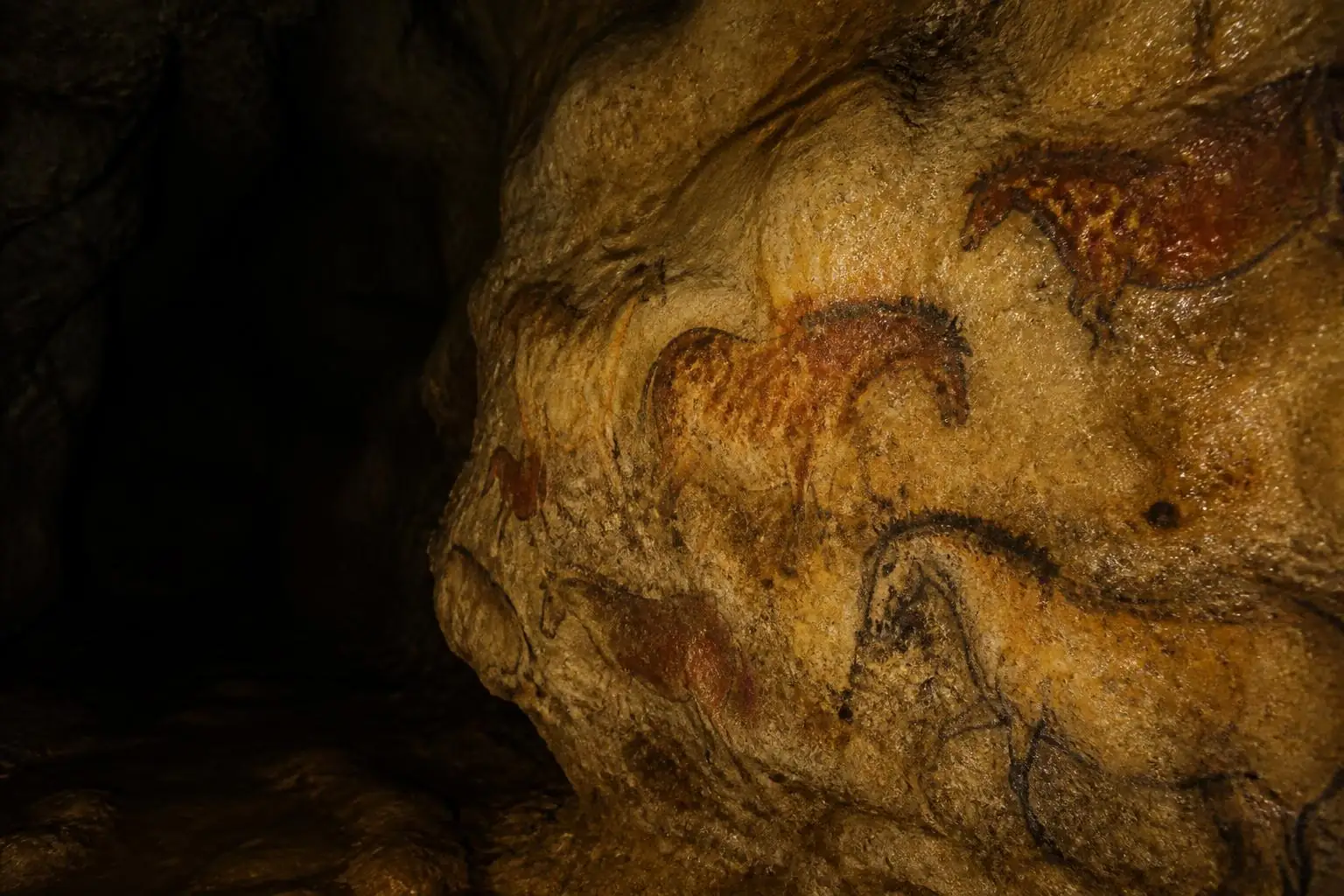
The model is consistent: a heavy head and convex profile, a thick neck, a short mane bristling upright, a sturdy body on slender legs, a heavy belly. The coat is almost always two-toned, dark on top and noticeably paler beneath the belly, around the muzzle and on the inside of the hind legs. A modern rider recognises this drawing immediately: a wild-type horse, in dun or mouse coat, with what coat guides call pangare markings, and often a dorsal stripe down the back.
This is not stylisation; it is observation. The painters were not rendering an idea of horse, but the animal before them, with details known only to someone who follows it year-round: the long hairs under the jaw in winter, the rounded belly line of a pregnant mare, the loose hair tufts hanging in spring. The same markers one learns to spot when studying the anatomy of the horse.
As to size, caution prevails. A cave wall is not a measuring rod, and figure dimensions obey available space rather than actual scale. The bone evidence suggests a small, compact animal, far from the size of the world’s largest horses.
On judging a horse painted twenty-one thousand years ago
1. The mane. Upright and short, as in wild equids, not falling over the neck as in our domestic horses.
2. The head profile. Convex muzzle, broad jaw, head heavy in proportion to body.
3. The line of the back. Often a continuous dark band from withers to tail: the dorsal stripe, a marker of primitive coats.
4. The contrast between belly and back. Lightening of the underside, muzzle and inner legs: this is pangare.
5. The state of the coat. Fringe under the jaw, tufts shedding: the painter marks the season.
6. The volume of the belly. A very deep abdomen on an otherwise spare frame reads as a pregnant mare.
7. The proportions. Slender legs and round hooves, rendered without perspective yet with joints in correct position.
8. Position on the wall. A horse painted on a bulging relief or in a crevice is a choice, not a lack of space: the rock is part of the drawing.
The season written in the horses’ coats
This is the most striking contribution of modern research, and it comes from a prehistorian who spent twenty years in this cave, Norbert Aujoulat. In publishing his study summary in 2004, he demonstrated that the three major species at Lascaux, horse, aurochs and deer, always superimpose in the same sequence. Never reversed. Horse first, aurochs over it, deer last.
His interpretation is equestrian and zoological before being symbolic. Each species would be depicted in the coat and attributes of its breeding season. The horse wears its spring livery, the aurochs that of summer, the deer that of autumn, antlers included. The sequence of walls would thus narrate an annual cycle, with the horse in the first position: the beginning.
This reading remains an interpretation, it is debated, and it is not the only one available. But it holds immense merit for those who know horses: it begins from a verifiable fact on the walls, moulting, not from intuition about the sacred. A horse shedding its winter coat, any rider recognises it in February at the first brush stroke. It happens that people were painting it already.
The inverted horse, the frieze of small horses and the so-called Chinese horses
The tour de force is not in the Hall of Bulls but just beside it, in a corridor some one hundred feet (30 metres) long called the axial diverticulum. The right wall bears the panel of Chinese horses, so named at discovery because their line reminded early observers of Far Eastern ink drawings. Here too is the frieze of small horses, a file of equines created not by brush but by pigment projection, blown by mouth or tube, with border stencils to stop the colour.
And at the very end, on the return of the wall closing the corridor, lies the locus of the Inverted Horse. The painter followed the rock’s curve so precisely that the animal tips and ends upside down. To see it whole, one must walk around the stone. It is a horse that cannot be viewed from a single vantage point: you must move, and the movement is part of the work.
At this level of mastery, one does not speak of hunters’ scribblings. One speaks of artists who knew their material, their pigments and their support, and whose favoured subject was the horse. This makes Lascaux the opening chapter of a story that has never ceased, that of the horse in art.
Absolutely no one rode these horses
Here lies the vertigo of the matter, and the point routinely overlooked when visiting a decorated cave.
The Lascaux horses are painted around twenty-one thousand years before us. Yet ancient DNA has greatly narrowed the date of origin for the horse we ride today. The reference study published in Nature in 2021, based on more than two hundred and seventy ancient genomes, places the cradle of the modern domestic lineage in the steppes of the lower Volga and Don, with its diffusion beginning only at two thousand two hundred years before the present era. Within centuries, this horse replaced local populations across all Eurasia.
Between the Lascaux painters and the first rider of this lineage, therefore, nearly nineteen thousand years elapsed. These horses were neither ridden nor harnessed nor herded. They were hunted, observed, counted, and manifestly admired.
A second surprise of the same order: the Przewalski’s horse, often presented as the last wild horse, does not descend from ours either, and the reverse is equally true. Genetic analyses connect it to the Botai horses of Central Asia around three thousand five hundred years before our era, a lineage that did not produce ours. It thus resembles the Lascaux silhouettes greatly without being their direct heir. This kind of reversal, equine archaeogenetics produces regularly, and it has already forced rewriting what was believed about great horse migrations, as it has allowed solving a four thousand-year-old mystery. It is also this genome work that explains how man has fashioned, breed by breed, the animal we call horse.
Key points
Lascaux is discovered on 12 September 1940 by Marcel Ravidat, eighteen, and three companions aged fifteen to seventeen, four days after Ravidat spotted the opening whilst walking his dog. Of six hundred and five identifiable animals, three hundred and sixty-four are horses, that is sixty percent, against fifteen percent of deer and fewer than five percent of aurochs. Recent dating places the whole assemblage around twenty-one thousand years before present. These horses were never ridden: the domestic lineage we know diffuses only from two thousand two hundred years before our era, roughly nineteen thousand years later. The cave opened to the public in July 1948, then closed in April 1963.
A million visitors, then the door closes
The cave opens to the public on 13 July 1948. The success is immediate and immense: in fifteen years, roughly a million people descend to see the horses. An staircase is installed, a bronze door, electric lighting, a water evacuation system.
And the paintings begin to die. The carbon dioxide expired by visitors, the moisture they bring and artificial light trigger two pathologies conservators name the green disease, an algae bloom on the walls, and the white disease, a calcite veil. In April 1963, André Malraux, Minister of Culture, closes the cave. It never reopens to the public.
What is visited today are reproductions, and they are remarkable: Lascaux II from July 1983 onwards, then Lascaux IV, a complete facsimile inaugurated late 2016 at the foot of the hill in Montignac. You will not see the genuine walls. You will see the same horses, to the millimetre.
What these horses have to do with yours
There is a troubling continuity between what the Lascaux painters did and what an owner does today. They noted a coat, a line of back, a mark on the head, the state of the hair by season. Three hundred and sixty-four times.
This is precisely, word for word, what appears on the first page of a modern horse’s identification document: the coat, the whorls, the markings, everything that allows one to say this animal is indeed that one. This description is called the description of marks, and it remains your horse’s identity papers. Keeping it current with vaccinations, wormers and care is what the digital health record makes possible. The logic has not shifted in twenty-one thousand years, only the medium has changed.
As for the coat itself, the vocabulary rewards attention. Pangare, dorsal stripe, dun, mouse: these are words made to describe precisely these primitive horses, and they are used every day to identify basic coat colours and to place a mount within the great families of horse breeds. Some of these coats conceal spectacular genetic stories, such as that of Camargue horses born black that whiten later.
The Lascaux horses are found in the Black Périgord, in the Vézère valley. It is also one of France’s finest equestrian trekking grounds, and nothing prevents you from seeing the descendants before the ancestors.
Before booking, two useful reference points: the true cost of a stay, detailed in our comparison of horse trekking prices in France, and the full catalogue of equestrian trips and treks region by region.
What we do not know
Many things, and it is worth saying so.
The exact dating of Lascaux remains contested. The most recent radiocarbon measurements give around twenty-one thousand to twenty-one thousand five hundred years calibrated before present, but earlier datings situated the whole rather towards eighteen thousand six hundred to eighteen thousand nine hundred years, and cultural attribution swings between the late Solutrean and early Magdalenian. We retain the order of magnitude of twenty-one thousand years, knowing it may still shift.
The count of figures varies by author and by what one accepts as countable. The six hundred and five determinable animals and three hundred and sixty-four horses come from reference inventories of wall art; other publications advance roughly three hundred and fifty horses among six hundred animals. The conclusion, however, does not budge an inch: the horse dominates decisively.
The date of closure to the public is given sometimes as 17 April, sometimes as 20 April 1963 depending on source. We therefore write April 1963.
Norbert Aujoulat’s seasonal interpretation is a scholar’s hypothesis, solidly argued but not consensual. It is presented here as such.
Finally, we do not know why these people painted. Propitiatory hunting, mythology, calendar, knowledge transmission: all have been proposed and nothing is proven. The only thing the walls prove is that they watched horses with an attention few modern riders would sustain.
Sources
Official Lascaux and Lascaux IV website (Department of Dordogne) for the discovery chronology, the 1948 opening, the 1963 closure and facsimiles. Ministry of Culture, National Centre of Prehistory, for the description of the axial diverticulum and panels. Jean Clottes database of the CNRS, after Leroi-Gourhan and Allain (1979) and Aujoulat (2004), for the bestiary count. Norbert Aujoulat, Lascaux, le geste, l’espace et le temps (2004), for the horse, aurochs, deer sequence and its seasonal reading. Librado et al., Nature, 2021, for the origin and diffusion of the modern domestic horse from the lower Volga and Don steppes. Gaunitz et al., Science, 2018, for connecting Przewalski’s horse to the Botai horses.
And if the story of the horse amuses you, it tests itself: our grand equestrian history quiz begins quite far back, but not yet at Lascaux. In another archaeological register, we have also told the story of the horse found harnessed beneath the ash of Pompeii.