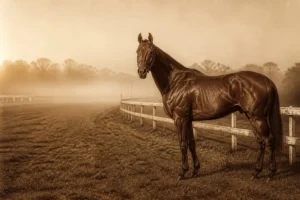

On 28 April 1945, with just ten days remaining until the end of war in Europe, an American cavalry squadron received orders to cross enemy lines. The objective was not ammunition dumps or military headquarters, but a remote stud farm in Bohemia, some thirty kilometres (18 miles) east of the front. Within hours, German soldiers would find themselves fighting alongside Americans to defend the mares and foals sheltering there. This operation, code-named Cowboy, would save an entire breed from extinction.
A raid behind enemy lines for a stud farm
The place was called Hostau, now Hostouň in the Czech Republic. In the spring of 1945, it served as a German military stud farm housing the Reich’s accumulated breeding stock: lipizzans brought from the Austrian stud at Piber, pure Arab horses seized in Poland, draught horses, pregnant mares and young foals.
The American front lay to the west, the Red Army advanced from the east, and the stud found itself exactly between the two forces, in territory the Americans knew they would have to cede to the Soviets once fighting ended. No one could predict what would become of these horses in a starving country amid a retreating army.
Colonel Charles Hancock Reed, commanding the 2nd Cavalry Group of the American Third Army, resolved to retrieve them. An operational force was assembled: two reconnaissance squadrons in M8 armoured cars, supporting vehicles, two M24 Chaffee light tanks and a covering infantry of 325 men under Major Robert P. Andrews and then Captain Thomas M. Stewart. Reed would later write a phrase that explained everything: they had seen enough death and destruction and wanted to do something good.
Intelligence came from a defeated German officer
The story begins days earlier. A Luftwaffe intelligence officer, Lieutenant-Colonel Walter Holters, presents himself under a white flag at the 2nd Cavalry Group command post and surrenders to the Americans. He has no wish to fall into Soviet hands. According to accounts from the American side, his conversation with Reed turns to horses, and the German produces photographs: the lipizzans and Arabs are there, mere kilometres away, and nobody knows what to do with them.
At the stud, the German commander, Lieutenant-Colonel Hubert Rudofsky, and the veterinarians surrounding him face an impossible situation. They refuse to see their horses dispersed or destroyed. The stud’s surrender is negotiated. When the American column arrives on 28 April, the garrison does not resist.
The operational force also liberates allied prisoners of war held in the sector: British, New Zealand, French, Polish and Serbian soldiers. A raid mounted for horses also restored freedom to men.
Why these horses warranted a military operation
A lipizzan is no ordinary horse, and this is not a matter of sentiment. It represents one of Europe’s oldest systematically managed breeds. The original stud, Lipica, was founded in 1580 by Archduke Charles II of Inner Austria, drawing on Iberian horse stock, the Andalusian horses then considered the finest war and riding horses on the continent, later crossed with Italian and Arab bloodlines.
Four centuries of selective breeding across known lineages, producing a herd counted in hundreds rather than thousands. The cavalry officers understood immediately: if these mares disappeared, it would not simply be a flock lost but an entire population, along with it the living foundation of the Spanish Riding School of Vienna, guardian of an unbroken classical dressage tradition stretching back to the sixteenth century.
The numbers vary depending on source, which is unremarkable for an improvised operation amid chaos. Some mission records mention approximately 250 mares to retrieve. American newspapers settled on 375 lipizzans. Military reports refer to roughly 1,200 horses of all breeds combined, Arabs and draught horses included. These three figures count different things: they should be read as orders of magnitude, not as an inventory.
German soldiers defended the stud alongside the Americans
This part of the story seems implausible, yet it is the best documented. Once the stud falls to American hands, Waffen-SS infantry attacks the position twice. The German soldiers at the stud, having just surrendered, ask to lend assistance and find themselves fighting on the same side as the Americans. Historians have documented only two instances throughout World War II in which American and German troops fought together against a common enemy. Hostau is one of them.
The fighting over the following days was real and costly: American sources report several killed and wounded in their ranks, and far heavier losses among the attackers. This was no touching anecdote. It was a military engagement, with casualties, waged for an objective that no tactical manual would have justified.
Then came the evacuation. Hundreds of horses, many of them pregnant or nursing mares, had to cover some fifty kilometres (31 miles) westward on roads choked with refugees and prisoners. Some were ridden, some led on foot, some loaded into trucks near the border. The column crossed into Bavaria precisely as the Soviets arrived.
How to judge a historical rescue narrative
- The administrative record. A real operation leaves orders, unit reports, officer names and dates. Cowboy has these: 2nd Cavalry Group, 28 April 1945, Hostau.
- Consistency of figures across sources. When counts diverge, it is not necessarily falsehood: one must verify what each source counts, mares alone or entire herd.
- The part played by cinema. A film adaptation condenses and romanticises. Here, the popular narrative owes much to the 1963 Disney film, which is not a historical source.
- The actual role of each side. A sound narrative does not reduce Germans to mere extras. The intelligence and the stud’s surrender came from them.
- The verifiable outcome for the animals. A rescue story is judged by what follows. Here, it is documented year by year, until return to Piber and Vienna.
7 May 1945: the Spanish Riding School performs for Patton
Meanwhile, three hundred kilometres (186 miles) to the south, another chapter unfolds. The stallions of the Spanish Riding School of Vienna had been evacuated to Sankt Martin im Innkreis in Upper Austria, with their director, Colonel Alois Podhajsky. The region had just been taken by the 20th Corps of General Walton Walker.
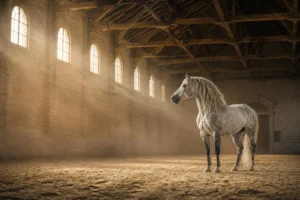
On 7 May 1945, the day of German capitulation, Podhajsky arranges a performance before American officers. General George Patton, visiting Walker, watches from the stands. The riders present the classical haute école movements, the elevated airs, that repertoire where the horse rears, leaps and lands in movements codified since the seventeenth century.
Podhajsky was not merely performing. He knew what he wanted: official protection for his school and for the mares still in Germany. At the end of the display, he asks for it, and Patton places the Spanish Riding School under the protection of the American army.
Two details make the scene less improbable than it seems. Patton had finished fifth in the modern pentathlon at the 1912 Stockholm Olympic Games, an event that then included a mounted cross-country course: he knew what he was watching. Podhajsky held the bronze medal in individual dressage from the 1936 Berlin Games. Two military officers, two elite horsemen, facing each other. Patton would die seven months later.
Ten years to come home
The rescue did not end on 8 May. The entire herd then had to be fed, cared for and rehoused across a drained Central Europe. The mares passed through Bavaria, then Upper Austria, at Wels and Wimsbach, where they were reunited with the Spanish Riding School stallions.
It would take until 1952 for them to reach Styria and the Piber stud, where the breed is still raised today, and autumn 1955 for the stallions to return to the Hofburg manège: the first performance within those historic walls took place on 26 October 1955, the very day of Austria’s first National Day. Podhajsky directed the school until 1965 and died in 1973.
Ten years between the raid and homecoming: this is the part the films forget.
The lipizzan is born dark and becomes white
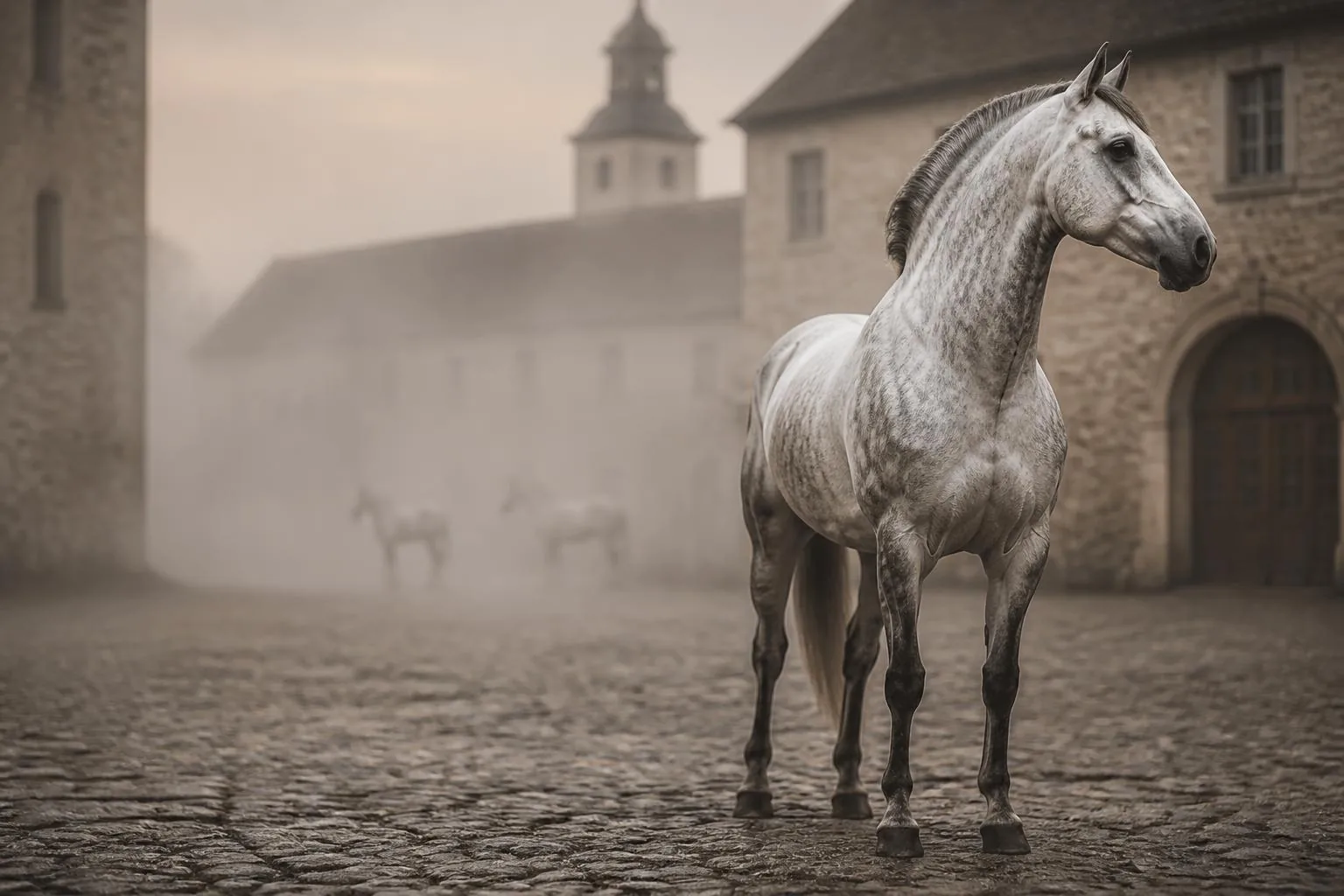
The white horses of Vienna are not born white. Lipizzan foals come into the world bay, black or dark grey, and gradually lighten, often between six and ten years of age, until reaching the white coat that defines their reputation. This is not white in the genetic sense but a very pale grey, as with many grey horses described in our coat colour guide.
The breed’s conformation tells its purpose: compact frame, high arched neck, powerful hindquarters, late maturity. This build was not selected for speed but for collection, that capacity to shift weight onto the hindlegs which makes the levade and school jumps possible. A baroque riding horse, not a racehorse. This also explains the breed’s fragility in 1945: with a restricted population and late maturity, the loss of a few hundred mares would suffice to erase four centuries in a single generation.
What this story tells us about a horse’s value
There exists a cynical reading of the affair: nostalgic cavalry officers saved their plaything. It does not hold. What Reed, Podhajsky and Patton defended appeared on no inventory: a genetic capital, equestrian knowledge and cultural continuity, embodied in animals that could not afford to wait for war’s end.
Equestrian history abounds in cases where a horse’s value bears no relation to its price. Wellington’s horse, Copenhagen, received a military funeral. The skeleton of Marengo, Napoleon’s mount, remains on display in London. Conversely, the record prices paid for horses guarantee neither sporting career nor productive offspring nor remembrance.
The 1945 rescue offers the inverse experience: at the moment when money had lost all value, men judged these horses worthy of risking lives for. It is perhaps the most honest valuation a horse has ever received, and it casts a harsh light on today’s auction records reaching millions.
Key points
- On 28 April 1945, the 2nd Cavalry Group crossed the lines to seize the Hostau stud in Bohemia and rescue its herd of lipizzans and Arab horses.
- Intelligence came from a German officer who surrendered, and German soldiers subsequently defended the stud alongside Americans against Waffen-SS troops.
- Counts vary: approximately 250 mares by some accounts, 375 lipizzans according to American press, roughly 1,200 horses total by military reports.
- On 7 May 1945, a Spanish Riding School performance before Patton secured official American army protection.
- The mares returned to Piber stud in 1952, the stallions to the Vienna manège on 26 October 1955.
Sources cited in text: American military archives and publications on the 2nd Cavalry Group, official histories of the Spanish Riding School of Vienna and Piber stud, biographies of Alois Podhajsky, Olympic results from 1912 and 1936. Equirider is affiliated with neither the Spanish Riding School of Vienna nor any military institution.