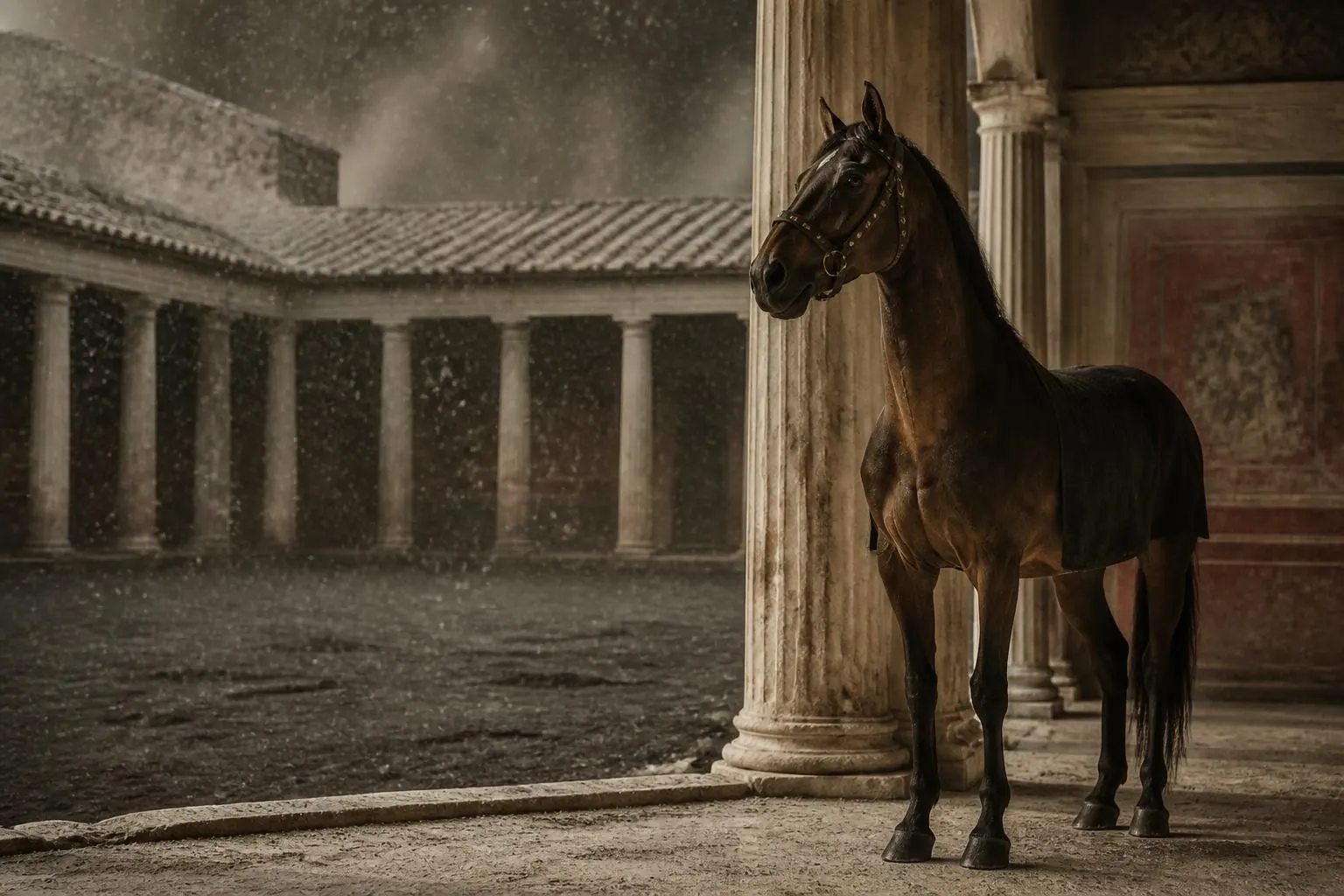

The eruption of Vesuvius on 24 August is commemorated each year, the day in 79 CE when ash engulfed Pompeii. Within a villa on the city’s edge, archaeologists discovered far more than human remains caught in the catastrophe. They found a stable, a wooden manger, and horses. One still wore its bit, iron bridle, and bronze ornaments between its ears.
The short answer
During 2018 excavations in the stable of a grand villa at Civita Giuliana, several hundred metres north-west of Pompeii’s walls, three equines came to light. One was preserved by plaster casting; another lay on its side near the manger to which it had likely been tethered; the third bore military-grade tack so substantial that archaeologists identified it as the mount of a man of rank. None of the three left the stable.
One stable, one manger, three horses
The site is called Civita Giuliana, situated roughly 700 metres north-west of Pompeii’s ramparts in what was then suburban countryside. The villa had been probed in the early twentieth century by private excavation, which identified some fifteen rooms, then abandoned for decades.
When modern stratigraphic excavation resumed, a room identified as a stable was exposed. The floor yielded a wooden manger, collapsed during the eruption and long since disintegrated. The excavators did not recover the manger itself: they found the void it had left in hardened sediment, and filled that void with plaster. The shape of the feeding trough returned.
The same technique captured the complete silhouette of one horse lying in the centre of the stable, then the legs of a second animal. Over the season, this second horse was fully revealed: resting on its right side, skull resting on its left foreleg. The archaeological park’s report adds a sentence difficult to forget: the animal was probably tethered to the manger and had not managed to break free.
A bit, an iron bridle, and bronze ornaments between the ears
The third animal, exposed late in the 2018 season, tells the most. Its skeleton was complete and in anatomical articulation, meaning the bones remained in proper relationship to one another. It still wore a bit and iron bridle. Between its ears, on the occipital bone, excavators recovered bronze decorative elements that had probably been affixed to leather straps long since perished.
It is a technical detail, and it is the entire subject. Two thousand years later, the material that survived is precisely what survives still in a tack room: metal. Leather vanishes, wood vanishes, bronze and iron endure. A rider in 2026 who opens her cabinet of bridles and bits handles the same materials in the same places. The bit still rests on the bars, that space of toothless jaw where bone is protected only by delicate mucous membrane, and the headstall still passes behind the ears, precisely where this horse bore its bronze.
A four-horned saddle, and not a single stirrup
On the ribs of the third horse, the military-saddled one, archaeologists recovered four objects of conifer wood, worked and sheathed in bronze, shaped like half-moons. A fifth bronze element, formed of three riveted hooks linked by an annulus to a disc, was recovered beneath the belly near the hindquarters.
The archaeological park’s interpretation is clear: these pieces belonged to a particular type of four-horned saddle. A wooden frame carried two horns forward and two behind, plated in bronze, and these four points anchored the rider. This model is documented throughout the Roman world from the first century onwards, particularly in military contexts, and it occupies a pivotal place in the long history of the horse saddle.
Why four horns instead of a simple seat: because the stirrup does not yet exist. The Roman rider has nothing beneath his feet. He has no purchase for mounting, no purchase to absorb shock, no means of coming out of the saddle. Specialists place the stirrup’s arrival in the West much later, around the seventh and eighth centuries, brought by equestrian peoples from the east. All Roman horsemanship hinges on this absence: grip the horse with your legs and brace yourself between four wooden bosses.
When you look at a modern stirrup, with its non-slip platform and branch that releases on impact, you are looking at the culmination of two thousand years of refinement around a problem this Pompeian horse posed already: how to stay aboard a moving back. The specification sheet for a horse saddle has not changed since; only the means have evolved.
How tack is judged, then as now
- Distribution of bearing points. A saddle is judged by how it spreads weight on either side of the spine, never across it. Roman horns anchored the rider; they did not solve this problem.
- Stability without tension. A good system holds the rider without forcing constant muscular contraction. This is what the stirrup provided.
- Contact in the mouth. A bit is judged on its bearing surface, the thickness of the mouthpiece and adjustment at the corners, not its appearance.
- Materials against the skin. Leather against metal, padding against withers: friction zones are where poorly adapted tack reveals itself.
- Adjustment, not brand. Expensive equipment badly fitted causes more harm than modest equipment well adjusted.
- Reversibility. Correct tack comes off quickly. The horse tethered to its manger is a brutal reminder of the cost of being unable to liberate an animal.
- Coherence with purpose. A parade saddle, a work saddle and a sport saddle do not answer the same requirements. This was true in 79 as well.
- What the horse tells you. The best judge remains the animal: a hollow back, refusal, resistance at the mouth. The Romans had no veterinary imaging; we do.
Fourteen-three hands at the withers, which was tall for the time
The plaster cast permitted measurement: approximately 14 hands 3 inches (1.5 metres) at the withers, meaning from shoulder to ground. The bone condition indicates an adult individual. Species identification remains cautious in the park’s documents: based on the silhouette’s morphology, proportions and withers height, this was probably a horse, Equus caballus, rather than a mule or hinny.
Fourteen-three hands today is not tall: most modern saddle horses exceed 16 hands. But ancient horses were generally smaller than ours, and that is why the measurement prompted archaeological attention. An animal of this stature, in this region, in 79, suggests deliberate selection.
The excavators cite Columella, a first-century Roman agronomist, who distinguished three categories of equine livestock: a nobler breed, suited to circus games and racing; mules; and finally a common breed producing mediocre specimens. The Civita Giuliana horse belonged to the first category, they contend. It did not work; it displayed itself. It was a sign of wealth as much as an animal, and this logic has scarcely changed since, as the longer history of the domesticated horse reminds us.
Someone had prepared them
The presence of bits and bridles in this stable prompted a hypothesis, advanced by the archaeological park’s director general at the time: these horses were ready for service, equipment and all. Someone had harnessed them. Perhaps to flee; perhaps to fetch someone.
It must be cited with its reservations, as originally framed: the same official specified that it was unknown whether the eruption had caught them during preparations to depart, and that analysis would settle the matter. This is not an established certainty; it is a plausible reading of circumstantial evidence. Of the first two horses, moreover, too little remains to say whether they too were harnessed.
What one can say without error, however, is that none of them left. Three valuable animals, prepared or not, died in the building where they lived. Horses that traverse History in glorious narrative, from Bucephalus under Alexander to the racehorse a Roman emperor wanted to make consul, are the exception. This is the rule.
What looters destroyed before archaeologists could
There is a brutal reason why no plaster cast exists of the third horse: looters came first. For years, tombaroli dug clandestine tunnel networks along the villa’s walls, extracting objects. These tunnels destroyed bone material, collapsed cavities and poured concrete where plaster should have been injected.
It was precisely to halt this pillaging that modern campaigns were launched, under an agreement between the archaeological park and the prosecutor’s office of Torre Annunziata, with the tunnels subsequently mapped by laser scanner. One rarely quantifies what antiquities trafficking costs: here, it counts in permanently erased information about a horse from 79.
A ceremonial chariot found just outside the stable
The story does not end with the horses. Several years later, in the portico fronting the same stable, excavators exposed a four-wheeled chariot of exceptional preservation: iron components in place, bronze and tin decoration, mineralised wood, traces of rope and botanical ornament. The park interpreted it as a pilentum, a ceremonial vehicle for processions and festive cortèges, not a working cart or racing chariot. A display vehicle, a stable of selectively bred horses, a bronze-mounted bridle: the villa tells the same social status, room by room.
Excavation remains incomplete
Civita Giuliana continues to yield. Two human victims were plaster-cast in an underground corridor, fabric creases preserved, followed by rooms of the slave quarters and their tiny cells. By late 2025, Italy’s Ministry of Culture announced further discoveries there: amphorae of beans, a large fruit basket, and a small domestic shrine. The site advances as modern construction above is demolished: the stable and its horses are but one piece of an ensemble still largely buried.
24 August may not even be the correct date
The date remains contested. 24 August 79 comes from letters by Pliny the Younger to the historian Tacitus, written more than two decades after the fact. The original has long since vanished: we read copies of copies, and the manuscript tradition is not unanimous.
In 2018, an inscription in charcoal on a wall undergoing work reignited debate: it bore a date corresponding to 17 October. Since charcoal is supposed fragile and quickly erased, site officials concluded the inscription dated shortly before the eruption, and therefore that it occurred in October. Other evidence pointed the same way: autumn fruits found on site, lit braziers, coins, mention in an ancient historian.
Then the pendulum swung back. Tests showed charcoal more durable than thought, and a 2022 academic work on Pliny’s letters dismantled the reading that favoured an October or November date drawn from a manuscript variant, pointing to transmission errors. The archaeological park has now returned to the traditional date of 24 August, without the case being closed. We know what this horse wore on its head, but not precisely which day it died.
Key points
- Three equines were discovered in the stable of a villa at Civita Giuliana, at Pompeii’s edge, during 2018 excavations.
- One horse was preserved by plaster casting: approximately 14 hands 3 inches (1.5 metres) at the withers, adult, tall for its time.
- Another still wore iron bit and bridle, with bronze ornaments between its ears.
- Wood pieces sheathed in bronze across its ribs corresponded to a four-horned saddle, designed to hold the rider in an era without stirrups.
- Preparation for flight is a hypothesis put forward by the archaeological park, presented as such.
- Looters’ tunnels made plaster-casting of the third horse impossible.
What this horse tells a rider today
Two thousand years separate that stable from ours, yet the questions remain identical: how to stay aboard a moving back, how to place a bit without wounding, how to distribute weight across a spine never designed for it. The Romans answered with four horns of wood sheathed in bronze; we answer with adjustable trees, measured padding and saddle-fit checks a professional redoes regularly. The difference is not fundamental; it is one of precision. And the day you stop checking, the horse tells you so, exactly as it did in 79.
Choosing a saddle that respects your horse’s back
Tree types, measurements to take, common mistakes: the complete guide to getting your saddle right.
Sources
Press releases and documentation from Parco Archeologico di Pompei on Civita Giuliana excavations (horse plaster cast, third horse with military tack, ceremonial chariot, human victims and slave quarter); statement from Italy’s Ministry of Culture (late 2025) on the slave quarter; Columella, De Re Rustica, book VI, chapter 27; letters from Pliny the Younger to Tacitus; and academic works published in 2022 on the eruption’s dating. Equirider is affiliated with neither Parco Archeologico di Pompei nor Italy’s Ministry of Culture.