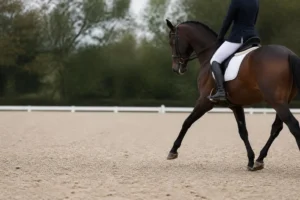

Your child has spent the summer raising horses that do not exist. They can reel off twenty coat colours, they talk pedigree and BLUP, they run an entire yard before breakfast. And you are wondering whether any of this bears the faintest resemblance to a real horse.
Short answer: partly, yes. Free horse games transmit correct vocabulary and genuine management discipline. But they also install five misconceptions, the kind that come unstuck at the first riding lesson or facing a vendor. Here is what holds up, and what does not.
What These Games Teach Correctly
The first contribution is vocabulary. A player of Equideow or Horse Reality can tell a chestnut from a bay, knows where the withers are, understands the difference between a mare and a filly. This terminology does not invent itself, and it saves time when your child first walks into a riding club. You can deepen it with our breed guides, more thorough than any in-game encyclopedia.
The second contribution is the map of disciplines. Dressage, show jumping, endurance, racing: games separate the events, demand différent horse profiles, and give an accurate sense of what equestrian disciplines actually entail. A child who has spent a month on Rival Stars Horse Racing grasps that a racehorse and a dressage horse do not do the same job.
The third contribution is more subtle: consistency. A browser-based breeding game requires daily visits, careful record-keeping, planning of breedings and training schedules. That is management, and it mirrors the rigour demanded of a horse owner. Star Stable adds an unexpected bonus: English fluency, since a large portion of the player base and content remains anglophone.
If you are looking for which game suits which age and platform, we have detailed every title in our guide to free horse games, from browser to mobile.
Five Misconceptions Every Game Installs Without Saying So
1. A horse heals with a single click. In a game, the health bar restores with an item bought seconds earlier. In a real yard, an injury counts in weeks, lameness demands diagnosis, and feet pass between the farrier’s hands every six to eight weeks or so. Care is not a button; it is a calendar.
2. Pedigree makes the champion. Breeding simulators reward the pairing of two well-rated animals with an even better offspring. Real genetics is far less obliging. Athletic qualities transmit only partially, and breeders say it plainly: two champions guarantee nothing whatsoever. The French Equestrian Institute regularly reminds us that selecting a breeding animal involves a cluster of indices, not a sum of scores.
3. You ride like you level up. An expérience bar fills in three evenings. A rider, by contrast, advances through long plateaus. The French riding fédération’s proficiency levels take months, sometimes years, to earn, and nobody jumps a metre obstacle because they clicked enough times. Progress with a horse comes through repetition, falls, and getting back on.
4. A horse is a purchase price. This is the sharpest gap between screen and reality. In a game, you pay once. In life, the purchase is the smallest line in the budget: livery, feed, veterinary, farrier, insurance, equipment, transport. Annual upkeep often exceeds what you paid for the horse itself. A simple exercise to get a sense of scale: work out a daily ration for a 1,100-pound (500 kg) horse, and see what that comes to over twelve months.
5. A horse is always available and willing. No game models refusal. The virtual horse does not retreat to the far end of the field when you arrive with a headcollar, fears no plastic bag, does not stiffen on a frosty morning. The living animal has moods, fitness levels, memory. That is what makes riding interesting, and it is precisely what simulation removes.
- True free play: how far you get without paying, and where the paywall appears.
- In-app purchases: premium currency, packs, chests. Check whether spending can be disabled on the device.
- Timers: breeding games impose waiting periods you can shorten by paying. This is the real business model.
- Moderation: public or private chat, message filters, reporting tools. The most sensitive point for under-13s.
- Equestrian accuracy: coat colours, breeds, disciplines. Some titles are meticulous; others invent freely.
- Platform: browser without download, mobile, PC. This shapes both screen time and gaming enjoyment.
Free Does Not Mean Costless
Almost all these titles run on freemium. Star Stable launches without payment, then full access requires subscription. Equideow, the French version of Howrse, distributes premium currency that accelerates everything. Mobile racing games live on packs and chests. The game is free; patience is not.
Two habits prevent nasty surprises. First, disable in-app purchases in your phone or account settings before you install anything. Second, set a named budget, however modest, rather than a blanket no that always buckles on a Sunday evening. A child managing ten pounds per term learns more than one told flatly no without explanation.
What No Game Simulates
The weight. A riding horse weighs between 880 and 1,320 pounds (400 to 600 kg) depending on type and breed. No controller makes you feel that. Nor the heat, nor the smell of hay, nor mucking out a box in February at seven in the morning, nor standing in the rain while the vet finishes their previous call.
That is where the gap becomes useful. A child who has played for two years arrives at the club with vocabulary and zero sensation. You must warn them beforehand, or the first lesson will feel like disappointment. The real horse is slower, heavier, more stubborn, and far more captivating than its pixel version.
Turning Three Hours of Gaming Into Real Skill
The method that works is to shift the game from end product to entry point. Ask them to justify their breeding choices aloud, then compare with what a real breeder does. If their game is Equideow, the Equideow breeding mechanics explained elsewhere on the site show plainly where the game simplifies and where it mirrors reality.
Next, arrange a taster session at a local yard, a pony day during school holidays, or even a yard visit. Many establishments open their doors in summer and welcome curious visitors. The leap from keyboard to halter happens faster in one morning than in ten explanations.
Finally, keep the game as reward, not substitute. It fills rainy days, maintains vocabulary, and bridges the gap until the next course. That is already substantial for free software.
- Free horse games teach accurate vocabulary, breeds, and disciplines.
- They distort five things: care, genetics, speed of progress, cost, and the horse’s consent.
- Free means freemium: disable in-app purchases before installing.
- The best use is a bridge to the riding club, not a replacement for it.
See the full list of free horse games, sorted by platform and age.