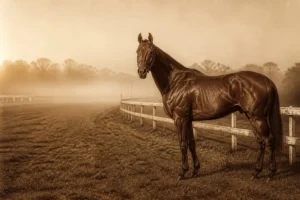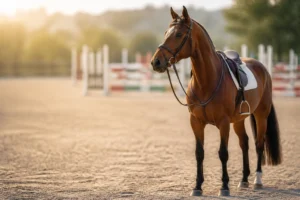

On Sunday 16 August 2026, at Aachen, the world eventing championship was won by an 18-year-old horse. fischerChipmunk FRH, a Hanoverian gelding born in 2008, completed all three phases of the championship with 23 penalties under German rider Michael Jung. Most of the horses competing against him at his early international starts have left the top level years ago.
An 18-year-old horse winning a world championship is more than a heartwarming sports story. It raises a question that matters to every horse owner, from the local riding club to the international circuit: what makes a horse last, and what stops him. Here is what happened that day, what this career truly reveals, and what ordinary horse owners can learn from it.
What unfolded at Aachen on Sunday 16 August
The FEI World Equestrian Games run from 11 to 23 August 2026 at Aachen, six disciplines on a single site, with the first qualifying places for the Los Angeles 2028 Olympics in the background. We outlined what awaited the French team during this fortnight ahead of the opening.
Eventing itself unfolded in three phases: a dressage test, then the cross-country on Saturday 15 August, the phase that nearly always decides the championship, and finally the show jumping on Sunday, ridden in reverse order of standing.
In the end, Michael Jung and fischerChipmunk FRH are individual world champions with a total of 23 penalties. Britain’s Rosalind Canter takes silver with Lordships Graffalo, her compatriot Laura Collett takes bronze with London 52. In the team competition, Great Britain wins the title, ahead of Germany and the United States.
Michael Jung, born in 1982, is already a triple individual Olympic champion in the discipline. What made this Sunday remarkable was not the name of the rider. It was the age of the horse.
Eighteen years: what that means for a top-level eventer
International eventing rules, in the edition in force on 1 January 2026, set very precise minimum ages: five years to enter international competition at foundation level, seven years for four-star level, nine years for five-star competitions and senior championships. Sport dictates when a horse may begin. It never says when he must stop: no maximum age appears in the regulations.
In practice, selection happens by itself. A top-level horse stops when his performances decline, when an injury fails to heal, or when his connections choose to retire him. Veterinary literature considers a horse old from around twenty years of age, which we detail in our article on the 20-year-old horse and his needs. In other words, an 18-year-old athlete is a horse approaching the threshold of old age whilst still keeping pace with a world championship.
It is this dual perspective that makes the case interesting. Nothing in the regulations prevents an 18-year-old horse from competing at a world championship. Almost everything in his physiology and career logic makes it rare.
A career that began with someone else
fischerChipmunk FRH is a Hanoverian gelding born in 2008, by the stallion Contendro I, bred by the Meyer-Kulenkampff family, who remained his owners. At five years old he joined German rider Julia Krajewski and won with her the German national championship for five-year-old youngstock.
The pair climbed the levels over several seasons. In 2018, they won the long four-star at Bramham with a notably strong dressage score, then led the dressage at the world championships at Tryon, United States, before a refusal on cross-country ended that attempt.
In February 2019, the German federation announced that Michael Jung would take the ride. The horse was not sold to the rider: ownership remained shared between the breeding family, the German federation’s structure and Jung’s sponsor, which explains the commercial prefix attached to his name. Chipmunk was eleven years old. At that age, a top eventer is considered to be entering his prime years, and many assumed the greater part of his career was already written.
Seven seasons before the missing title
What followed reads like a long list of near-misses. European Championships 2019: team gold, individual silver. Tokyo Olympics, held in 2021: fourth place in the team, eighth individually. World Championships at Pratoni, Italy, in 2022: the pair led before the final show jumping phase, knocked rails down, finished fifth, and watched Britain’s Yasmin Ingham take the world title. The German team won gold that day.
In between, the horse won twice the toughest of all American five-star events, Kentucky, in 2022 then again in 2025. At the Paris Games in 2024, he finally secured individual Olympic gold, at sixteen years old.
The individual world title remained elusive until Aachen two years later, at eighteen years old, on home soil for the rider. A career of this length at the top, with two different riders and an Olympic gold medal in between, has few equals in the discipline.
Why eventing wears a horse faster than most realise
Eventing is the discipline that demands the most contradictory things from a single horse: the precision and calm of dressage one day, the speed and engagement of cross-country the next, the freshness and suppleness of show jumping the day after. Our eventing guide details the flow of the three tests and how penalties accumulate.
Cross-country is what costs the body most dearly. A sustained gallop over several kilometres (miles), fixed obstacles that do not yield, landings downhill, changes of terrain from holding grass to hard or deep ground. Every stride is an impact, and these impacts number in the tens of thousands over a career.
The next day, show jumping tests what is left. It is as much a test of recovery as of technique, and this is precisely where tired horses knock rails. A horse that jumps cleanly on Sunday after a cross-country championship the day before is, by definition, a horse that recovers quickly.
What wears a horse down, and what preserves him
There is no recipe that guarantees a long career, and it would be dishonest to suggest otherwise. A horse that lasts is first and foremost good genetics, a frame that distributes strain properly, and an element of luck that no protocol can replace. Around him, at this level, there constantly orbit a groom, a veterinarian, a farrier and care staff.
What does transfer, however, are the principles. Progressive workload rather than sudden peaks. A calendar that allows real breaks and does not tick every possible box. Variety in work, flat work, hacking, competition, rather than repetition of the same exercise. Turned out time, because free movement maintains joints and peace of mind. And monitored going, neither rock-hard from drought nor churned up by rain.
The final principle is the least spectacular and arguably the most decisive: detect early. A lameness caught in the week it appears costs far less than a lameness compensated for three months by the rest of the body.
The three areas that determine a long career
The feet, first. The quality of trimming and the regularity of the farrier’s visits weigh more heavily over ten years than any feed supplement. Our farrier schedule for horses sets the frequency guidelines by season and workload.
The back and locomotion next. A saddle that no longer fits, a horse that muscles up and changes shape, an imbalance in the rider, and discomfort sets in without ever becoming true lameness. Monitoring the back, limbs and mouth are part of the routines described in our complete horse care guide.
And finally the teeth, because a horse that does not chew well does not digest well, and a horse that does not digest well loses the condition he will need as he ages. This becomes critical after fifteen years, with nutritional needs that shift, as we explain in our article on feeding the older horse.
What determines the longevity of a sports horse
- The consistency of training load, rather than the intensity of individual sessions.
- The number of competition outings per season, and especially the recovery time allowed between them.
- The quality of the going worked year-round, a criterion invisible in results but readable in the tendons.
- Time turned out loose, which maintains joints, digestion and mental wellbeing.
- Regularity with the farrier and the state of the feet, the first cause of enforced rest.
- Dental monitoring, which governs body condition as soon as the horse advances in age.
- The speed at which discomfort is spotted and investigated, rather than compensated for over months.
- A written record of monitoring, the only way to compare a horse to himself three years earlier.
What this champion means for a club horse
Almost no horse will ever run a world championship, and that is perfectly fine. But the underlying question is the same in any owner’s yard: at sixteen, eighteen or twenty years old, a horse in good health, properly monitored and worked without excess, can continue competing, hacking and progressing in his work.
The most common trap is not asking too much; it is stopping everything at once in the name of age. An older horse suddenly put on complete rest loses muscle, stiffens, gains or loses condition, and ages far faster than the neighbour’s horse that continues light work four times a week.
There is a counterpart, which is not negotiable: the older a horse gets, the more regular and documented his care must be. Vaccinations, dentist, farrier, weight, check-ups, everything that is written down can be compared, and our horse health record exists for precisely this. Any drop in form, any loss of condition or any new lameness is addressed with a veterinarian, never at the tack shop.
Key takeaways
- fischerChipmunk FRH, a Hanoverian gelding born in 2008, is eventing world champion at Aachen on 16 August 2026 with Michael Jung on 23 penalties.
- Great Britain wins the team title, ahead of Germany and the United States.
- International regulations set a minimum age to compete, nine years at senior championship level, but no maximum age.
- The horse was trained by Julia Krajewski before moving to Michael Jung in February 2019, at eleven years old.
- He was already individual Olympic champion at Paris in 2024, and twice winner of the five-star at Kentucky.
- A long career depends chiefly on consistency, going, feet, teeth and early diagnosis.
- Stopping an older horse suddenly makes him age faster than keeping him in light, regular work.
The right approach
Your horse is past fifteen or works hard year-round. Return to the care routines that make the difference over time.
Sources
Eventing results from the FEI World Equestrian Games 2026 at Aachen as published following the competition on 16 August 2026, reported by francophone equestrian press and the event’s official page. FEI Eventing Rules, 27th edition in force on 1 January 2026, article 503.4 on horse ages. Horse information and breeding data published by the Hanoverian stud book databases. Communication from the German Equestrian Federation in February 2019 regarding the rider change, and reports from specialist press on the 2018, 2019, 2021, 2022 championships and the Paris 2024 Games. Guidelines for managing older horses from IFCE publications and veterinary literature. Equirider is affiliated with neither the FEI, nor the French Equestrian Federation, nor any of the yards mentioned. For any specific horse, your veterinarian remains your reference.