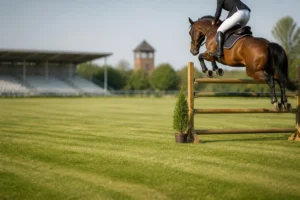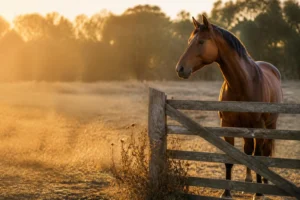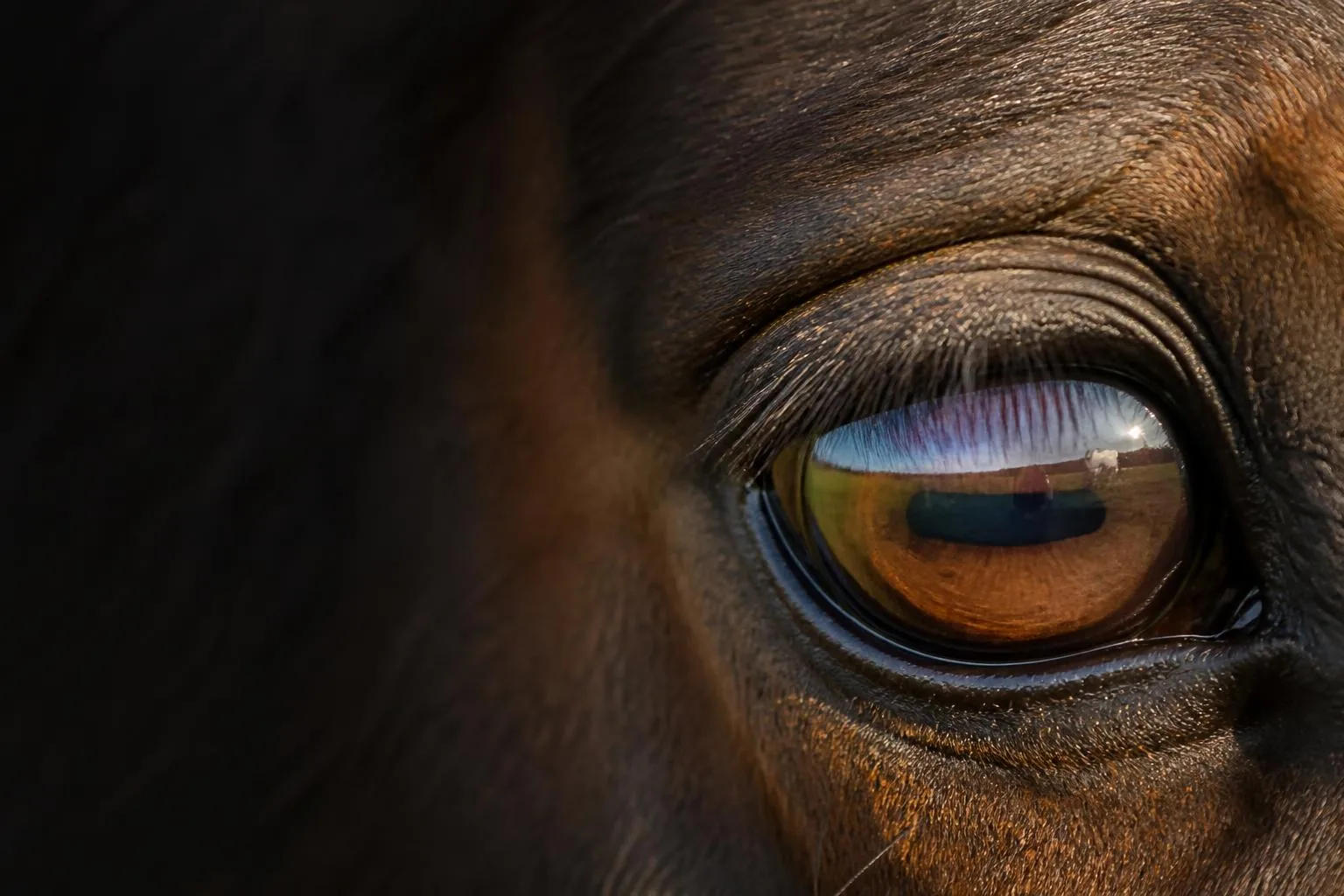

For decades, the jumps and guide rails at British racecourses gleamed in bright orange: the colour that catches human eyes, the shade of high-visibility jackets and traffic cones. Except it had been chosen for human vision, not equine. In 2022, the British Horseracing Authority repainted 368 steeplechase fences and 2,132 hurdle panels across 40 racecourses in white. The reason was straightforward: the horse jumping those fences could barely distinguish orange from the surrounding landscape.
It is the perfect entry point to understanding something we forget every day in the stable. Your horse does not see the world you describe to him. He inhabits a different visual universe entirely: different colours, an almost circular field of vision, two permanent blind spots, and a sluggish adaptation to shadow that accounts for half the refusals we blame on temperament.
Two thousand five hundred jumps repainted, and the answer lies in the eye itself
The story began in 2017. The British Horseracing Authority and the industry’s research foundation commissioned a study from the University of Exeter, led by Sarah Paul and Martin Stevens, specialists in sensory ecology: the study of how each species actually perceives its environment.
The method was two-pronged. First came optical analysis: 131 jumps photographed across 11 racecourses, using equipment that calculated contrast as a horse’s retina would perceive it, not a human eye, against varied backgrounds and in different light. Then came behavioural observation: 14 training horses in Richard Phillips’s yard at Adlestrop, Gloucestershire, filmed jumping obstacles while their colours were changed.
The results, published in January 2020 in Applied Animal Behaviour Science under the title “Horse vision and obstacle visibility in horseracing”, were definitive. The existing orange did not maximise contrast for horses at all. Yellow, blue and white stood out far more clearly against real racecourse backgrounds. But crucially, only one colour altered the horses’ measured jumping behaviour: white. Faced with a white jump, horses took their strides further out, meaning they perceived the obstacle earlier and positioned themselves accordingly.
Fluorescent yellow performed comparably, but faded quickly in sun and rain. A colour that lost its intensity in three weeks was useless. White it was.
The announcement came on 22 February 2022. Nine courses first, beginning 14 March 2022 at Stratford, then Hexham, Newton Abbot and the rest, with completion across all 40 jump courses by December 2022, and point-to-point events following in the 2022-23 season. An entire sport changed the colour of its equipment because a laboratory showed it what its horses were actually seeing.
Video: 69 seconds
What the video shows
The horse is dichromatic: he cannot distinguish red or orange from the green of grass. British racing commissioned research that proved it, and 40 racecourses repainted their equipment white. What that means for the horsebox, the stable door, and the refusals we attribute to stubbornness.

What the horse actually sees: two colours, not three
We are trichromats. We have three types of cone cells in the retina, sensitive to blue, red and green, and their combination creates the colour palette we think is universal.
The horse is dichromatic. He has only two types of cones: one sensitive to short wavelengths (blue) and one to medium wavelengths (yellow and yellow-green). The IFCE describes it simply in its Équipédia vision guide: horses perceive blue and yellow nuances very well, but cannot distinguish red from green.
Practically speaking, this does not mean he sees in black and white, nor that an orange jump would be invisible. It means orange, red and much of the green spectrum collapse into the same range of dull, yellowish or greyish tones for him. Set an orange guide rail in front of a green hedge and brown earth: for you it pops. For him, it vanishes.
This explains why a horse can jump cleanly all season over coloured poles, then refuse a subtle jump painted in shades matching its surroundings. It is not obstinacy. It is a contrast problem, and contrast must be judged through his eyes, not ours. The same questions arise in show jumping, where jump decoration changes how a horse approaches it far more than most riders realise.
Three hundred and fifty degrees of vision, and two blind spots
The horse’s eyes sit high and wide on the skull. This is predator architecture: it evolved first to scan the horizon while the head grazes.
The result is a visual field of roughly 350 degrees, with a binocular band of about 65 degrees directly ahead, the rest seen by one eye at a time. He sees almost everything around him, but perceives depth only in a narrow corridor straight ahead.
The front blind spot
There is a dead zone just below the nose and directly in front of the muzzle. A grazing horse does not see the grass blade he takes: he finds it with his lips, his whiskers and his sense of smell, not his eyes. This is also why a horse often does not see you when you stand directly in front of his head at 1 foot (30 cm), talking to him.
Over a jump, this blind spot has a direct consequence: from a certain point in the approach, the horse no longer sees the fence he is jumping. He jumps from memory, relying on the image captured two or three strides earlier. Hence the importance of what he can perceive early, and why white on a guide rail matters.
The rear blind spot
The second blind spot runs directly behind the quarters. It is the most famous because it is the most dangerous for humans, and it is the foundation of all safe handling: never emerge silently into this zone, speak to the horse, keep a hand on him as you pass behind. The Galops guide to equine senses establishes this at the first levels, and it holds true for every riding career that follows.
How to tell if a refusal is about the eyes, not character
1. The light at the moment of refusal. Horsebox entrance, stable door, moving from a lit arena to a darkening field: a refusal always triggered by a change in brightness points to the eye, not the mind.
2. Timing patterns. Same place passes without issue at noon but blocks at 6 pm in October. That is a sign.
3. Direction. A horse that jumps an obstacle one way and refuses the other often sees two different scenes, especially against the light.
4. Colour and background. Dull jump against a similarly toned background, shadow cast across the track, dark puddle: these are contrast ruptures, not caprices.
5. Head carriage. A horse raising or lowering his head sharply, or twisting slightly, is trying to place the object in his binocular zone. Let him look.
6. Laterality. A horse systematically refusing from one side may have a problem in one eye, which requires a vet’s examination.
7. Onset. A new refusal in a horse who was doing well deserves an eye exam before any schooling correction.
8. What has been ruled out first. Teeth, back, saddle, lameness and rider’s hand all come before concluding “he cannot see”. A horse refusing forward rarely has just one reason to do so.
He sees better than you in the shadows, and far worse during the transition
The horse possesses a tapetum lucidum: a reflective layer behind the retina found in many nocturnal animals, and responsible for the eyeshine in headlights. Its function is simple: light passing through the retina without being absorbed is bounced back, giving the photoreceptors a second chance to capture it. His retina also contains far more rods, the cells responsible for low-light vision, than ours.
The consequence: in equal light conditions, in clear night or woodland, the horse sees better than his rider.
The problem is not darkness itself. It is the transition. Equine veterinary literature commonly cites roughly 45 minutes (45 m) for a horse’s eye to fully adapt moving from bright sunlight to a dark space, versus about 20 minutes (20 m) for a human. This figure circulates widely and varies by individual and source: we present it as an order of magnitude, not a constant. The horse’s dark adaptation curve was characterised in a study published in Veterinary Ophthalmology in 2012, and the consensus point is this: adaptation happens, it works well, and it is slow.
Practical translation: when you walk into a dark stable on a bright day, your eyes recover in a minute or two. His do not. In the meantime, he is moving through a zone he can barely perceive, and he knows it.
The horsebox, the stable door, the lit arena
A horsebox seen from outside in daylight is a black rectangle. Asking a horse to load is asking him to voluntarily enter a space where he will see almost nothing for minutes, on an inclined floor that shifts, with a low ceiling. The fact that he eventually does it is already remarkable.
A few simple measures change everything, and they follow directly from what we have just covered:
Park the box so natural light enters the interior, not facing the sun, which turns the doorway into a black hole. Open the side ramp and windows to let daylight in. Choose a pale interior that reflects light over dark fittings. Give the horse time to look before asking, and do not block his visual corridor while loading. These details often matter more than loading technique, and they are worth keeping in mind when choosing a vehicle from our horse transport guide.
The same logic applies at home. A stable door opening onto an unlit corridor, an arena where you turn on floodlights while a horse works, a school where the low autumn sun cuts the surface in two zones: these are contrast situations, and a horse hesitating in them is being logical, not wilful. As autumn shifts sessions to late afternoon, these transitions multiply suddenly.
The essentials
The horse is dichromatic: two types of cones instead of three, good perception of blue and yellow, and no distinction between red and green. This is what led British racing to repaint 368 steeplechase fences and 2,132 hurdle panels across 40 racecourses in white from March 2022, following research from the University of Exeter published in 2020. His visual field is roughly 350 degrees, with a binocular zone of about 65 degrees and two blind spots: one under the nose, one behind the quarters. He sees better than you in dim light thanks to his tapetum lucidum, but takes much longer than you to adapt when moving from bright daylight to darkness. A refusal that always happens at the same place and time deserves a look at the light before correcting the horse.
Clear vision at what distance
Equine visual acuity is generally estimated at around 20/30, some measurements reaching 20/60 depending on protocol. In other words, what a human sees clearly at 100 feet (30 m), a horse sees clearly at 67 feet (20 m). He is not myopic in the medical sense, but his image is less sharp than ours. He compensates through movement: a stationary object blended into the landscape becomes clearly identifiable the moment it moves, another legacy of predator logic.
Another rarely mentioned peculiarity: the horse’s optical axis slopes roughly 20 degrees downward from horizontal. This means head and neck position directly change what he can see clearly. A horse raising his head at a novel object, or lowering it before a jump, is focusing. Preventing head movement is asking him to judge without looking, and this is also why a poorly fitted bridle or tight hand costs more than we imagine. The marks a bit leaves in the mouth and a constrained head carriage often tell the same story.
When it is no longer about optics but health
Everything above describes a healthy eye. There is a point where behaviour shifts from normal perception to pathology, and that is when to call a vet rather than change your approach.
Red flags: an eye that waters, closes halfway or stays closed, a cloudiness or blueness of the cornea, a pupil no longer reacting like the other one, a horse bumping objects on one side only, or whose vision seems to decline in episodes.
In horses, the most feared cause of progressive vision loss has a name: recurrent equine uveitis, an inflammation inside the eye that progresses by episodes, each one damaging internal structures further. It responds better the earlier it is caught, which requires knowing what a normal eye looks like: our guide to equine eye anatomy exists for exactly this purpose. And faced with a horse refusing without obvious cause, our guide to why your horse refuses to move forward works through the causes in order.
Nothing written here replaces a proper examination. An eye that changes appearance in hours is a veterinary emergency, as serious as colic.
What changes in your routine
Three habits are enough.
First: let the horse look. Three seconds of halt before a novel object beats three minutes of discussion. He places it in his binocular zone, he focuses, he proceeds.
Second: treat light transitions like obstacles in their own right. Pause at a horsebox entrance, corridor, covered round pen. Nothing more.
Third: record it. A refusal dated, located, with time and weather becomes usable data after three occurrences, whereas memory never is. This is the role of a digital health record kept current, just as you do with vaccines and worming, and it applies equally to all daily care.
One last thing matters most: this paint story says it all. For over a century, a sport painted its obstacles in the colour that reassured humans. It took a team of biologists, 131 jumps photographed and 14 horses on film to realise that the main player, the one jumping them, could not see it at all.
Sources: British Horseracing Authority press releases (22 February 2022) and University of Exeter (2018, 2022); Paul S. C. and Stevens M., “Horse vision and obstacle visibility in horseracing”, Applied Animal Behaviour Science, volume 222, January 2020; IFCE Équipédia guide to equine vision; Ben-Shlomo G. and colleagues, “Characterization of the normal dark adaptation curve of the horse”, Veterinary Ophthalmology, 2012; reference works on equine visual acuity by Timney and Keil.