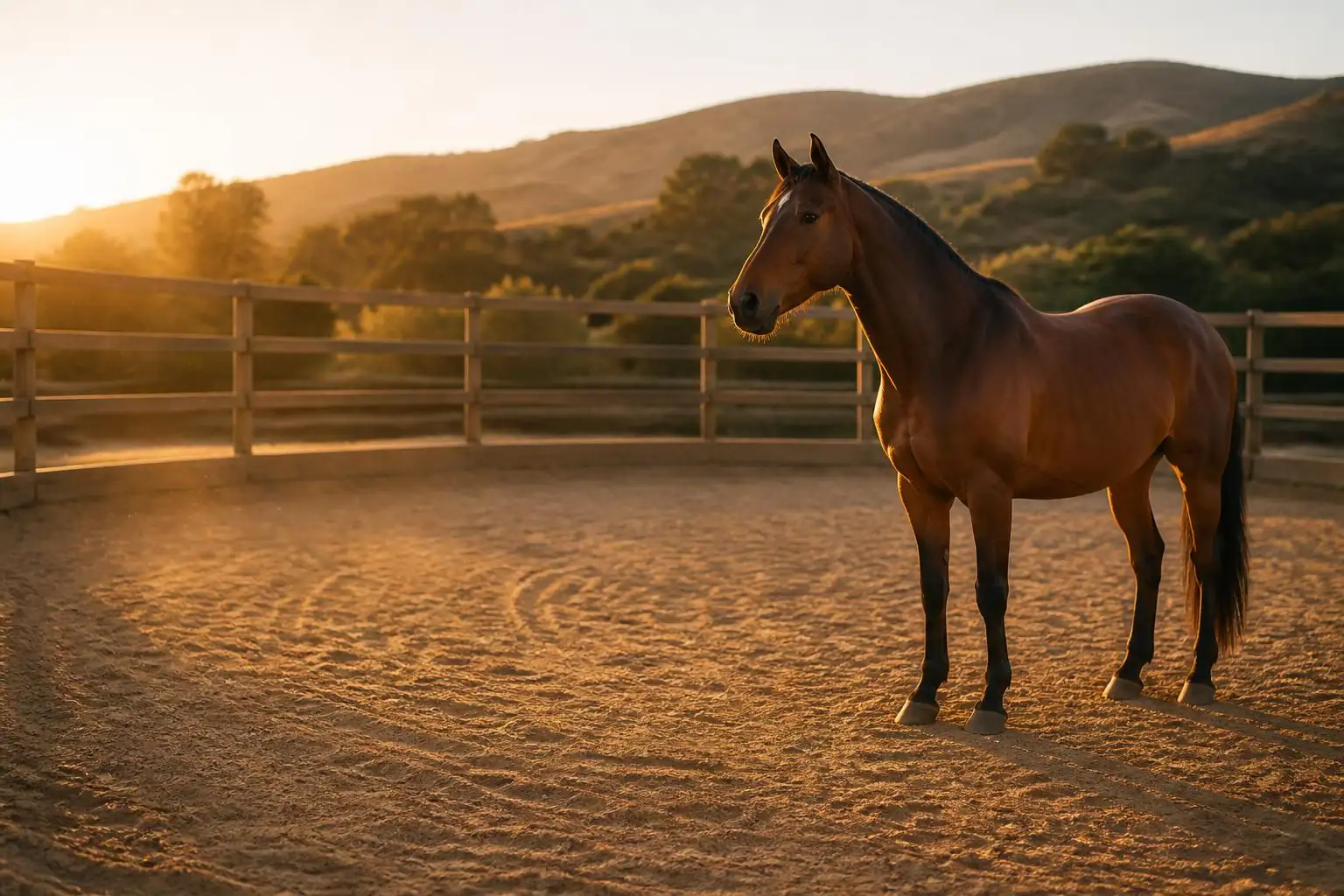

On 31 July 2026, a 91-year-old man died at his ranch in Solvang, California, from complications of an autoimmune disease. His name was Marvin Earl Roberts, though everyone called him Monty, and he spent forty years doing in public what many horsemen judged impossible.
He would enter a round pen with a two-year-old that no one had ever ridden. Thirty-five minutes later, the horse carried a saddle, bridle and rider without resistance. In 1989, the offices of Elizabeth II brought him to England to see it with their own eyes, and the Queen asked him to write a book.
Thirty years on, science finally measured what was actually happening in that round pen. The result is more interesting than the legend: he was probably wrong about the explanation, and right about the practice.
A thoroughbred two-year-old, a round pen, thirty-five minutes
The scene was reported by American daily newspapers in September 1997, during a public demonstration. The horse is a two-year-old thoroughbred, never broken, belonging to a breeder in Washington State. It enters the arena, and the gate closes behind it.
For about ten minutes, Roberts circles it by flicking a rope behind it, never touching the animal. Then he stops abruptly and turns his back. The horse freezes. Roberts approaches in small steps, stroking it between the eyes, then at the withers, then along the flanks. The horse begins to follow him around the arena with no halter and no rope.
Roberts then places the tack in the middle of the round pen, circles the horse around it twice, then puts the pieces on one after another. The newspaper account is unambiguous about the timing: thirty-five minutes after the horse entered the arena, it had a saddle and rider on its back.
His commercial promise amounted to a single sentence: what conventional breaking spreads over three weeks, he could compress into half an hour. This filled his venues and earned him as many enemies as admirers.
What he called Equus
According to his own account in his books, the method originated at age thirteen. Sent to Nevada to round up wild horses for the mustang race at the Salinas rodeo, the teenager spent his days watching the herds. From this he drew a conviction that never left him: horses communicate through readable and predictable body language, which serves to establish boundaries and express fear, irritation or relaxation.
He named this language Equus and maintained that humans could use it. His entire method flowed from this premise. Eyes fixed on the horse’s eye and open shoulders send it forward, as a dominant mare would drive a youngster from the group. Closed shoulders and averted gaze invite it to return.
Roberts said he read three signals, in this order. The inner ear blocking towards him: the horse is listening. The head dropping level with the neck: the horse proposes to negotiate. The jaws chewing in thin air: the horse accepts. Then came the moment that gave the method its name, the join-up, when the animal, left free, crosses the pen to lean against the man’s shoulder.
This vocabulary spread around the world. It was also the most fragile part of the edifice.
The Windsor invitation, and a Queen who commissioned a book
In 1989, having heard of these methods, Queen Elizabeth II’s staff invited him to the United Kingdom to demonstrate them to her stable personnel. According to Roberts’s account, it was the sovereign herself who then insisted he write a book about his non-violent methods.
The book appeared in 1996 under the title The Man Who Listens to Horses. It spent fifty-eight weeks on the New York Times bestseller list, exceeded five million copies sold and was translated into more than fifteen languages.
The relationship lasted until the end. He returned to Windsor in 2002 for the Golden Jubilee, was made an honorary member of the Royal Victorian Order in 2011 for services to Her Majesty’s racing establishment, and saw the Queen become patron of his Join-Up International organisation in 2012. After the Queen’s death in September 2022, he was invited to her funeral. A documentary released in 2023, The Cowboy and the Queen, tells this unlikely friendship.
The French misunderstanding spans nearly thirty years
In France, almost everything the general public believes about him stems from a double confusion, both of editorial origin.
The first concerns the title. The original is called The Man Who Listens to Horses. The French translation, published by Albin Michel in 1997 in a translation by Alain Deschamps, is titled L’Homme qui sait parler aux chevaux (The Man Who Knows How to Talk to Horses). Listening became speaking, the exact opposite of what Roberts defended his entire life, he who repeatedly insisted that the horse was already speaking and that the human’s work consisted of learning its language.
The second confusion is weightier. The French edition’s presentation made Roberts the man who inspired Nicholas Evans’s novel adapted to screen by Robert Redford. Yet Evans, when asked about the model for his character Tom Booker, wrote explicitly that others had claimed to be his inspiration, but the only one who truly inspired him was Buck Brannaman. The novel’s character, published in 1995, and the film released in 1998, is modelled on three American horsemen: Tom Dorrance, Ray Hunt, and especially their younger contemporary Buck Brannaman.
In other words, the man who inspired the film is not the one the Queen brought over. Two different men, two neighbouring schools, a single “horse whisperer” label stuck to both by marketing. Roberts himself hated that word.
The horse trader who spotted an Arc winner
His other half is often forgotten. A graduate in animal science from Cal Poly University in 1959, he progressed through rodeo and helped found Flag Is Up Farms in Solvang in 1966, becoming its sole owner and where he would die sixty years later. From 1973 to 1986, he was one of the principal sellers at Hollywood Park’s thoroughbred two-year-old sale for racing.
Obituaries in specialist racing publications credit him with purchasing a yearling that no one wanted, later resold for 175,000 dollars to Robert Sangster and his associates. Entrusted to Irish trainer Vincent O’Brien, this horse ran under the name Alleged and won the Prix de l’Arc de Triomphe twice, in 1977 and 1978. A man able to spot a two-time Arc winner in a sales ring is more than a fairground showman.
What science actually measured in the round pen
Two papers published five years apart offer the most honest answer about this method. They do not say the same thing, and that is precisely what is interesting.
In 2012, a study signed by Veronica Fowler, Mark Kennedy and David Marlin appeared in the journal Anthrozoös. Fourteen unbroken horses, aged three to five years, were paired according to temperament then randomly assigned to two protocols: Roberts’s technique on one side, a conventional British technique on the other. Each trainer had thirty minutes per day for twenty days.
The numbers are stark. At first saddling, average maximum heart rate rose to 127 beats per minute in horses trained with Roberts’s method, versus 176 in the conventional group. At first mounting, the gap widened: 76 beats versus 147. Twenty days later, horses in the Roberts group also scored higher marks on jumping and dressage tests.
Two reservations apply, and they are not minor. Fourteen horses means seven per group: the sample is small. And, according to how Roberts’s own organisation presented it, it was Roberts himself who conducted the arm named after him, facing a qualified British instructor. A trial where the inventor defends his own method is not neutral.
The mechanism is not what he believed it was
In 2017, a team led by Emily Kydd, Barbara Padalino, Cathrynne Henshall and Paul McGreevy published an analysis in PLOS ONE of forty-five videos of round pen work posted online, selected from over three hundred candidates, twenty-four posted by amateurs and twenty-one by professionals.
Their conclusion is blunt. The fact that the horse ends up following the human is nothing like a social contract: it is a learned response, built through negative reinforcement, that is, pressure applied and released the moment the horse offers the expected behaviour. The authors write that nothing allows us to affirm that this following proves the horse sees the human as a leader or as a higher-ranking herd member. As for the chewing, read everywhere as a sign of willing submission, they recall another hypothesis: a reaction to a stressful situation, adrenaline surge drying the buccal mucosa and triggering jaw and tongue movements.
One of their findings deserves to be posted in every round pen. The probability that a horse will end up following the human is not statistically linked to the amount of driving exercised, and this holds for amateurs and professionals alike. In other words, circling a horse for longer does not make it come in any more. The authors explicitly caution those tempted to drive harder to obtain the result.
This shift is not academic bickering. If you believe a story of hierarchy, you interpret flight or resistance as disrespect and respond with more pressure. If you understand it as learning, you first seek what frightens and then tend to the moment of release. This is the whole subject of applied equine ethology, and this is what separates good free work from an exhausted horse.
How to judge a method called gentle
- Whether the horse has a route of escape, or conversely whether the space is small enough that it has no option.
- The timing of pressure release: immediate when the right behaviour appears, or two seconds too late.
- How many circles are imposed before stopping, and at what speed they are done.
- The breathing and sweating at the end of the session, whether they look like work or like flight.
- The nature of the signals invoked: observable facts, or intentions attributed to the horse.
- Measuring the result by more than public impression, such as heart rate or a score three weeks later.
- What the method says about its own failures, instead of blaming the horse’s character.
- Whether it accepts being filmed for an entire session, uncut, including when it goes wrong.
Warning
A round pen is not a playground. Driving a horse at liberty in an enclosed space creates pressure: poorly dosed, it produces a panicked and confined animal, and the risk of injury applies equally to horse and human. The authors of the study published in PLOS ONE explicitly warn against using the internet as a sole source of training, and against exceeding the threshold of useful arousal. Breaking in and free work with a young horse should be done with a qualified professional, on suitable ground and in an appropriate facility.
The shadows he never dispelled
The portrait would be incomplete without this. Roberts’s foundational narrative rests partly on the figure of a brutal father, Marvin E. Roberts, himself a trainer and author in 1957 of a self-published training manual, Horse and Horseman Training. Roberts claimed his father beat him as a child, and he built his method in explicit opposition to practices he described as submission wrung by pain.
Several family members, including his younger brother Larry, his aunt Joyce Renebome and his cousin Debra Ristau, publicly contested this version, notably in a book published in 1999 titled Horse Whispers and Lies. In 2000, detractors registered a domain name in his name; the World Intellectual Property Organisation ruled in his favour, finding the registration abusive.
This file cannot be settled from France. It deserves mention because it recalls a simple rule: a method is judged by what it produces in the horse, not by the biography of the one selling it.
What concretely remains of it for your horse
The legacy is not in the vocabulary, it is in the standard. Before him, the English word for breaking was “breaking”. It has become commonplace in a French stable to assess a young horse by its relaxation rather than its submission, and to consider that breaking which leaves a horse sweaty and panicked is failed breaking. He contributed substantially to that shift.
On the ground, this translates into three verifiable things. First, progression: the stages of breaking a young horse are passed in order, and each must be validated before the next. Then work on the ground, since free work remains the moment when we best see what the horse truly understands. Finally, equipment, because an ethical halter acts through precise pressure points and is far from incidental, exactly as the question of whether you can do without a bit cannot be settled by posturing.
There remains the image Roberts started with at thirteen, in the Nevada desert: a herd of mustangs sorting its affairs without a word. From that desert came the horse of his life: Shy Boy, the mustang he had approached at liberty and to whom he devoted a book in 1999. Specialist press reports it died a few months before him, at thirty-three. Roberts maintained his entire life that he had learned that language. Research today says he was wrong about the name of what he was doing, and right about the way he did it. For a two-year-old horse entering a round pen, it is the second half of that sentence that matters.
Key points
- Monty Roberts died on 31 July 2026, aged 91, at his ranch in Solvang, California.
- His public demonstration involved getting saddle, bridle and rider accepted by an unbroken horse in roughly half an hour, in a round pen.
- Queen Elizabeth II brought him over in 1989 and asked him to write the book that sold more than five million copies.
- The French title inverted the English one, and the character in Robert Redford’s film is not him but Buck Brannaman, by the novelist’s own admission.
- A 2012 study measured significantly lower heart rates at first saddling with his method; a 2017 study showed the mechanism is learning-based, not a shared language or hierarchy.
- Practical consequence: you seek what frightens and tend the moment of release, rather than reading resistance as disrespect.
Your young horse is reaching breaking age
The stages, the order in which to pass them, the signals that show it is ready for the next and those that say to step back: all is detailed in our guide.
Sources cited in the text: account of public demonstration published by American daily press in September 1997; biographical notice and official distinctions of Monty Roberts; Albin Michel Editions catalogue for the 1997 French edition; Nicholas Evans statement on the model for his character; obituaries in specialist racing press; Fowler, Kennedy and Marlin, journal Anthrozoös, 2012; Kydd, Padalino, Henshall and McGreevy, journal PLOS ONE, 2017.