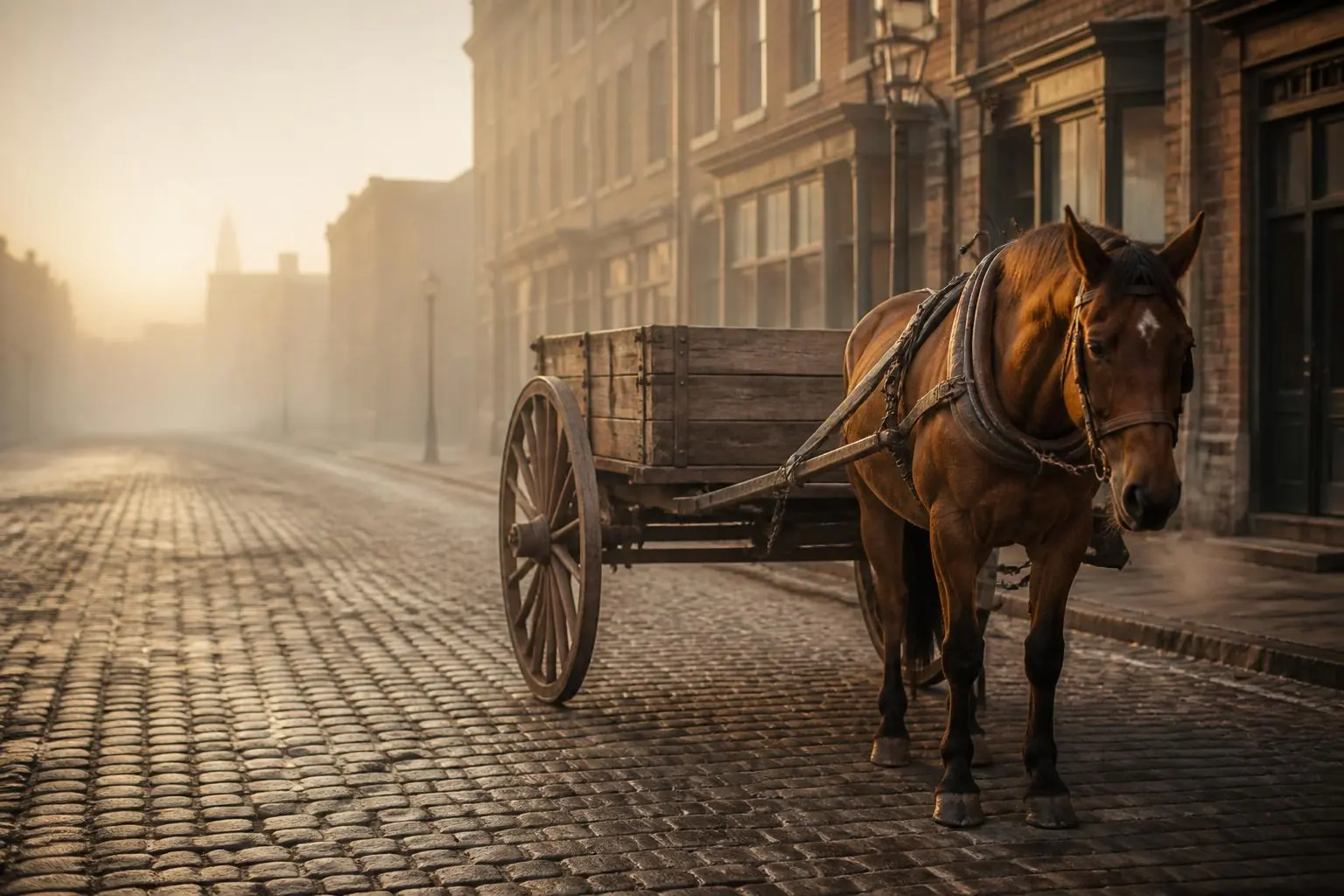

On 9 November 1872, fire broke out in a warehouse in central Boston. The first fire engine to reach the scene was hauled by men on ropes, because the horses at the fire station lay fevered and coughing in their stalls. The fire destroyed 776 buildings and over a thousand commercial premises, and killed about twenty people, including several firefighters, before it was contained the following midday.
These horses had not been grounded by poisoning or mere misfortune. They were felled by equine influenza, what Americans called the Great Epizooty, and within weeks it had swept through nearly every horse in North America. The virus responsible belongs to the same family as the strain circulating in our stables today, tracked foyer by foyer by the French equine health surveillance network. Our dossier on equine flu details the disease; this article recounts what happens when it escapes everyone’s control at once.
The autumn every horse coughed at the same time
The first cases were reported in late September 1872 on farms around Toronto. By 1 October, the city itself was struck: within three days, the stables of the horse-drawn streetcar companies and the main livery yards were out of service. By 12 October, Ottawa too was affected, with the streetcar company reduced to just six serviceable animals.
Then the map filled in at the pace of trade routes. Mid-October brought Montreal, Detroit and New England. By late October, New York, Boston, Chicago. Early November saw Cincinnati, Norfolk, Charleston. The wave reached California by mid-March 1873. Only two places escaped almost entirely, and this detail holds a lesson: Prince Edward Island and Vancouver Island, the only places where horses did not circulate freely with the continent.
In affected areas, morbidity approached 100 per cent: nearly every horse fell sick at once, with fever, dry cough, and copious nasal discharge. Mortality remained low relative to case numbers, between one and three per cent depending on region, reaching ten per cent where animals had been worked despite fever. Horses remained unusable for one to two weeks, sometimes a month.
Boston, 9 November 1872: a fire engine hauled by hand
Contemporary accounts from Boston report that only three horses out of eighty in the fire service remained fit to work when the fire broke out. In New York, the same records show two serviceable horses out of 144. A city in 1872 without horses was not merely slowed: it was robbed of its engines. Steam-powered fire pumps weighed several tons and were moved by teams of animals.
Yet the story should be tempered, for it is too convenient as told. Fire Chief John Damrell had anticipated the problem and hired five hundred additional men to replace the horses’ strength. Moreover, the inquiry commission that examined the disaster concluded that the absence of horses had delayed the arrival of help by only minutes. The true causes lay elsewhere, and they are documented: a densely built quarter, mansard roofs that carried flames from one building to the next, water pipes insufficient to supply height-reaching nozzles. The epizooty did not burn Boston. It simply made that night the image everyone retained of an entire society suspended on the health of its horses.
A continent on horseback, suddenly at a standstill
The 1870 census counted approximately 7.1 million horses and 1.1 million mules in the United States. Everything depended on them: urban streetcars, coal delivery, canal barge hauling, firefighting, merchandise convoys. When this motive force stopped within fifteen days, only makeshift solutions remained.
Teams of men were harnessed to pull streetcars and carts. Oxen were requisitioned, then sent back: they could not hold their footing on paved streets. Barges on the Erie Canal sat idle for lack of animals to tow them. Coal deliveries to railway companies ceased. Merchandise piled up in Buffalo and New York yards. The United States began importing healthy horses from Mexico. Some economic historians even link the financial panic of 1873 to this transport paralysis. The connection remains debated, but it indicates what an ailing horse meant to the economy then.
What no one could see in 1872
At the time, no one knew what a virus was. Newspapers spoke of Canadian disease, catarrhal fever, bad air, and treatments ranged from poultices to bloodletting. The first equine influenza virus was not isolated until 1956 in Prague, a subtype H7N7. The second, H3N8, was identified in 1963 in Miami. The H7N7 has not been found in horses since 1979: it is therefore H3N8 that circulates today, across nearly every continent.
Its mechanics explain what happened in 1872. Incubation lasts one to three days, leaving little time between infection and first symptoms. The virus spreads by aerosols, ejected across many dozens of metres by coughing, and by anything that passes from one horse to another: hands, clothes, buckets, halters, brushes, vehicles. A horse with flu remains immobilised for two to four weeks, and this long convalescence, more than mortality itself, is what causes damage. The typical signs, high fever, dry hacking cough, nasal discharge, and lethargy, are detailed in our equine flu dossier.
The same virus still circulates, including in France
This is not ancient history. In France, after three years without confirmed cases, an epizooty began in late December 2018. RESPE, the equine pathology epidemiological surveillance network, recorded 58 foyers and over 317 sick horses across the entire episode, from December 2018 to July 2019.
At the same time, across the Channel, British racing authorities suspended all fixtures for six days in February 2019 after the virus was detected in vaccinated horses at an active yard: twenty-three meetings cancelled. Twelve years earlier, Australia, previously unaffected, had seen its entire sector grind to a halt for months after the virus was introduced to its territory.
And last winter reminded everyone. RESPE issued a heightened alert in January 2026: confirmed foyers from mid-November to late January across fifteen departments, from Manche and Calvados to Alpes-Maritimes, passing through Maine-et-Loire, Sarthe, Nord and Essonne, alongside cases of equine herpesvirus type 1 elsewhere, a disease we detail in our equine herpesvirus factsheet. New cases were reported in spring 2026, and the network called in June for strengthened surveillance as the show season and summer gatherings approached. By early August 2026, it was relaying a confirmed case in Sweden.
How to judge a yard’s real protection
- The date of the last booster, horse by horse, not a reassuring average across the group.
- What is written and signed by your vet in the identification document, the only proof accepted at shows.
- The existence of a proper isolation box with its own equipment, not the far box you remember during a crisis.
- Temperature-taking, twice daily during risk periods and before any movement.
- What becomes of a horse arriving at the yard or returning from a show.
- Shared equipment: buckets, halters, brushes, thermometer, and the order in which boxes are tended.
- The comings and goings of outside workers who move from yard to yard the same day.
- The reflex at first fever: isolate, ring the vet, stop all movement, alert neighbours.
Why a vaccinated horse can still fall ill
This is the question that resurfaces at every outbreak. The equine influenza virus drifts: its surface protein changes gradually, so a recent strain can partly elude immunity built against an older one. It is the same mechanism as human flu, which is why international recommendations on equine vaccine composition are reviewed each year.
In 2019, RESPE was very clear: the virus isolated in France differed from strains circulating elsewhere in Europe, and these viral characteristics could explain, at least in part, why properly vaccinated horses showed clinical signs. The network maintained its recommendation in the same breath, because vaccination does not promise what we think it does. It limits symptoms and especially virus shedding. A vaccinated horse that catches flu is ill for less time and contaminates far fewer others around it.
The instruction repeated by the network during active circulation is simple: give a booster if the last flu injection was more than six months ago, on a horse in good health. Our horse vaccination guide details the five useful vaccines and their schedules, and our health record tracker helps you avoid discovering an overdue booster the day before a show.
What regulations require before a show
Flu vaccination is not optional for a competition horse in France; it conditions entry. The basic scheme rests on two priming injections spaced 21 to 92 days apart. Then come the boosters, and here circuits diverge: the French federation requires at least one annual booster, while the international federation requires a booster within six months plus twenty-one days before the show and forbids any injection in the seven days before arrival. Breeding circuits have their own protocols, often stricter.
Everything must be noted and signed by your vet in the horse’s identification document, the one you forget in a drawer and whose role we detailed in this article on the passbook. This page alone is proof at entry control to a showground. Before entering, best to check the circuit’s rules and visa status, as our page on FFE competitions and SIF accounts reminds us: an out-of-date booster can force you to start a full priming course again, meaning you lose part of the season.
The actions that truly break the chain
The protocol recommended during active circulation fits in a few lines, and its logic has not changed since 1872: what stops an epizooty is stillness. Isolate any equid running a fever, limit unnecessary movement, take temperature twice daily, call the vet before moving anything.
The rest concerns daily organisation. Dedicate a bucket, halter, set of brushes and thermometer to the isolated horse, and tend it last. Wash your hands leaving its box. Avoid shared water troughs and shared buckets at shows, where horses from dozens of yards meet for two days. Clean and disinfect the lorry between transports, for the vehicle is the true link between yards, as we note in our horse transport article. Report suspect cases to your vet, for it is this network of sentinel practitioners that allows the network to publish alerts useful to all.
Indeed, the 1872 story ends as it began, with a lesson about movement. The two islands that escaped the wave had neither better vets nor better forage. They simply had fewer horses coming and going.
Disclaimer
This article is informative and does not replace veterinary advice. Fever, cough and nasal discharge alone do not confirm flu: strangles, herpesvirus and other respiratory infections produce similar pictures, and only a vet can decide, with analysis to back it. Faced with a horse running a temperature: isolate it, call your vet, and give nothing of your own initiative, particularly not anti-inflammatories, which would mask fever and confuse diagnosis.
The booster that counts is the one you did not forget
Calendar of five useful vaccines, intervals by circuit, foals, mares and older horses: everything is in our guide.
Key points
- In autumn 1872, equine flu originating in Ontario touched nearly every horse in North America, with morbidity near 100 per cent and mortality of one to three per cent.
- On 9 November 1872, the Boston fire destroyed 776 buildings while the fire service had almost no serviceable horses. The inquiry commission concluded that the horses’ absence cost only minutes.
- The virus was not identified until much later: H7N7 in 1956, H3N8 in 1963. Only H3N8 still circulates in horses.
- In France, RESPE recorded 58 foyers and over 317 sick horses between December 2018 and July 2019, and relaunched a vigilance alert in January 2026.
- A vaccinated horse may show clinical signs if the strain has drifted, but remains ill shorter and sheds far less virus.
- During active circulation: booster if the last injection was over six months ago, and immediate isolation of any feverish horse.
Sources
The 1872 epizooty and Boston fire: Historical Society of Ottawa, New York Almanack, JSTOR Daily, academic work on the Great Epizooty of 1872-1873, US census of 1870. Virology: reference literature on isolation of equine strains in 1956 and 1963. French situation, 2018-2019 assessments and January 2026 vigilance alerts: RESPE statements. British racing suspension of February 2019: British racing authority. Vaccination rules: FFE, FEI, Société hippique française, IFCE. This article is independent and is not affiliated with RESPE, IFCE, FFE or FEI.