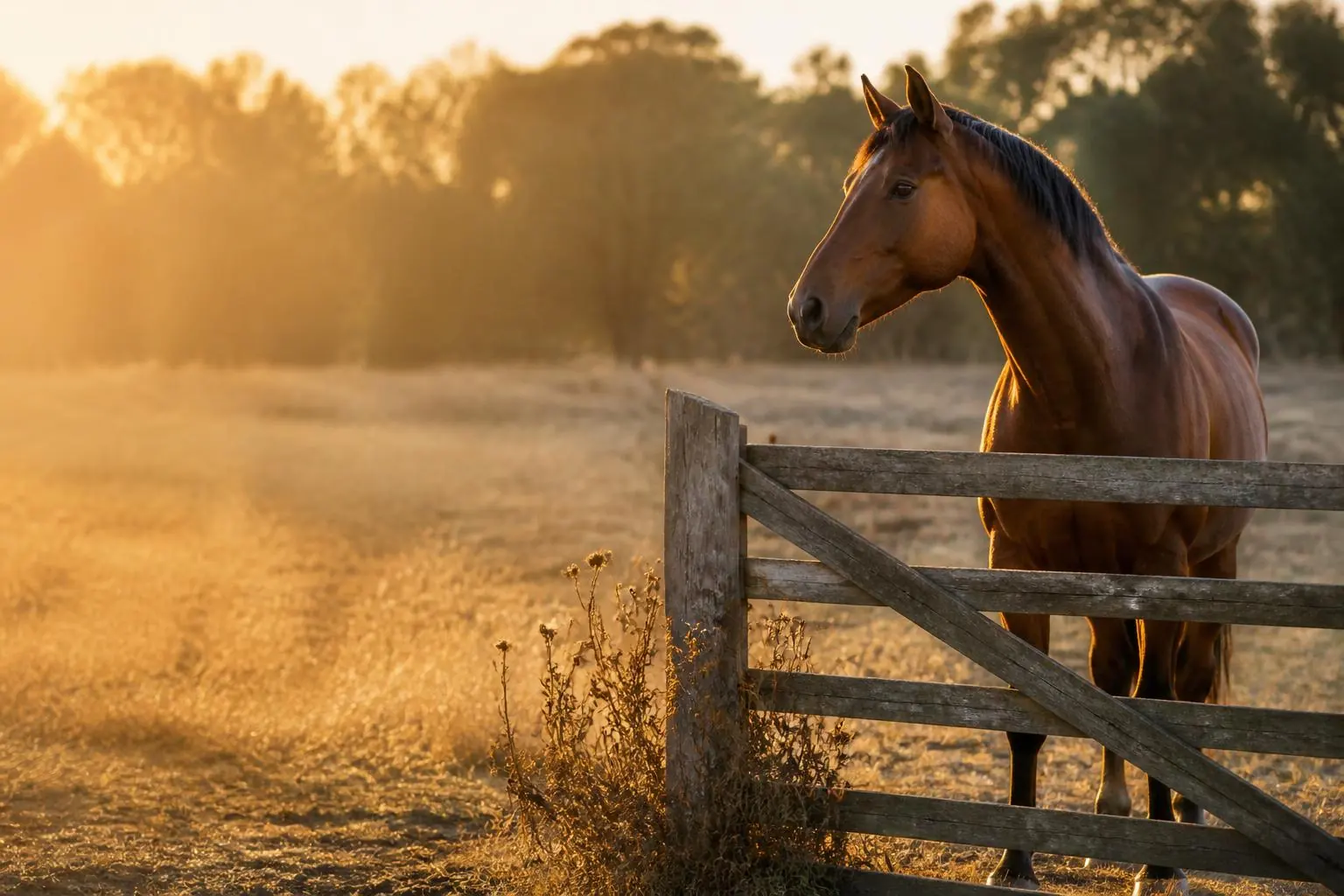

No, he hasn’t forgotten you. Three weeks on the beach won’t erase you from a horse’s memory. What has changed during your absence is his body, his place in the herd and what’s growing in his field. This is almost always what explains a sluggish first session back, not a grudge.
Three weeks isn’t long in a horse’s memory
The horse possesses a long-term memory. Equine ethology research shows that he recognises a familiar human by face, voice and outline, and retains that recognition for months, sometimes years, without seeing them again. Researchers call it lasting associative memory: the horse stores a person alongside the experiences he has had with them.
He has no calendar. He recognises a pattern of signals: your walk down the lane, the sound of your voice, the rhythm at which you open the gate. When it all returns at once, the information reactivates. This is why some horses whinny before you’re even in sight.
What differs from one horse to another is the intensity of the reaction, not the recognition. A calm horse who keeps grazing has identified you just as surely as one who trots across the field. The first doesn’t love you less, he simply has a different temperament and a more interesting field.
What he has retained: you, or what you’ve done to him?
The distinction matters. The horse associates a person with a repeated experience. If he spent spring being lunged too long on hard ground, he has retained the longe line as much as your face. If he was rewarded at the right moment and left alone when providing the effort asked, he has retained that too.
This is the fundamental principle of equine ethology applied to ridden work: a horse’s behaviour reflects his learning history, not a moral judgement about you. The phrase “he’s doing it on purpose” doesn’t hold up under observation. What looks like wilfulness is almost always anticipation of an discomfort already experienced: a pinching saddle, a pulling hand, a transition asked for too quickly.
The same logic applies to revenge. No credible research documents retaliatory behaviour in horses. He avoids what has bothered him; he seeks what has relieved him. This is more useful to know than a psychological explanation when you return to work. Riders wanting to explore this thinking further often pursue equine ethology training, often eligible for funding, rather than tips gathered at the arena’s edge.
During your absence, his body has changed
This is where the real difference lies, and it’s what most riders underestimate on their return. A horse turned out to grass for three weeks is not a horse on pause.
The topline wastes first
The musculature along the topline builds slowly and disappears quickly. A few weeks without work is enough to lose muscle that was developed in spring, behind the withers and over the loins. Cardiovascular fitness drops too.
Direct consequence: the saddle that fitted in July isn’t guaranteed to fit in August. A wasted topline, or a horse who has gained condition at grass, alters the bearing points. Before riding again, run your hand under the panels, check the wither clearance and observe the sweat pattern after the first session. Our guide to fitting a saddle to a horse’s back details the key checks you can do in five minutes.
August grass no longer nourishes like May grass
By early August, most fields are bare, dry and nutrient-poor. Growth has stopped, the nutritional value of what remains has dropped, and horses spend more time searching than eating. Two profiles emerge: the horse who has lost condition because the field can’t sustain him, and the one who has gained weight on a still-rich patch without working.
In both cases, the September feed plan is not the one from June. Forage becomes the foundation again, and supplements are recalculated based on the horse’s actual condition. Work through a ration calculation tailored to his weight and workload before increasing anything. A horse who has lost condition doesn’t catch up in three days of grain.
Check the water too: in August, a field trough heats up and fouls quickly, and dry grass swallowed without adequate water increases digestive risk.
His feet have grown
Trimming intervals are measured in weeks, usually six to eight depending on the horse, season and ground. A holiday break often falls midway through this cycle. Long feet, collapsed heels or loose shoes alter the horse’s balance before you even mount. This is the first call to make.
- Body condition: ribs palpable but not visible, neck and loins without marked hollowing.
- The feet: when was the farrier last here, wear, shoes in place.
- The back: reaction to palpation along the loins, tolerance to girthing, regular sweat pattern.
- Fitness: recovery time to calm after five minutes of lunging trot.
- Behaviour during grooming: ear position, tail, evasion, tension in touched areas.
- Mouth and teeth: date of last dental check, chewing action, food residue in the manger.
- Movement on foot: regularity at all three gaits on hard ground then soft ground.
The herd has carried on without him
A horse living out spends his days managing relationships. Three weeks is enough time for a new arrival, a friend to move on, or a field to change. Friendships reorganise, distances shift.
What you find at the gate is therefore a horse who has spent twenty days being a horse: watching, moving in a group, setting his own rhythm. A horse who starts to jostle on the longe or cuts distance on the headcollar hasn’t decided to test you. He’s applying what worked at grass for three weeks. Taking him back in hand requires re-establishing clear boundaries, without brutality and without constant negotiation.
Return to the stable, when it happens, alters transit, activity and sleep. Stretch the transition over several days when your yard allows.
The five mistakes on day one
- Resuming at your previous level. Your last July session isn’t the August starting point. The horse has lost muscle, not skill.
- Judging behaviour before you’ve examined his body. A refusal, stiffness or tail swishing should be verified on the ground and in hand first.
- Mounting without checking the saddle. Three weeks at grass changes a topline, which changes bearing points.
- Keeping the June feed plan. August grass provides less, and so does his actual condition.
- Translating into human language. “He’s cross with me”, “he’s sulking”, “he’s taking revenge” are comfortable explanations that waste time finding the real cause.
Bring him back over three weeks, not three days
Week 1: observe more than work
Thorough grooming, hands over every inch, check feet and all contact areas of the tack. Then short outings: hand-walking, 10 to 15 minutes lunging both directions, flat soft ground. The goal is gathering information about his body, not getting him fit.
In August, schedule these sessions early morning or late afternoon. An unfit horse in the arena at 3pm faces two stresses, effort and heat.
Weeks 2 and 3: return in stages
Increase only one variable at a time: first duration, then intensity, finally technical difficulty. Three short sessions a week beat two long ones. Ridden work in the field at walk on the flat rebuilds a foundation without hammering joints. Collected transitions come last, once the horse can maintain rising trot without hollowing.
The simple measure: if he recovers poorly session to session, if his back becomes sore or if his grooming behaviour deteriorates, you’ve gone too fast. Step back down a level.
When it’s not attitude but pain
Some signs aren’t trained through, they’re examined. Even subtle lameness, a back that hollows when girthed, marked loss of condition in three weeks, a withdrawn horse staying apart from the group, sudden refusal to be touched in one place: in these cases, the vet comes before work resumes.
The logical order stays the same: vet to rule out medical causes, farrier for foot balance, equine dentist if the mouth is involved, then equine osteopath once diagnosis is confirmed. Osteopathy supports the process, not replaces it. Our horse care hub covers the daily monitoring benchmarks to establish from day one back.
This article offers general guidance. It does not replace veterinary examination, which alone can diagnose and prescribe. With lameness, a wound, rapid condition loss, a withdrawn horse or signs of colic, call your vet without delay.
- A horse’s memory for a familiar human is measured in months, not days. Three weeks won’t erase you.
- He associates a person with repeated experiences, making the concept of grudges irrelevant.
- Back muscle is lost faster than it’s built; always recheck saddle fit before remounting.
- August grass is sparse and poor: reassess condition and diet at the return.
- Three weeks of gradual reintroduction beats one ambitious session on day one.
- For deeper reading on behaviour and learning, our equine ethology guide covers the essentials.