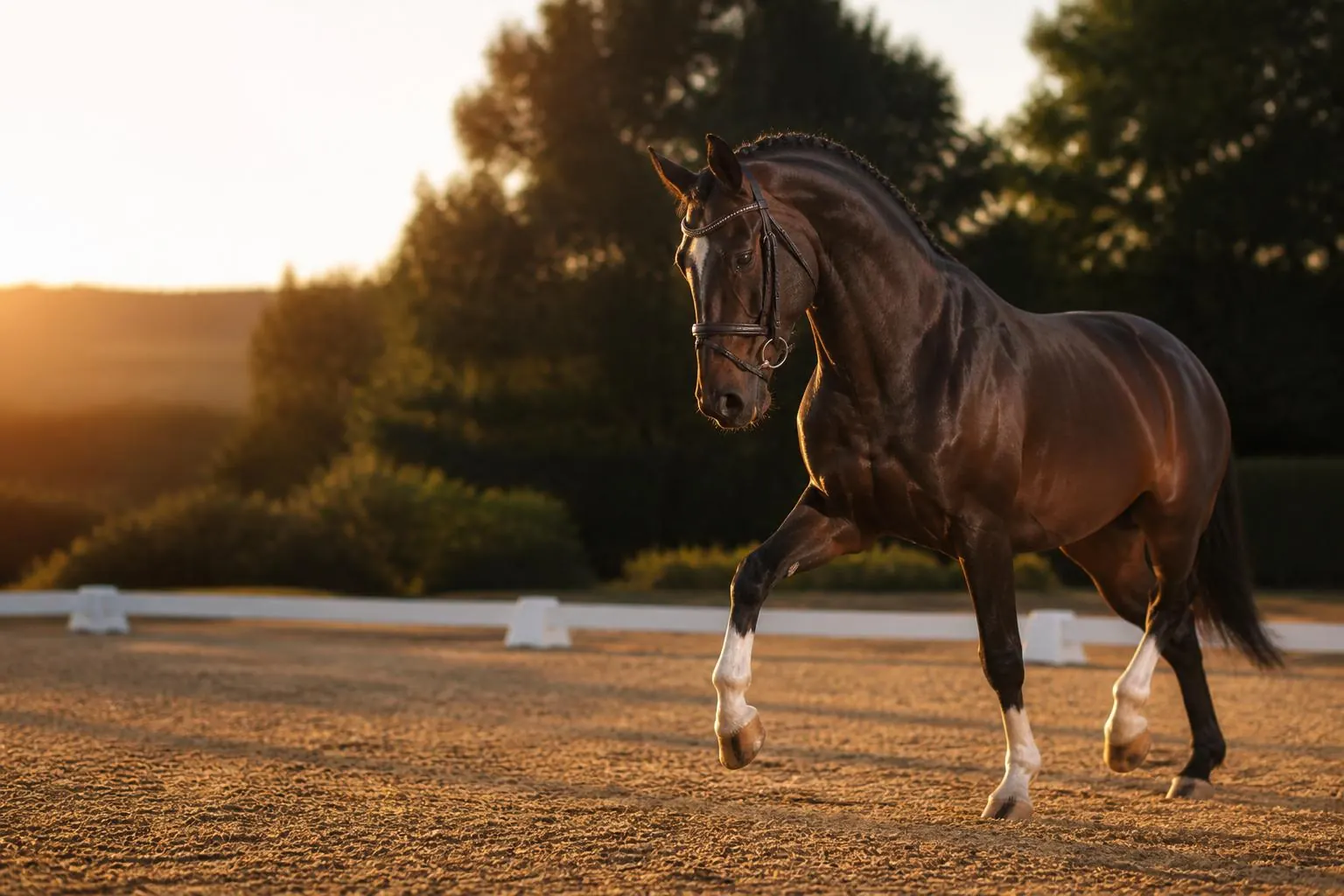

On 11 August 2026, in Aachen, a horse will enter the sand rectangle at collected canter, 60 metres by 20 metres (200 by 65 feet). It will halt sharply, salute, then execute thirty-three movements before seven judges in the main stadium, seating nearly 40,000. No rails to knock down, no clock to beat: a mark of 0 to 10 for each movement, and a percentage published to three decimal places. This is what truly unfolds on the dressage arena at the World Championships.
Three days, three competitions, three medals
Dressage opens the fortnight in Aachen and runs in three acts, from 11 to 15 August 2026, in the main stadium. The Grand Prix, on 11 and 12 August, brings together all competing pairs and decides the team medals. The Grand Prix Special, on 14 August, awards the first individual title. The Freestyle to Music, on the evening of 15 August under the lights, awards the second.
The format is a funnel. Under FEI regulations, the Special is open to the top thirty from the Grand Prix, and the Freestyle to the top eighteen from the Special, with a maximum of three pairs per nation. A team fields three or four riders, but only the three best scores count. These are followed by the cross-country phase on 15 August, show jumping from 19 August onwards, and para-dressage from 19 to 23 August, detailed in our guide to the Aachen World Championships.
Seven judges around a rectangle of 20 metres by 60
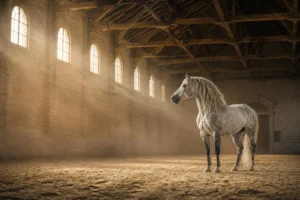
The arena is deceptively simple: a flat, sandy surface of 60 metres by 20 metres (200 by 65 feet), surrounded by a white boundary about 30 centimetres (1 foot) high, with letters outside. No obstacles, no visible tricks.
At the Olympic Games and senior Grand Prix championships, the FEI appoints seven judges, plus an alternate, all of different nationalities. Three sit on the short side behind letter C, two on the long sides at B and E, and two on the opposite short side. Seven viewpoints on the same horse: an irregularity invisible from the front shows clearly from the side.
Each judge dictates their marks to a secretary. At this level, each judging box has an alert button to discreetly warn the C judge of bleeding, lameness, a course error, or equipment problems. The public learns nothing of this in the moment.
One mark per movement, a single harmony mark
Each movement receives a mark of 0 to 10 from each judge: 10 for excellent, 6 for satisfactory, 4 for insufficient, 0 for not executed. Half-marks from 0.5 to 9.5 are allowed, and the most difficult movements carry a coefficient of 2, doubling their weight.
In the current Grand Prix, the thirty-three movements total 440 points. A single harmony mark is added after the exit: this encompasses cooperation, lightness, and discretion of the aids. With its coefficient of 2, it counts 20 points, bringing the total to 460. The Special comprises thirty-six movements for 450 points, plus the same harmony mark, totalling 470.
Each judge’s score is converted to a percentage and published to three decimal places: a world title can be decided by a few hundredths of a point. A judge supervision panel, mandatory at this level, acts as a safeguard: if one judge’s score deviates by 5 per cent or more from the average of the others, it can be aligned to the nearest score by unanimous decision.
What is judged in a dressage test
- Regularity of gaits. Rhythm must remain clear and even at walk, trot and canter.
- Collection and balance. The horse transfers weight to the hindquarters and remains self-carrying.
- Precision. Every figure has its letter and stride count: a piaffe is judged on the twelve to fifteen strides required.
- Elasticity of the back and activity. The criterion that separates a horse executing movements from one truly performing.
- Harmony and discretion of the aids. A single mark given at the end of the test, coefficient 2: the more visible the aids, the lower the mark.
Piaffe, passage, flying changes: the vocabulary of Grand Prix
The spectator sees everything but does not always name what they see. The piaffe is this trot almost on the spot, highly collected, requested three times in the test, each time over twelve to fifteen strides. The passage is a very rhythmic and suspended trot, where the horse appears to bounce in slow motion. The transitions passage, piaffe, passage are scored separately: the transition from one exercise to another without loss of rhythm is what separates a good pair from a medal contender.
Half-pass is a diagonal movement where the horse advances and moves sideways at once, the legs crossing. Flying changes are canter strides where the horse changes lead in the air: the test requires nine every two strides, then fifteen on each stride down the same diagonal. The canter pirouette makes the horse turn around its hindquarters in six to eight strides. Two little-known details: the whip is forbidden in the arena, and a horse must be at least eight years old to compete at Grand Prix level.
Why a horse trotting on the spot is an athlete
The piaffe deceives the eye. It looks slow, almost motionless, therefore easy. It is the opposite: to trot on the spot, the horse must flex more through hips, stifles and hocks, lower its hindquarters and transfer considerable weight there, while keeping the shoulders free and the back supple. It produces great energy without advancing: thrust becomes elevation, not displacement.
A horse that tenses, sways, or steps back even one stride loses points immediately. This gymnastics develops over years. The regulations indeed forbid any horse to compete at this level before eight years old, and many reach their peak much later, at an age when athletes in other equestrian sports have often already given their best.
What loses a title in seconds
A test can fall apart quickly, and not only from a poor mark. A course error, a movement executed in the wrong place or wrong order, costs two percentage points on every judge’s sheet, and a second error eliminates. Other breaches, called technical faults, cost 0.5 points each without eliminating: entering with a whip, without gloves, before the bell, using voice or clicking the tongue repeatedly, failing to hold the reins in one hand at the salute.
Elimination offences are final. Marked lameness noted by the C judge eliminates, with no appeal. Resistance preventing the test from continuing beyond twenty seconds eliminates, and sooner if it endangers anyone. The horse or rider falling eliminates. A horse that leaves the rectangle with all four feet eliminates. Any outside assistance, voice, signals or earpiece, eliminates. And critically: if fresh blood is found on the horse during the test, or in the mouth and spur area during the equipment check on exit, the pair is eliminated, permanently. Any performance contrary to the horse’s welfare or constituting abusive riding eliminates too.
Freestyle to Music: dressage without a script
The evening of 15 August is the most accessible to an uninitiated spectator: the rider composes their own choreography to music of their choice, provided they include the compulsory figures.
The sheet divides into two equal halves. Sixteen technical marks on figures such as piaffe over a minimum of ten straight strides or nine consecutive flying changes total 200 points. Five artistic marks, each with coefficient 4, total the other 200: rhythm, energy and elasticity; harmony between rider and horse; choreography, use of the arena and inventiveness; degree of difficulty and calculated risk; music and interpretation. The final score is the average of the two percentages. At championship level, an official difficulty scale rewards taking calculated risks.
Welfare debate never leaves the arena
No honest presentation of dressage can ignore the controversy that has accompanied it for twenty years. It concerns hyperflexion of the neck, often called rollkur, a very low and tightly rolled head and neck position achieved during training. In 2010, following a roundtable in Lausanne, the FEI ruled: any position obtained by aggressive force is unacceptable, whilst a low and round flexion obtained without excessive force remains permitted. The boundary lies in the method, making it hard to police and reigniting debate at each championship.
Since then, safeguards have multiplied: systematic equipment checks and blood tests on exit, and introduction of a standardised instrument to measure noseband tightness, replacing the two-finger estimate with an identical measurement for all. A complete overhaul of the regulations is under discussion in 2026; the official text specifies that one measure under study, ending the double bridle for juniors, would take effect on 1 January 2027 if adopted.
This is not a specialist quarrel: it is the condition of the discipline’s survival on the Olympic stage, where dressage has featured for more than a century, as our page on equestrian sport at the Olympic Games recalls.
Sources cited in text: FEI dressage regulations in force 1 January 2026 (articles 402, 411, 423, 424, 425, 434, 441, 442), official test sheets and the 2026 World Championships programme. Equirider is not affiliated with the FEI or FFE.
Key takeaway
Seven judges, a mark of 0 to 10 for each movement, a single harmony mark with coefficient 2, a percentage to three decimal places: dressage is won on details that the regulations measure to a tenth. To understand the discipline before 11 August, our dressage guide covers the basics step by step.